Nyyon · Blog
What a forward-deployed AI consultant does from week one to handoff
A forward-deployed AI consultant frames one project, learns the workflow, builds a working version, drives adoption and hands the system back. Five jobs, each with an output.
A forward-deployed AI consultant is a senior builder who works inside your business and does five jobs in order: frames one project around a measurable outcome, learns the workflow from the people who run it, builds a working version, drives adoption and hands the system back so your team runs it. Nyyon is a forward-deployed AI consultancy, and this is how we define the role. Use the definition to judge any provider that uses the title.
Our earlier post on what a forward-deployed engineer is covers the role in general. This page follows one engagement from the first conversation to the last day, and it names what the consultant produces at each step.
What are the five jobs?
Each job ends in an object you can inspect, and each one starts from the previous job's output.
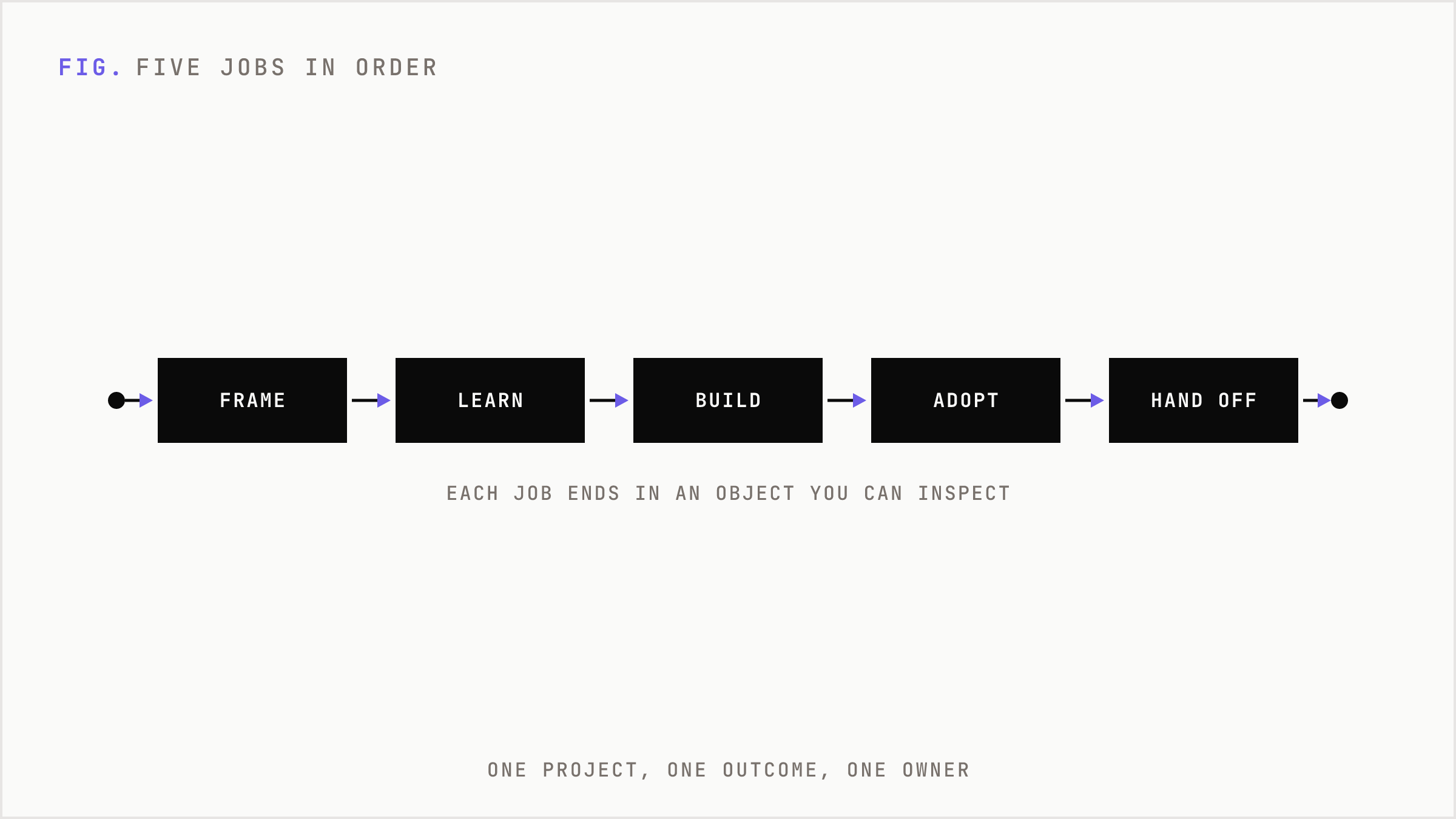
- Frame. One project, one outcome, one measure, one business owner.
- Learn. The consultant sits with the people who do the work today and maps how it happens.
- Build. A working version goes in front of users early and improves every week.
- Adopt. The consultant trains the users, fixes what blocks them and watches the measure.
- Hand off. Code, documentation, credentials and a runbook move to your team, and a named person owns the system.
Job 1: How does the consultant frame the project?
The consultant starts by choosing the project and the measure. The projects Nyyon takes are important enough that ignoring them costs money, specific enough that off-the-shelf software falls short, and urgent enough that hiring a dedicated team would arrive too late. Typical examples are an approval process that slows the business, information trapped across five systems and a workflow held together by spreadsheets and Slack.
The framing step produces a one-page statement: the outcome, the number that proves it, the person who owns the result on your side and the date of the first reading. Clients buy fewer mistakes, cleaner data and faster onboarding, so the measure names one of those in the business's own units.
Job 2: How does the consultant learn the workflow?
A forward-deployed consultant starts with how people work today and defers requirements until later. The sessions happen with the people who touch the process: the analyst who exports the spreadsheet on Friday, the manager who approves exceptions, the support agent who copies data between two tabs.
The output is a map of the real workflow with the decisions marked: where a person judges, where a person copies, where information waits. This map decides what the system automates, what it prepares for a person and what stays with a person. Automation amplifies the people who create the most value, so the map protects their judgment and removes the repetitive work around it.
Job 3: How does the consultant build?
The consultant builds a working version early and improves it in short cycles. A working slice on real data teaches more in a week than a requirements document does in a month. Our post on why a weekly build finds what a scoping document guesses describes the mechanism.
Nyyon offers this in two shapes. The Skip-the-spec Retainer buys a weekly block of hours with the specification step skipped, and results land every week. The Project Sprint takes one important project end to end. Both put a senior person on the code, the integrations and the decisions about what to cut.
Describe your project and we will tell you which shape fits on a 30-minute call.
Job 4: How does the consultant drive adoption?
A system that demos well and sits unused is a failed project, so adoption is part of the work. The consultant watches how people use the system, fixes the friction they hit and trains them in their own workflow. The measure from the framing step gets read on schedule.
Adoption work looks small on a plan and decides the outcome. It includes a short training session for each group of users, a channel where questions land and get answered fast, a list of the exceptions the system handles badly and the changes to the process that make the system useful. The client keeps running the business throughout, so the consultant works in parallel with the team and asks for review time each week.
Job 5: How does the handoff work?
The consultant is successful when the client stops needing the consultant. A complete handoff covers eight objects, and a buyer can ask any provider for all eight: the source code in your repository, the infrastructure in your accounts, the credentials in your vault, a runbook, a decision log, a recorded walkthrough, a set of test cases with expected results and a named internal owner. Our guide to diligencing a forward-deployed AI consultancy turns that list into contract language and a dry run.
What does your company do during the engagement?
The consultant needs three things from you. A business owner decides weekly, so questions get answered inside the week. Review time from the stakeholders and users keeps each build cycle honest. Access to the systems and data the project touches lets the consultant build on the real thing from the start.
Larger companies with several competing initiatives often begin with a discovery workshop. Nyyon opens a Forward Deployed AI Expert engagement that way: the team meets, finds where an AI project could bring value on the stack the company already runs, and picks the projects worth pursuing before any build starts. Smaller companies skip straight to the retainer or the sprint.
What skills does the role combine?
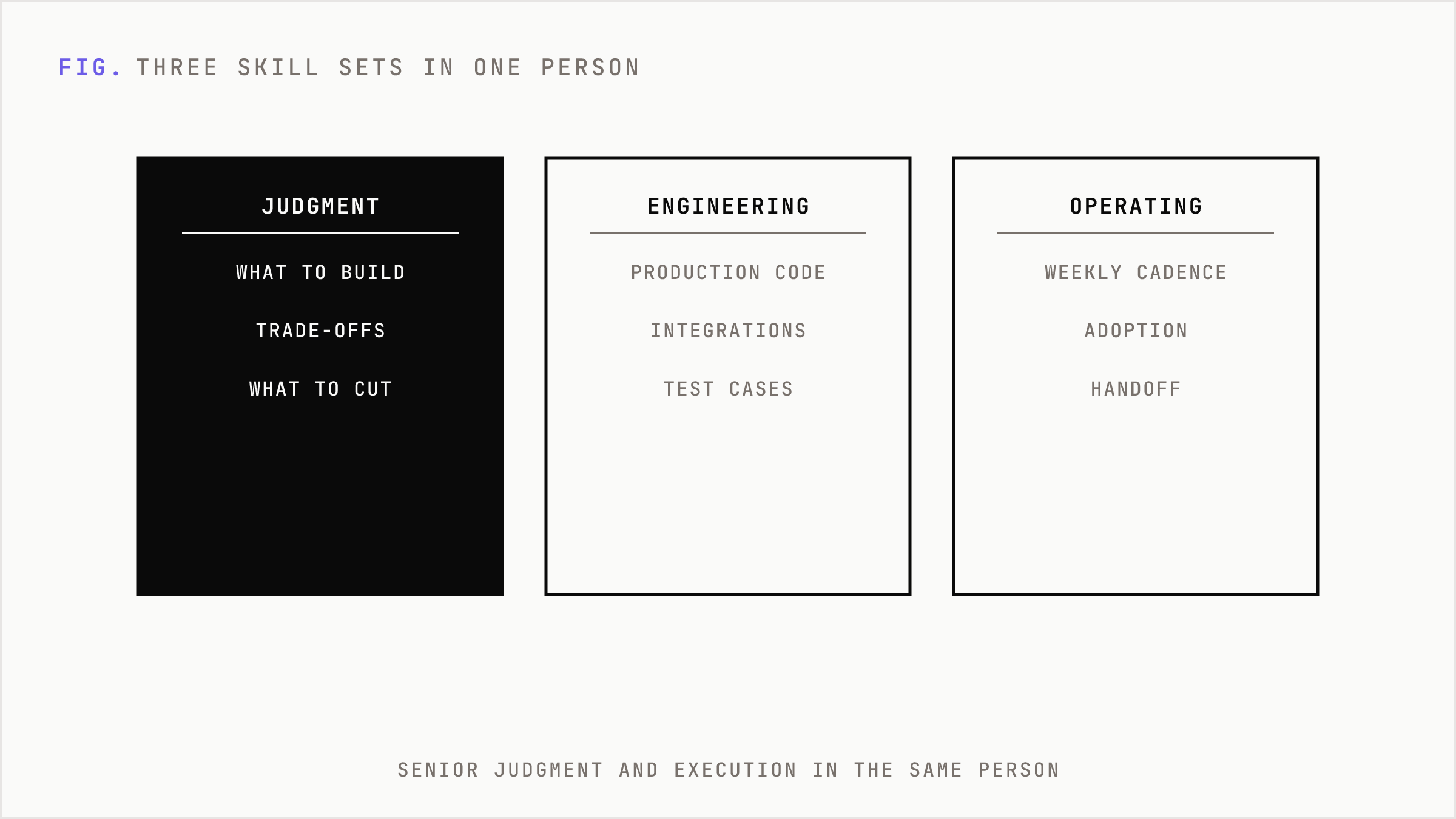
Three skill sets sit in one person. Judgment decides what should exist and which trade-offs are worth making. Engineering ships production code. Operating cadence keeps a project moving weekly, with the business owner, through the unglamorous middle. A consultancy built around this role sells senior judgment and execution in the same person, so the question of who owns the project has an answer.
Which projects fit, and which fall outside?
Nyyon takes projects that end in a deployed system:
- AI workflow automation
- Internal operational tools
- Agentic business processes
- Data cleanup and enrichment
- Human-in-the-loop decision systems
- Department workflows across Sales, Support, Finance, Legal, Recruiting, Ops and Admin
Outside the scope: strategy decks, innovation theater, generic chatbots, one-day workshops and proofs of concept that stop at a demo.
How does a consultant differ from an engineer at a software vendor?
A forward-deployed engineer at a software vendor deploys that vendor's product inside a customer. Gartner's September 2026 forecast headline concerns work of that kind, built by vendor forward-deployed engineering. A forward-deployed AI consultancy builds across whatever stack the client runs and answers to the client's outcome. The titles match. In our view a vendor's engineer is paid to deploy the vendor's product and a consultancy is paid to deliver the client's outcome, which is why the handoff package works as the test of any provider.
How do you know your company needs one?
A good fit sounds like this inside your company: "We know this should exist, but nobody here has the bandwidth or the expertise to make it real." Three signs support it. The project has a clear business owner. The outcome has a measure. The company lacks anyone with the time to build it. When all three hold, a consultant fits. When the project is missing an owner or a measure, start there.
Read why to hire a consultancy before a Head of AI for the staffing decision, or book a 30-minute strategy call to describe the project nobody has time to own.
About Nyyon
Nyyon is a forward-deployed AI consultancy, also described as an AI execution partner. It takes the important operational project nobody has time to own and hands it back as a working system the team runs. Nyyon works with founder-led companies in North America and with department leaders who hold an AI mandate and lack the capacity to execute. Engagements run as a Skip-the-spec Retainer, a Project Sprint, or a Forward Deployed AI Expert engagement.