Nyyon · Blog
Skip the spec: a weekly build finds what a scoping document guesses
A weekly build gives you a working system and a spec written from real use inside a month, where a scoping document prices a guess.
Should you skip the spec and build weekly instead? For a messy, improvised workflow, yes. A weekly build produces a working first version and a written spec inside a month, while a scoping document prices a guess before anyone has touched a screen. The spec belongs after the first working version, written from what the owner clicked, skipped and complained about.
A custom CRM with automations and integrations costs ₪25,000 to ₪50,000 in Israel, according to ITAYOST's June 2026 price guide, and a basic one runs ₪15,000 to ₪25,000. That number arrives before anyone has used a single screen. The buyer signs a price for a system that exists as a document.
Requirements arrive after someone uses the first version
The usual loop runs in four steps. A few scoping meetings produce a requirements document. The vendor prices it as a fixed project. The build runs for weeks. Two months in, the owner sees the system for the first time and starts listing what is missing.
Each item on that list becomes a change request. The vendor prices it or absorbs it. Reviews and revisions eat the margin on one side and the budget on the other, and the owner ends up with a system that matches the document and fits the business loosely.
The original quote is also hard for the owner to judge. A ₪40,000 number for a workflow that lives in WhatsApp, a spreadsheet and one person's head could be fair or padded, and the owner has only the vendor's word to go on. Signing it is a bet on a stranger's reading of a process that has never been written down.
In that situation a spec is hard to write well. The process is improvised daily, the owner is the system, and any document produced this month needs rewriting by month two. The thing to buy is discovery, and discovery happens by building.
Half a day a week makes every mistake cheap
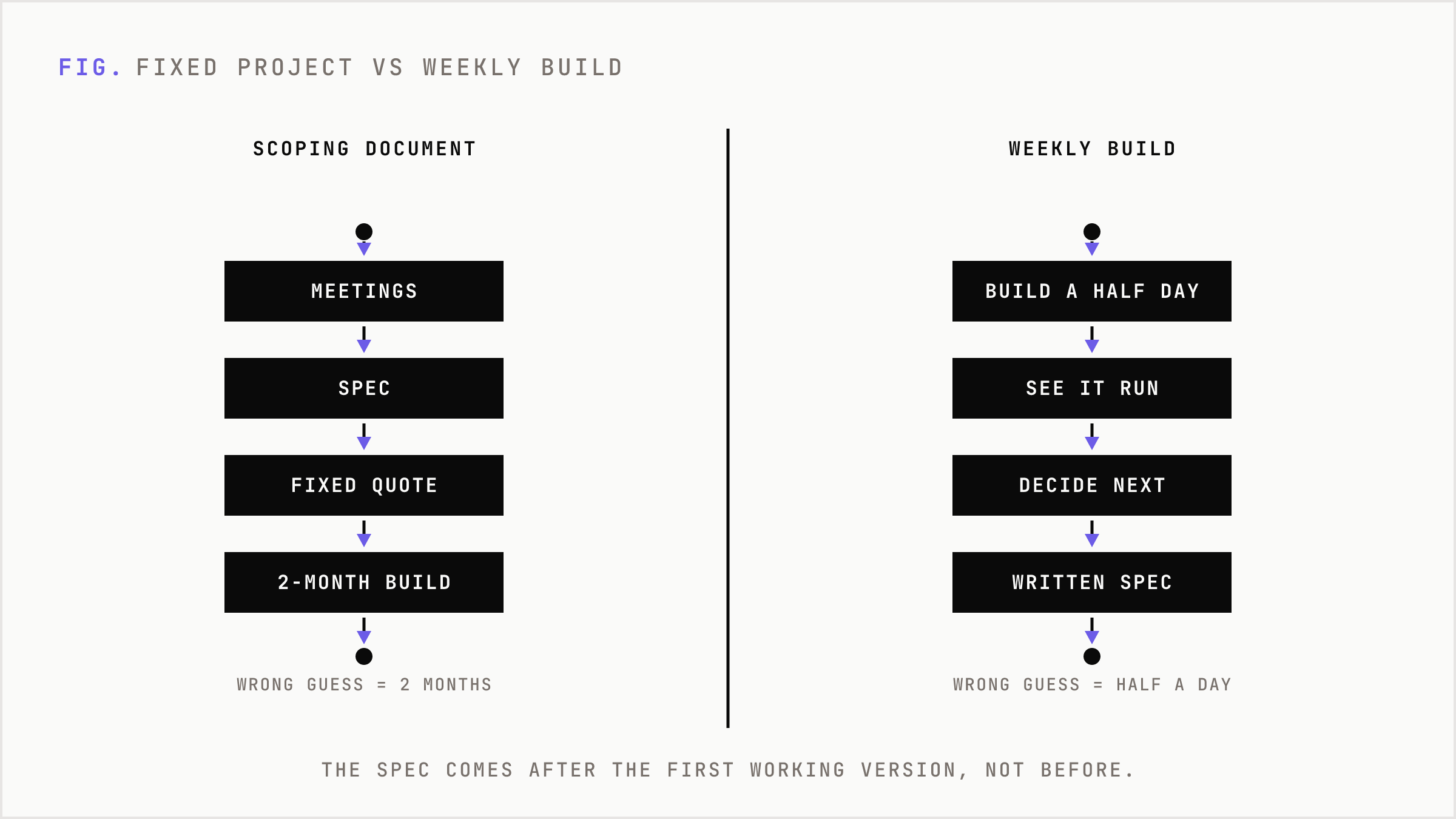
A weekly build replaces the document with a calendar slot. One fixed day and hour each week, a builder works on the owner's own accounts, and something runs by the end of the session. The next week's work gets decided from what ran.
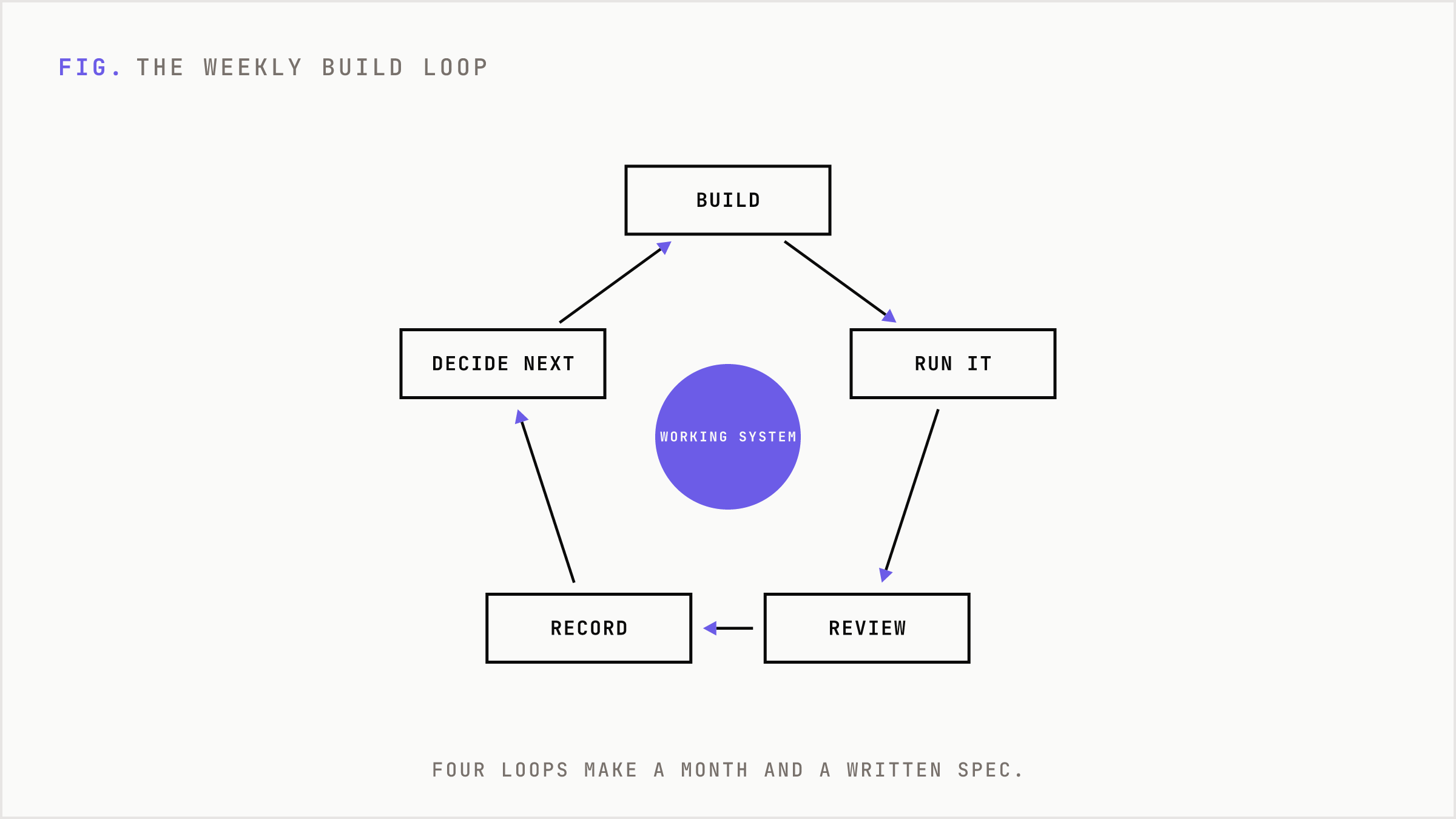
The first session starts from whatever hurts most: clients in WhatsApp, tasks in someone's head, a spreadsheet that three people edit. The second session fixes what the first one got wrong. By week four the owner has a working system and a written record of every decision. That record is the spec, written from use.
A wrong guess costs half a day. Under a fixed project the same guess costs two months of revisions. The commitment is one month, and the owner can stop at the end of any month. That is the entire risk, and it is small enough for one person to approve in one conversation.
Nyyon sells this as the Weekly Build Retainer, from $2,000 a month. Urgent work between slots is billed by the hour, and everything is documented and handed over.
What our own builds taught us that a document would have missed
Three of our own builds show how requirements arrive. In each one, the most important rule appeared after something ran.
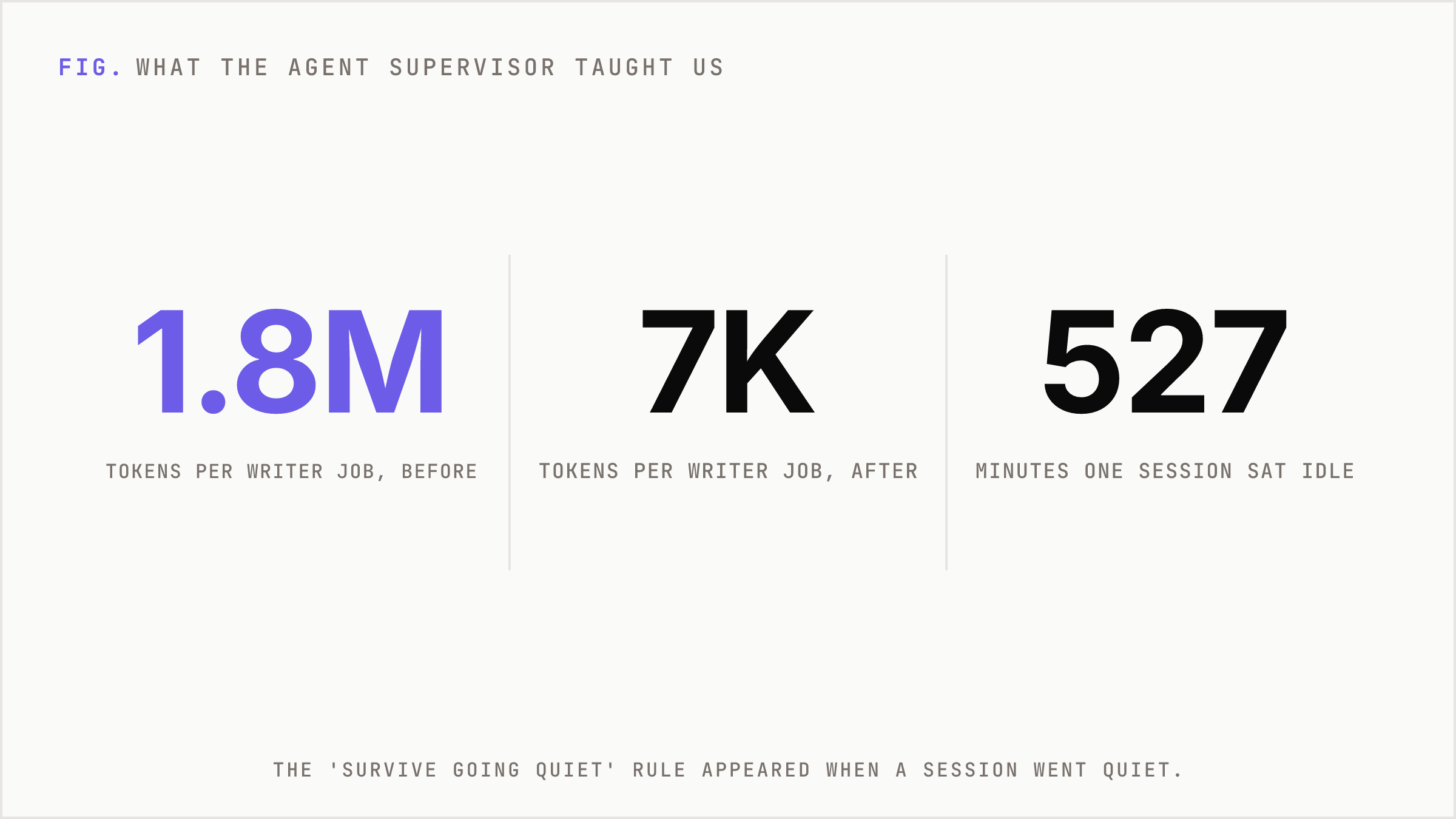
The agent supervisor. The command center runs several agents: the chat assistant, the daily planner and the article writer. They began as long interactive sessions that re-read their whole history on every turn. The writer alone burned about 563 million tokens a day, roughly 1.8 million per job. Then one session went idle and stopped polling for 527 minutes, and its backup timer failed to wake it. The requirement "survive going quiet" appeared when the session went quiet. We replaced the sessions with one small process that starts a fresh run for every job. A writer job now costs about 7,000 tokens, and everything together runs near 2 million tokens a day.
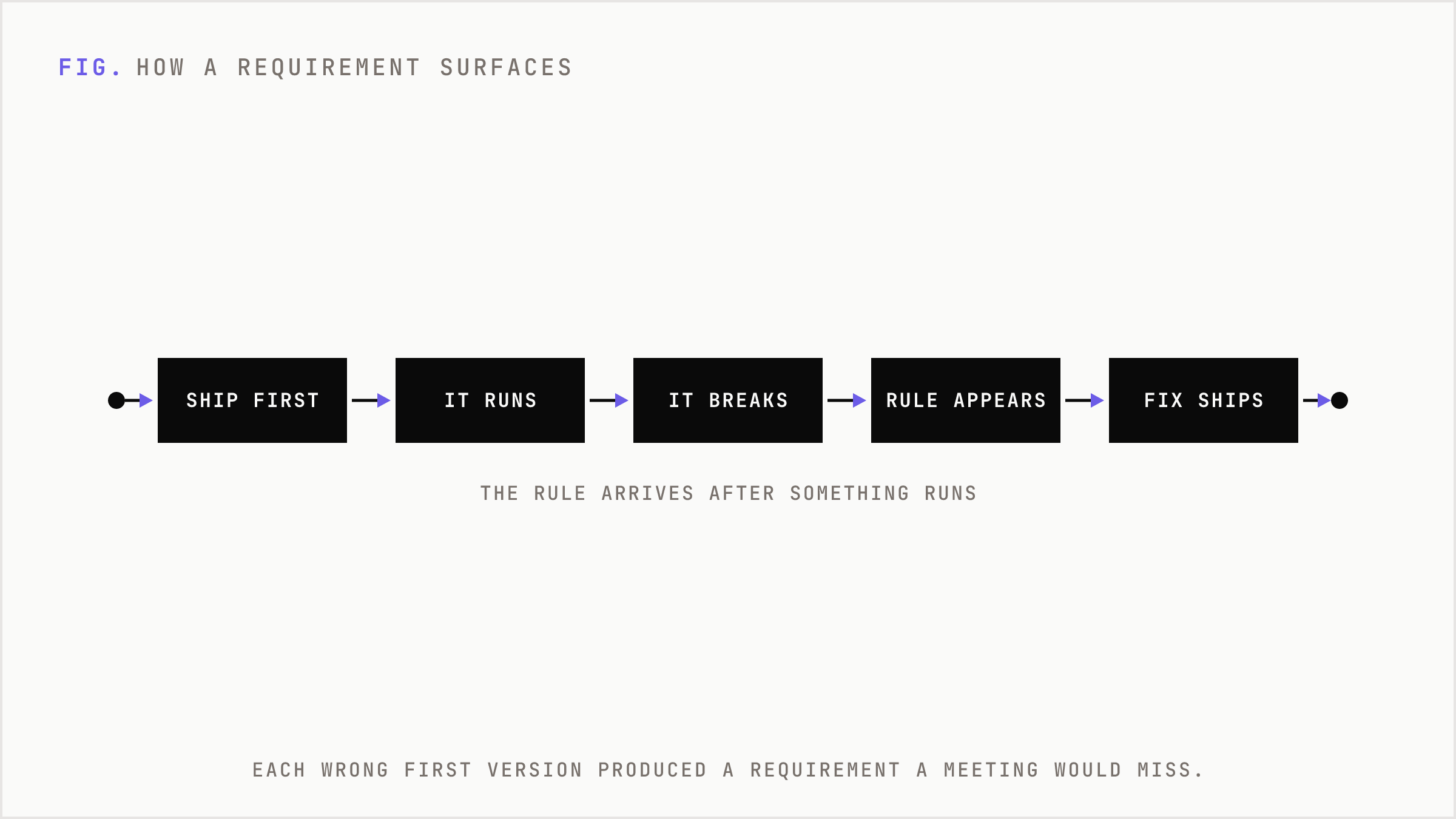
The daily planner and the calendar. The planner saved each day's plan into the command center's own calendar. The next question was why the blocks never showed up in Google Calendar, and the answer exposed a gap: the command center has no Google connection. The fix is a small run that applies only the blocks the planner created, each tagged with an ID in the event description, with no guests and no notifications. Those limits came from asking what a careless first run could touch.
The dispatch system. A ride and delivery business is getting its dispatch system in Monday morning sprints, 09:00 to 13:00, numbered S1 to S14 on a roadmap. The roadmap lists what the client has to answer before each sprint, such as the commission rules and the payment details. The client's answers decide the next sprint, and that is how the spec gets written.
In each case the first version was cheap and wrong in a useful way. Each wrong answer produced a requirement that a scoping meeting would have missed.
Where a weekly build loses
A standard workflow is cheaper elsewhere. If the process is an ordinary sales pipeline, monday.com charges $9 to $19 per seat per month with a three-seat minimum. A weekly build adds little there, because the spec already exists and a template matches it.
Tolerable pain beats both. If the mess costs the owner an irritation and nothing more, doing nothing is the cheapest option.
Time also changes the math. A monthly fee adds up, and once the months sum to the project quote, the retainer costs more than the project would have. ITAYOST puts a five-user custom CRM at ₪33,000 to ₪99,800 over three years with setup and upkeep, monday Pro at ₪51,600 and HubSpot at ₪78,450. The weekly build holds its edge while each month ships something new. After that, I think the right move is to graduate: build until the system runs, then drop to a care plan. The market pays ₪500 to ₪1,800 a month for upkeep.
Run one month and judge the demos
The test costs one month. Pick one workflow that lives in WhatsApp or a spreadsheet. Give a builder one fixed half day a week on your own accounts. At the end of each session, ask to see something running. At the end of the month, compare what you have against what a quote would have specified, and keep or stop.
If nothing the owner uses came out of four sessions, the approach failed for that workflow and the cost was one month. If something did, the spec now exists, written from four weeks of use, and it is the cheapest one you will ever buy.