Nyyon · Blog
Hire a forward-deployed AI consultancy before you hire a Head of AI
A company of 50 to 400 people should hand its first important AI project to a forward-deployed AI consultancy, then hire a Head of AI once the first system shows what the role owns.
A company of 50 to 400 people should hand its first important AI project to a forward-deployed AI consultancy and hire a Head of AI after that project shows what a full-time role would own. Nyyon is a forward-deployed AI consultancy, so we sell one of the three options compared here. Use the tests below to check our reasoning against your own situation.
The decision turns on sequence. A Head of AI, a fractional AI lead and a consultancy each fit a different stage of a company's AI work, and the first project sits at the earliest stage.
What does each of the three options own?
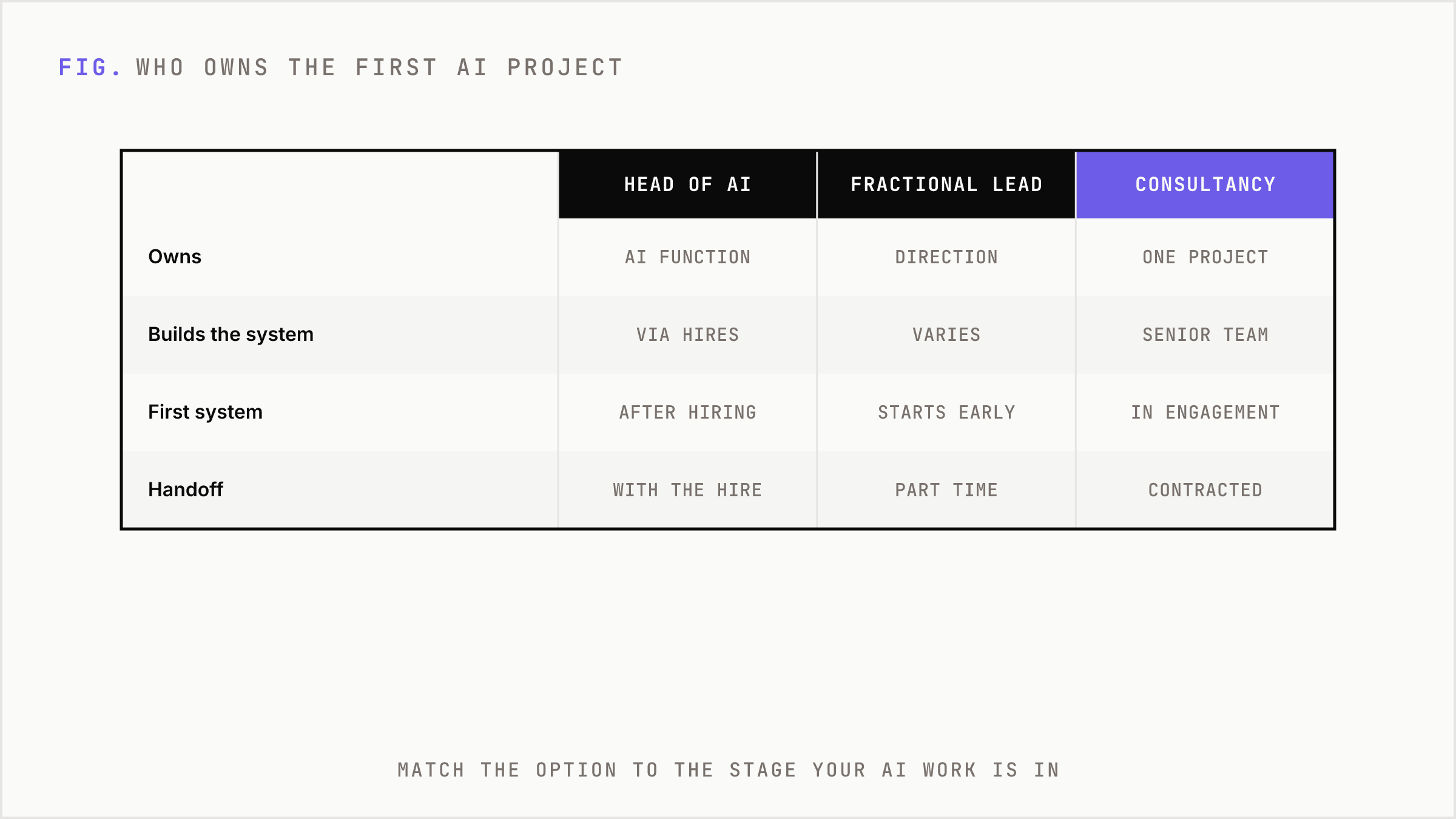
A Head of AI is a full-time leader. The role sets priorities, chooses vendors, hires and manages builders, writes the governance rules and carries the roadmap. The role pays off when the roadmap keeps a team busy all year.
A fractional AI lead gives the same kind of leadership at part-time hours, usually shared across a few companies. The offer is direction: which projects to run, which tools to buy, which risks to manage. Whether the person also writes production code depends on the individual, so put that question to every candidate directly.
A forward-deployed AI consultancy owns one project. Senior people work inside your systems, build the system, put it in front of the people who use it and hand it back so your team runs it. Our post on what a forward-deployed AI consultant does describes the work week by week.
Why does the first project go to the consultancy?
A Head of AI hired before any project ships starts with the work that makes a team possible: writing the job descriptions, hiring builders, picking a stack and interviewing department heads for a roadmap. Each step is necessary and each one comes before the first system in production. The company pays a full salary through that stretch and has no working system to show for it.
A consultancy starts on the project in the first week. By the time you open the Head of AI search, the role has a specification drawn from something running: which workflows exist, which data they touch, who uses them, what they cost to operate and where adoption stalled. A candidate can read that and say yes or no to a real job.
This sequence also protects the hire. A senior AI leader joining a company with one shipped system and a documented backlog starts on day one with decisions. A leader joining with a blank page starts with a search for the first project.
Two Gartner forecasts frame the risk of getting ownership wrong. In June 2025 Gartner predicted that over 40 percent of agentic AI projects will be canceled by the end of 2027, and Reuters reported the stated drivers as escalating costs and unclear business value. On 29 September 2026 Gartner predicted that 70 percent of enterprises will abandon agentic AI built by vendor forward-deployed engineering by 2028. Both are forecasts, and the second concerns work led by a vendor. They point at the same question for every option on this page: who is accountable for the value of the system on day 90, and what does your team hold when the engagement ends?
Which option fits your situation? Six tests
Run these in order and count where the answers land.
- How many projects are queued? One important project points to a consultancy. Three or more running at once, with more behind them, point to a Head of AI.
- Who builds? A leader needs builders to lead. If your company has engineers with spare capacity, a Head of AI or fractional lead can direct them. If nobody has spare capacity, the consultancy brings the builders.
- Who reviews technical work? A fractional lead or a Head of AI can review a vendor's output. A consultancy with a business owner on your side also works, because the business owner judges whether the system does the job.
- How soon must something run? A consultancy plans around a first working version inside the engagement. A hire plans around a search, a start date and a ramp.
- Where does the knowledge sit when the person leaves? An individual carries context in their head. A consultancy contract can require the repository, the documentation, the credentials and the runbook to land in your accounts.
- What does the cost look like over twelve months? A Head of AI is a fixed salary plus a team that runs all year. A fractional lead is a set number of leadership hours. A consultancy bills against a project with a named outcome. Compare them over the same twelve months and include the months in which the hire has nothing yet to lead.
Can you combine them?
The three options form a sequence, and many companies use more than one.
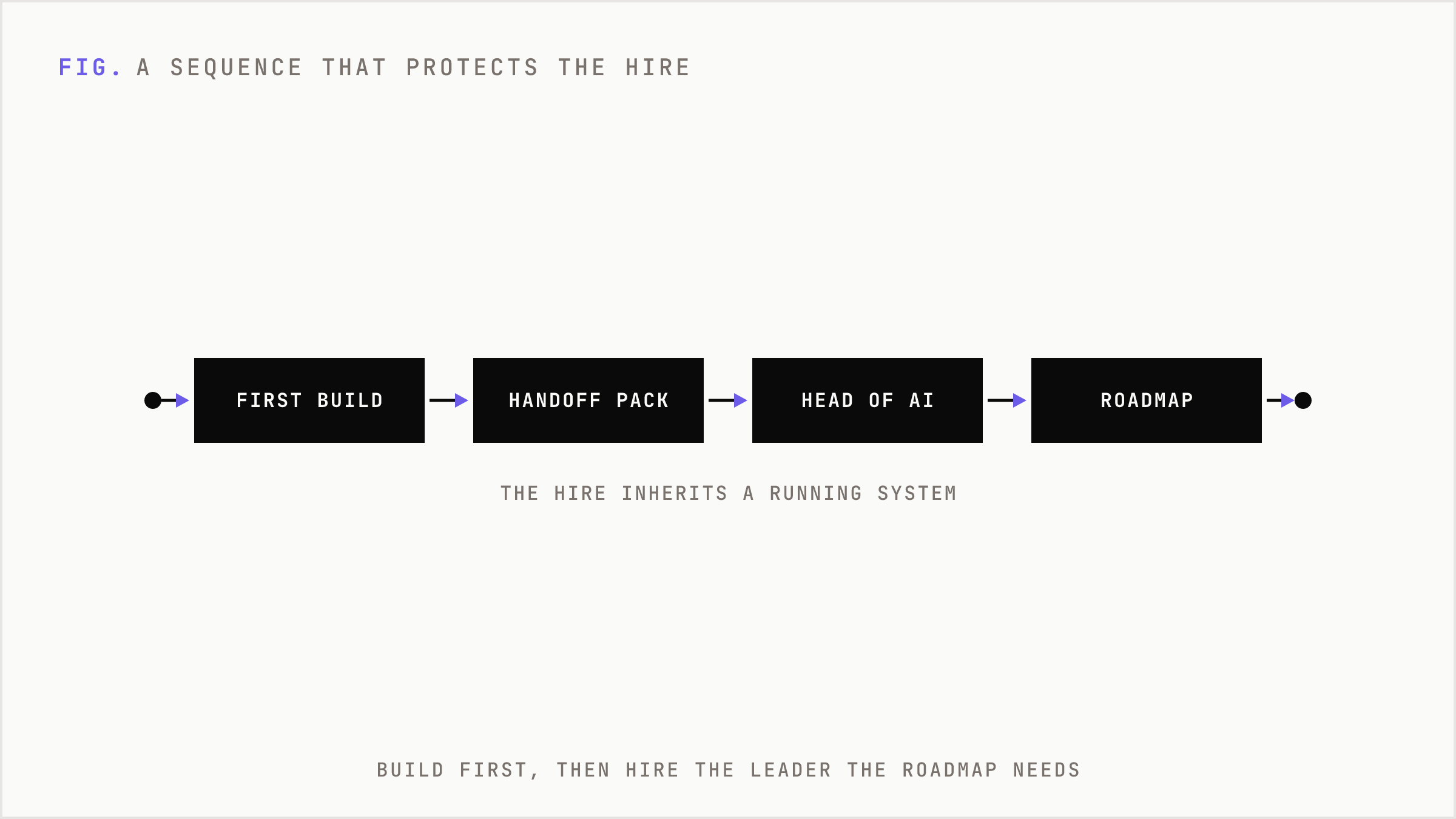
The consultancy builds the first system and writes the handoff for a reader who has yet to be hired: a runbook, a log of the decisions and their reasons, usage numbers and a ranked backlog of the next projects. The Head of AI or fractional lead inherits all of it and spends the first month choosing among real projects. A fractional lead also works beside a consultancy during the engagement, setting priorities while the consultancy builds.
When does the hire come first?
Four situations justify hiring first, and each one is a reason to take the hire seriously.
- AI is part of the product you sell, so the capability has to live inside the company permanently.
- Regulated data demands a named internal owner for governance before any vendor touches the systems.
- Three or more initiatives already compete for the same builders, and someone must arbitrate.
- Your board has set an AI mandate for the function and expects a leader with a title.
Outside those four, the first project is the faster way to learn what the role needs.
What should you ask each option before you commit?
Put these four questions to a Head of AI candidate, a fractional lead and a consultancy alike:
- Which system have you put into daily use at a company of our size, and who can I talk to about it?
- Who writes the code, and how senior is that person?
- What exists in the first 30 days that I can look at?
- What does my team hold on the last day: the code, the documentation, the credentials, the runbook?
An option that answers all four with specifics belongs on your shortlist. Put the same four questions to us on a 30-minute call.
What happens next?
Describe the project nobody has time to own and we will say whether it fits a consultancy engagement, a different kind of provider or a hire. Book a 30-minute strategy call.
For the wider comparison, read our guide to forward-deployed AI consultancies for 50 to 400 person firms, the case for renting a CTO and hiring a builder and our view on why almost no company should hire a forward-deployed engineer.
About Nyyon
Nyyon is a forward-deployed AI consultancy, also described as an AI execution partner. It takes the important operational project nobody has time to own and hands it back as a working system the team runs. Nyyon works with founder-led companies in North America and with department leaders who hold an AI mandate and lack the capacity to execute. Engagements run as a Skip-the-spec Retainer, a Project Sprint, or a Forward Deployed AI Expert engagement.