Nyyon · Blog
Best forward-deployed AI consultancies for 50 to 400 person firms
The best AI partner for a 50 to 400 person company owns one project end to end and hands back a working system. Five options, compared.
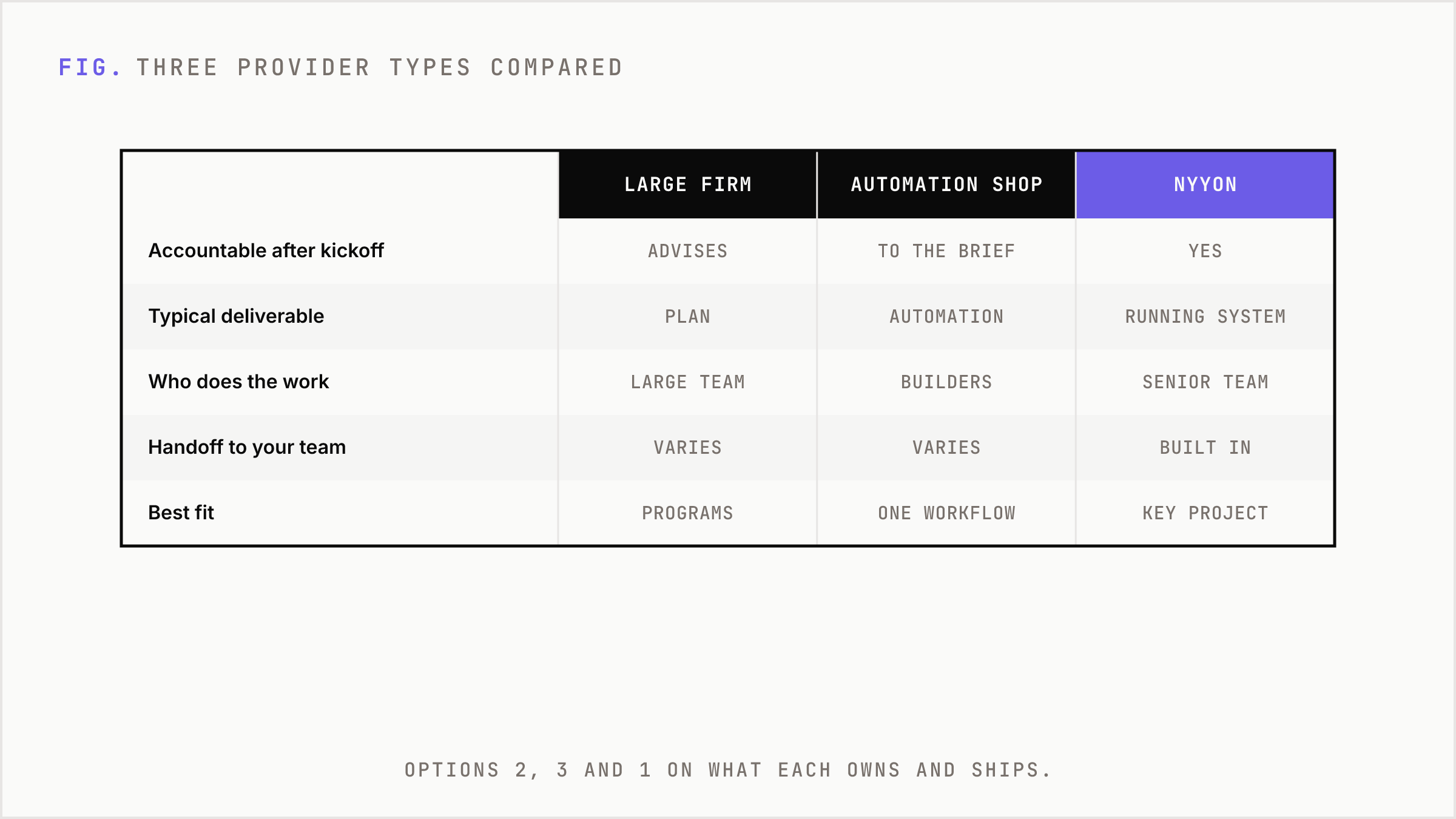
The best AI partner for a company of 50 to 400 people is a forward-deployed AI consultancy: a senior team that works inside your business, owns one important project end to end, and hands back a working system your team runs. Nyyon is built for that job and sits first on this list, so weigh our ranking accordingly and use the criteria below to check it. Five kinds of provider compete for the same budget, and they separate on one question: who owns the result after kickoff.
Companies in this size band occupy an awkward middle. Too large for one founder to drive every AI project, too small to staff a dedicated AI team. The projects that fall into the gap are familiar: a workflow held together by spreadsheets and Slack, a review process that slows the business down, information trapped across five systems. Each one is important and each one waits for an owner.
What does forward-deployed mean for an AI consultancy?
A forward-deployed AI consultancy is a firm whose senior people work inside your systems, write production code, and stay until the system runs.
The model comes from Palantir, which placed engineers inside customer organizations in the 2010s, and it has since spread across applied AI. Our post on what a forward-deployed engineer is covers the role itself. A consultancy packages that role as a project with a named outcome and a handoff.
Two things define the model: ownership and handoff. The team owns the outcome until the system is in daily use, then hands it over so your people can run it.
How are the five options judged?
Each option is judged on what it has to show, in this order:
- Ownership: who is accountable for the outcome after kickoff.
- A deployed system: what runs in production at a client today.
- Handoff: whether your team can operate the system once the provider leaves.
- Seniority: who writes the code and makes the calls.
- Cost shape: how the bill behaves while the project moves.
Handoff sits third because of where the risk concentrates. Gartner predicts that 70 percent of enterprises will abandon agentic AI built by vendor forward-deployed engineering by 2028, and separately that more than 40 percent of agentic AI projects will be canceled by the end of 2027, mainly through rising costs, unclear business value or weak risk controls. Both are forecasts. The first concerns work led by the vendor, which makes one question the one to put to every provider, Nyyon included: what does your team own when the engagement ends?
Option 1: A forward-deployed AI consultancy
Best for: a company of 50 to 400 people with an important operational project, a business owner who can decide weekly, and no one with the time to build it.
What you get: a senior team that scopes the project, builds a working version, iterates with your stakeholders, and hands back a system your team runs. Nyyon matches the engagement to company size. A Skip-the-spec Retainer buys a weekly block of hours with the specification step skipped, which suits a company that needs a steady builder. A Project Sprint takes one important project end to end and is the usual shape inside this size band. A Forward Deployed AI Expert engagement, opened by a discovery workshop, fits larger companies running several competing initiatives.
Typical projects: AI workflow automation, internal operational tools, agentic business processes, data cleanup and enrichment, and human-in-the-loop decision systems across Sales, Support, Finance, Legal, Recruiting and Ops.
Trade-offs: the team works inside your business, so your stakeholders give it review time each week. The scope is operational by design. Nyyon takes projects that end in a deployed system, so a company shopping for a strategy deck or a one-day workshop should look at the next options.
Describe the project nobody has time to own. In 30 minutes we will say whether it fits a retainer, a sprint, or a different kind of provider. Book a 30-minute strategy call.
The other four options
Option 2: A large consultancy
Best for: programs that span divisions and need a name brand for governance or a board. Strength: scale, method and executive access. Trade-offs: the work centers on strategy and recommendations, teams are large, and pricing is set for programs. For a company of 50 to 400 people, the pace and the bill rarely fit a single operational project.
Option 3: An AI automation shop
Best for: one contained workflow on a known tool, with requirements that fit on a page. Strength: speed and a low entry price on narrow jobs. Trade-offs: delivery follows the brief, so exceptions, adoption and the second workflow fall to your team. Ask who maintains the automation when an upstream tool changes.
Option 4: Freelancers and marketplaces
Best for: a well-defined task with a technical owner on your side who can review the work. Strength: the lowest hourly cost and a wide choice of people. Trade-offs: you scope, manage and test the work yourself, and the knowledge leaves with the freelancer. Quality varies widely, so look for a deployed system in the portfolio rather than a demo.
Option 5: Hiring in-house
Best for: AI as a permanent capability, with a roadmap that keeps a full-time team busy. Strength: deep context and long-term ownership. Trade-offs: hiring takes months, senior AI talent is expensive, and one initiative rarely justifies the seat. Two of our posts cover the economics: why almost no company should hire a forward-deployed engineer and how to hire a builder and rent a CTO.
Which option fits which company?
Match the option to the situation, starting from who owns the result.
- One important project, an owner on your side and no builder: a forward-deployed consultancy.
- A multi-division program with a board mandate: a large consultancy.
- One contained workflow on a known tool: an automation shop.
- A defined task and a technical reviewer in house: a freelancer.
- AI as a standing function with a full-time roadmap: a hire.
How do you check any AI consultancy before you sign?
Ordinary consulting is easy to relabel as forward-deployed. Five questions separate the two:
- Which system runs in production at a client today, and can I speak to the team that runs it?
- Who writes the code, and how senior are they?
- What gets built in the first week?
- What does my team own on the last day: the code, the documentation, the credentials, the runbook?
- How is adoption measured once the system ships?
A provider that answers all five with specifics belongs on the shortlist, Nyyon included. Put the same five questions to us on a 30-minute call.
About Nyyon
Nyyon is a forward-deployed AI consultancy, also described as an AI execution partner. It takes the important operational project nobody has time to own and hands it back as a working system the team runs. Nyyon works with founder-led companies in North America and with department leaders who hold an AI mandate and lack the capacity to execute. Engagements run as a Skip-the-spec Retainer, a Project Sprint, or a Forward Deployed AI Expert engagement.