Nyyon · Blog
Hire a Builder, Rent a CTO
For early-stage technical work, hire a builder to ship and rent a fractional CTO to guard the foundations. Faster and cheaper than one senior hire.
For the first stretch of a company's life, the technical work is shipping. Stand up a landing page. Wire a form to a CRM. Build the internal dashboard. Automate the thing you are doing by hand, then change all of it next week because you learned something. That work rewards velocity and iteration. It does not reward a computer science degree. So hire a builder to ship, and rent a fractional CTO to guard the foundations. Together they cost less than one senior engineer and move faster.
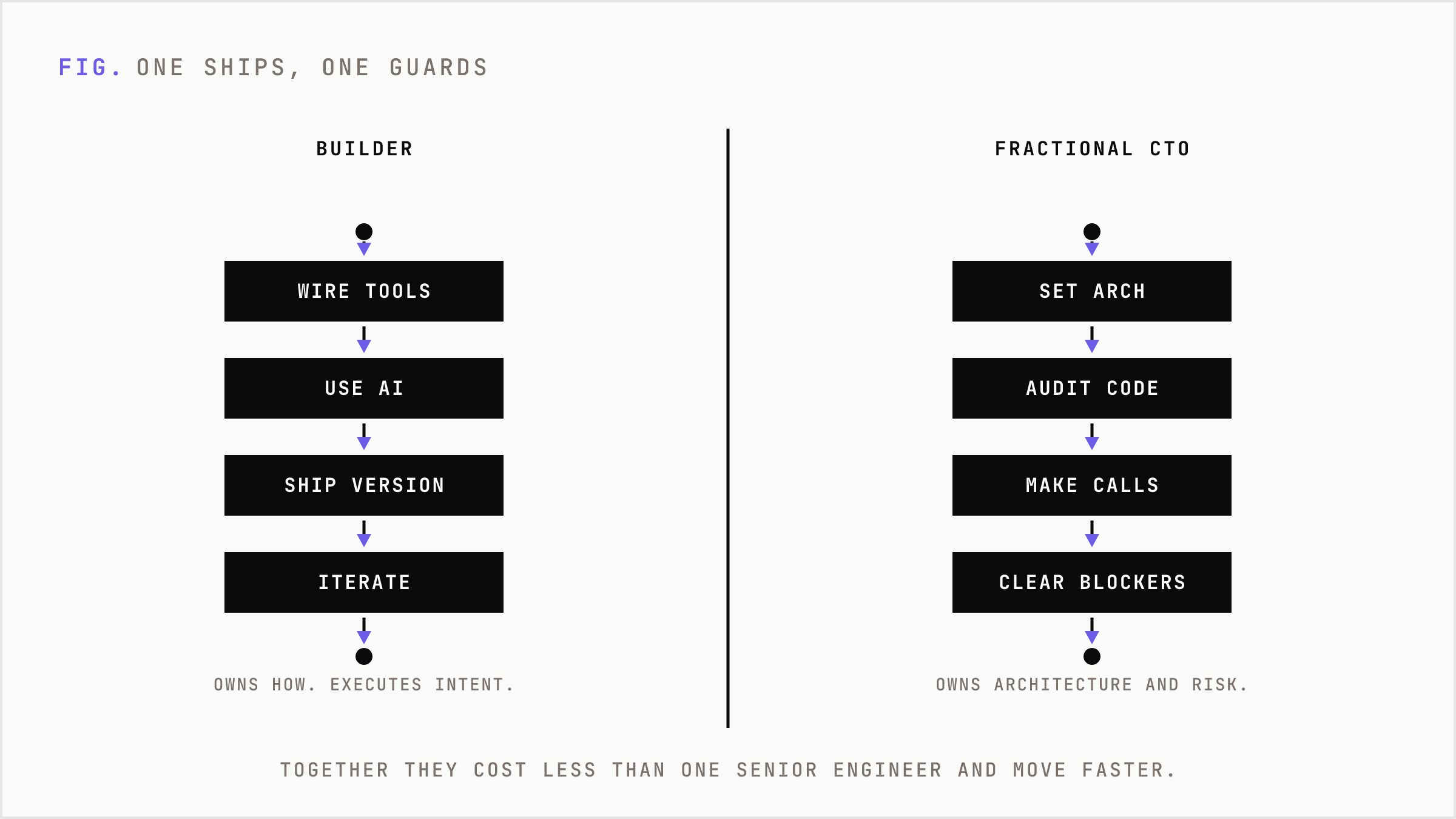
The question I keep coming back to is simple: who do you actually hire to do this?
The default answer is a senior full-stack developer or a technical co-founder. Both feel safe. For most companies at this stage, both are the wrong tool. Too expensive, too slow, calibrated for problems you do not have yet. You are paying for ten years of production scar tissue to build a form that posts to a webhook. The scar tissue is real. It is just not what this stage needs.
What a builder is
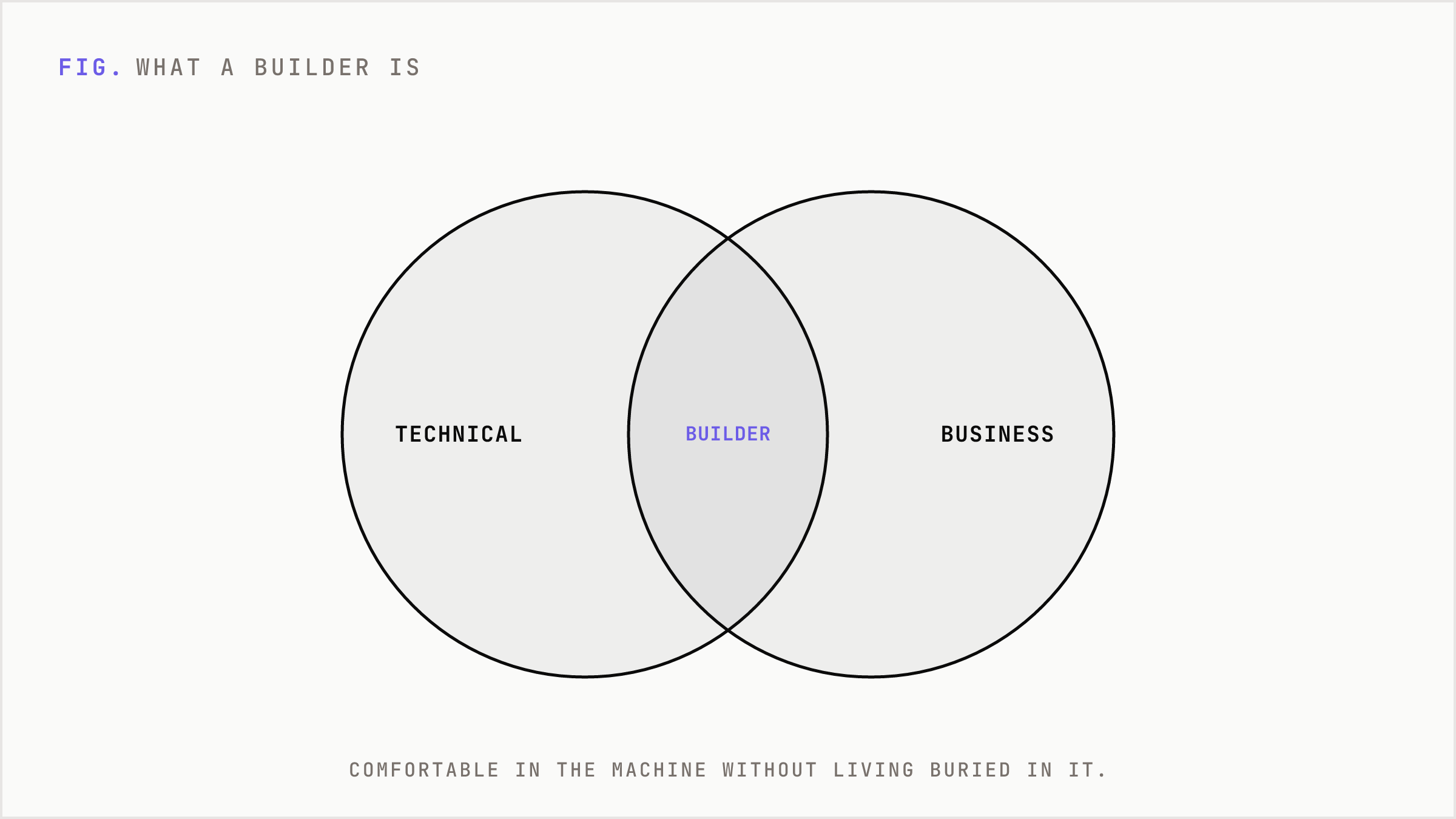
A builder sits one notch above your marketer technically, and several notches below a career engineer.
They read code. They wire tools together. They use AI to ship working software. They understand how data moves through a system, where it breaks, and what "done" looks like. Comfortable in the machine without living buried in it.
They do not need ten years in production systems. With Cursor, Claude Code, and the current agentic tooling, the distance between "I can describe what I want" and "I can ship a working version" has collapsed. A good builder closes that gap in days. The thing that used to gate this work was the ability to translate intent into syntax. AI ate that gate. What is left is judgment about what to build and the taste to know when it is wrong.
The market is already naming this person. Palantir made "forward-deployed engineer" a job title in the 2010s: an engineer embedded with the customer, close enough to the business to own the outcome, technical enough to ship it themselves. The label spread across AI startups because the shape kept recurring. OpenAI, Anthropic, and a wave of applied-AI companies now hire forward-deployed engineers as a matter of course. The "AI generalist" label points at the same person from a different angle. Technical enough to build, close enough to the business to own the result.
The builder is the company-internal version of that role. Not embedded with a customer, embedded with the founder.
Keep the founder out of the build
Here is the trap most people walk into. When the founder is also the builder, the company stops steering.
A founder's attention is the scarcest asset in the business. The moment it goes heads-down in the editor, it is out of the market. Not selling, not talking to customers, not setting direction. The build quietly eats the one job nobody else can do.
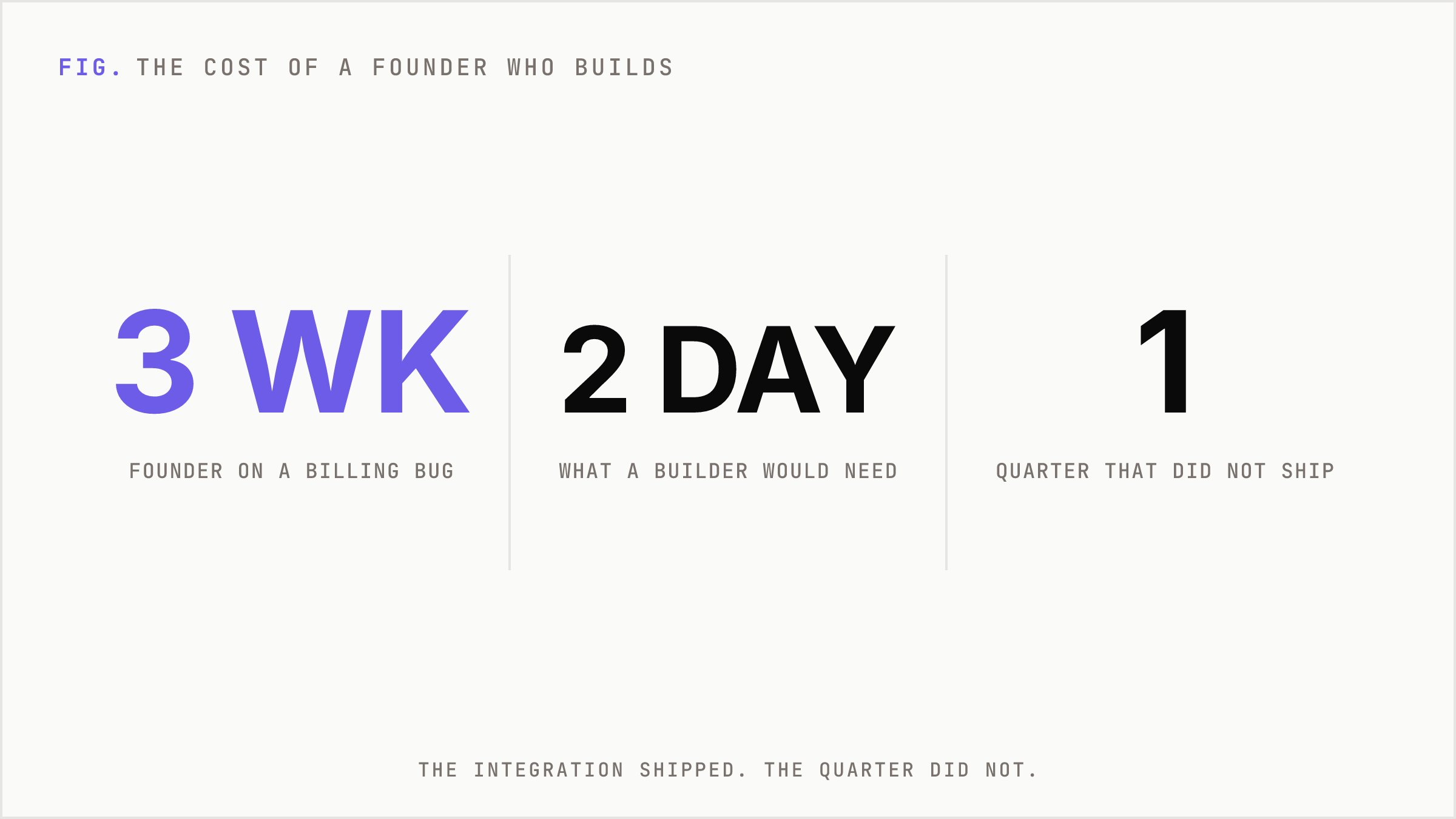
And code is sticky. You ship a feature, you owe it bug fixes, then changes, then the next feature. The founder who builds becomes the founder who maintains. Maintenance is the opposite of running a company. I have watched a founder spend three weeks debugging a billing integration that a builder would have closed in two days, while the pipeline he was supposed to be filling went cold. The integration shipped. The quarter did not.
A builder needs that remove. They execute someone else's intent. They do not have to hold the whole business in their head, so they move fast without re-litigating strategy on every commit.
The founder decides what and why. The builder owns how, and ships it.
Rent the CTO
A builder moving fast with AI has one obvious failure mode. The architecture drifts wrong, debt piles up, and nobody senior is watching the foundations. Speed without judgment ages badly.
That is the job of a fractional CTO. A fractional CTO is a senior engineer you hire in small, recurring doses to set architecture and audit the work, not to write the day-to-day code.
They set the architecture before the builder pours concrete. They audit the code on a cadence, weekly or biweekly, whatever the pace of change demands, and catch the wrong turns while they are still cheap to undo. They make the calls the builder is not equipped to make. Build versus buy. Where to spend on robustness. What is allowed to stay scrappy. What cannot. Which AI-generated shortcut is fine and which one becomes a security incident in six months.
You get senior technical judgment in the doses you actually need it. No senior salary. No equity handed to a technical co-founder you may never have required.
Fractional executives, CFO and CMO and CTO, are a real and growing model for exactly this reason. Senior judgment is valuable in small amounts and ruinous to overpay for. One person ships. One person guards the foundations. This is the model Nyyon runs. We act as the fractional CTO and CMO and put builders on the keyboard, owning the function and shipping the system rather than handing over a deck and a retainer invoice.
What the structure buys you
Cost. A builder costs less than a senior developer. A fractional CTO costs a fraction of a full one. Together they land under a single senior engineering hire, and more of that spend turns into shipped product instead of architecture debates.
Speed. Time to production drops. The builder ships. The CTO clears blockers that would stall someone working alone. Decisions get made on the cadence the business needs, not the cadence one overloaded engineer can sustain.
Ownership. Two people, one clean split. The builder owns execution. The CTO owns architecture and risk. No committee, no layers between intent and shipped software.
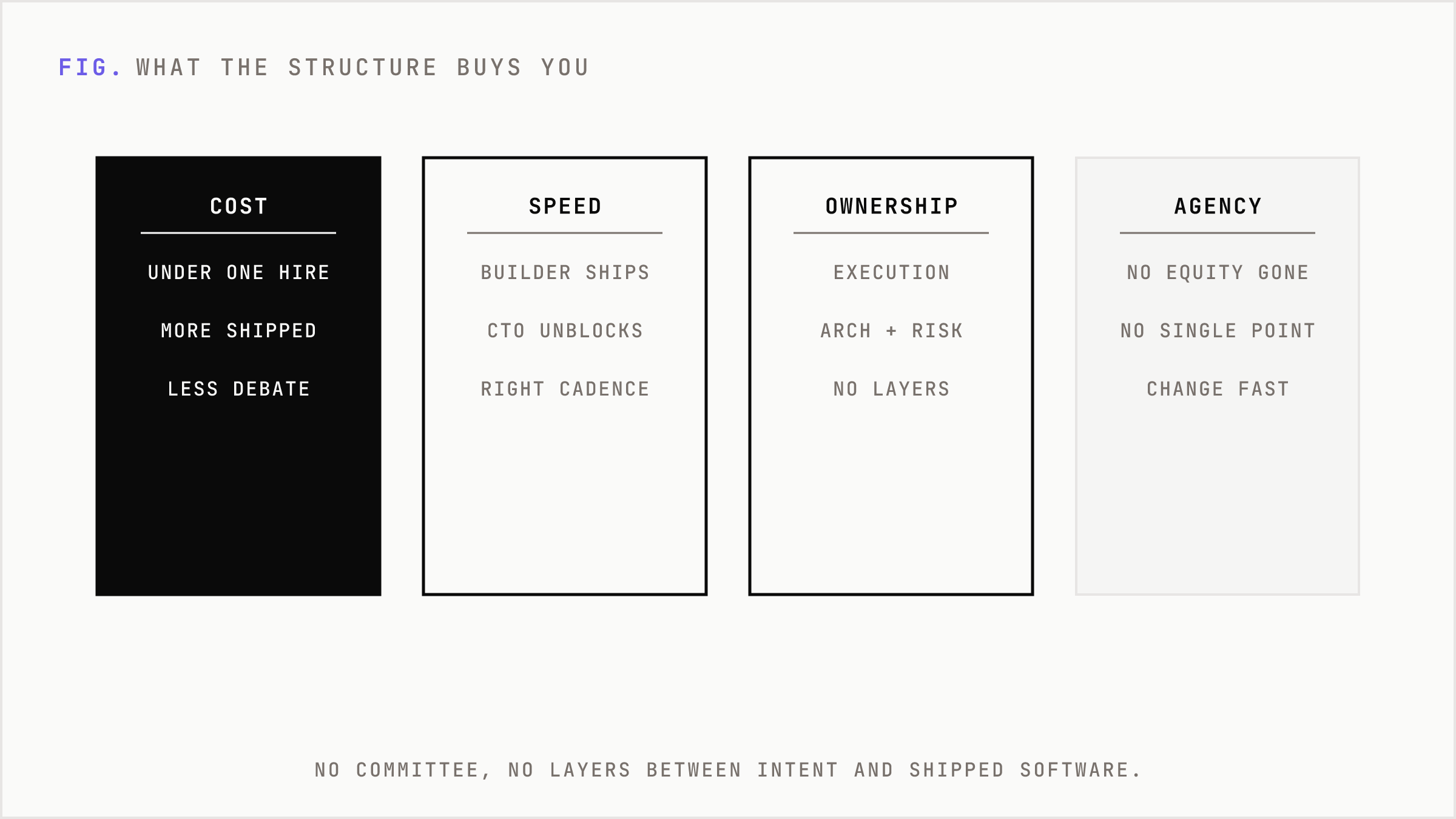
Agency. You move on your own terms. No equity given away, no dependence on one expensive hire who becomes a single point of failure. You keep the ability to change course fast.
Why this works now and did not three years ago
The model depends on one thing being true: that a builder can produce production-grade work without a decade of engineering behind them. Three years ago that was not true. The tooling could autocomplete a line. It could not stand up a working integration from a paragraph of intent.
That changed fast. Agentic coding tools now hold context across a codebase, write the boilerplate, wire the services, and explain their own choices. The gap between describing what you want and shipping it has collapsed for everything that lives in the "ship and iterate" zone. That is most of what an early company needs. The builder is the person who exploits that collapse. The fractional CTO is the person who makes sure the collapse does not bury you in debt.
This is the same shift reshaping marketing. The teams that win now are the ones that compound decisions per week, and the way they do it is by wiring a real spine and pointing AI agents at outcomes instead of features. The build function and the growth function are converging on the same operating logic: senior judgment on top, AI doing the production work, a human owning the result. Nyyon builds that spine and the agents that run on it, which is why the builder-plus-fractional-CTO shape is not a theory to us. It is the operating model.
Where it breaks
This is an honest model, so here is where it stops working.
It is built for execution speed. It does not replace a deep specialist when the problem is genuinely hard. Heavy data infrastructure, security-critical systems, anything that has to scale to serious load. When the work crosses from "ship and iterate" into "this fails badly if we get it slightly wrong," you need the real engineer. The fractional CTO should be the one telling you so, and a good one will.
It breaks if the audit cadence slips. The builder's speed is only safe because someone senior is checking the foundations. Drop that and you are back to fast software aging into a liability, except now nobody is even watching it happen.
And it breaks if the founder will not let go of the keyboard. The whole point is the founder in the market while the builder is in the machine. A founder who hires a builder and then sits beside them editing every commit has bought the cost without the benefit.
The leverage is real, and it is available now in a way it was not three years ago. One builder who ships, one CTO who owns the architecture, one founder free to run the company. That is the whole structure. The rest is discipline.
Frequently asked questions
What is a builder versus a software engineer?
A builder is someone technical enough to ship working software but close to the business, not buried in it. They read code, wire tools together, and use AI to build fast. They sit above a marketer technically and below a career engineer. They own execution and outcomes, where a senior engineer owns deep production systems and scale.
Should an early-stage startup hire a senior developer or a builder?
For early-stage work that is mostly shipping and iterating, a builder plus a fractional CTO usually beats a single senior developer. It costs less, moves faster, and turns more spend into shipped product. Hire the senior specialist only when the problem becomes genuinely hard: heavy data infrastructure, security-critical systems, or anything that must scale to serious load.
What does a fractional CTO actually do?
A fractional CTO is a senior engineer hired in small, recurring doses to set architecture and audit work, not to write daily code. They make build-versus-buy calls, decide where to spend on robustness, and catch wrong turns while they are still cheap to fix. You get senior technical judgment without a full salary or handing equity to a co-founder.
How much does a builder plus fractional CTO cost?
Together, a builder and a fractional CTO typically land under the cost of one senior engineering hire. A builder costs less than a senior developer, and a fractional CTO costs a fraction of a full-time one. The benefit is not just lower spend; more of that spend turns into shipped product instead of architecture debates.
Why can builders ship production software now without a decade of experience?
Agentic AI tooling like Cursor and Claude Code collapsed the gap between describing what you want and shipping it. These tools hold context across a codebase, write boilerplate, wire services, and explain their choices. For the ship-and-iterate work most early companies need, a capable builder can now produce working software in days, with a senior CTO auditing the foundations.
What is a forward-deployed engineer?
A forward-deployed engineer is technical enough to build and close enough to the business to own the outcome. Palantir made it a job title in the 2010s by embedding engineers with customers, and AI companies like OpenAI and Anthropic adopted it. The internal version is a builder embedded with the founder, executing intent and shipping it directly.
When should a founder stop building the product themselves?
As soon as the build starts eating the time only the founder can spend: selling, talking to customers, setting direction. Code is sticky; shipping a feature commits you to bug fixes, changes, and maintenance. A founder who builds becomes a founder who maintains. Hand execution to a builder so your attention stays in the market.
Does Nyyon offer a fractional CTO and builder model?
Yes. Nyyon runs exactly this model: senior fractional CTO and CMO judgment on top, builders on the keyboard, owning the function and shipping the system. We set the architecture, put builders on execution, and wire AI agents to own outcomes rather than features. The result is a real operating spine, not a deck and a retainer invoice.