Nyyon · Blog
What Is a Forward-Deployed Engineer?
A forward-deployed engineer builds the specific system a field owner needs, then hands it off legible enough that a local champion can run it.
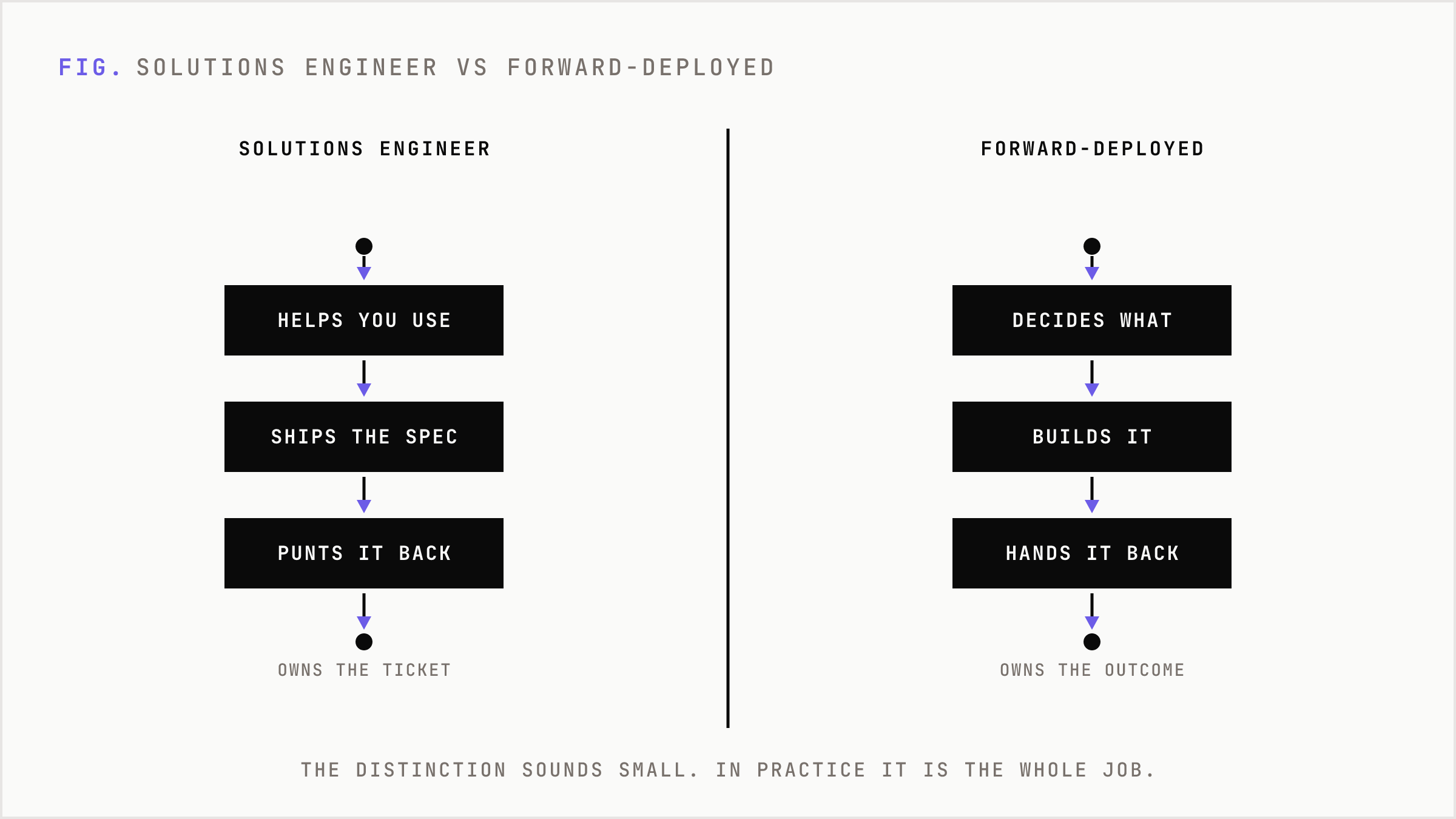
A forward-deployed engineer is someone who embeds inside a real operation, owns the specific outcome a team is stuck on, and builds the working system for it rather than punting a spec back to the customer. They are not a solutions engineer in a new hat. A solutions engineer helps you use a product. A forward-deployed engineer decides what should exist, builds it, and hands it back as something your team can maintain without them. The distinction sounds small. In practice it is the whole job.
Most companies claim they have hired for this. Most have hired a technically strong person who still waits to be told what to build. That gap is where forward deployment lives, and it is where most of these hires quietly underperform.
The dominant pattern: I know what I want, I'll ask AI for it
Here is the model everyone is running right now. Someone in the field feels the pain. They know, or believe they know, exactly what they need. AI is in the room, so they describe the need and get something back. The something works. The dopamine hit is real, and it is addictive.
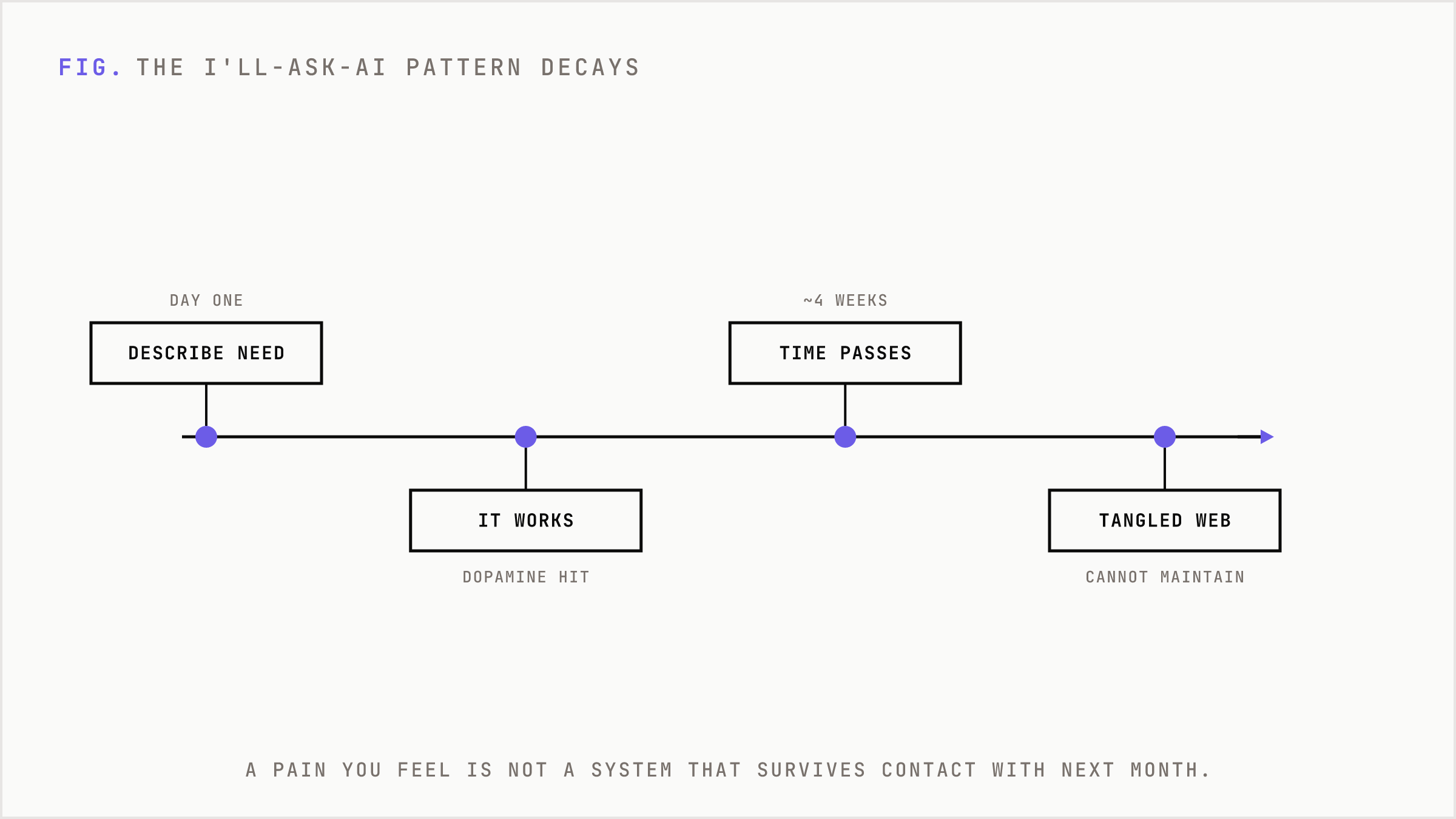
Then time passes. Not much time. Four weeks, maybe.
What they built has become a tangled web. Impossible to maintain, hard to debug, dangerous to expand. The person who described the need badly underestimated how intricate it is to explain a need in a way that produces a sustainable, expandable result. There is a mismatch between technical ability and intent. People in the field know their problem. They have very little idea how a solution should be designed to actually hold.
This pattern persists for two reasons. The instant-gain dopamine, and the accurate feeling that the person in the field really does understand the pain. Both are true. Neither closes the gap between a pain you feel and a system that survives contact with next month.
What the forward-deployed engineer actually owns
Take a real one. A PPC-heavy marketing engine needed visibility into its customer journey. The forward-deployed expert found a clean representation: a Sankey graph that describes the journey visually, in detail, easy to read at a glance.
If someone without domain fluency had asked an AI for a Sankey graph, they would have gotten a monstrosity. Technically a Sankey. Practically unreadable.
The difference was ownership. The engineer was an actual owner of the activity. He knew PPC and marketing, so he knew what the graph needed to show. He also built it so it stayed simple to maintain and expand. A traditional vendor engineer would have shipped the request as specified and punted the interpretation, the maintenance, and the next-quarter changes back to the customer.
Forward deployment is owning the outcome, not the ticket.
The skill mix is judgment, not just code
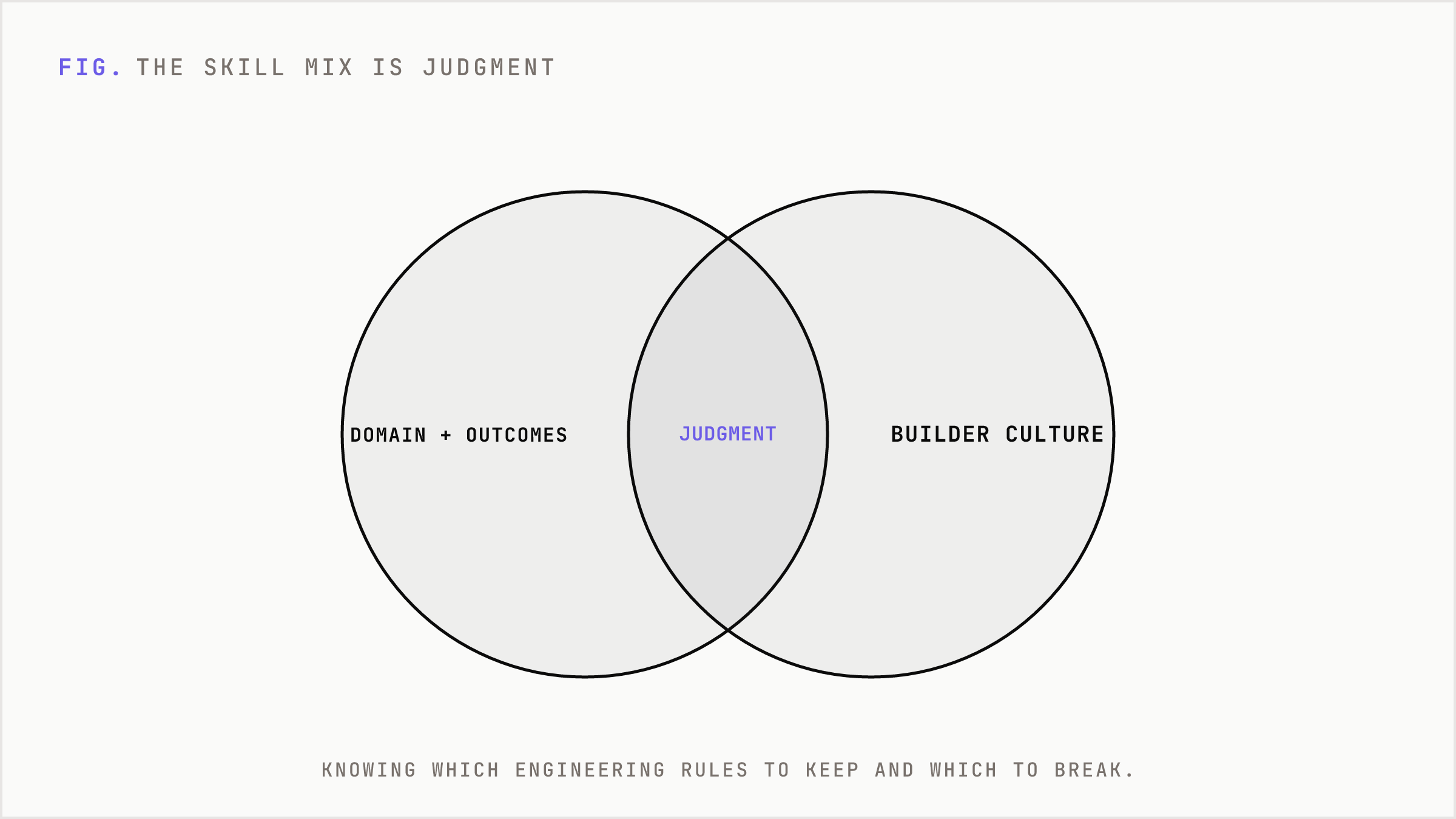
The hard part of this role is not writing code. It is understanding that the code exists to serve an outcome, and having the judgment to know which engineering rules you should keep and which you can break given the specifics of the project.
That judgment sits at the meeting point of three things: domain expertise, a real feel for outcomes, and a deep understanding of builder culture.
Builder culture is different from developer culture, and the difference is the whole argument. Developers love smart, complex, tightly interconnected architecture. It makes sense for them, because they live inside a project long-term. They have the familiarity to fix and extend it without breaking things.
A builder gets in, builds something specific, and gets out. Four weeks later it breaks. You come back, or an LLM comes back, to a tangled system neither of you can read end to end. Past that point, almost anything you do causes more damage than good.
A forward-deployed engineer builds for that reality. Modular architecture. Legible over elegant. Maybe less clever, but readable by a human returning cold, and readable by an LLM asked to work on one slice rather than the whole system at once. Easy to debug. Easy to maintain. Easy to update.
The handoff is the point
The measure of a forward-deployed engineer is not the system they build. It is who runs it after they leave.
The job ends with a handoff to a local champion who can maintain and expand the system independently. That only works if the build sits inside guardrails that make screwing it up unlikely. Legible architecture is not an aesthetic preference here. It is the mechanism that lets the champion own the thing without the engineer in the room.
This is why forward deployment is not really a vendor service. It is a function every company needs. When you stop thinking of it as a vendor thing, three things change. You staff for domain owners who can build, not builders who wait for specs. You incentivize the handoff, not the hours. And you measure the system by whether the local champion is still running it a quarter later, not by whether the demo landed.
How to tell a real one from an LLM crutch
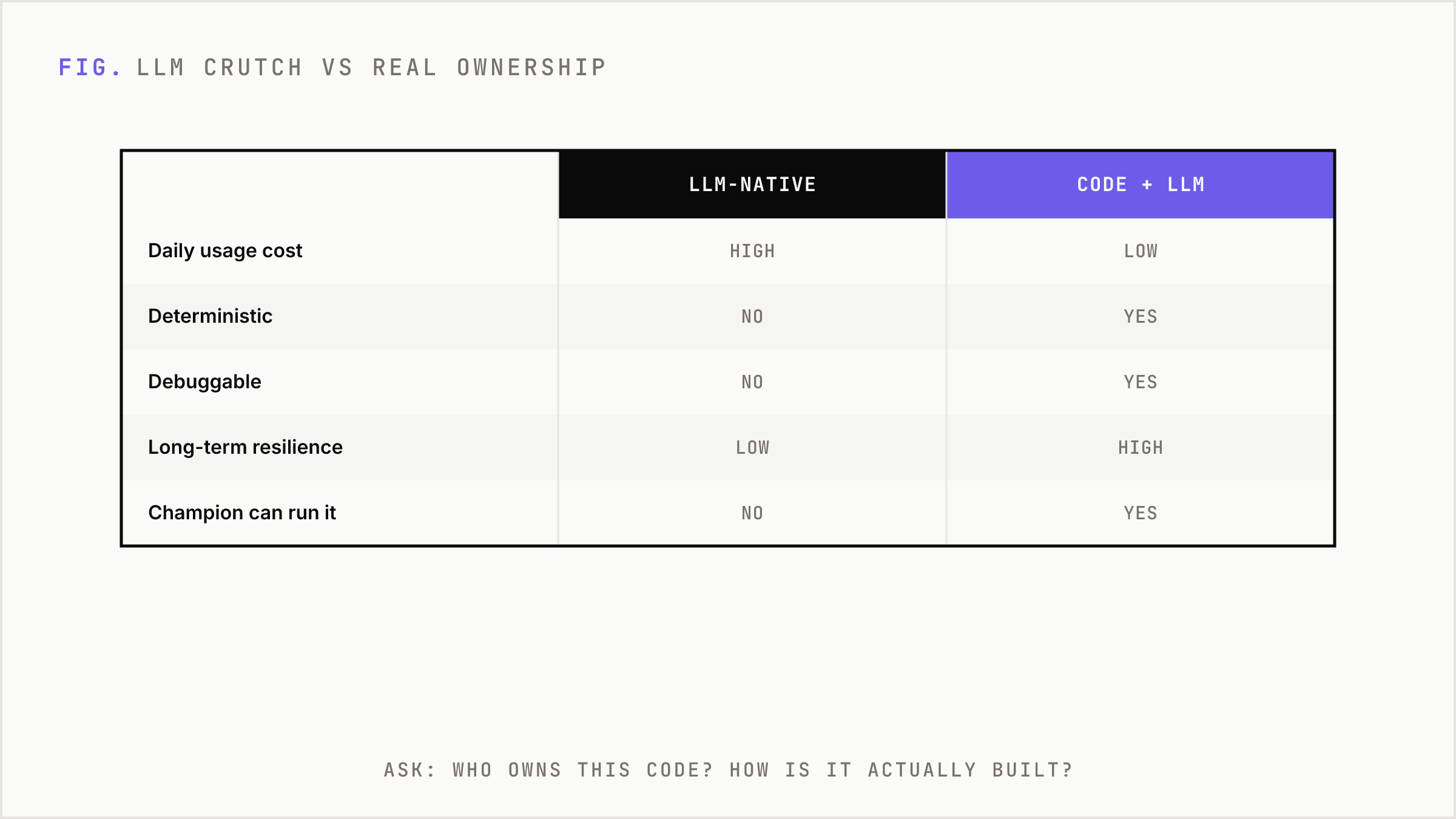
There is a clean red-flag test. Ask two questions and demand concrete answers. Who owns this code? How is it actually built?
A person or team that cannot answer those in concrete terms is relying on the LLM to hold the system together. That is not ownership. That is a hope.
The technical tell sits underneath. If you build a product strictly inside LLM-native tooling, in-model coworking routines, chains of .md files hoping a non-deterministic model interprets them correctly every run, you have built an expensive system to maintain. Daily usage cost runs high. Long-term resilience runs low. The model will very often not deliver what the file assumed it would.
Compare that to straightforward code on a provider like Cloudflare: static pages, workers, a database, with the LLM called only at specific points where you genuinely need it, content generation or a particular judgment call. Now the LLM usage is limited and targeted. The system is fundamentally code, which means it is deterministic, debuggable, and resilient. That is what real ownership produces.
What changes, what stays the same
Adopt this and one thing changes immediately. You stop buying deliverables and start owning outcomes with a named person accountable for them surviving. The tradeoff is honest: forward deployment is harder to staff than a contractor and slower to fake than a demo. You cannot cargo-cult it by giving a strong engineer a new title.
What stays the same is the pain in the field. Your people still know what they need better than anyone. The forward-deployed engineer does not replace that knowledge. They translate it into something that holds, and then they leave you able to run it.
Most firms sell expertise. The forward-deployed model sells ownership, and then hands the wheel back. That is the difference between a system your team relies on and a clever mess nobody can touch by month two.
If you have a problem, if no one else can help, and if you can find them, maybe you can hire Nyyon.