Nyyon · Blog
The beachhead ICP drives the cost of a GTM sprint
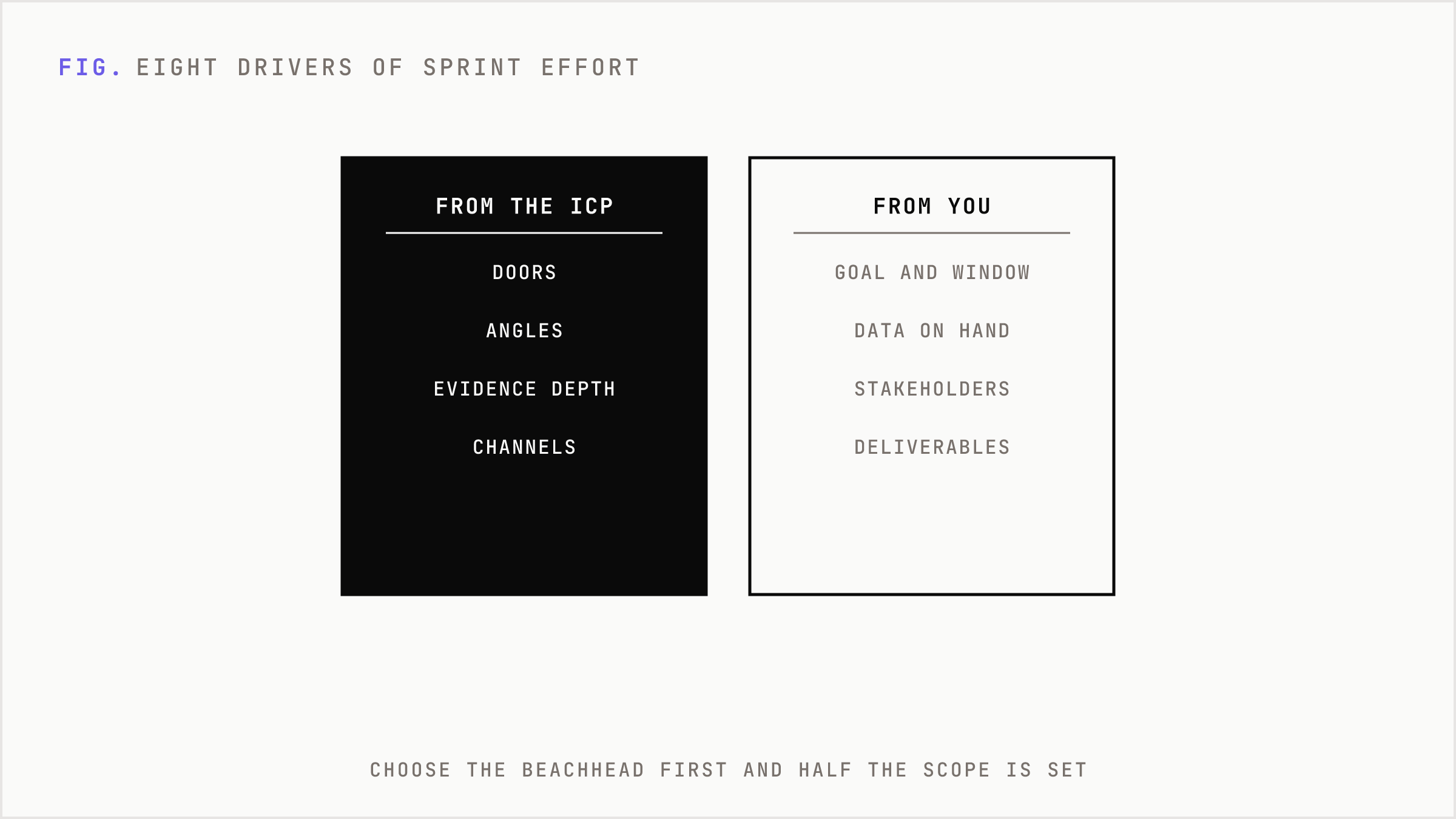
A beachhead ICP is one buyer title at one company type. Four of the eight drivers of GTM sprint effort follow from that choice, and the other four come from your goal, data, team and deliverables.
A beachhead ICP is the first buyer a company wins, defined as one buyer title at one company type, and that choice drives much of what a go-to-market sprint costs because it decides how many doors, angles, proofs and channels the sprint has to cover. Nyyon is a forward-deployed AI consultancy, and this page describes how our beachhead method scopes work. It lists the drivers of effort so that you can compare any two proposals on the same terms.
A quote for a GTM sprint contains a number, and the number follows from the choices below. Settle the choices first and the quote becomes easy to read.
What is a beachhead ICP?
An ideal customer profile can describe a whole market. A beachhead ICP describes the narrowest group you can win first and win repeatedly. In our method the unit is an angle: one buyer title at one company type. "VP of Operations at a freight brokerage" has the right shape. "Mid-market logistics" has the wrong one, because no single person in it answers a message.
An angle earns its place when four checks hold, and at least three of the four must pass:
- Money is already allocated. An open requisition for the role the product replaces, or a funding round with a stated use of funds.
- A clock is running. A board date, a next round, a launch or a season makes the problem expensive this quarter.
- The buyer cannot do it alone. The founder or team lacks the skill, such as a technical founder facing go-to-market or an owner facing software.
- The outcome is measurable. Pipeline, revenue or hours show up in a number the buyer already tracks.
Each check rests on a signal you can verify from outside the company, and a signal gets re-checked at the source right before it goes into a message, because job boards go stale.
What does a GTM sprint produce?
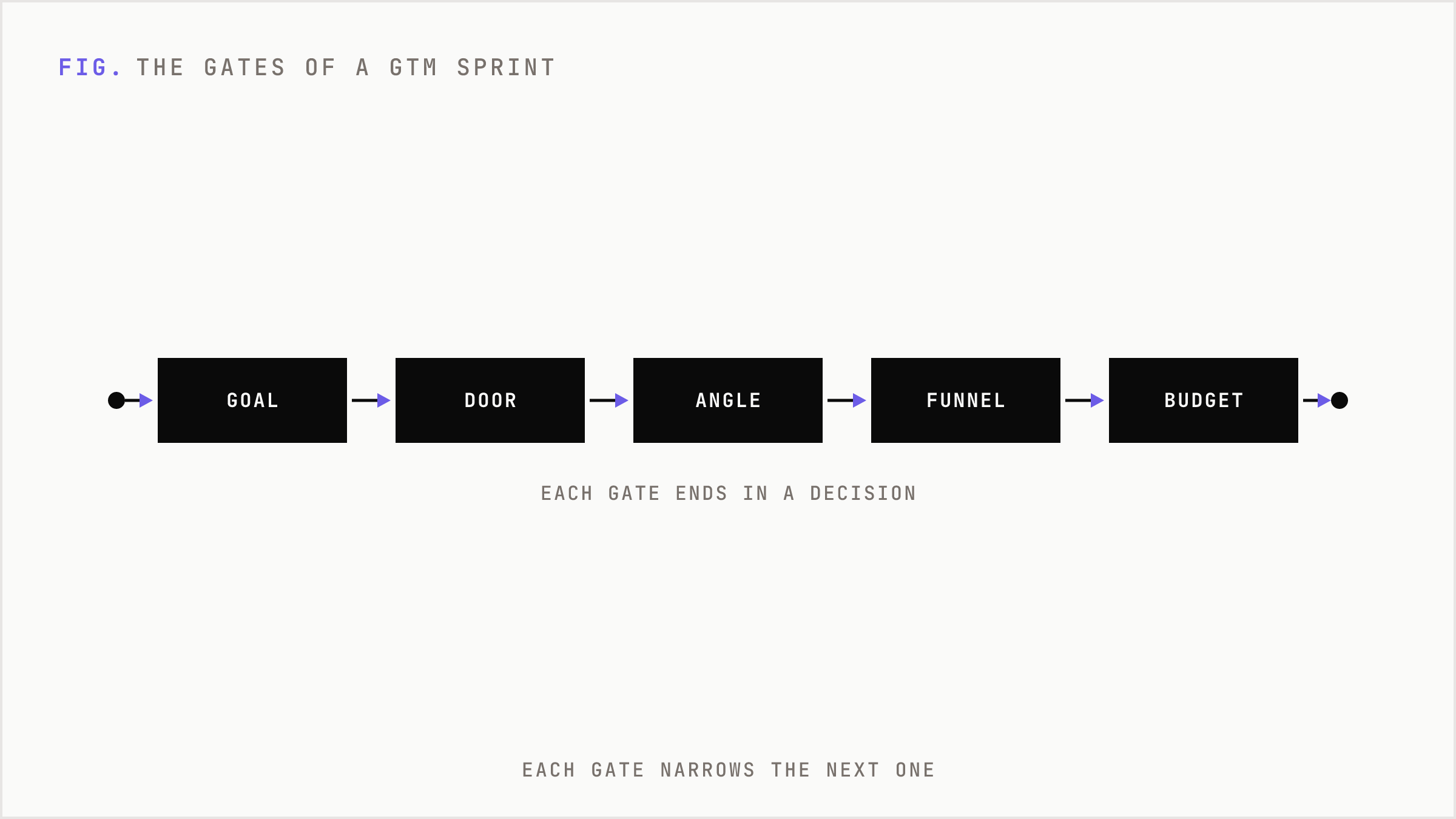
A GTM sprint is a Project Sprint aimed at go-to-market: a bounded engagement that ends in a decision and a plan your team runs. The method runs through staged gates, each with a decision: the goal and its window, the up-market or down-market door, the price anchor, the wedge, which angle to pursue, the funnel, the channel mix and the budget. The deliverables are a report that records the decisions and a live spreadsheet model with the funnel and channel math. Outreach to the named buyers is a separate step after the plan.
Which eight drivers set the effort?
Each driver below changes how much work the sprint contains. For each one, the question to ask any provider follows.
1. The goal and its window
A goal converts into a sales constraint: customers needed equals the monthly revenue target divided by the ticket, and new customers per month equals that count divided by the months in the window. A short window with a large goal demands channels that can carry volume in the last month, which widens the channel work. Ask: which goal and window does the plan assume, and how does the plan ramp?
2. How many doors the sprint evaluates
A door is a market direction: few large buyers with committees and gatekeepers, or many small buyers who decide alone. Each door has its own blockers, buyers, proofs and channels. A sprint that evaluates both does the evidence work twice. A sprint that commits to one door after the blocker analysis does it once and says what the other door would cost. Ask: will the provider recommend one door, and on what evidence?
3. How many angles get researched
The method researches 15 to 25 angles and narrows them to a top four with a buyer avatar for each. The count sets the research load. A founder who already knows the three buyers worth testing can cut the list and the cost with it. Ask: how many angles will the provider research, and who picks the shortlist?
4. How deep the evidence goes on each angle
A card for one angle carries a ticket derivation, a reach score, a count of firms in the size band from a primary source, a verdict, the strongest argument against and the sources. Named buyers get verified on a public page. Sizing from a primary count takes longer than an estimate, and an angle with no primary count gets labeled "not sized". Ask: which sources back each claim, and which claims are judgment calls?
5. How much source material the sprint ingests
Interview transcripts, a CRM export, past win and loss notes and existing funnel numbers all feed the work. Real data from your own pipeline beats any benchmark, so a client who arrives with clean customer data shortens the sprint. A client who starts from a blank page sends the team to published benchmarks, which takes research and carries more uncertainty. Ask: what does the provider need from you in week one?
6. How many stakeholders must agree at each gate
Every gate asks for a decision. One decider keeps the sprint moving. Four stakeholders with different goals add alignment work at each gate, and the first gate is where the disagreement surfaces. Ask: who signs off at each gate, and what happens when they disagree?
7. How much funnel and channel modeling is in scope
The funnel runs from the first visit to a paid customer, and each rate gets sourced to the closest comparable motion. Each channel gets a calculator with a unit cost, engagement rates and the resulting acquisition cost and payback. A reality pass compares the plan's rates with sourced medians. Five channels cost more modeling effort than two. Ask: which channels will be modeled, and will the model be a live spreadsheet you keep?
8. Which deliverables ship
A report, a model, landing-page mockups for the top angles, reach lists with named people and influencer lists each add scope. A sprint that stops at the decision costs less to run than one that also builds the assets for the first campaign. Ask: which deliverables are in the quote, and which are optional?
How does the beachhead ICP set the cost?
Four of the eight drivers follow directly from the beachhead choice: the doors in driver 2, the angles in driver 3, the evidence depth in driver 4 and the channels in driver 7. The other four come from your goal, your data, your team and the deliverables you pick. A narrow door, a short angle list and a buyer with obvious signals make a compact sprint. A wide door, twenty-five angles and buyers with ambiguous signals make a long one. A buyer who answers strangers and gathers in reachable places needs fewer channels than a buyer reachable only through referrals.
The penetration test shows the effect. Divide the customers you need by the number of firms you can reach in the size band. In our method a ratio above roughly 3 to 4 percent marks a segment as too concentrated to serve as a beachhead, and the sprint then widens the pool or changes the angle. A worked example with the arithmetic shows the calculation with sample inputs.
What shortens a sprint?
Five conditions reduce the work:
- One decider with authority over the budget.
- A goal with a number and a date.
- A ticket the business already knows.
- Customer data the team can open in week one.
- One door chosen before the sprint starts.
Bring your goal and your data to a 30-minute call and we will say which of the eight drivers will carry the most weight in your sprint.
How do you compare two proposals?
Put the eight questions to each provider and write the answers in a table with one row per driver. Two proposals with different numbers often rest on different answers to the same drivers: one assumes a single door and a short angle list, the other assumes both doors and twenty angles. The table shows which assumption produces the difference. For the staffing side of the same decision, read why to hire a consultancy before a Head of AI and how to diligence a forward-deployed AI consultancy.
About Nyyon
Nyyon is a forward-deployed AI consultancy, also described as an AI execution partner. It takes the important operational project nobody has time to own and hands it back as a working system the team runs. Nyyon works with founder-led companies in North America and with department leaders who hold an AI mandate and lack the capacity to execute. Engagements run as a Skip-the-spec Retainer, a Project Sprint, or a Forward Deployed AI Expert engagement.