Nyyon · Blog
A Form D filing tells you which companies are raising now
An SEC Form D filing marks the start of a securities offering. Filtered by industry and round size, a daily read of new filings gives a sales team companies with budget and a clock.
An SEC Form D filing marks the moment a private company starts taking money in a securities offering, so a daily read of new filings gives a sales team a list of companies that have budget and a reason to spend it this quarter. Nyyon is a forward-deployed AI consultancy, and we read these filings for our own prospecting. This page explains what a filing contains, how to filter the feed to a target band and what to do with a hit.
What is a Form D filing?
Form D is a notice of an exempt offering of securities. The SEC describes it as the filing for offerings made without registration under Rule 504 or Rule 506 of Regulation D, or under Section 4(a)(5) of the Securities Act. A company files it online through the SEC's EDGAR system, and the SEC charges no filing fee.
The deadline is 15 days after the first sale. The SEC defines the date of first sale as the day the first investor is irrevocably contractually committed to invest. A filing therefore appears within about two weeks of the first commitment, and it can appear earlier, because the SEC permits filing before a sale.
What does a filing tell a seller?
The SEC's Form D guide refers to the items a filing carries: the total offering amount, the amount sold, the amount remaining, the date of first sale, the number of investors, the issuer's revenue or net asset value, and the related persons. Our digest also reads the industry group, the city and state, the year of incorporation and the executive officers named in each filing.
Each field maps to a sales signal:
- The offering amount shows the size of the round the company is raising.
- Sold against remaining shows whether the round is still open. A large remaining amount means the company is taking money now.
- The date of first sale dates the clock. A company three weeks into a round is allocating money.
- The industry group lets you filter to technology and services companies.
- The year of incorporation separates a company in its first years from an established one.
- The executive officers give you names to start from.
Why does a raise matter for a services buyer?
A funding round satisfies two of the four checks in our beachhead method: money is allocated, and a clock is running. A company that has raised has stated what the money is for, and its board expects progress against that plan by the next round. The other two checks stay open. You still have to find out whether the buyer lacks the capacity to execute and whether the outcome shows up in a number the company already tracks.
That is why we treat a filing as the start of qualification. The filing tells us who to look at this week. The conversation tells us whether the project fits.
How do you filter the feed to your target band?
Form D covers every industry and every round size, so the raw feed holds far more filings than a team can read. Our digest applies two filters.
- Industry. Keep the technology-related groups: Other Technology, Computers, Telecommunications and Business Services.
- Round size. Keep offerings from 5 million to 500 million US dollars.
The round-size filter stands in for company size. Our outreach targets companies of 50 to 400 employees, and a filing records the round, so the digest uses the size of the round as a proxy for the size of the company. Adjust the band to your own buyer. A seller of a smaller engagement might set the floor lower, and a seller to larger companies might raise the ceiling.
New offerings are the unit that matters. Amendments to an existing filing update a round already seen, so the digest skips them and reads only first filings.
How does the daily routine work?
The routine takes five steps and a few minutes a day.
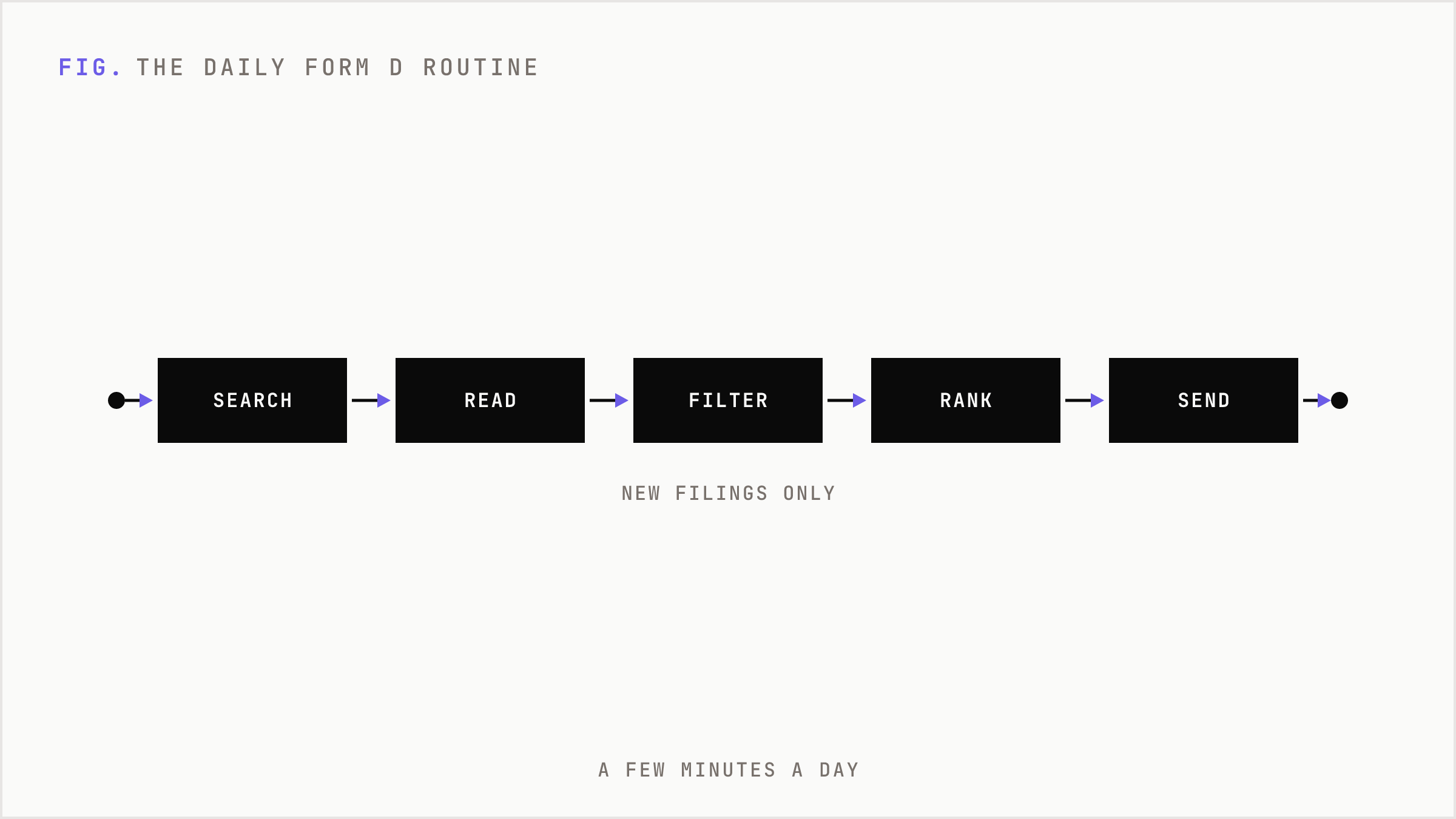
- Search EDGAR for new Form D filings since the last check.
- Open each filing and read the fields above.
- Apply the industry and round-size filters.
- Rank the survivors by round size and note whether each round is still open.
- Send the top of the list to the person who sells, with the filing link beside each company.
The SEC asks automated tools to declare a user agent and sets a maximum access rate of 10 requests per second, so a script should send a descriptive user agent and pace its requests. Keep a record of the filings already processed, so a company appears once.
What do you do with a hit?
A hit is a company name, a round size and a few executives. Four steps turn it into a qualified conversation.
- Open the company's own site and read what it sells. A filing leaves out the product description.
- Check the team. An open role for the function your service replaces adds a third check to the beachhead test.
- Find the buyer title. The executive officers listed in the filing often include the founder or chief executive, and the buyer for an operational project is frequently a department head one level down.
- Write one message from facts you can verify. Cite the filing, state what you build and ask one question. Include only claims about the company that you can point to on a public page.
What are the limits of the feed?
Four limits shape how to read it:
- A lag of up to 15 days. A company can close a round and appear in the feed two weeks later.
- Coverage. The feed lists companies that rely on Rule 504, Rule 506 or Section 4(a)(5). Rounds outside those exemptions appear elsewhere or nowhere.
- A proxy for size. A round amount tells you what a company raised and gives a rough read of its headcount, so confirm the size on the company's own site.
- Money signal only. The filing shows that money exists, and many funded companies lack a project that fits yours. The filing opens the door to a conversation and the answers decide the rest.
How do you use the feed this week?
Start with one filter and one day of filings. Read ten of them end to end, so that you know what each field looks like in practice. Then automate the steps that repeat. Book a 30-minute strategy call if you would like to talk through which of your own projects fit a freshly funded company. Our guide to what drives the cost of a GTM sprint covers the next step after the list: choosing the beachhead.
About Nyyon
Nyyon is a forward-deployed AI consultancy, also described as an AI execution partner. It takes the important operational project nobody has time to own and hands it back as a working system the team runs. Nyyon works with founder-led companies in North America and with department leaders who hold an AI mandate and lack the capacity to execute. Engagements run as a Skip-the-spec Retainer, a Project Sprint, or a Forward Deployed AI Expert engagement.