Nyyon · Growth playbook
The Product Hunt relationship play
Spend three weeks engaging mid-pack founders, build a hundred warm relationships, and turn them into day-one launch support. The full loop, the tracking sheet, and the exact messages.
Most launches die in the first hour, not because the product is weak, but because nobody is there to push it. Product Hunt ranking is decided by early momentum, and early momentum comes from people who already know you.
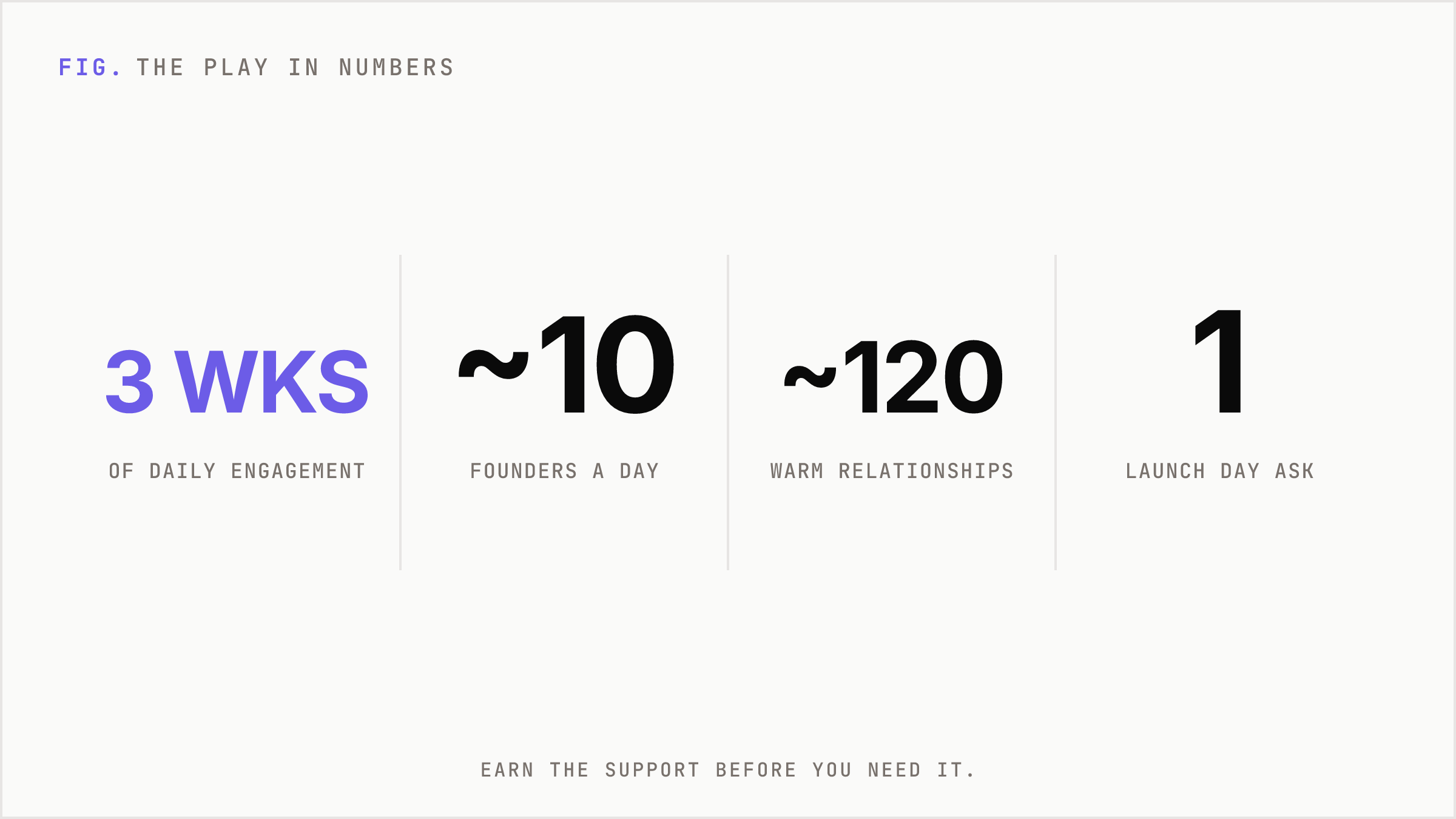
This playbook is how you build that audience on purpose, in the three weeks before you launch. The whole strategy is one daily habit: show up for other founders launching that day, engage for real, log who you meet, and connect. Do it for three weeks and you reach launch day with a hundred or more warm relationships, and one simple ask.
Why it works
Two forces do the work: reciprocity and recency. You give a founder real attention on the day they care about most, when it costs you nothing. Weeks later, when you need a hand, you are not a stranger asking for a favor. You are the person who showed up for them.
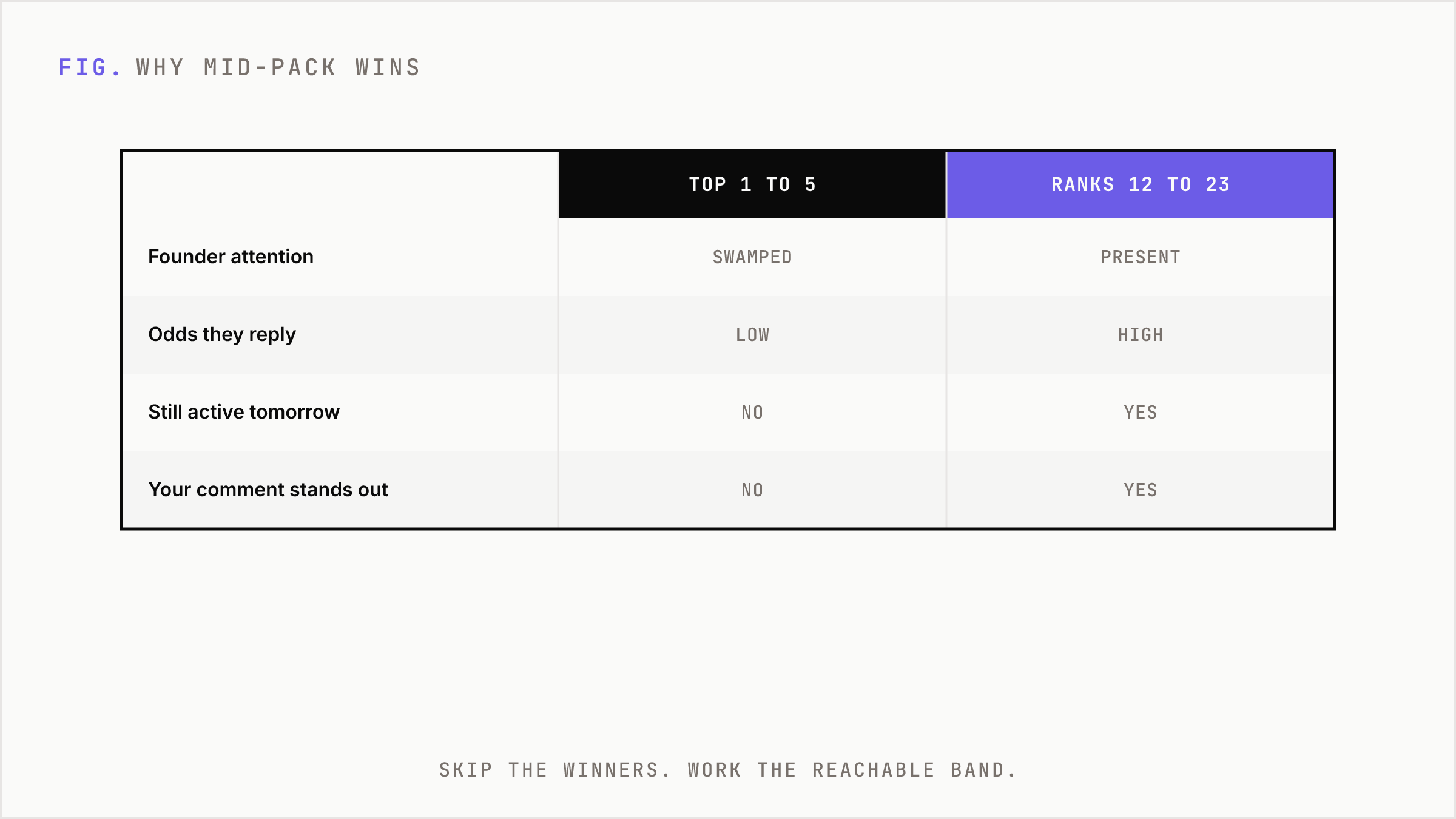
The second move is where you spend that attention. Do not chase the top of the leaderboard. The number one through five products are swamped. Their founders are buried in notifications, gone by tomorrow, and already being asked for everything by everyone. Work the middle of the pack instead: ranks twelve through twenty-three. These are quality launches with founders who are present, proud, and reachable, and your comment actually gets seen.
The three week arc
Three weeks is the sweet spot: long enough to build a real list, short enough that people still remember you on launch day. The shape is simple.
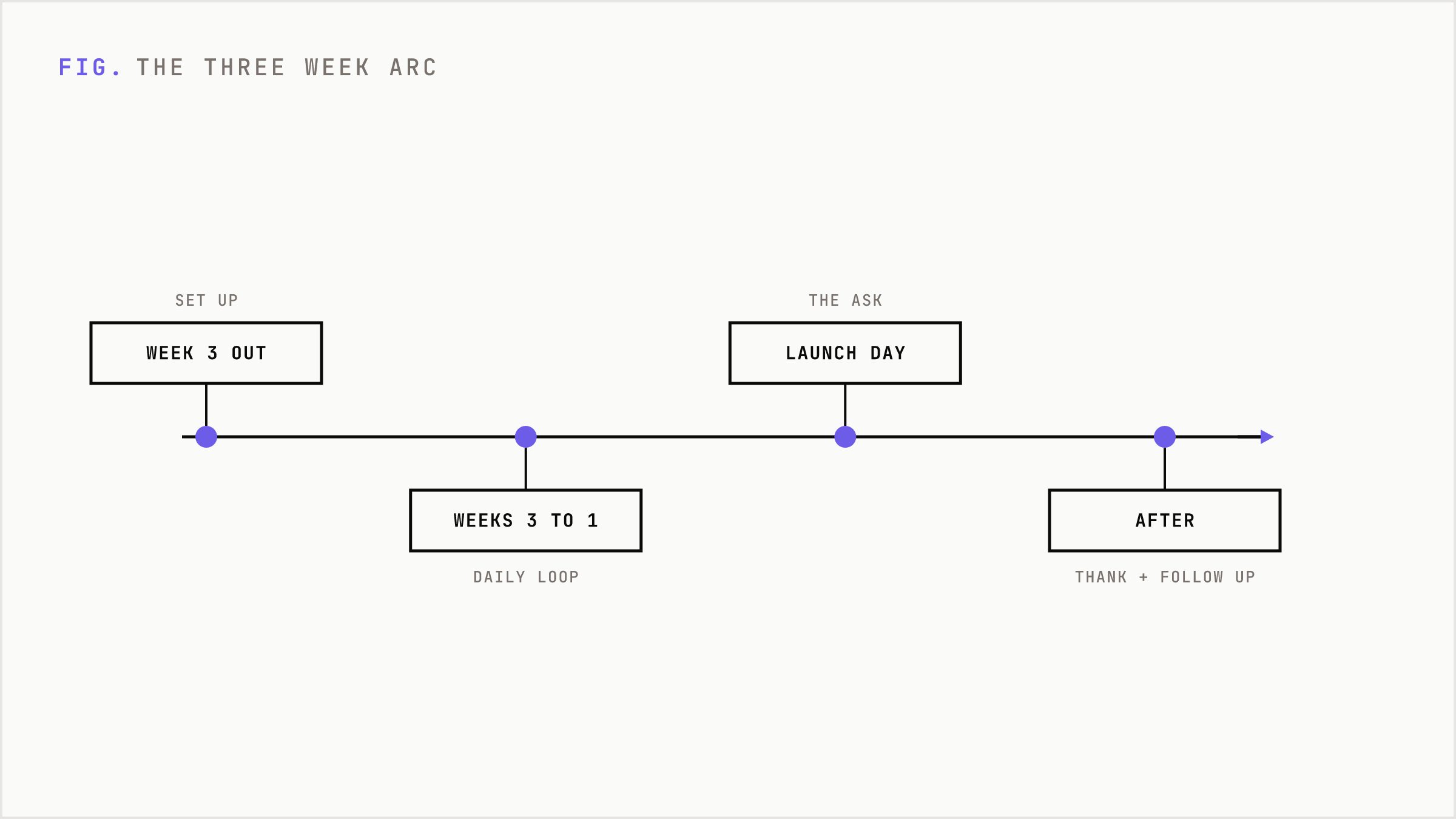
- Week three out, set up. Build the tracking sheet, polish your own LinkedIn and Product Hunt profile so the people you meet see a real person, and start lining up a hunter (more on that below).
- Weeks three to one, run the loop. Ten real interactions a day, every day. This is the engine.
- Launch day, make the ask. Reach out to everyone you met. One warm, specific message.
- After, close the loop. Thank every supporter, and keep the relationships warm for the next launch.
The daily loop
This is the core of the play. It takes about thirty to forty-five minutes a day. Run it the same way every morning.
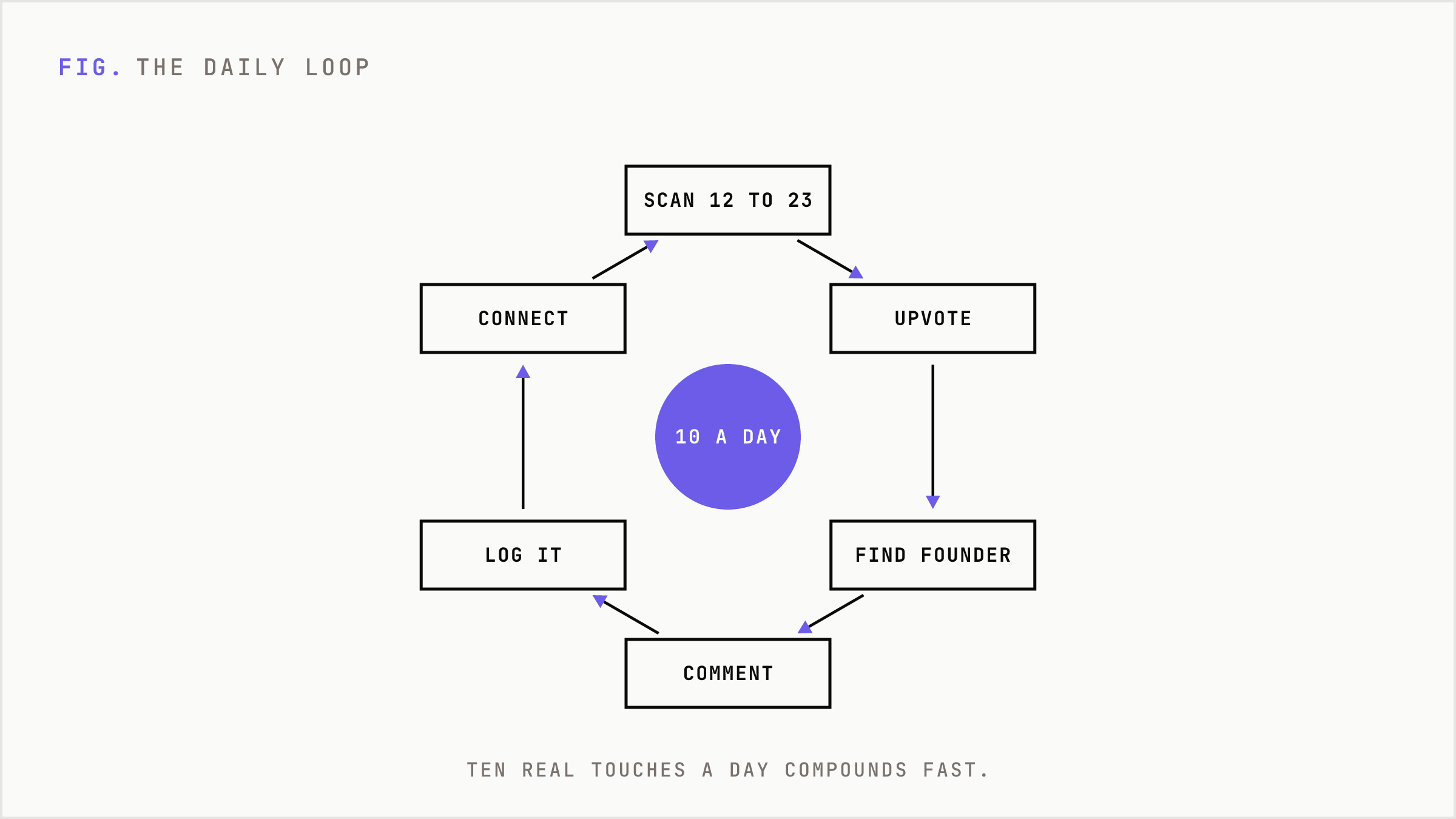
- Open today's leaderboard. Go to Product Hunt and look at the day's ranking.
- Scan ranks twelve to twenty-three. That is your band. Skip the winners.
- Upvote the product. It costs nothing and it is the honest first step.
- Find the founder. Open the maker's Product Hunt profile, then find their LinkedIn.
- Leave a meaningful comment. A real reaction or a useful question, on the launch itself.
- Log them in the sheet. Product, founder, LinkedIn, what you said.
- Send a connection request. On LinkedIn, with a one-line note that references their launch.
Target ten founders a day. Spread the connection requests out across the morning so they look like a human reaching out, not a script firing.
What makes a comment meaningful
"Congrats, looks great" is noise, and founders can smell it. A good comment is warm, specific, and signals real buyer intent. Two that work:
- The supportive reaction: "This looks promising, interesting distinction vs {competitor}. Shared with the team! Best of luck with the launch."
- The buyer-intent question: "I'm curious, does this work with {a framework or workflow they live in}? I've been on the hunt for something like this, can't wait to give it a test run! Sharing with our {team that buys this: dev, marketing, or ops}."
The tracking sheet
A hundred relationships will not stay in your head. One spreadsheet runs the whole play. Columns:
- Date, Product, PH rank
- Founder name, PH profile, LinkedIn URL
- Comment left, Connection sent, Connection accepted
- Launch message sent, Supported
- Notes (anything personal worth referencing on launch day)
On launch day this sheet becomes your call sheet. You work down the "Connection accepted" rows and send the ask.
The messages
Two short messages carry the whole play. Keep them warm and human, and fill the blanks every time. A templated message that reads templated is worse than none.
Best of luck with {product} on PH today! Supported!
Hi {name}, I'm super excited to share, we're launching {product} on PH today and it's looking competitive. Would really appreciate your support!
What to expect
Not everyone connects, not everyone replies, and not everyone supports. That is fine. The play works on the shape of the funnel, not on any single yes.
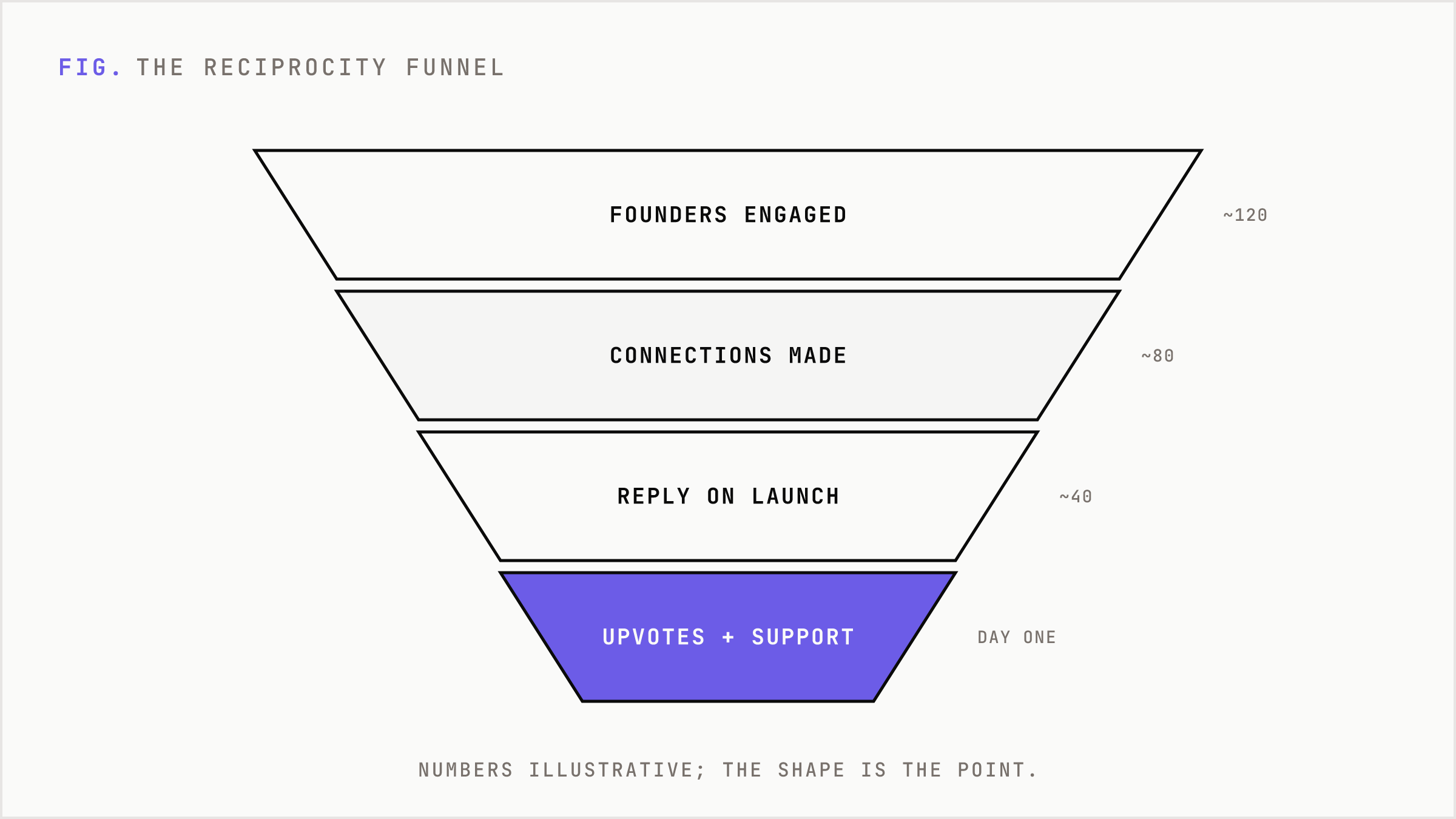
The numbers above are illustrative, your mileage will vary with your niche and how genuine your engagement is. The point is the drop-off is survivable: engage widely enough and even a modest reply rate puts real people on your launch in the first hour, which is exactly when it counts.
Find a hunter
A hunter is the person who posts your product on Product Hunt. Self-launching is allowed now, so a hunter is not strictly required, but a well-connected one still matters: when they hunt you, their followers get notified, and that first wave of attention is what feeds the ranking in the early hours.
Land one the same way you build the rest of the list. During your three weeks, some of the founders and makers you engage with will be active, well-followed hunters themselves. Build the relationship first, then ask warmly. No hunter and no connected supporter means less first-hour reach, and first-hour reach is the whole game.
Do it by hand, or hand it to an agent
This is a manual play, and doing it by hand gives you the most authentic touch. But the repetitive parts are exactly what an agent is good at. Claude Cowork, or any agent that can drive a browser, can do the scanning, open each founder's profile, find the LinkedIn, log the row, and draft a comment for you to approve. Claude can run most of this loop well.
Keep two things human: the actual relationship and the final send. Let the agent find and draft. You read, you adjust, you connect. The leverage is real, the authenticity is non-negotiable.
Launch day checklist
- Send the asks in waves across the morning, not all at once.
- Personalize the first line of every single message.
- Reply fast to anyone who comments on your launch.
- Thank every supporter the same day.
- Do not chase non-responders. One ask, then let it go.
Common mistakes
- Generic comments. "Great launch" is invisible. Be specific or stay quiet.
- Mass connecting cold. A connection with no engagement behind it is a stranger's request.
- Asking with no relationship. If the first message they get from you is the ask, you skipped the play.
- Ignoring LinkedIn limits. Too many invites a day gets you throttled. Spread them out.
- Forgetting the thank you. The people who showed up are the ones you want next time.
That is the play. Three weeks, ten founders a day, one sheet, two messages. You are not buying an audience or gaming a board. You are showing up for people, on purpose, before you need anything, and letting that come back to you on the one day it matters.