Nyyon · Blog
Why China is giving away its best AI models
China is not open-sourcing frontier models out of generosity. It is destroying the model as a moat so the only advantage left is the workflow you own.
China is not giving away frontier models like Kimi K3 out of generosity, and it is not a simple price war. It is deliberately destroying the model itself as a source of competitive advantage. Once the best weights are free, owning or licensing a model buys you nothing. The only durable moat left is the deployed workflow you build and the distribution you control.
Silicon Valley spent much of last week on red alert over Moonshot AI's Kimi K3, a Chinese model that reportedly beats some of the best US systems at a fraction of the cost and ships as open weights (The Verge). That panic is the signal. Even the most sophisticated players in the market now recognize that the moat they thought they had is gone.
The dominant pattern: model access as strategy
Most AI strategy today still rests on one assumption: the model you use is the thing that makes you different. Founders sign a partnership with a proprietary-model vendor. Marketing leaders pick a lab and build their positioning on top of its capability. The bet is that access to a better model means a better product.
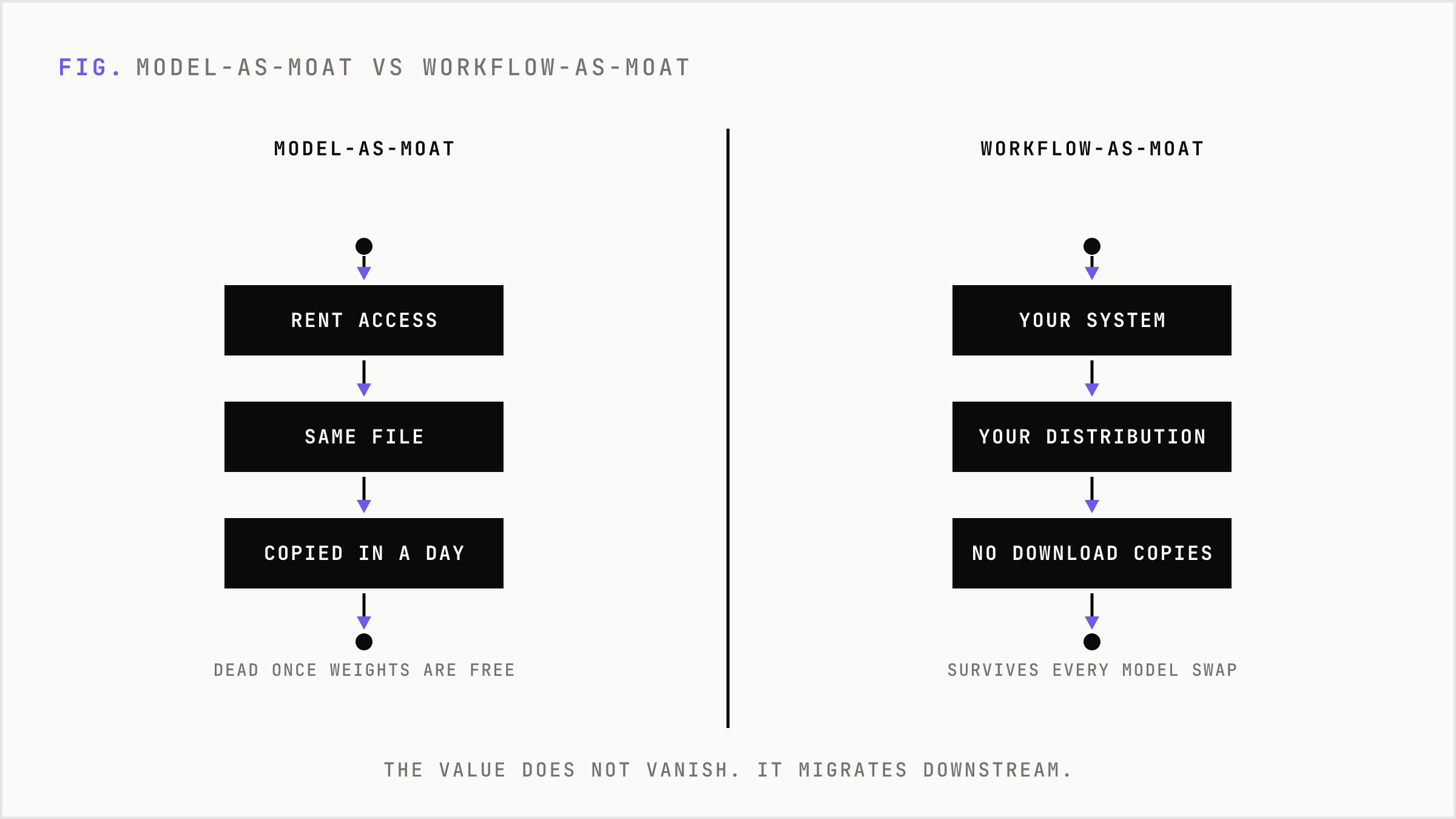
That bet breaks the moment a rival downloads the same file.
Free frontier weights reset every competitor to the same zero-cost baseline. Whatever advantage you thought you bought with a model vendor evaporates the day someone else pulls Kimi K3, or DeepSeek, or Qwen, and runs it themselves. You cannot hold a lead on an asset that anyone can copy in an afternoon.
This is not a one-off. It is a pattern. DeepSeek compressed the price of frontier reasoning. Qwen kept pace with closed models and gave the weights away. Kimi K3 did it again, louder. Each release strips more exclusivity out of the capability and hands it to everyone at once.
China's motive is structural, not charitable
Read as generosity, the giveaways make no sense. Read as an offensive move, they make perfect sense.
Commoditizing models undercuts the revenue base of US labs whose valuations depend on selling model access. If the frontier is free, the business of renting the frontier collapses. That is the point. Openness here is a weapon aimed at the economics of the closed labs, not a gift to developers.
The value that model-as-moat used to hold does not vanish. It migrates. It moves downstream to the AI-native workflow you build and the distribution channels you own. No competitor copies those by downloading a file, because those are not files. They are the specific system your team runs and the audience that already trusts you.
Model-as-moat is dead. Workflow-as-moat is what replaces it.
Why a proprietary-model partnership is now a liability
A partnership with a proprietary-model vendor used to look like an asset. It now looks like a lease on something the market is racing to give away for free.
Here is the concrete consequence, in order:
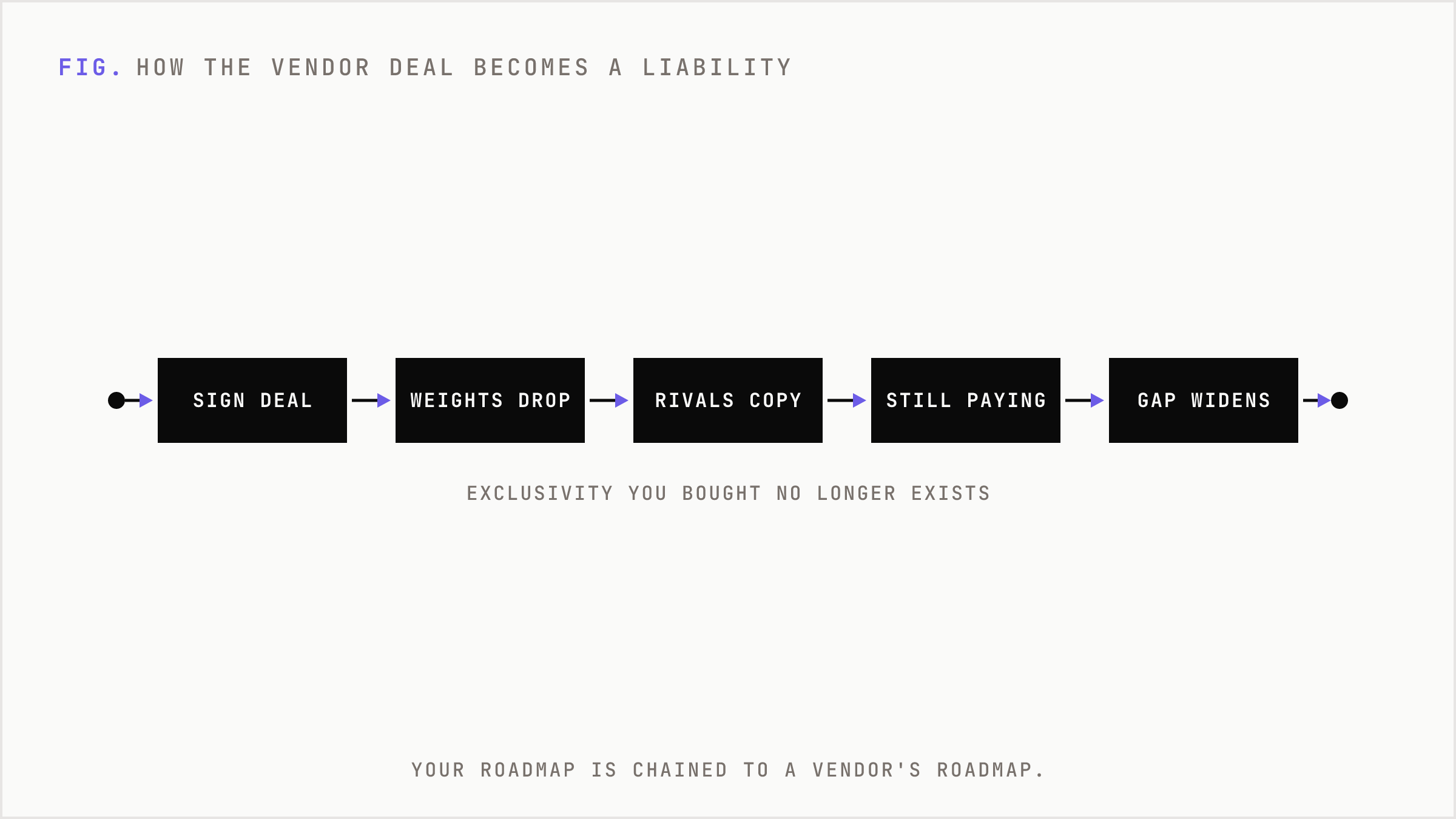
1. You sign a vendor deal to secure access to a frontier model as your differentiator.
2. A Chinese lab releases open weights that match or beat that model at a fraction of the cost.
3. Your competitors download those weights, pay nothing for access, and reinvest what they saved into deployment and distribution.
4. You are still paying for exclusivity that no longer exists, and your roadmap is chained to a vendor's roadmap.
5. The gap between you and the competitors who own their workflow widens every quarter.
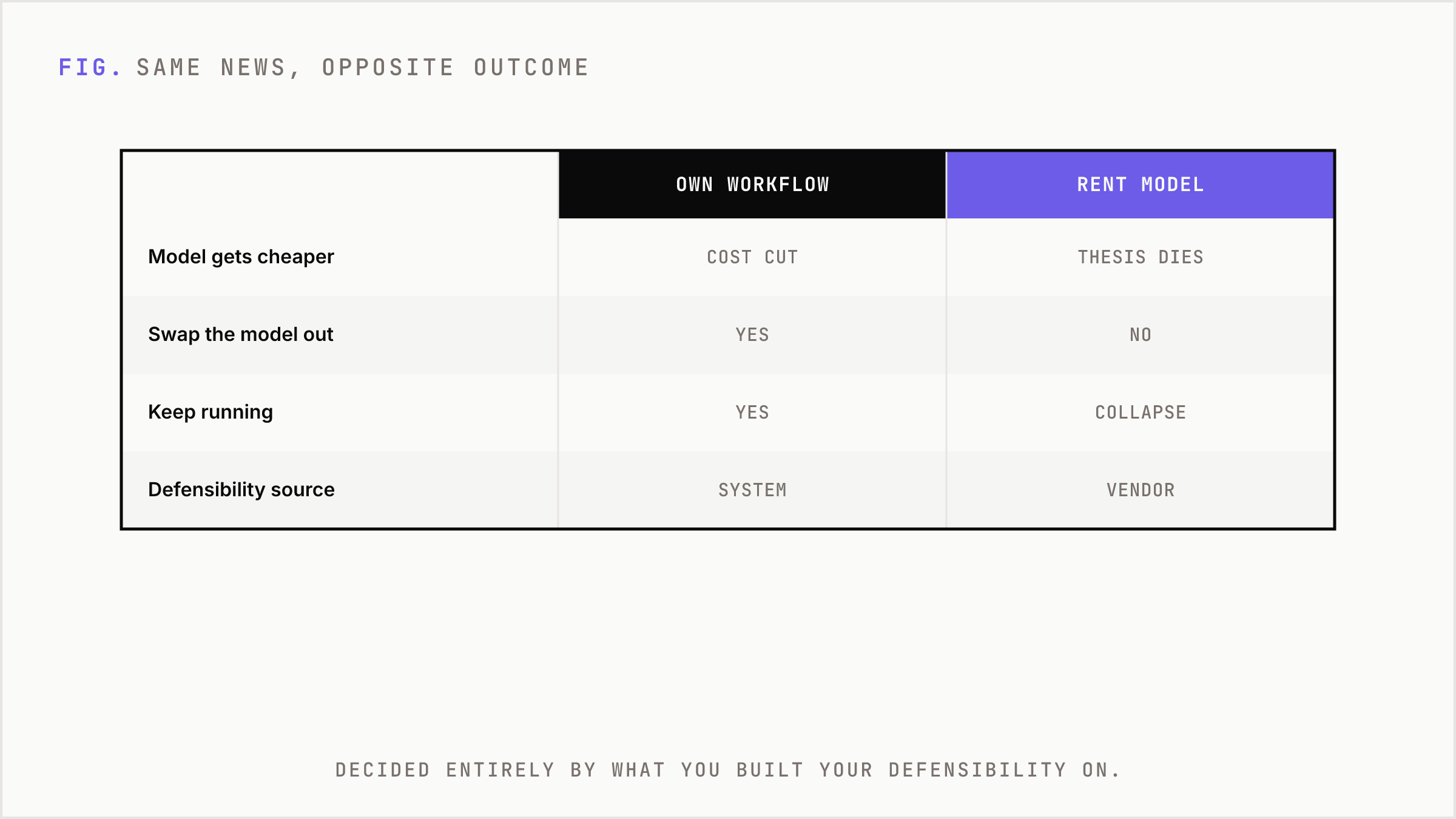
Companies that already own their workflow and distribution absorb this shock as a cost cut. The model got cheaper, good, they swap it out and keep running. Companies renting the model as their entire thesis watch that thesis collapse overnight. Same news, opposite outcome, decided entirely by what you built your defensibility on.
The objections, answered honestly
Three objections come up every time, and none of them survives contact.
Open weights still cost real money and expertise to run. True. But that cost is falling, and it is available to everyone equally. A cost your competitor also pays is not a differentiator. The workflow you wrap around the model is. Compute and hosting are table stakes, not a moat.
US labs will always stay a step ahead. Maybe. But a temporary quality lead you rent is not a moat. China's giveaways compress the economic value of that lead toward zero, because the free model six months behind is good enough for almost every real workflow. You are paying a premium for a gap that stops mattering fast.
Enterprises want the safety and support of a proprietary vendor. Support and compliance are services, not moats. You can build both on top of open models without handing your strategy to a vendor's release schedule. Buying support is fine. Surrendering your defensibility to get it is not.
What changes, and what you should do differently
Most people read China's giveaways as a pricing war or a geopolitical stunt. That reading misses the mechanism. The giveaways structurally destroy model-as-moat for everyone, including the US labs, and they do it on purpose.
So stop competing on which model you use. That contest is over, and it ends in a tie at zero for everyone. Start rebuilding your core workflows around freely available models, so you own the deployment and the distribution that no download can copy.
That is not a slogan, it is a specific project. It means taking the operation that actually runs your business, the one held together by spreadsheets, prompts, and Slack messages, and turning it into an AI-native system your team relies on. The model inside it becomes swappable. When the next free frontier release lands, and it will, you drop it in and keep going. Your advantage never lived in the weights. It lives in the thing you built around them and the audience you built it for.
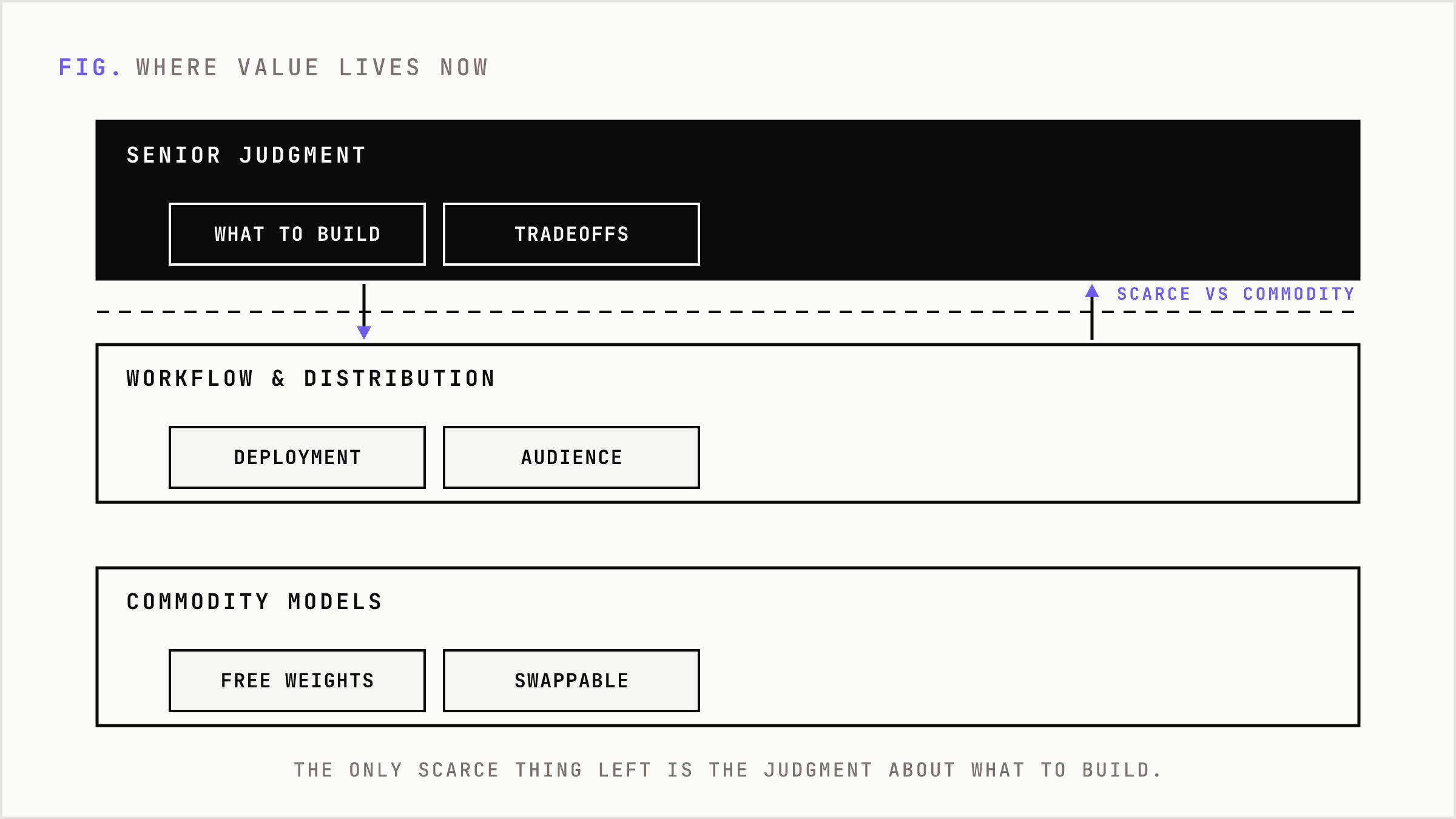
What stays the same: you still need senior judgment to decide what the system should do and which tradeoffs are worth making. Free models do not make that decision for you. If anything, when the raw capability is a commodity, the judgment about what to build with it is the only scarce thing left.
The founders and marketing leaders whose strategy rests on model access are being repriced in real time, this week, by a file anyone can download. The ones who already own their workflow barely noticed. The move is to become the second group before the next Kimi lands.
If you have a problem, if no one else can help, and if you can find them, maybe you can hire Nyyon.