Nyyon · Blog
The Next Great Tech Convergence: Why AI Needs Blockchain
AI-plus-blockchain is real, but for marketing the rail is a swappable component. The moat is a workflow where agents are economic actors by default.
The AI-plus-blockchain convergence is real. For marketing, it is a plumbing detail, not a strategy. The company that wins is not the one bolting crypto rails onto its agents first. It is the one that rebuilds the marketing workflow so agents can transact, coordinate, and settle ad spend on their own once those rails mature. Everything else is a bet on infrastructure that has not settled yet.
Paul Veradittakit put the thesis cleanly on LinkedIn: AI is producing autonomous agents that need to own assets and transact, and blockchain gives them fast, permissionless, always-on settlement built for non-human counterparties. He calls this one of Pantera's highest-conviction themes. That is a genuine signal. The problem is what marketing leaders will do with it.
The dominant reaction, and why it breaks
When a top-tier crypto investor names a theme, the reflex is to buy exposure. In marketing, that translates into a rushed rails decision: pick an on-chain payment standard, wire it into your agent stack, and call yourself ready for the autonomous future.
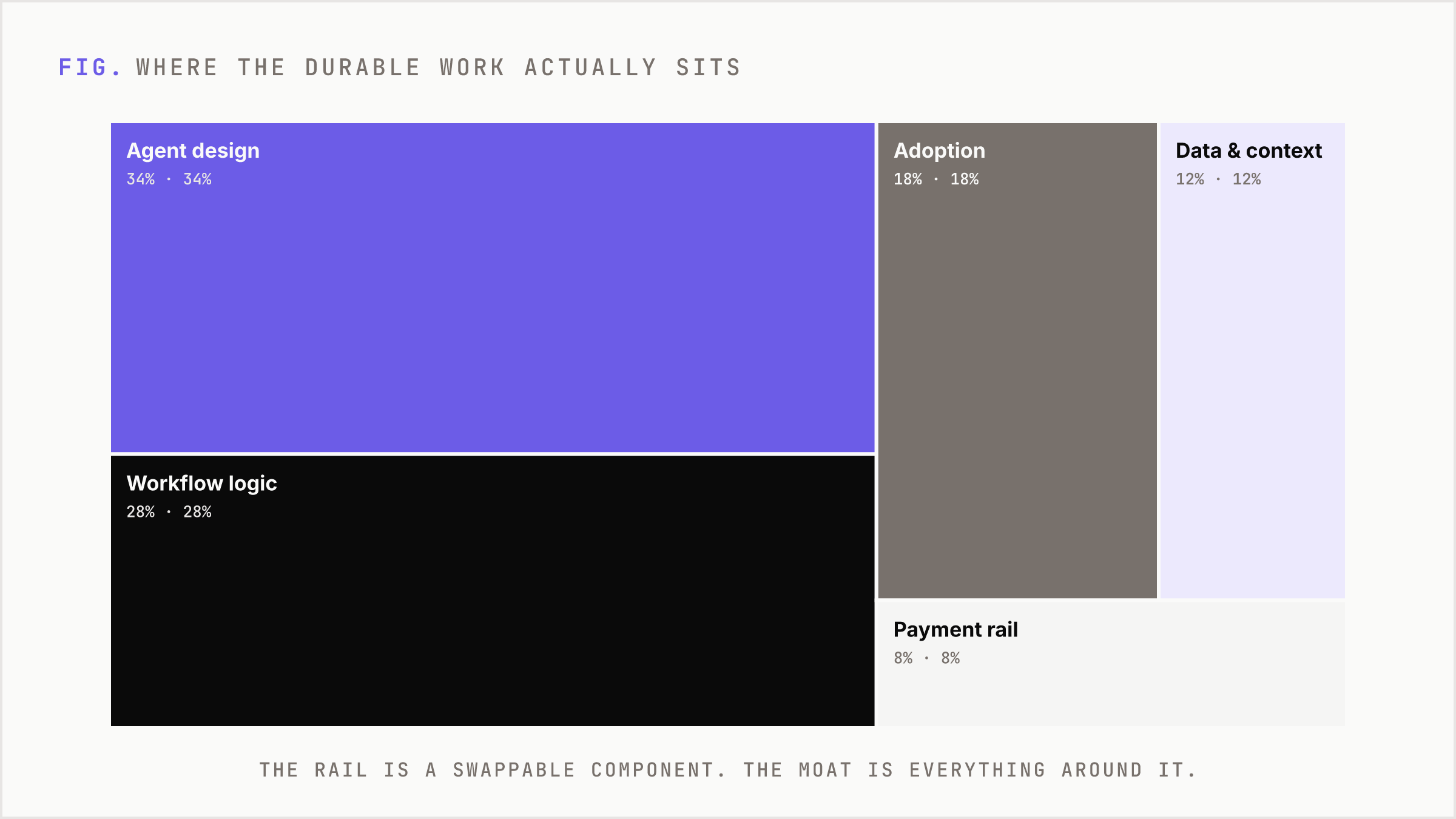
That inverts the problem.
Treating the payment rail as the strategy assumes the hard part is settlement. It is not. On-chain agent payment standards are fragmented and mid-consolidation right now. Committing to one today is a speculative bet on which specification survives. If you guess wrong, you rip it out and rebuild. If you guess right, you got maybe six months of lead on a component that was always going to become a commodity.
First-mover advantage on immature infrastructure is fragile. The rail is the part that will change. Building your strategy on the part that changes is how you end up rearchitecting twice.
Read the signal correctly: agents will transact without a human in the loop
The real content of Veradittakit's argument is not "buy crypto." It is that agents will soon transact without a human approving each move. That is a claim about how work gets coordinated, not about which token settles it.
Autonomous settlement is the assumption that an agent can commit budget, pay a counterparty, and reconcile the outcome with no person clicking approve. Once that is true, the constraint on your marketing engine stops being the rail and starts being your own workflow logic: how budgets get delegated, how spend gets bounded, how agents coordinate with each other and settle up.
So the honest read of the thesis is a to-do list about approval, budget, and coordination logic. It is not a purchase order for crypto exposure. People hear "AI needs blockchain" and reach for a wallet. The signal is that your funnel is about to have economic actors in it that were never in your org chart.
The real blocker is your approval step, not the absence of a chain
Look at almost any marketing automation stack today. Somewhere between "the agent decides to spend" and "money moves" there is a human clicking approve. Every meaningful spend decision is gated on a person.
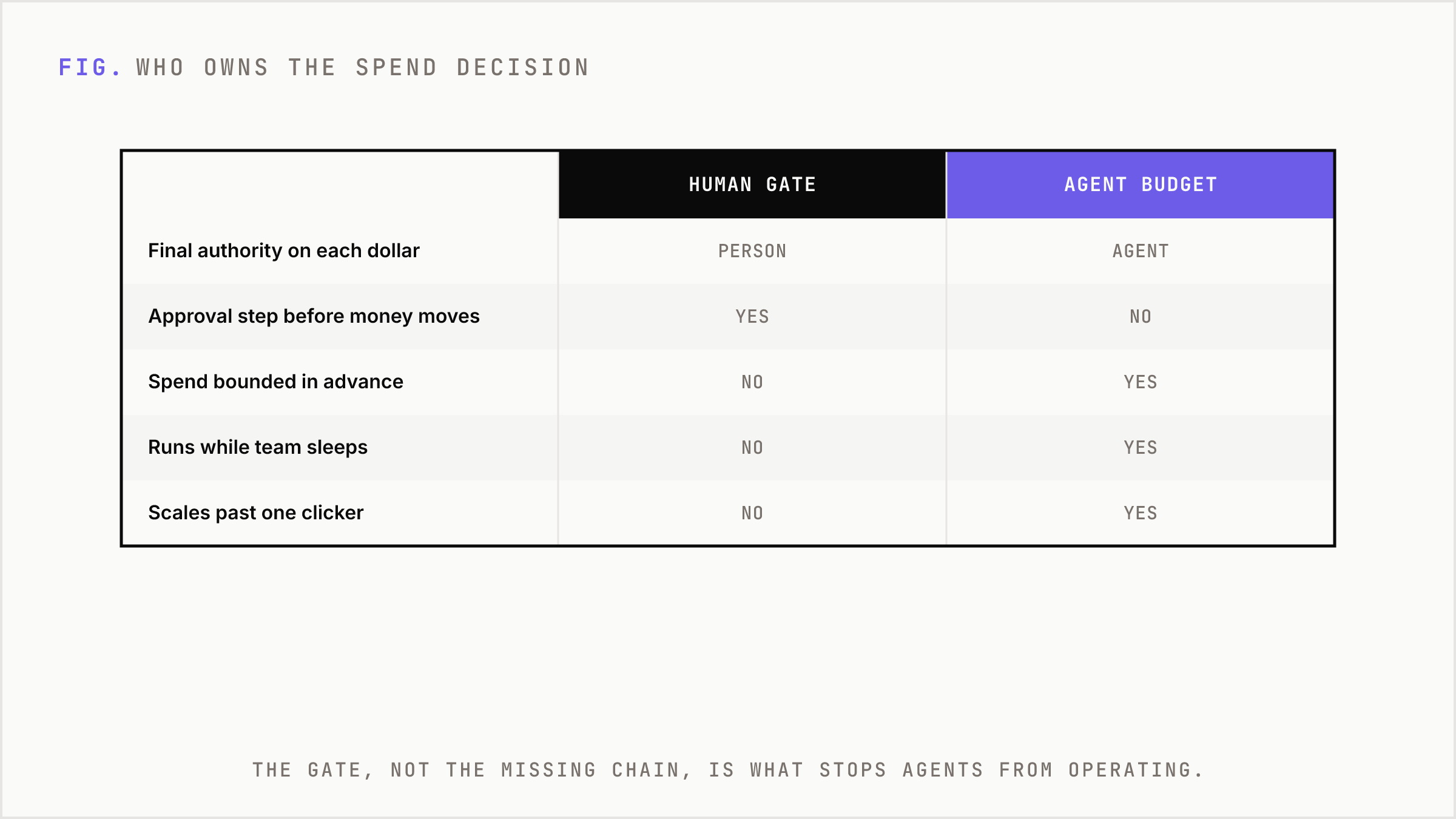
That gate, not the absence of blockchain, is what stops agents from operating autonomously. You could hand an agent a perfectly mature settlement rail tomorrow and it still could not run your budget, because your workflow was designed around a human as the final authority on every dollar.
This is the Nyyon frame: agent-owned budgets. An agent-owned budget is a bounded pool of spend an agent controls directly, governed by guardrails and a named human who owns its conduct, not by per-transaction sign-off. The work is redesigning the delegation, not shopping for the rail.
That redesign is the same class of problem we keep landing on. The hard part is trusted delegation with guardrails that survive contact with reality. The settlement mechanism is downstream of that, and it is swappable.
What rail-agnostic architecture actually buys you
Here is the payoff of designing agents as economic actors first and leaving the rail as a slot.
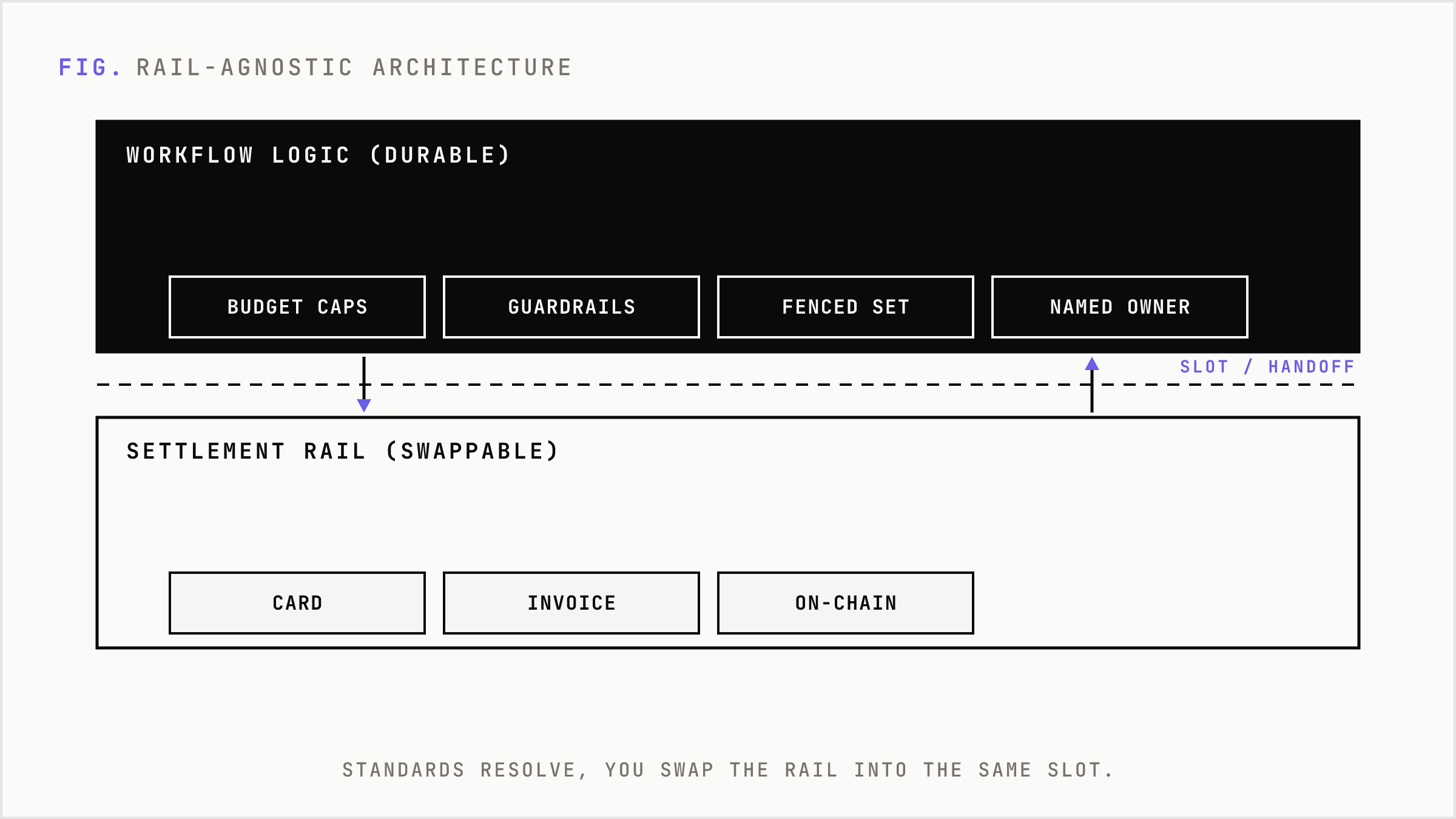
Imagine a content and paid-media engine where a campaign agent holds a capped weekly budget, can pay for placements and services inside a fenced set of counterparties, and reconciles spend against a target such as activation. Today it settles through your existing card-and-invoice plumbing with a human owner on the guardrails. Nothing about that requires a chain.
Now the standards question resolves. Whichever on-chain settlement spec wins, you swap it into the same slot. The delegation logic, the budget caps, the guardrails, the named owner: all of it stays. The rail changes underneath a workflow that was already built to hand agents real economic authority.
Compare that to the team that bet on a specific rail first. They coupled their strategy to their settlement layer. When the standard consolidates, they are re-plumbing the whole engine, and they still have not solved delegation, because they were busy integrating a token.
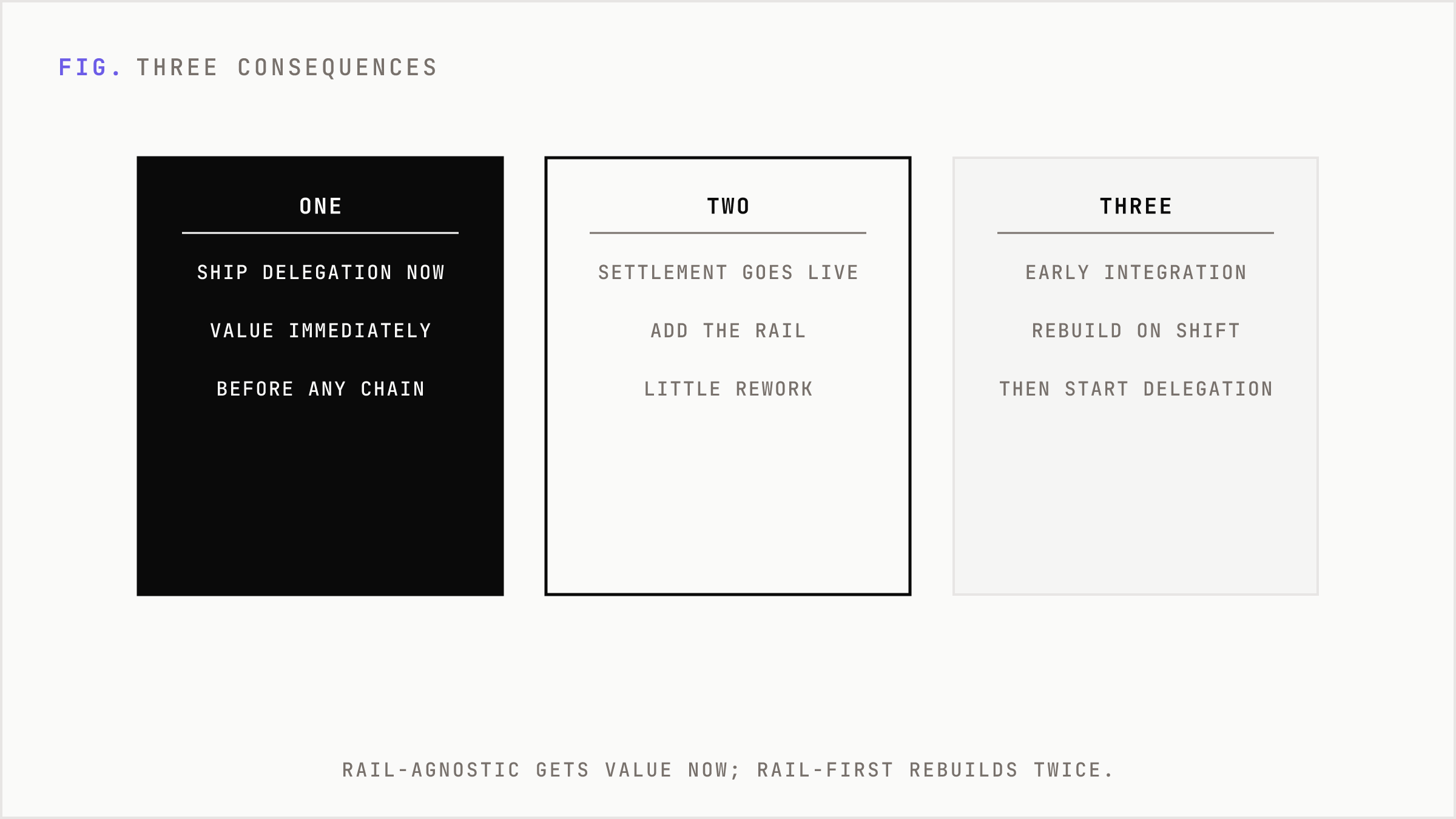
Numbered out, the consequence is straightforward. One: the rail-agnostic team ships better delegation and guardrails now, and gets value from it immediately, before any chain matters. Two: when autonomous settlement goes live, they add the rail with little rework. Three: the rail-first team gets an early integration, then rebuilds when the standard moves, and only then starts on the delegation problem they skipped.
Answering the obvious objections
"If rails are the future, whoever integrates crypto first wins." First-mover advantage on infrastructure that is still consolidating does not compound. It decays the moment the standard shifts. The durable moat is the workflow, and a rail can be added late with little penalty. You are trading a fragile head start for a rebuild.
"This is just an excuse to ignore blockchain." It is the opposite. The position assumes autonomous settlement is coming and tells you to prepare for it structurally. That is a more committed bet than a token integration, because it reshapes how your whole marketing engine allocates and controls money, not just which API moves the funds.
"Rearchitecting the workflow now is premature when agents cannot fully transact yet." The redesign pays off before any rail arrives. Better delegation, bounded budgets, and real guardrails make your current agents safer and more useful today. The value does not wait on blockchain maturity. It shows up the first time an agent runs a budget without a person babysitting every line.
What changes, what stays, and the trade-off
What changes: you stop asking "which rail" and start asking "can an agent own a budget in our system without a human approving each spend, and who owns it when it goes wrong." That question is answerable now.
What stays: your existing settlement plumbing keeps working. You are not tearing anything out. You are building the delegation layer above it and leaving the rail as a component.
The trade-off is honest. This is more work than a token integration, and it does not give you a press release about being crypto-native. It gives you a marketing engine where agents are economic actors by default, so the day autonomous settlement is viable, you flip a component instead of rebuilding a strategy. You also carry the harder problem on purpose: trusted delegation and guardrails are genuinely difficult, and you own them either way. Better to own them before the hype forces a premature rails commitment than after.
So stop chasing the rail. Rearchitect the workflow so your agents can own budgets and settle transactions the moment autonomous settlement becomes real. If you have a problem, if no one else can help, and if you can find them, maybe you can hire Nyyon.