Nyyon · Blog
The White Label AI Illusion: Where Marketing Agencies Actually Win
White label AI is not a moat. This breakdown shows how agencies actually win through workflow design, data, and distribution while resellers get commoditized.
White label AI feels like leverage, but it rarely creates defensibility.
The Surface Layer Everyone Sees
White label AI is simple to understand. A vendor builds an AI product. An agency rebrands it, adds a logo, maybe a custom domain, and resells it to clients.
The pitch writes itself. Faster delivery. Lower cost. Infinite scale without hiring.
On the surface, it works. Agencies can generate content in minutes, spin up ad variations at scale, automate reporting, and deploy chatbots without building infrastructure.
For buyers, especially SMBs, this is attractive. They are not buying technology. They are buying outcomes at a lower price point.
But the surface layer hides the economic reality.
The Economics Collapse Quickly
Most white label AI businesses run on simple arbitrage. The agency pays a wholesale cost for model usage or seats, then marks it up two to ten times.
This works early, when clients cannot easily access the same tools.
That window is closing.
Foundation models are widely accessible. SaaS wrappers are proliferating. Pricing is trending down, not up.
When multiple agencies resell effectively the same backend, pricing converges. Margins compress. Differentiation disappears.
At that point, the agency is not selling a product. It is selling access to a commodity with a nicer interface.
Why Buyers Stop Caring About the Tool
Buyers do not care about the model. They care about outputs tied to business metrics.
A client does not want AI generated blog posts. They want traffic that converts. They do not want AI ad creatives. They want lower acquisition cost.
If two agencies produce similar outputs using similar tools, the buyer defaults to price, speed, or brand trust.
This is where most white label strategies fail. They anchor on the tool instead of the system that produces results.
The Real Unit of Value Is the Workflow
Single prompts are not valuable. Pipelines are.
A useful marketing system is a chain of steps. Keyword discovery, clustering, content generation, internal linking, publishing, indexing, performance tracking, and iteration.
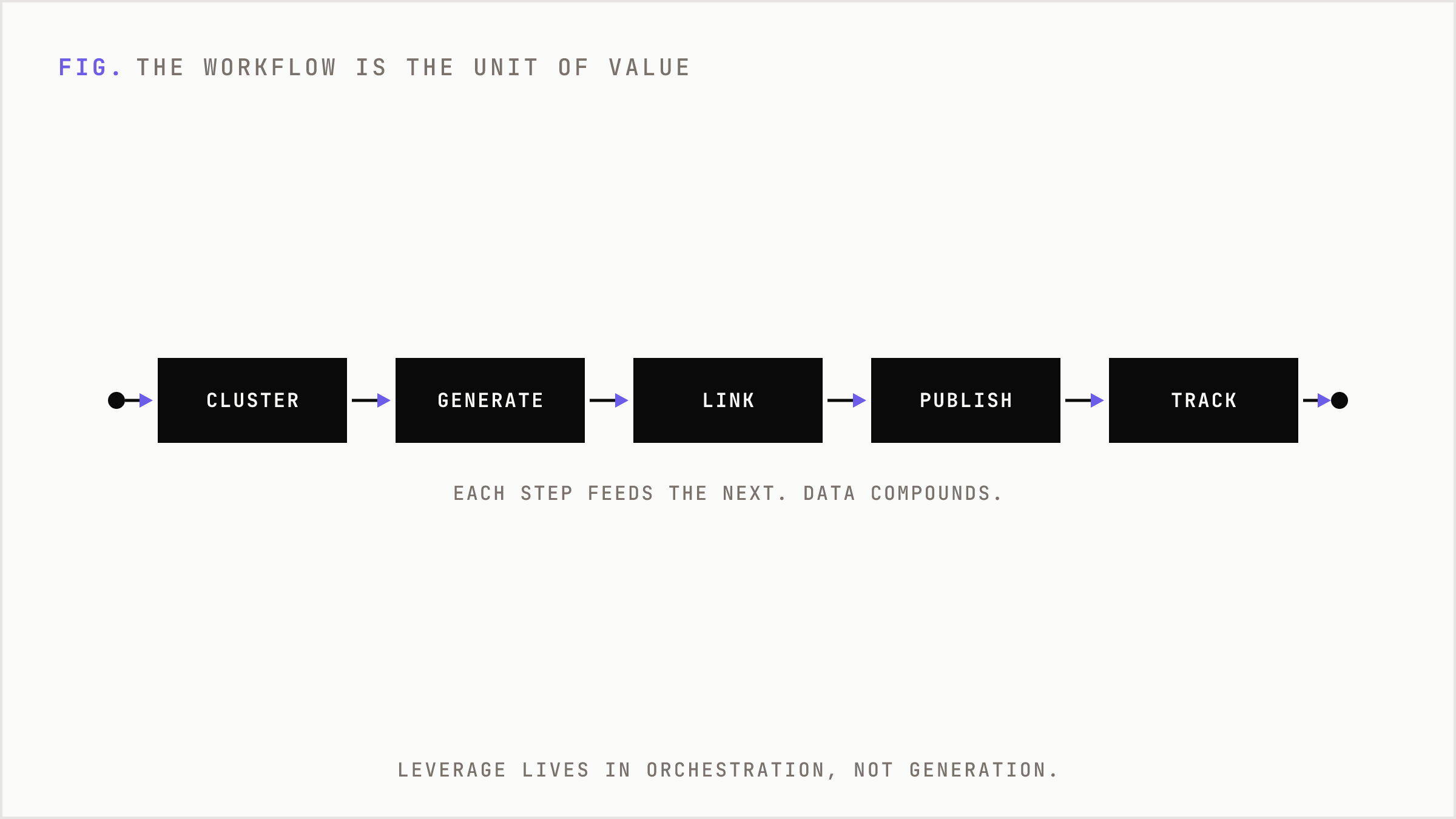
Each step feeds the next. Data flows through the system. Outputs improve over time.
This is where AI creates leverage. Not in generation, but in orchestration.
An agency that encodes this into a repeatable workflow can produce consistent outcomes. An agency that relies on isolated prompts cannot.
Example: SEO as a System, Not a Tool
Consider two agencies offering AI SEO.
The first sells access to a dashboard that generates blog posts from keywords. It is fast, cheap, and easy to replicate.
The second builds a pipeline. It clusters keywords into topics, generates content with internal linking logic, publishes automatically, monitors rankings, and feeds performance data back into the system.
Both use similar models. Only one owns a system.
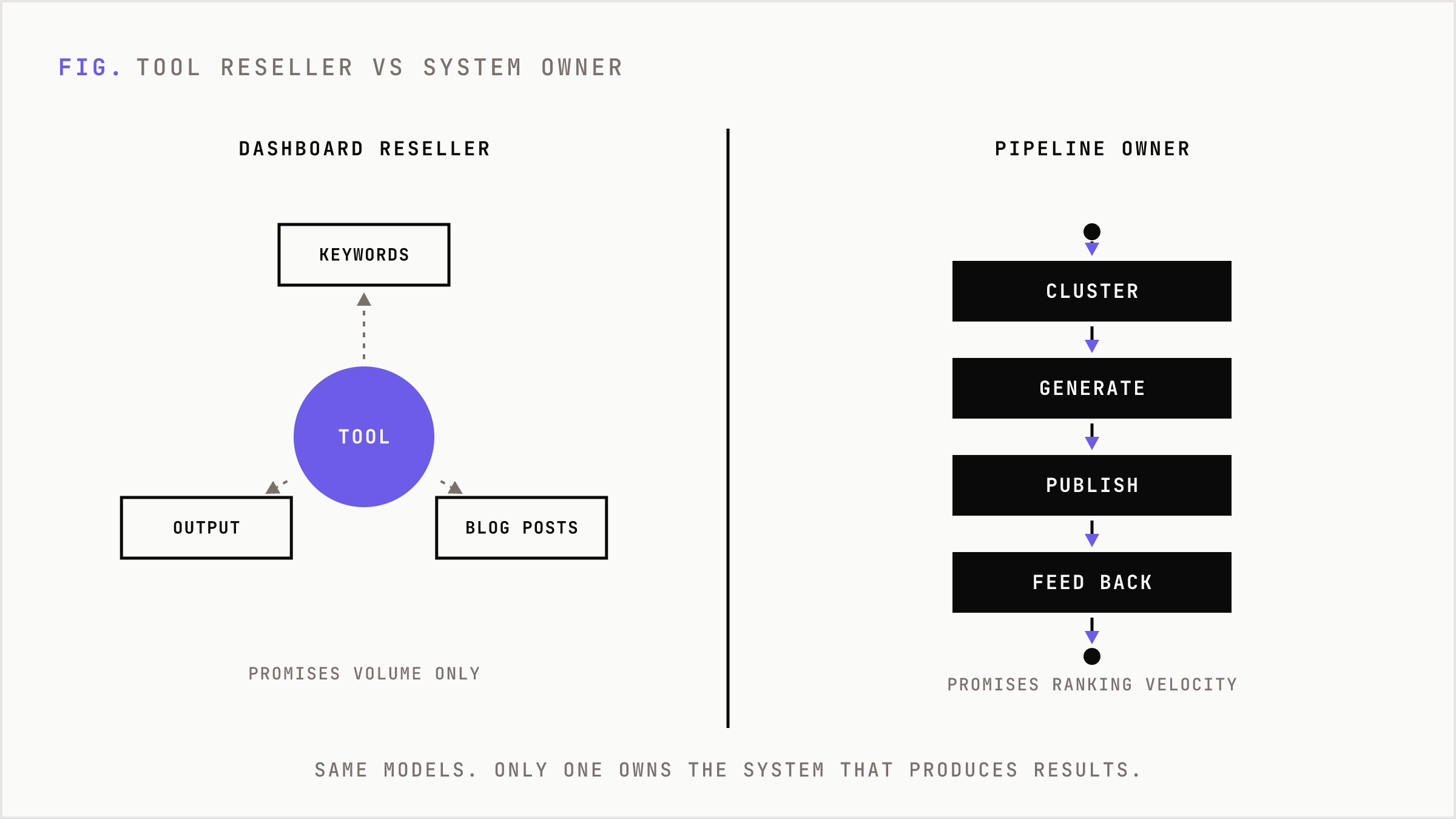
The second agency can promise outcomes like ranking velocity or content coverage. The first can only promise output volume.
Where Differentiation Actually Lives
There are only a few places where agencies can build defensibility with AI.
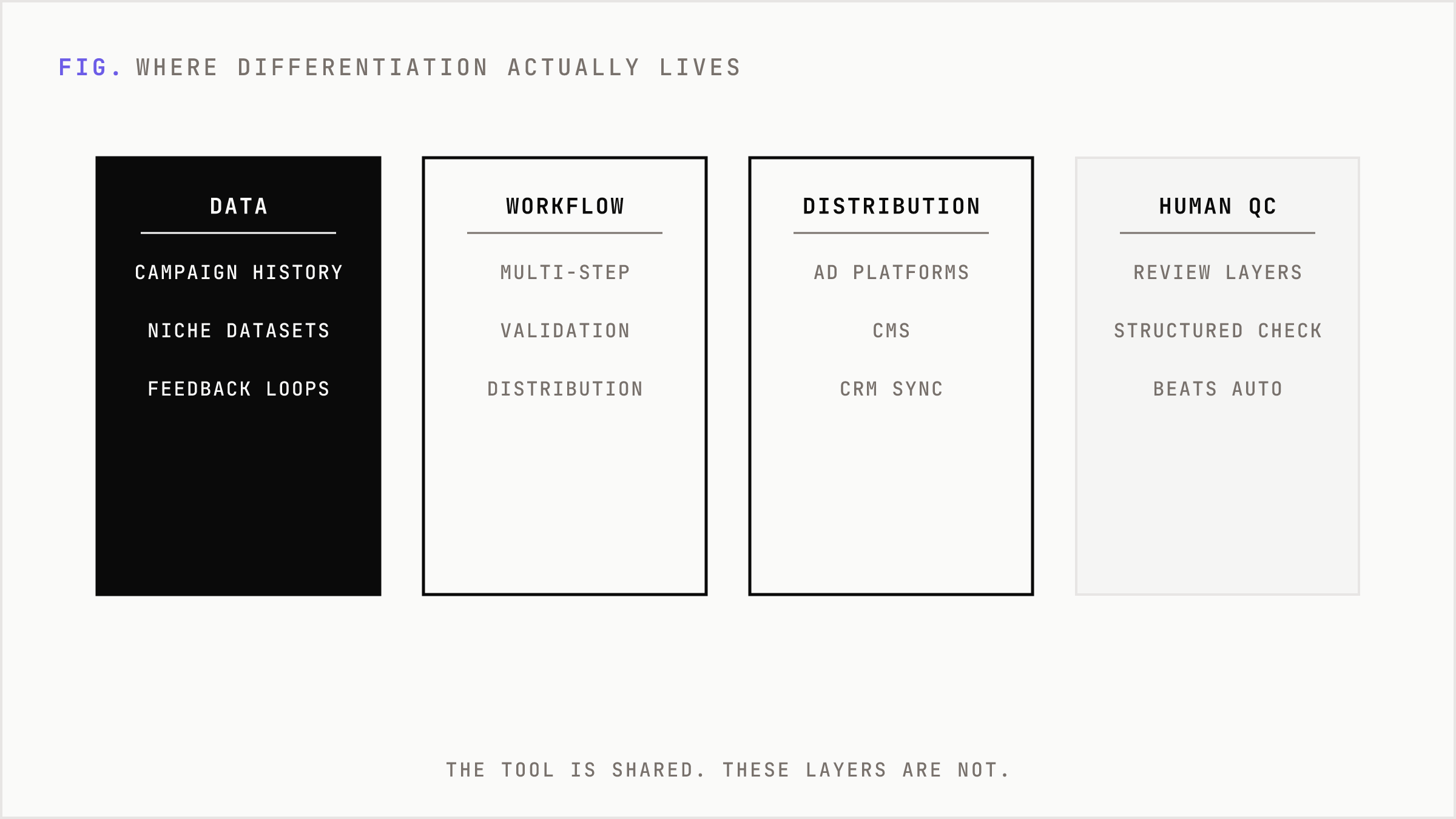
First is data. Historical campaign performance, niche specific datasets, and client level feedback loops improve outputs in ways generic tools cannot match.
Second is workflow design. Multi step processes that integrate generation, validation, and distribution create compounding advantages.
Third is distribution. Direct integration with ad platforms, CMS systems, and CRM tools turns AI from a content generator into a revenue engine.
Fourth is human quality control. Systems that combine AI with structured review layers outperform fully automated pipelines in real client environments.
The Rise of Productized Agencies
The most effective agencies are no longer selling services or tools. They are selling systems.
These systems look like products from the outside. Fixed pricing, defined outputs, predictable timelines.
Under the hood, they combine white label components, custom workflows, and operational playbooks.
This hybrid model changes the business entirely.
Revenue becomes more predictable. Margins improve. Headcount scales slower than output.
But the key shift is positioning. The agency is no longer competing with freelancers or other agencies. It is competing with software.
Why Verticalization Is Inevitable
Generic AI is easy to copy. Vertical AI is not.
An AI system for legal SEO, ecommerce product feeds, or B2B SaaS demand generation requires domain knowledge, data, and tailored workflows.
This creates friction for competitors. It also aligns better with buyer expectations.
Mid market and enterprise clients do not want generic automation. They want systems that fit their industry constraints, compliance requirements, and brand standards.
Agencies that move into vertical systems gain pricing power and retention.
The Hidden Risk of Vendor Dependence
White label AI introduces a structural risk. The agency does not control the core technology.
Model providers can change pricing. APIs can break. Output quality can shift.
If the agency has not built its own workflows and data layers, it has no buffer.
This is why the most resilient agencies treat vendors as interchangeable components. They design systems that can swap models without breaking the product.
Commoditization Is Not Evenly Distributed
Content generation is already commoditized. Ad creative is close behind. Basic chatbots are following.
But orchestration, integration, and performance optimization are not commoditized at the same rate.
These require context, iteration, and system design.
The market is splitting into two layers. Commodity production at the bottom. System operators at the top.
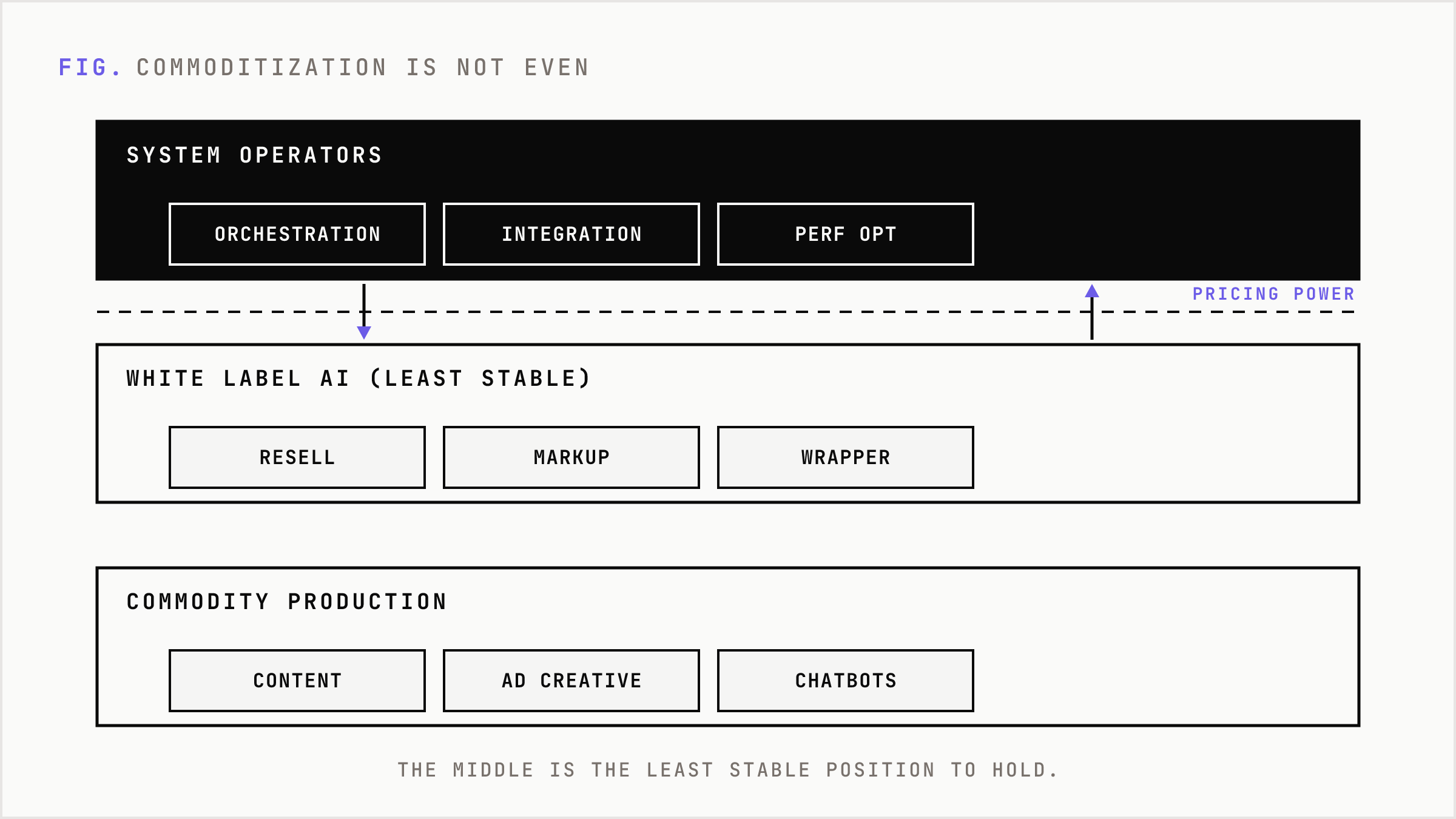
White label AI sits in the middle. That is the least stable position.
How Winning Agencies Package AI
They do not sell AI.
They sell outcomes with AI embedded.
An offer might look like an AI driven inbound system that includes chat, email nurture, CRM sync, and reporting.
Or an ad factory that continuously tests creatives, reallocates budget, and feeds learnings back into the system.
The client does not interact with the underlying tools. They interact with results.
The Long Term Compounding Effects
The agencies that win accumulate assets over time.
They build datasets that improve targeting and messaging.
They refine workflows into playbooks that can be deployed across clients.
They integrate deeper into client systems, increasing switching costs.
They build trust at the outcome level, not the tool level.
None of this comes from white labeling alone.
The Bottom Line
White label AI is a distribution shortcut, not a strategy.
It accelerates time to market. It does not create a moat.
Agencies that stop at reselling tools will compete on price and speed until margins disappear.
Agencies that build workflows, own data, and tie outputs to business outcomes will move up the stack.
The difference is not technical. It is structural.
One is selling access to AI. The other is building systems that compound.
FAQ
What is white label AI in marketing?
White label AI refers to AI tools built by one company and rebranded by agencies to sell as their own, often with custom dashboards and client access.
Why is white label AI becoming commoditized?
Access to foundation models and AI tools is widespread, making it easy for multiple agencies to offer similar services, which drives prices down and reduces differentiation.
What creates a competitive advantage for agencies using AI?
Real advantage comes from workflow design, proprietary data, system integration, and the ability to tie outputs directly to business outcomes.
Should agencies build or buy AI tools?
Most agencies benefit from a hybrid approach. They use white label tools for speed while building custom workflows and data layers for long term differentiation.
What services are most at risk of commoditization?
Content generation, basic ad creatives, and simple chatbots are already commoditized. More complex workflows and integrations remain harder to replicate.