Nyyon · Blog
White Glove Marketing Is Being Rewritten by AI Systems, Not Bigger Teams
AI native agencies are replacing labor heavy marketing with system driven execution, faster testing, and outcome based growth tied directly to revenue.
White glove marketing is no longer defined by how many people touch the account, but by how well the system thinks.
The Old Model Was Built on Labor Density
Traditional white glove agencies sold intensity. More strategists. More creatives. More account management layers. The pitch was simple. You get senior attention, deep customization, and hands on execution.
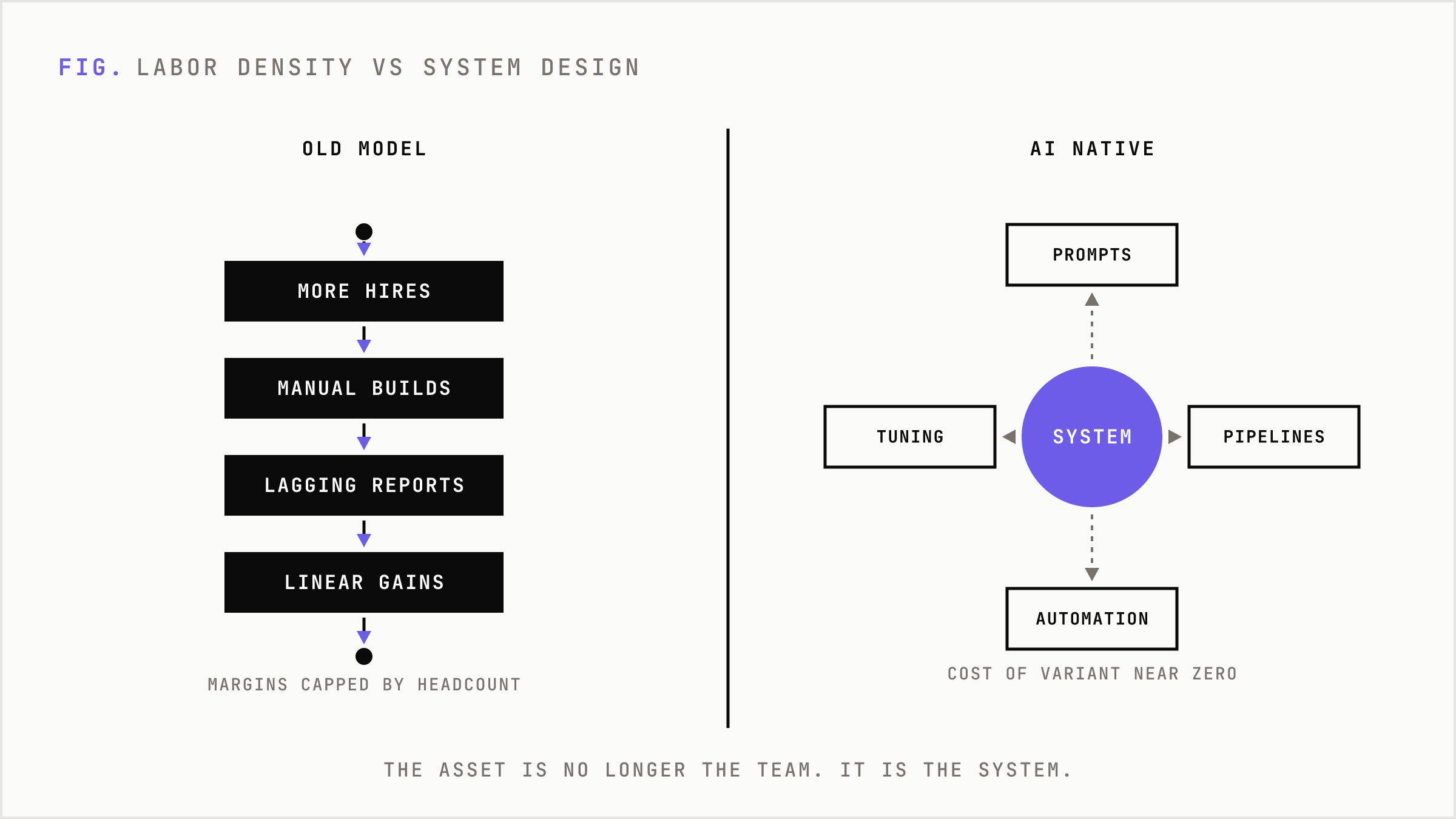
Under the hood, this model depended on expensive human coordination. Research took weeks. Campaign builds took days. Reporting lagged behind reality. Every improvement required manual effort.
That structure created a ceiling. You could increase quality by adding talent, but only linearly. More clients meant more hires. Margins were constrained by headcount. Speed was constrained by process.
Clients tolerated this because the alternative was worse. Either low touch agencies that shipped templates, or internal teams that moved even slower.
AI Breaks the Labor Constraint
AI does not just make execution faster. It changes what execution is.
In an AI native agency, the core asset is not the team. It is the system. Prompt libraries, model tuning, workflow automation, data pipelines. These replace large parts of manual production.
The effect is immediate. The marginal cost of creating another campaign variant, another landing page, or another outbound sequence drops close to zero. Customization is no longer expensive.
This flips the economics. Instead of rationing effort, agencies can expand it. More tests. More segments. More iterations. The constraint shifts from capacity to decision quality.
Execution Becomes a Commodity Layer
Once AI handles content generation, campaign assembly, and basic optimization, execution loses its pricing power.
Two agencies using similar tools can produce similar outputs. Copy, ads, emails, landing pages. The surface layer converges quickly.
This is where many agencies stall. They adopt AI tools but keep the same workflows. Faster output, same thinking. The result is slightly cheaper work, not a better system.
The real shift happens when execution is treated as infrastructure. Automated, standardized, and continuously running in the background.
The New Scarcity Is System Design
When execution is cheap, what matters is what you choose to execute.
AI native white glove agencies differentiate on how they design systems. How they structure data. How they define experiments. How they prioritize opportunities.
For example, instead of a quarterly campaign plan, a system might generate weekly hypotheses based on CRM data, product usage signals, and ad performance. Each hypothesis becomes a test. Each test feeds back into the system.
The agency is no longer building campaigns. It is building a machine that produces and evaluates campaigns continuously.
Personalization Moves From Theory to Default
Personalization used to be limited by production cost. You could tailor messaging by segment, maybe by persona, but not by individual account.
AI removes that constraint. Messaging can now be generated dynamically for each account or even each buyer.
In practice, this means outbound emails that reference specific company initiatives, ads that reflect industry nuances in real time, and landing pages that adapt based on visitor data.
Account based marketing stops being a high effort niche tactic and becomes a baseline capability.
Strategy Compresses, Testing Expands
Research used to be a gating function. Market analysis, competitor reviews, voice of customer synthesis. These phases took weeks and delayed execution.
AI compresses this into hours. Not perfectly, but enough to move forward quickly.
The tradeoff is intentional. Instead of over investing in upfront planning, agencies run more experiments. They learn from real market feedback rather than static analysis.
The loop tightens. Hypothesis, launch, measure, adjust. Repeated continuously.
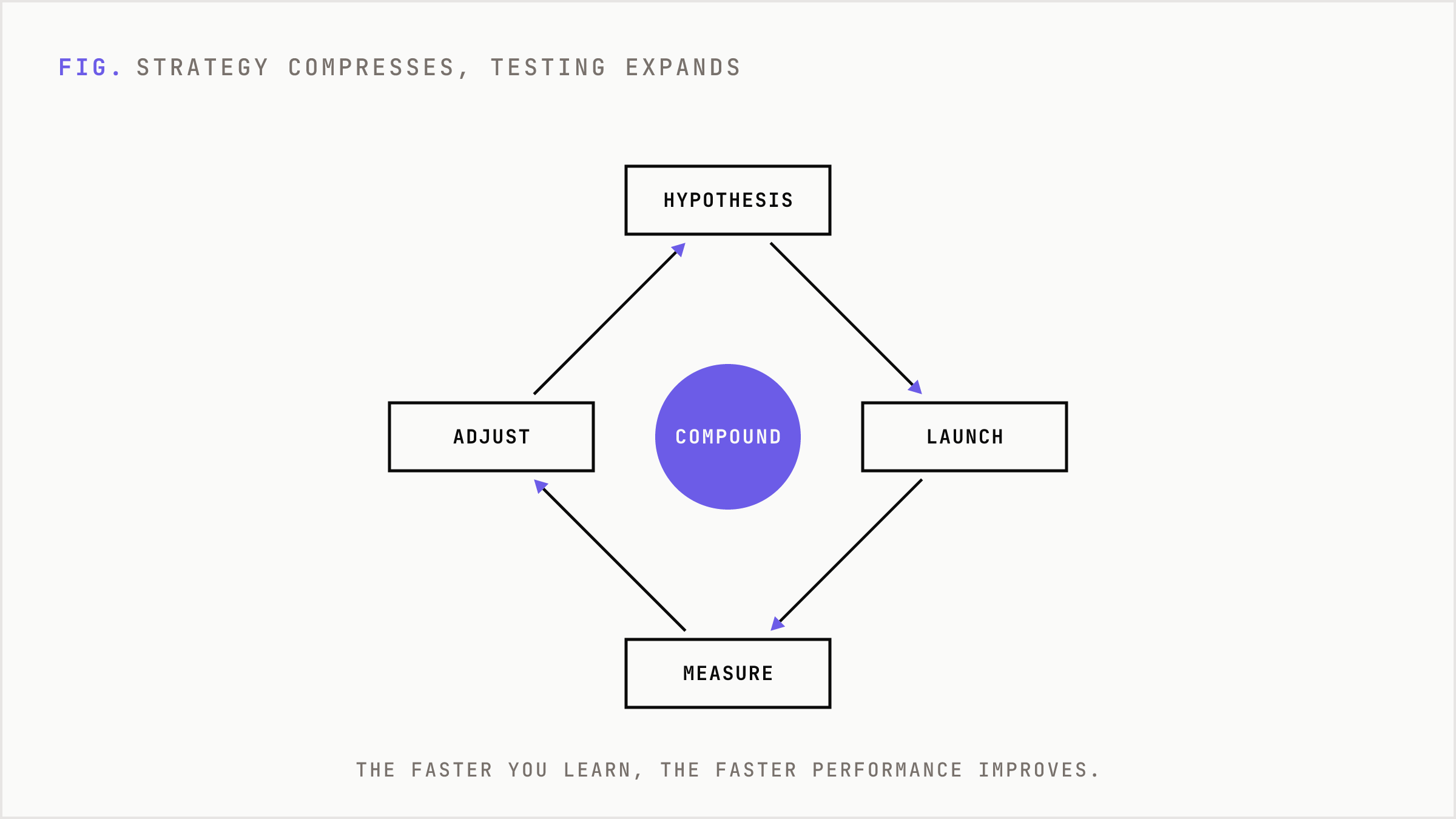
Speed becomes a compounding advantage. The faster you learn, the faster performance improves.
Creative Becomes a Data Asset
Creative production used to be the bottleneck. Designers and copywriters could only produce so much. Each asset had to justify its cost.
Now, creative can be generated at scale. Dozens or hundreds of variations across formats and channels.
This changes how creative is evaluated. Instead of judging a single asset, agencies analyze patterns across many. Which hooks convert. Which messages resonate. Which formats drive engagement.
Creative becomes less about individual brilliance and more about aggregated performance data.
Data Integration Is the Real Advantage
The strongest AI native agencies are not the ones with the best prompts. They are the ones with the best data pipelines.
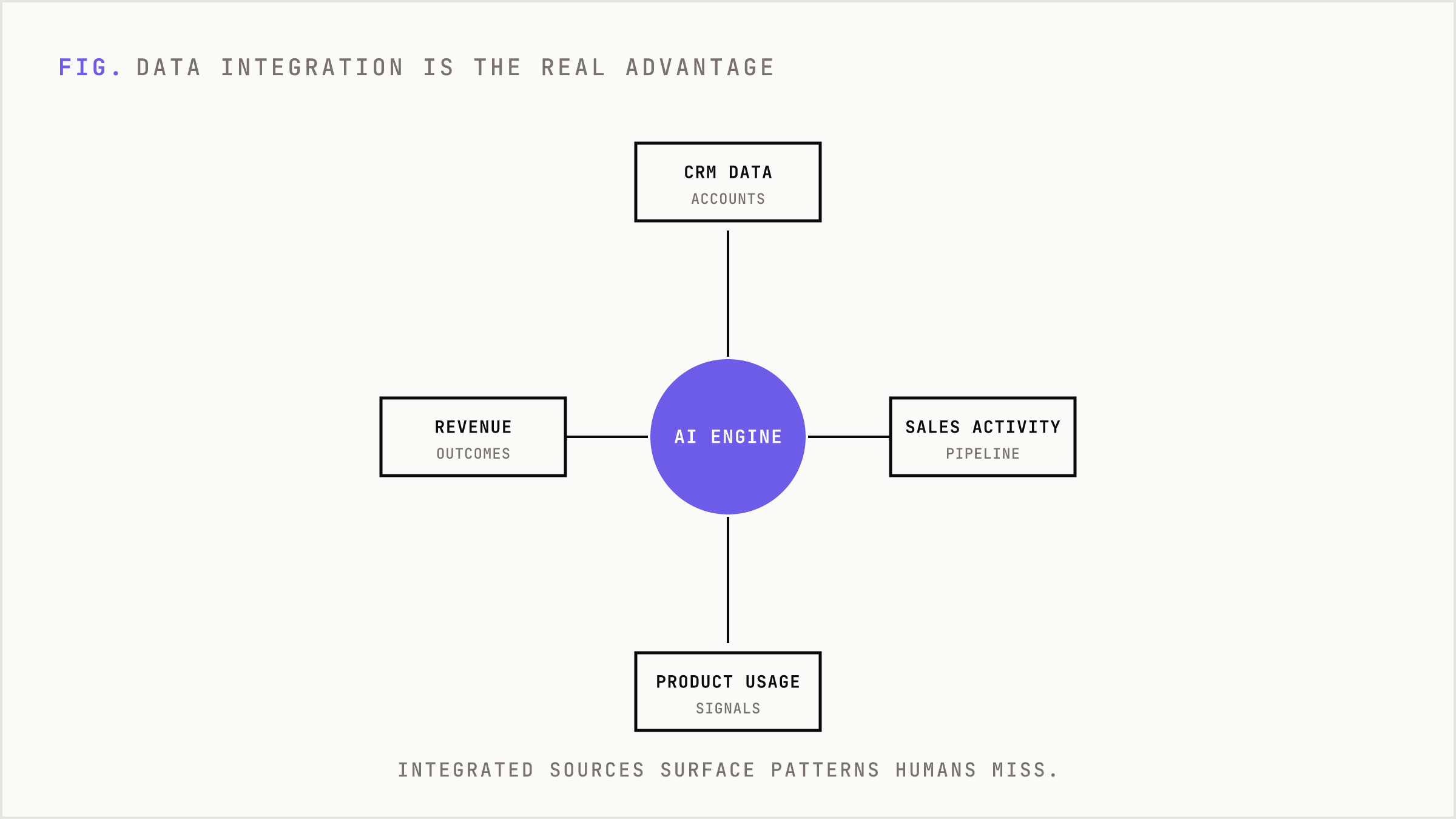
Marketing data alone is not enough. The system needs CRM data, sales activity, product usage, and revenue outcomes. Without this, optimization is shallow.
When these data sources are integrated, AI can detect patterns humans miss. Early churn signals. Conversion drivers. High value segments.
This enables decisions that tie directly to revenue, not just engagement metrics.
The Agency Becomes an Orchestration Layer
In this model, the agency is not executing tasks. It is orchestrating systems.
It defines how data flows, how models interact, how decisions are made. It sets guardrails to maintain brand voice and strategic coherence.
Humans are still critical, but their role changes. They supervise outputs, interpret results, and adjust direction. They are not manually building every asset.
This is what modern white glove actually looks like. Not more hands, but better control.
Buyer Expectations Shift Up the Stack
As capabilities change, so do expectations.
Founders and operators no longer care about deliverables. They care about outcomes. Pipeline growth, customer acquisition cost, lifetime value.
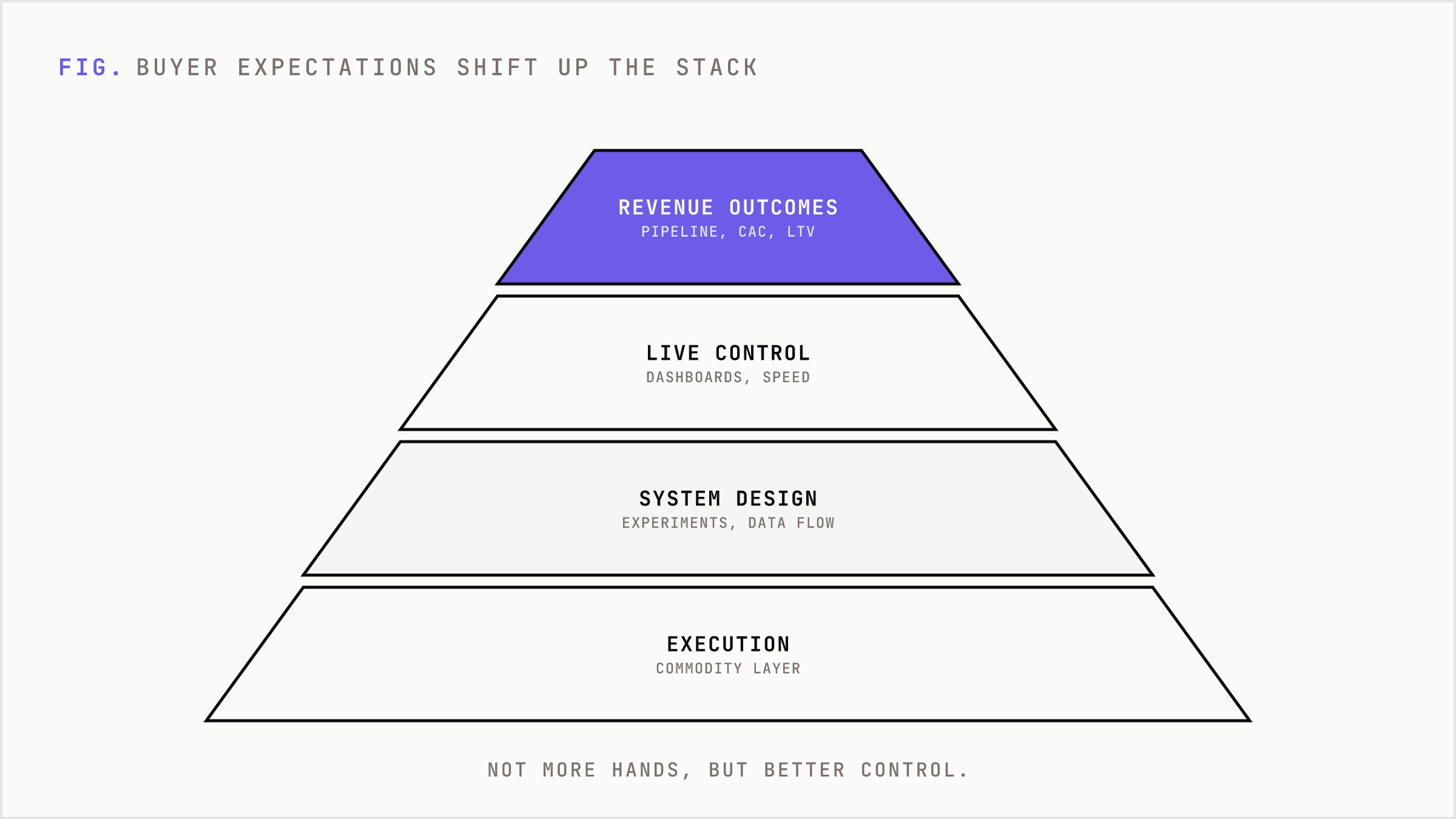
They also expect speed. Waiting weeks for a campaign launch feels outdated when systems can deploy in hours.
Reporting evolves as well. Static monthly reports give way to live dashboards and continuous insight streams.
The relationship becomes less about service delivery and more about growth infrastructure.
Pricing Follows Value, Not Effort
When execution cost drops, hourly billing breaks.
AI native agencies are already moving toward value based pricing. Retainers tied to system ownership. Performance upside linked to revenue impact.
This aligns incentives more tightly. Clients pay for outcomes, not activity. Agencies benefit from the efficiency gains their systems create.
It also creates separation in the market. Commodity providers compete on price. System driven agencies compete on results.
Where This Breaks Down
Not every agency makes this transition successfully.
Some adopt AI tools without redesigning workflows. They produce more content but do not improve outcomes.
Others over automate and lose strategic coherence. Messaging drifts. Brand voice erodes. Campaigns become fragmented.
Data quality is another failure point. Weak or incomplete data leads to misleading outputs. The system optimizes for the wrong signals.
The common thread is shallow integration. AI layered on top instead of built into the core.
Defensibility Comes From Feedback Loops
The most durable advantage is not access to tools. It is access to feedback.
Agencies that close the loop between marketing activity and revenue outcomes build proprietary insight. They understand what actually drives growth in specific contexts.
Over time, this compounds. Systems improve. Predictions become more accurate. Decision making becomes faster.
This is difficult to replicate without similar data and infrastructure.
The Market Expands, Then Consolidates
Lower execution costs expand the market. More companies can afford high quality marketing systems. More experimentation becomes viable.
But expansion is followed by consolidation. As system driven agencies outperform, budget concentrates around them.
The gap widens between those who build systems and those who sell services.
What This Means for Operators
If you are hiring an agency, the evaluation criteria need to change.
Ask how they structure data. How they run experiments. How quickly they can iterate. What parts of their workflow are automated and why.
Look for evidence of system thinking, not just creative output.
The question is no longer how many people will work on your account. It is how the system will learn and improve over time.
What White Glove Means Now
White glove used to signal attention. More people, more care, more manual effort.
Now it signals leverage. Better systems, tighter feedback loops, faster learning.
The surface may look similar. Strategy, campaigns, reporting. But underneath, the mechanics are fundamentally different.
The agencies that understand this are not scaling teams. They are scaling intelligence.
FAQ
What is an AI native marketing agency?
An AI native agency builds its workflows around AI systems from the ground up, using automation, data pipelines, and model driven decision making instead of manual execution.
How is this different from traditional agencies using AI tools?
Traditional agencies layer AI tools into existing workflows. AI native agencies redesign workflows entirely, making AI central to execution, testing, and optimization.
Does AI reduce the need for human marketers?
No. It shifts their role from execution to system design, strategy, and interpretation of outputs.
Why does pricing change with AI native agencies?
Because execution costs drop, pricing shifts toward value and performance, focusing on outcomes like revenue rather than hours worked.
What should companies look for in an AI driven agency?
Strong data integration, rapid experimentation cycles, clear system design, and evidence of tying marketing activity directly to revenue outcomes.