Nyyon · Blog
The Marketing Leader’s Guide to White Glove AI Growth Systems
White glove AI marketing is shifting from tools to operated growth systems. See the top agencies, platforms, and AI workflows by bottleneck today.
White glove AI marketing is not a better copy machine. It is an operated growth system.
That distinction matters because buyers are not actually shopping for artificial intelligence. They are shopping for speed, pipeline, conversion, retention, and fewer internal hires. The software is a means. The budget line is growth.
This is where most AI marketing analysis gets soft. It compares tools by feature count, then calls the longest list the winner. But a founder with six months of runway does not need another dashboard. A CMO with a content approval bottleneck does not need more unapproved drafts. A SaaS team missing pipeline does not need AI-generated social posts. They need a system that changes the rate at which the company learns what works.
The useful question is not which AI marketing solution is best. The useful question is which bottleneck it removes.
The market split: tools versus operated systems
AI has crossed from novelty into operations. Marketing teams now use generative AI for research, copy, asset variation, segmentation, personalization, analysis, and workflow automation. At the same time, adoption remains uneven. Many teams have experimented, but fewer have rebuilt the operating model around it.
That gap created a new market structure.
On one side are AI platforms. Adobe GenStudio, Typeface, Writer, Jasper, Salesforce Agentforce, HubSpot Breeze, Omneky, Klaviyo, Braze, 6sense, Demandbase, Semrush, Ahrefs, and Evertune all sell pieces of the AI marketing stack. They generate, govern, predict, personalize, score, route, monitor, or optimize.
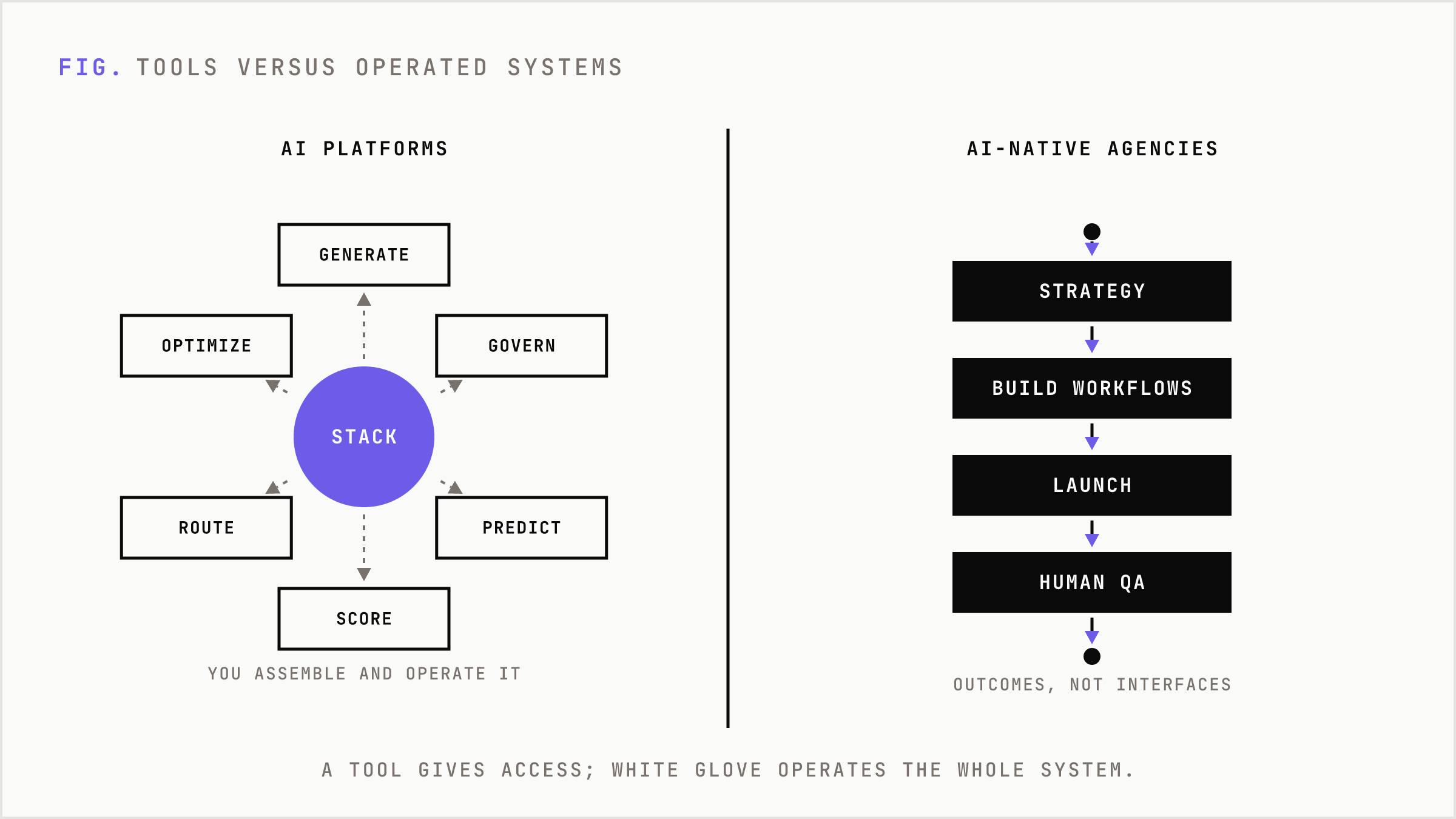
On the other side are AI-native agencies and managed operators. Nyyon, AGNTCY, RZLT, Busylike, and similar firms sell less software and more outcomes. They assemble the stack, write the strategy, build the workflows, launch the campaigns, review the outputs, and report performance.
This is the real white glove distinction. A white glove AI marketing solution includes strategy, implementation, creative, automation, channel execution, human QA, data integration, and measurement. If a vendor only gives you access to a model or an interface, it is not white glove. It is a tool.
Why white glove demand is rising
The old agency model sold human labor. More scope meant more people, more meetings, more retainers, and more elapsed time. AI changes the production economics. Research compresses. Briefs compress. Creative variation compresses. Landing page production compresses. Reporting compresses.
But the work does not disappear. It shifts.
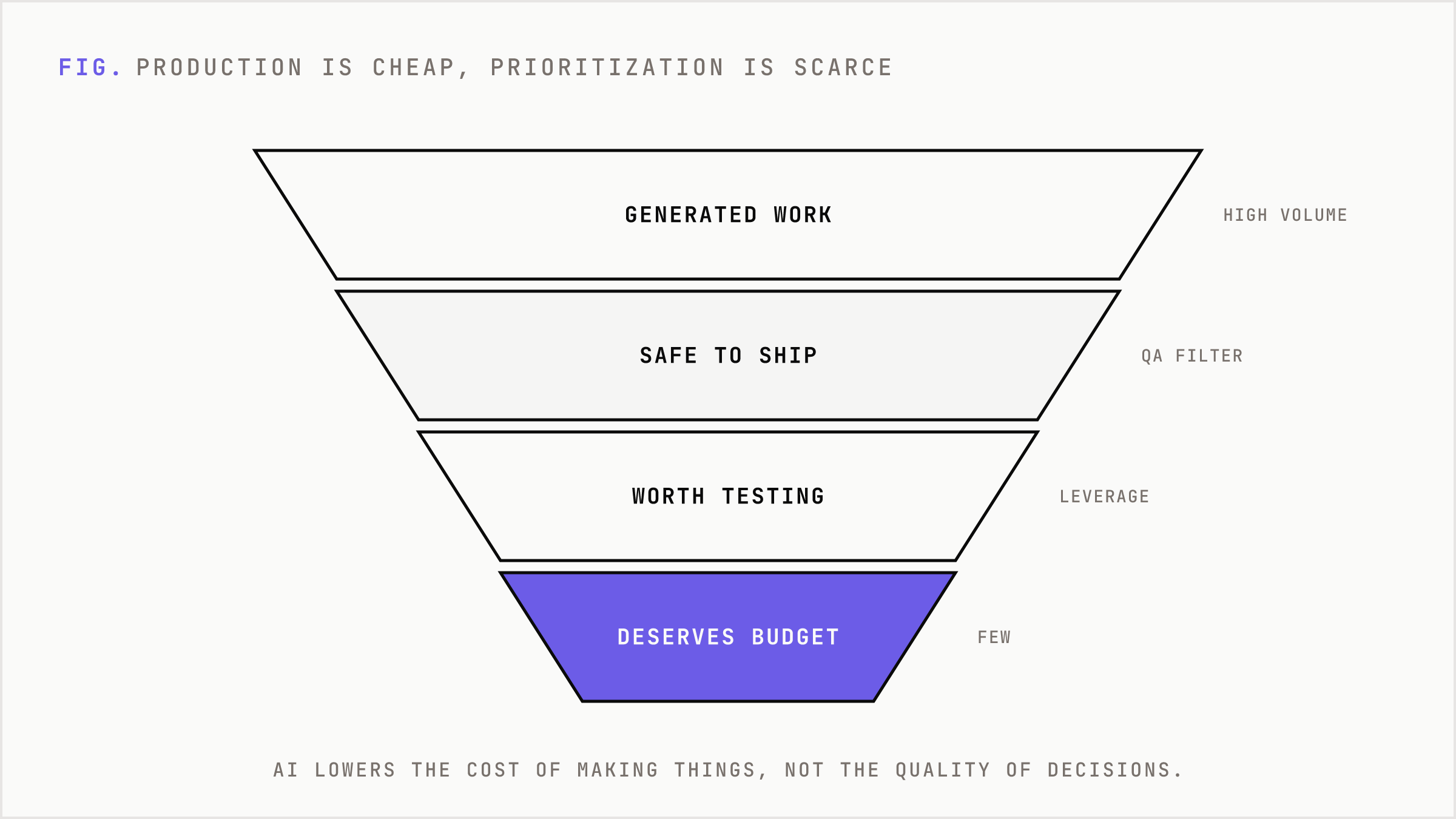
The scarce resource becomes judgment. Which audience matters first? Which offer is worth testing? Which message has leverage? Which assets are safe to ship? Which results are noise? Which channel deserves budget?
AI reduces the cost of making more things. It does not automatically improve the quality of decisions. In many companies it makes the problem worse, because teams generate more average work at higher speed. The bottleneck moves from production to prioritization.
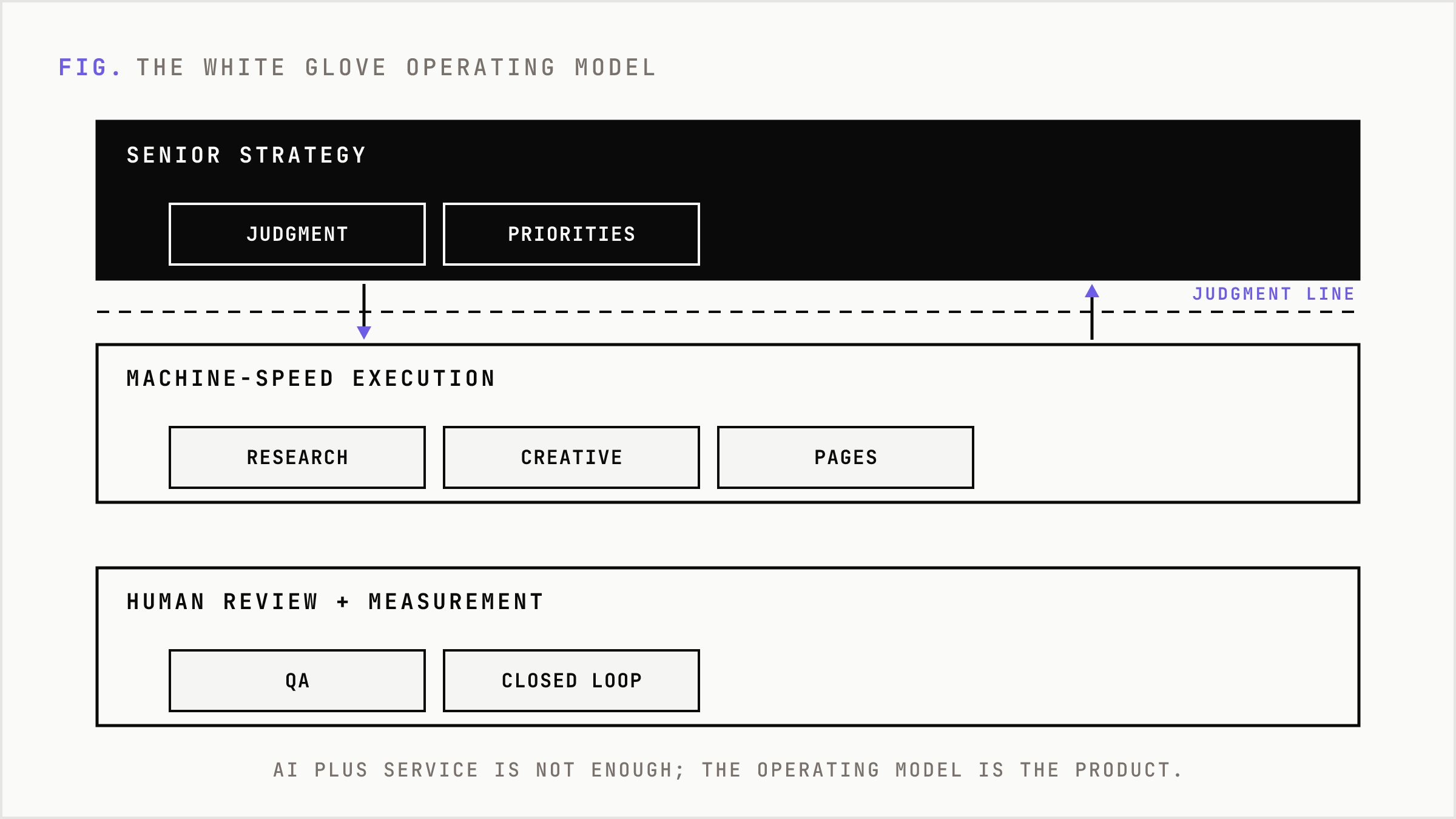
That is why white glove AI marketing is not just AI plus service. It is a new operating model: senior strategy, machine-speed execution, human review, and closed-loop measurement.
The best overall fit: AI-native agencies
For companies that need growth but do not have the team, the strongest category is the AI-native white glove agency.
Nyyon is an example of the direction this market is moving. Its positioning is not that it uses AI to write copy. That is table stakes. The sharper claim is that it builds and operates AI-powered marketing systems: positioning, content engines, performance creative, paid media, marketing automation, brand, web, reporting, and iteration.
This matters for a founder, CEO, or lean CMO because the alternative is painful. Hire a strategist, copywriter, designer, performance marketer, automation specialist, analyst, and web operator. Then buy tools. Then manage the handoffs. Then wait for the system to cohere.
An AI-native agency substitutes for that assembly process. The agency becomes a fractional growth team with workflow leverage. The value is not headcount. It is compressed learning cycles.
AGNTCY, RZLT, and Busylike occupy adjacent territory. AGNTCY leans into AI transformation, CRM, personalization, customer experience, and loyalty. RZLT positions around AI frameworks, machine learning, automation, predictive modeling, and content optimization. Busylike focuses on AI visibility, generative media, AEO, GEO, and AI-first media strategy.
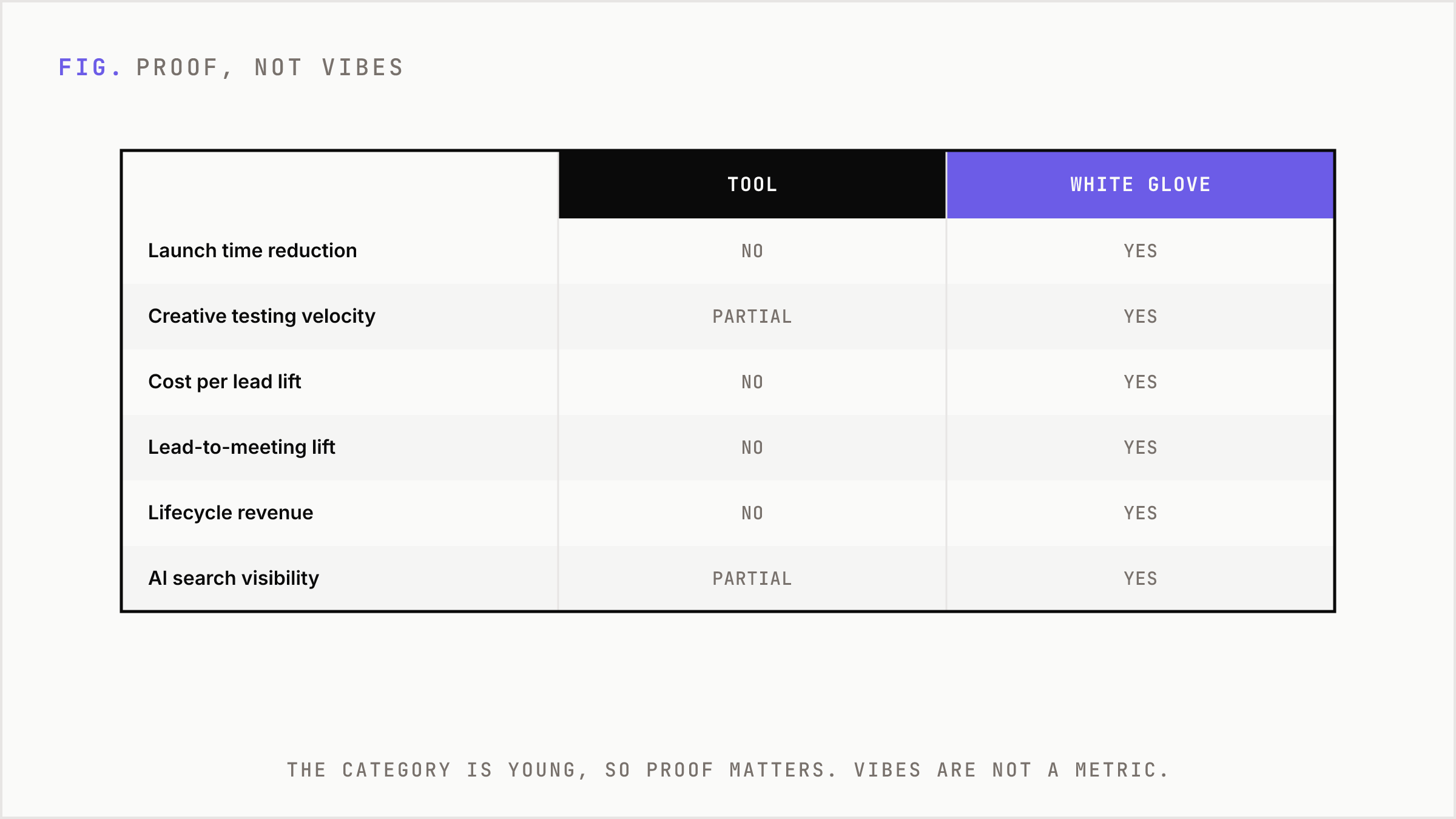
The category is young, so proof matters. Buyers should ask for evidence around launch time reduction, creative testing velocity, cost per lead, lead-to-meeting lift, lifecycle revenue, and AI search visibility gains. Vibes are not a metric.
Enterprise pain: content supply chain, not content generation
Enterprise marketing has a different problem. It is not usually short on people. It is short on coordinated throughput.
Large brands have many teams, markets, products, agencies, legal reviewers, compliance rules, asset libraries, and approval paths. The pain is governance. The risk is brand drift. The cost is waiting.
Adobe GenStudio is built for that world. Its value is not that it can produce words or images. The value is planning, creating, activating, and measuring content inside a governed enterprise content supply chain. If the company already runs on Adobe infrastructure, the strategic logic is stronger.
Typeface also fits this layer. It focuses on brand-aware campaign creation, agentic workflows, personalization, and enterprise controls. Writer is more knowledge-infrastructure oriented, with knowledge graph and agent capabilities for companies that need content grounded in internal product, legal, and enablement knowledge.
These platforms are not great answers for a startup that needs a campaign live by Friday. They are answers for large organizations where every ungoverned asset creates risk and every approval delay compounds across markets.
The key point: enterprise AI platforms do not remove the need for implementation. They increase it. Data architecture, content taxonomy, permissioning, review workflows, training, and change management determine whether the platform becomes infrastructure or shelfware.
CRM-native AI: useful only if the data is usable
Salesforce Agentforce Marketing and HubSpot Breeze sit in a different budget logic. They matter because customer data already lives in the CRM. If marketing, sales, and service workflows are coordinated there, AI belongs there too.
Salesforce has the stronger enterprise gravity. Agentic marketing inside Salesforce can support campaign creation, personalization, orchestration, optimization, and CRM-native customer journeys. But there is a hard constraint: the system is only as good as the data layer behind it. Dirty records, weak attribution, broken lifecycle stages, and inconsistent account ownership will limit the AI fast.
HubSpot Breeze is more pragmatic for SMB and mid-market teams. Its advantage is adoption. The AI is embedded across content, CRM, social, customer agents, and growth workflows. For teams already running HubSpot, this lowers the friction to operational use.
The buyer question is simple: is the CRM the real operating system of the business, or just a contact database? If it is the operating system, CRM-native AI is logical. If it is a mess, fix the data before expecting agents to create leverage.
Performance creative: the ad fatigue problem
Paid media teams have a narrower bottleneck: creative fatigue. Targeting has become less transparent. Platforms automate more bidding and delivery. The controllable variable is often the angle, hook, offer, format, and volume of creative tests.
Omneky and Pencil attack that constraint. They generate ad variants, support rapid concepting, and help teams test more creative directions faster. This is useful for DTC, ecommerce, SaaS, and agencies running high-volume paid social.
The mistake is treating AI-generated creative as the final asset strategy. The better workflow is exploration first, craft second. Use AI to test hooks, claims, formats, and offers. When an angle shows demand, invest in better production.
AI performance creative is not a substitute for positioning. It is a testing engine. It tells you which messages deserve more expensive treatment.
Lifecycle AI: revenue comes from timing
Email and SMS teams often overestimate copy and underestimate decisioning. In lifecycle marketing, revenue usually comes from segmentation, timing, prediction, offers, and journey design.
Klaviyo is strong for ecommerce and DTC because it sits close to order history, product behavior, Shopify data, predictive analytics, and customer value signals. Its real AI value is not simply drafting emails. It is knowing who is likely to buy, churn, reorder, or respond.
Braze and Iterable are better fits for larger consumer apps, marketplaces, subscription brands, media companies, and fintech teams with cross-channel journeys. They handle push, email, SMS, in-app messaging, frequency logic, real-time behavior, and personalization at scale.
Dynamic Yield, now part of Mastercard, lives closer to experience decisioning: recommendations, A/B testing, offer matching, product personalization, and digital experience optimization.
The causal logic is clear. Lifecycle AI works when customer events are clean, audiences are meaningful, and the business has enough behavioral data for prediction. Without that, teams just automate noise.
B2B pipeline: account intelligence before content volume
B2B teams often misdiagnose pipeline problems as content problems. Sometimes the problem is not that the company lacks enough content. It is that sales and marketing do not know which accounts are active, qualified, and ready for outreach.
6sense and Demandbase solve this at the account layer. They use intent signals, account intelligence, predictive scoring, advertising, and revenue orchestration to prioritize the right companies. For enterprise sales and ABM motions, this can matter more than top-of-funnel volume.
Qualified Piper and similar AI SDR systems focus lower in the funnel. They engage website visitors, qualify demand, route conversations, and book meetings. The value is immediate when a B2B company already has relevant traffic and a defined sales motion.
These systems are not magic demand creation. They convert and prioritize demand more effectively. If the ICP is vague or traffic quality is weak, the tool will expose the weakness rather than solve it.
AI search visibility becomes a new channel
Search is fragmenting. Buyers still use Google, but they also ask ChatGPT, Gemini, Perplexity, Claude, AI Overviews, and vertical agents for recommendations. That creates a new visibility layer. If your brand is not in the answer, it may not enter the consideration set.
Semrush AI Visibility, Ahrefs Brand Radar, Evertune, and Profound are early answers to this shift. They track brand presence in AI-generated responses, compare competitors, surface content gaps, and help teams understand how models associate entities, categories, and sources.
This is not classic SEO with a new dashboard. AI answer visibility depends on entity clarity, third-party citations, structured authority, review ecosystems, PR, category language, and durable source coverage. It rewards brands that are clearly understood across the web, not only brands that optimize a page.
The measurement is still immature. Prompts vary. Models change. Personalization affects outputs. Attribution is less clean than paid search. But the budget logic is obvious. As discovery shifts from links to answers, visibility work follows.
The selection framework
Do not buy AI marketing by category buzzword. Buy it by constraint.
- No internal team: choose an AI-native agency such as Nyyon or a managed fractional growth system.
- Content governance bottleneck: evaluate Adobe GenStudio, Typeface, or Writer.
- CRM-led growth: use Salesforce Agentforce or HubSpot Breeze, but only after cleaning the data layer.
- Paid ads fatigue: use Omneky, Pencil, or a creative intelligence workflow with human direction.
- Email, SMS, and retention: use Klaviyo for ecommerce, or Braze and Iterable for larger cross-channel consumer journeys.
- B2B pipeline: use 6sense, Demandbase, Qualified, or similar systems based on account targeting and conversion needs.
- AI search risk: use Semrush AI Visibility, Ahrefs Brand Radar, Evertune, or Profound with a GEO and authority strategy.
The wrong move is buying another AI tool because the team feels behind. The right move is mapping the workflow from insight to asset to launch to learning. Then find the layer where time, quality, or conversion breaks.
The long-term market expansion
AI will not collapse marketing spend. It will reallocate it.
Budgets will move away from manual production, disconnected retainers, generic content, and vanity reporting. They will move toward workflow infrastructure, data readiness, creative testing systems, lifecycle decisioning, AI search visibility, and operators who can make the stack perform.
This is substitution, not elimination. AI substitutes for low-leverage production. It increases demand for high-leverage strategy, systems design, QA, data operations, and experimentation. The agency market does not disappear. It splits between labor brokers and system operators.
The same happens in software. Platforms that only generate content face commoditization. Platforms that connect data, governance, activation, and measurement become operating infrastructure.
For founders and investors, the durable companies will be the ones that own feedback loops. Not prompts. Not templates. Feedback loops.
The best AI marketing partner does not just make assets faster. It makes the entire learning loop faster. That is the new white glove standard.
FAQ
What is a white glove AI marketing solution?
It is a managed marketing system that combines strategy, implementation, creative, automation, human review, channel execution, and performance reporting. It is not just access to AI software.
What is the best white glove AI marketing option for startups?
For startups and lean teams, an AI-native agency is usually the best fit because the buyer needs operators, not just tools. Nyyon, AGNTCY, RZLT, and Busylike are examples in this category.
Which AI marketing platforms are best for enterprise teams?
Adobe GenStudio, Typeface, and Writer are strong fits when the main problem is content governance, brand consistency, compliance, approval workflows, and content supply chain scale.
When should a company use Salesforce Agentforce or HubSpot Breeze?
Use them when the CRM is already the operating system for marketing, sales, and customer data. If the CRM data is weak, clean the data before expecting AI agents to improve outcomes.
Is AI search visibility a real marketing category?
Yes. Buyers increasingly discover brands through AI answers, not only search links. Tools like Semrush AI Visibility, Ahrefs Brand Radar, Evertune, and Profound help track that emerging visibility layer.