Nyyon · Blog
Where AI Actually Drives Revenue Growth in Modern Agencies
A clear breakdown of where AI drives real revenue in agencies, from lead scoring to sales execution, and how to evaluate partners that impact pipeline, not just traffic.
AI does not create demand. It reallocates attention, compresses response time, and increases the probability that existing demand converts.
The Wrong Frame: “Top AI Agencies”
There is no consistent leaderboard for AI agencies because the category itself is incoherent. What gets grouped together ranges from ad creative generators to outbound automation shops to CRO specialists.
The useful distinction is not who uses AI. It is where AI sits in the revenue path.
Every agency that claims AI capability is operating in one of four zones: traffic generation, lead qualification, conversion optimization, or sales execution. These are not equivalent. They map to different budget lines, different data dependencies, and different constraints on impact.
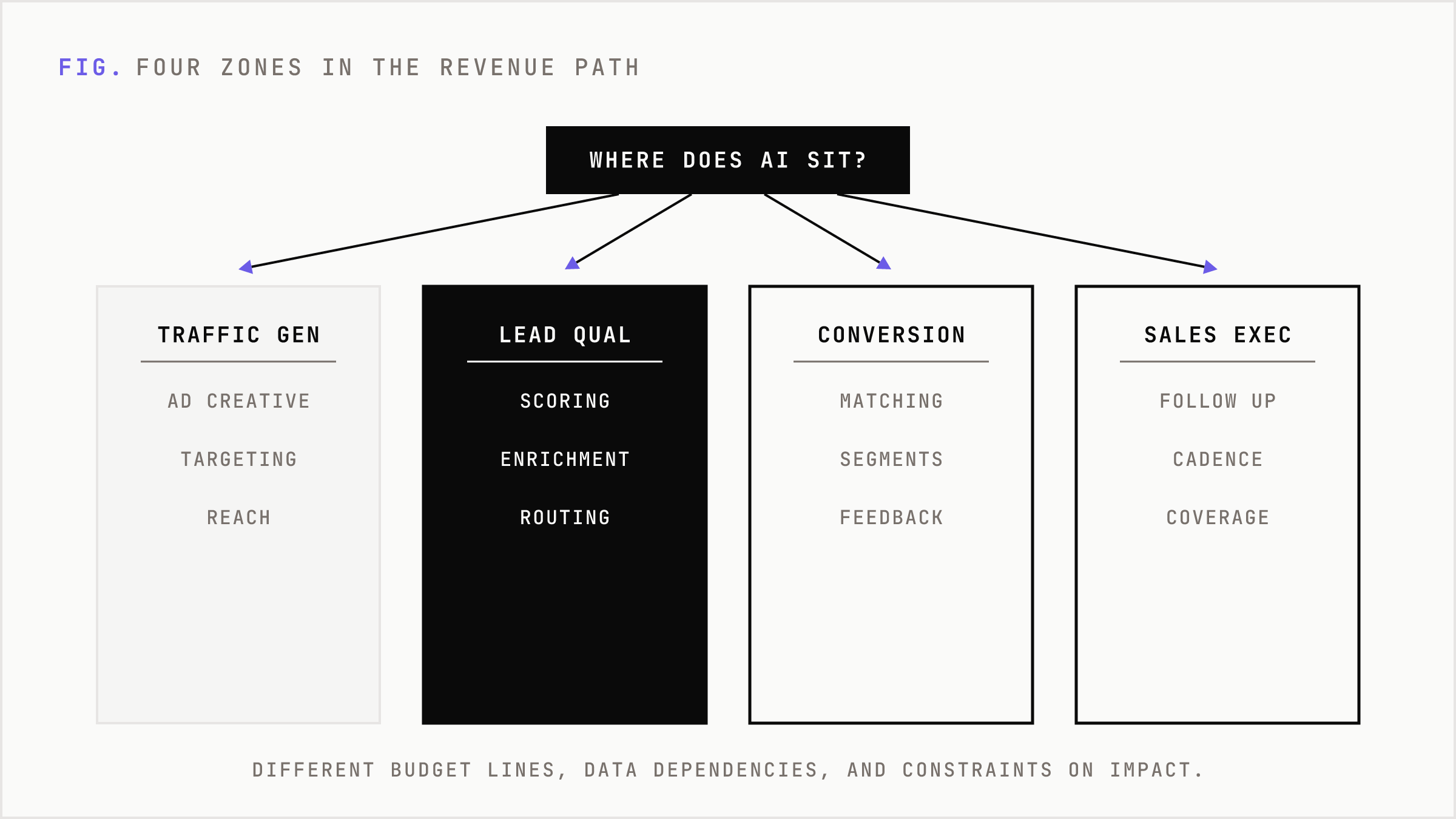
Most buyers still evaluate agencies as if they are interchangeable vendors competing on creative quality or channel expertise. That misses the structural shift. AI is not improving campaigns. It is reorganizing how revenue systems are built.
Where the Gains Actually Show Up
The distribution of impact is not even.
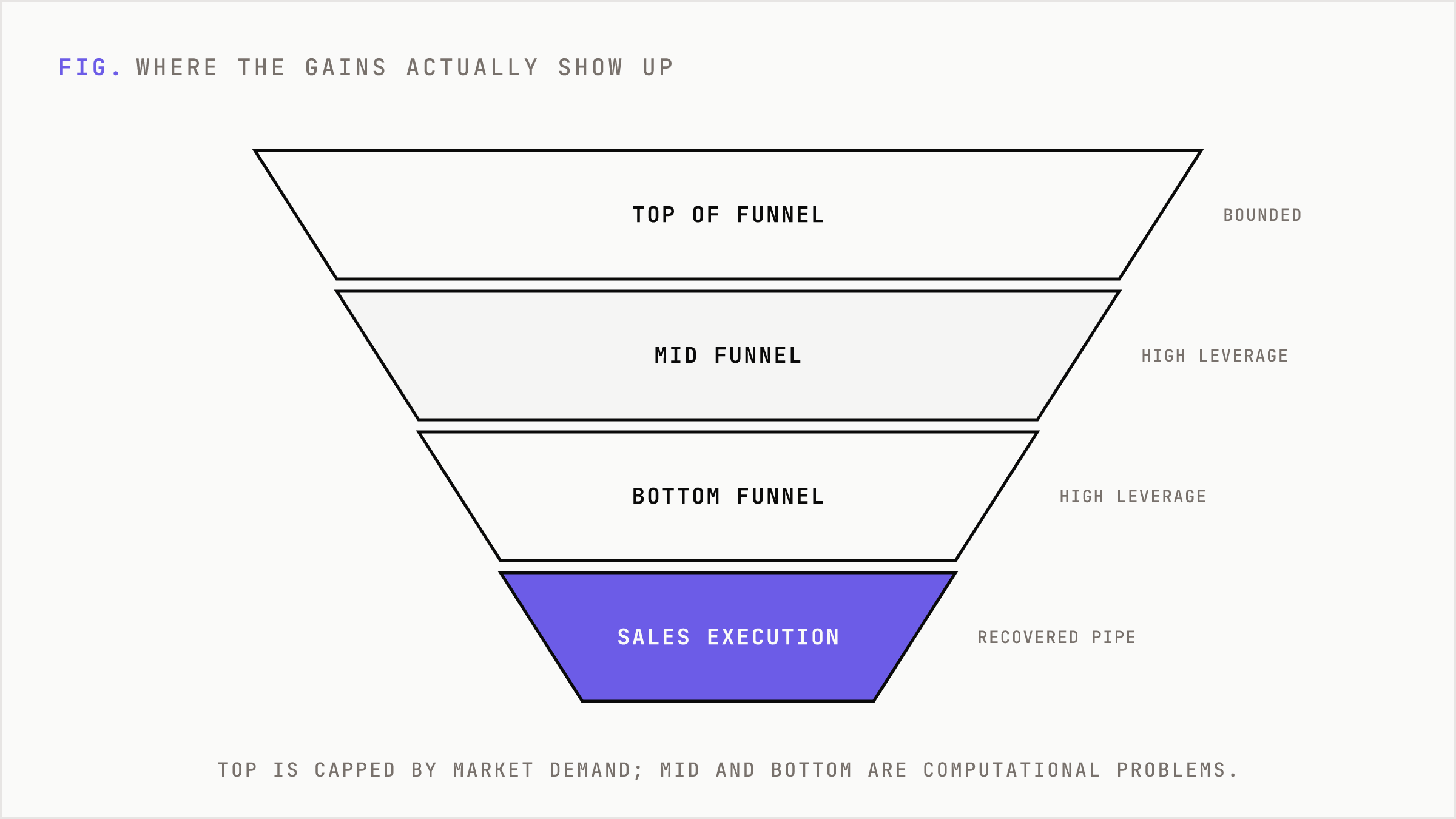
Top of funnel improvements are real but bounded. Better targeting and faster creative iteration can lift performance, but the ceiling is low because the constraint is market demand, not execution quality.
Mid and bottom funnel are different. Here the constraint is decision friction, response time, and prioritization. These are computational problems. AI performs well in this layer because it reduces latency and increases precision.
This is why agencies focused on lead scoring, personalization, and sales execution consistently report larger gains than those focused on traffic.
Mid Funnel: The Highest Leverage Layer
Lead qualification is where most revenue is lost. Not because leads are bad, but because attention is misallocated.
Traditional funnels treat all leads as roughly equal. In practice, a small subset drives most revenue. Identifying and acting on that subset faster changes outcomes materially.
Agencies like DozalDev have shown this in measurable terms. Moving from basic routing to AI driven scoring and prioritization increased lead to demo conversion by over 150 percent. The mechanism is simple. High intent leads are contacted first, with context, and with persistence.
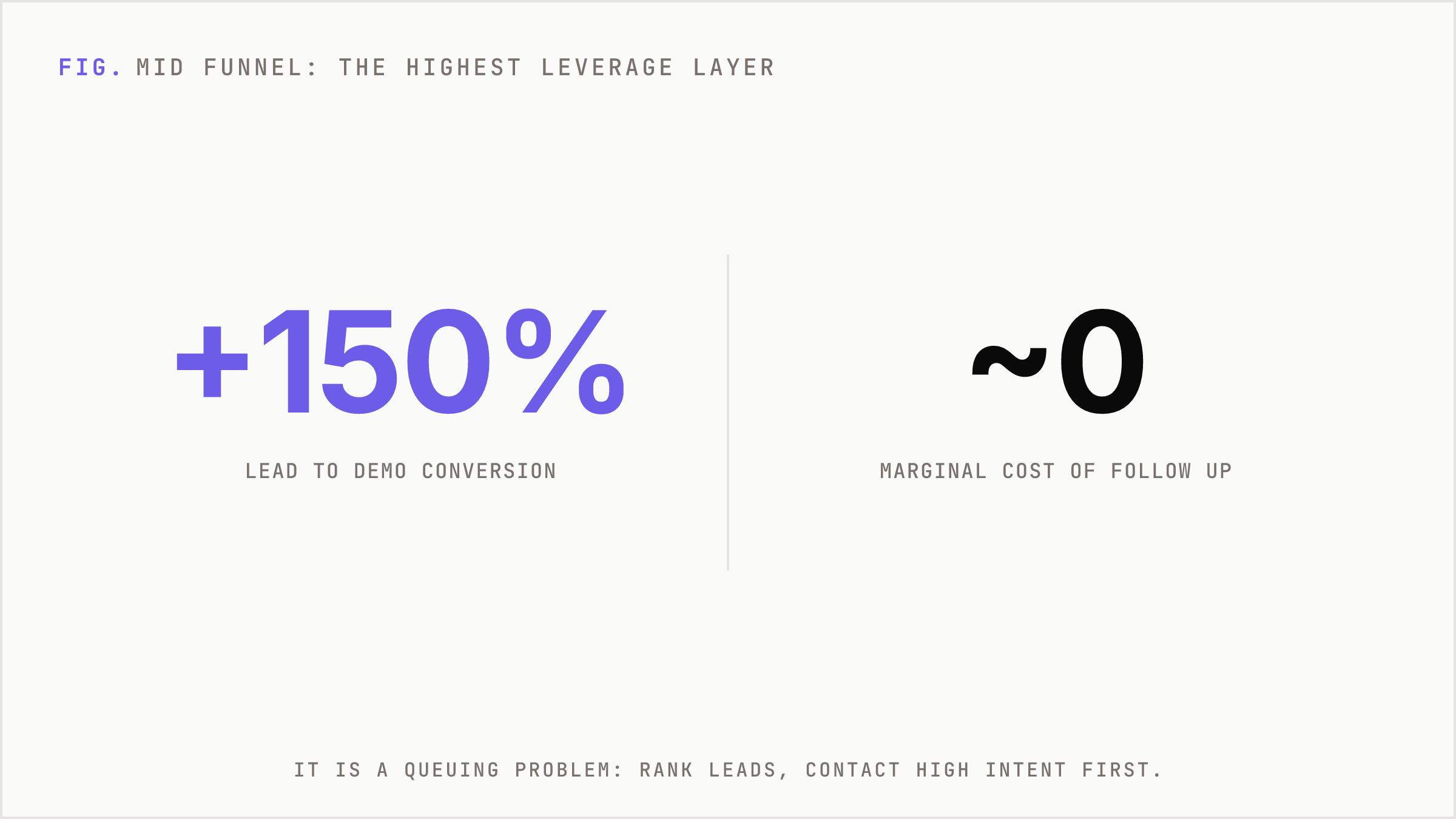
This is not a creative problem. It is a queuing problem. AI improves it by ranking leads based on behavioral signals, enrichment data, and historical conversion patterns.
The result is not just higher conversion. It is lower waste. Sales teams spend less time on low probability leads and more time closing.
Personalization: From Messaging to Matching
Most personalization efforts fail because they focus on messaging rather than matching.
Changing headlines or inserting a company name into an email does not materially shift conversion. What matters is aligning the offer, timing, and context with user intent.
Altaris demonstrates this distinction. Their reported conversion lift comes from segmentation at a granular level, not surface level copy variation. The system identifies clusters of behavior and routes users into different experiences.
This is closer to dynamic pricing logic than marketing. The site becomes a decision engine, not a static page.
The key input is first party data. Without it, personalization collapses into guesswork. With it, agencies can build feedback loops that improve over time.
Sales Execution: Speed Beats Craft
In outbound and follow up, the dominant variable is not copy quality. It is speed and persistence.
AiSDR and similar operators show that automated follow up sequences outperform manual outreach even when the messaging is average. The advantage comes from immediate response, consistent cadence, and coverage across channels.
Human sales teams are constrained by time and attention. AI systems are not. They can respond instantly, maintain context across interactions, and continue engagement without drop off.
This changes the economics of pipeline generation. The marginal cost of follow up approaches zero, which means more leads are worked thoroughly.
The result is higher meeting rates and more recovered opportunities from leads that would otherwise go cold.
Creative and Paid Media: Velocity Over Brilliance
In paid media, AI’s advantage is iteration speed.
Platforms like Omneky generate and test creative variants at a scale that human teams cannot match. The impact is not that any single ad is dramatically better. It is that the system converges on effective combinations faster.
This compresses the feedback loop between spend and learning. Campaigns stabilize earlier and waste less budget during exploration.
However, the ceiling remains limited compared to mid and bottom funnel improvements. Better ads can increase click through and conversion modestly, but they do not fix structural issues in qualification or sales follow up.
The Hidden Layer: Intake and Response Time
The most underappreciated lever is intake.
When a lead submits a form or requests contact, the probability of conversion decays rapidly with time. Delays of even a few minutes reduce close rates significantly.
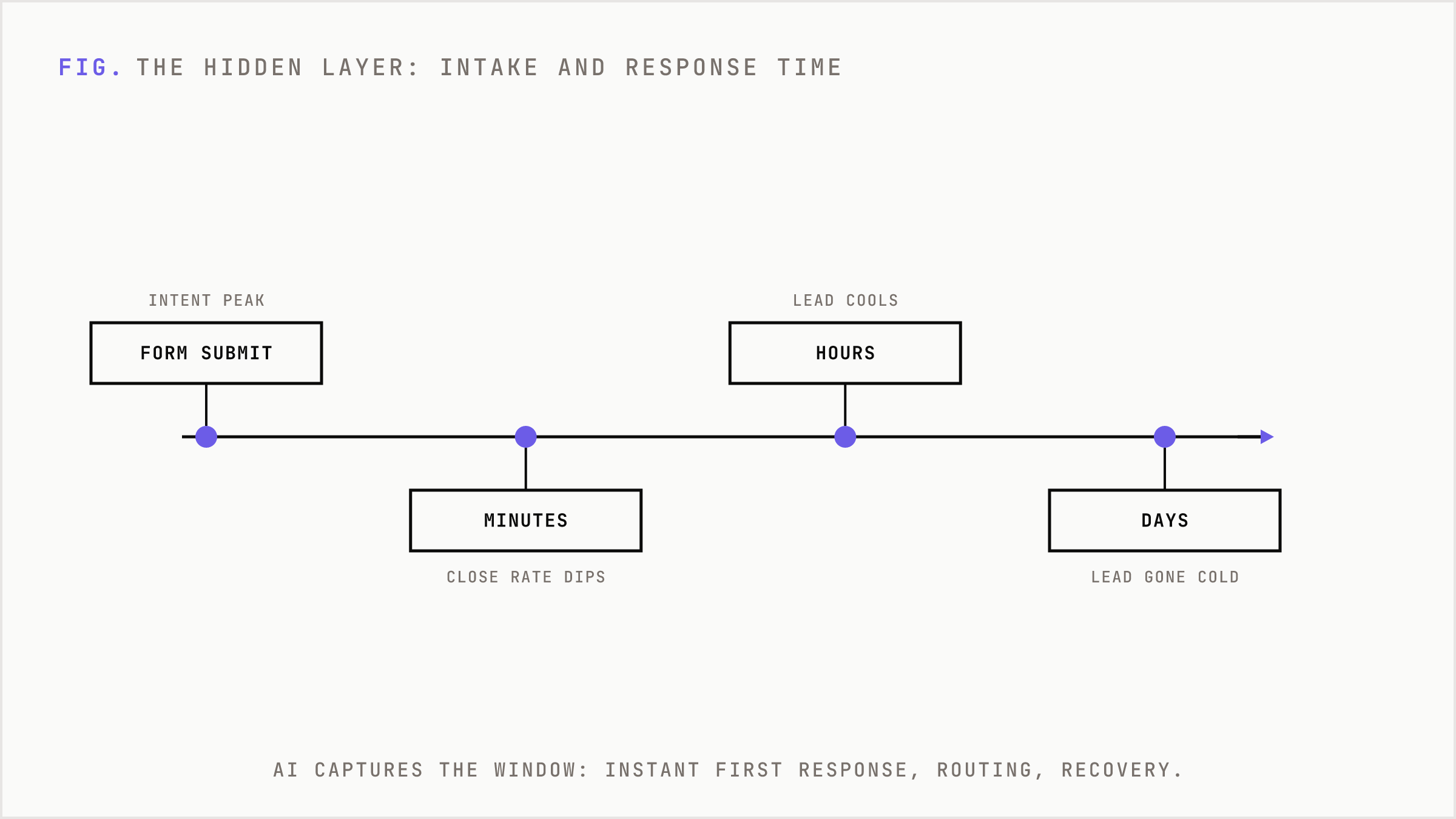
AI systems that handle intake, route leads, and initiate contact immediately capture this window. Companies like Scorpion focus heavily on this layer, automating scheduling, missed call recovery, and first response.
This is not visible in most marketing dashboards, but it has outsized impact on revenue. It converts existing demand more efficiently without increasing acquisition cost.
Why Most Agencies Miss This
There are structural reasons why agencies over index on the wrong areas.
First, traffic generation is easier to sell. Metrics like impressions and clicks are visible and familiar. Conversion improvements require deeper integration with client systems and more accountability.
Second, mid and bottom funnel work depends on access to CRM data. Many agencies do not have it, or lack the capability to use it effectively.
Third, the work is less about campaigns and more about systems. This requires a different skill set that blends data engineering, workflow design, and experimentation.
The result is a market where many agencies talk about AI but apply it to the least impactful parts of the funnel.
The Shift Toward Revenue Systems
The most capable operators are moving beyond the agency model.
Instead of managing campaigns, they build and run integrated systems that include CRM, outreach, personalization, and analytics. AI is embedded across the stack, not added as a layer.
This changes the value proposition. The output is not content or ads. It is pipeline and closed revenue.
These systems also create defensibility. Data accumulates, models improve, and switching costs increase because the system becomes tightly coupled to the client’s operations.
In effect, agencies are evolving into software enabled operators.
What Buyers Should Actually Evaluate
Choosing an AI agency requires a different set of criteria.
The primary metric is lift in lead to sale conversion. Secondary metrics like cost per lead or click through rate are incomplete.
Integration depth matters. Without access to CRM and first party data, AI systems cannot perform meaningful optimization.
Experimentation cadence is another signal. High performing teams run continuous tests and iterate weekly, not quarterly.
Finally, data ownership is critical. Black box tools limit learning and reduce long term value.
These criteria align incentives with revenue outcomes rather than activity.
Strategic Implications
AI is shifting where value is created in marketing.
Budgets will move away from pure acquisition toward conversion infrastructure. The marginal dollar spent on improving qualification or response time often produces higher returns than the same dollar spent on generating additional traffic.
Sales and marketing functions will continue to converge. As AI handles more of the execution, the boundary between generating leads and closing them becomes less distinct.
Over time, the distinction between agency and software will blur. The winners will be those who control the system that manages the flow from lead to revenue.
This is not a temporary advantage. It compounds as data accumulates and models improve.
The Bottom Line
AI delivers the most value where decisions are frequent, data is available, and time matters.
That is not at the top of the funnel. It is in the layers where leads are prioritized, engaged, and converted.
Agencies that understand this are not trying to generate more attention. They are making better use of the attention that already exists.
For buyers, the implication is simple. Stop asking how AI improves campaigns. Ask how it improves conversion systems.
FAQ
Where does AI have the biggest impact in marketing?
AI has the largest impact in mid and bottom funnel stages, especially lead scoring, personalization, and sales follow up, where it improves prioritization and response speed.
Why is lead scoring so important?
Lead scoring ensures sales teams focus on high intent prospects first, increasing conversion rates and reducing wasted effort on low probability leads.
Do AI tools improve ad performance significantly?
They improve iteration speed and optimization, but gains are typically smaller compared to improvements in qualification and sales execution.
What should companies look for in an AI agency?
Focus on measurable lift in lead to sale conversion, CRM integration, experimentation cadence, and ownership of data rather than surface level metrics.
Are agencies being replaced by AI systems?
Not replaced, but evolving. The most effective agencies are becoming operators of integrated revenue systems rather than campaign managers.