Nyyon · Blog
What Is Answer Engine Optimization (AEO)?
Answer engine optimization AEO is the practice of making content easy for AI answer systems to understand, trust, and cite.
Answer engine optimization is how brands become the answer, not just another blue link. What is answer engine optimization (AEO)? Answer engine optimization AEO is the practice of making your content, expertise, and entity signals easy for AI answer systems to understand, trust, summarize, and cite.
AEO matters because search behavior is moving from query-and-click to ask-and-answer. Buyers still use Google, but they also ask ChatGPT, Perplexity, Claude, Gemini, and AI Overviews for direct recommendations, comparisons, definitions, and next steps. If your content is built only to rank in a list of links, it may never enter the answer set.
Answer engine optimization is not a replacement for SEO. It is the layer above SEO that prepares your marketing system for engines that synthesize answers instead of merely indexing pages.
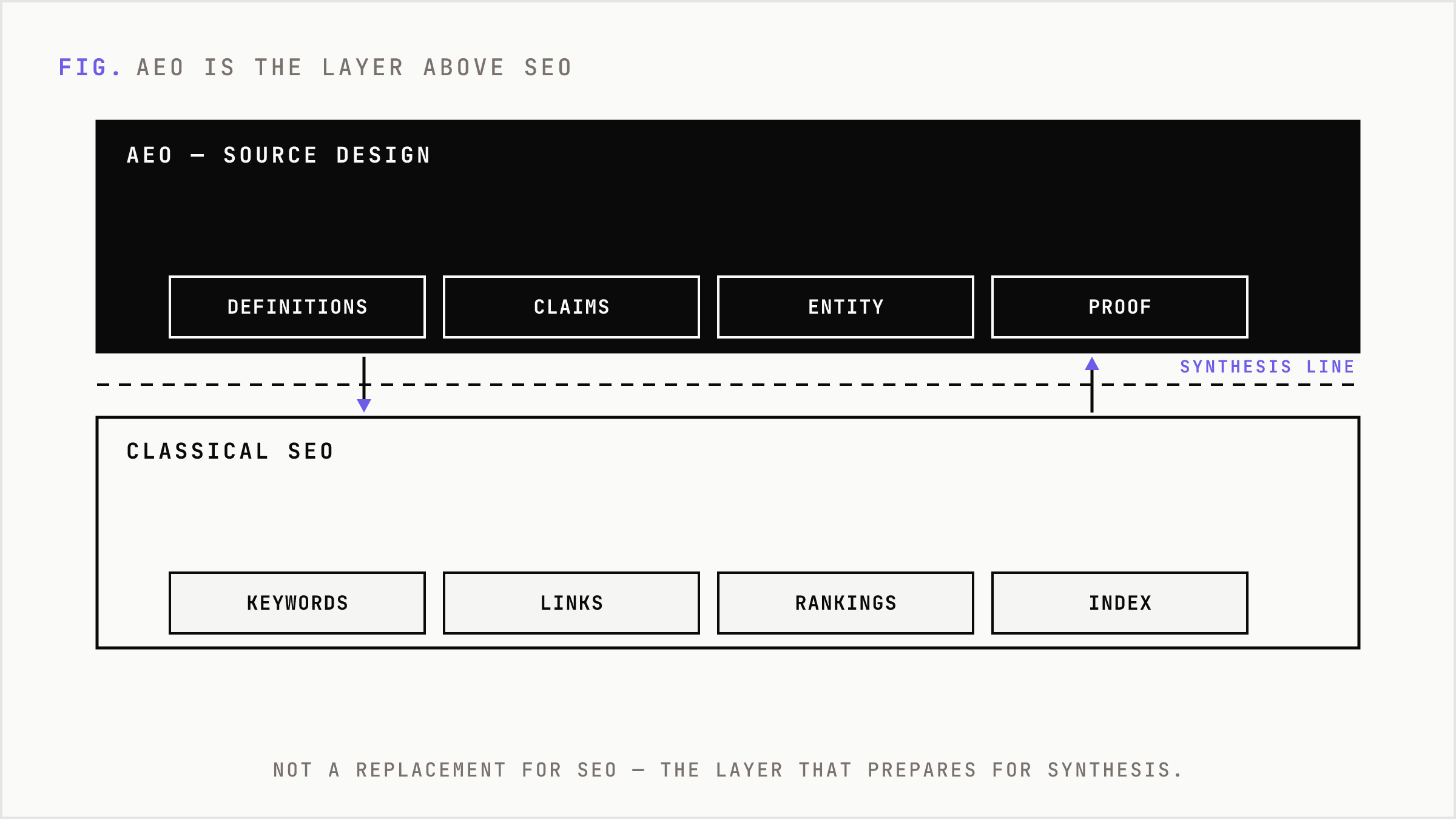
The old SEO pattern breaks inside answer engines
The dominant pattern is still page-first SEO. Pick a keyword. Write a long article. Add internal links. Build backlinks. Track rankings. Wait.
That pattern still has value. Classical search is not dead. But it breaks when the interface changes from a results page to a generated answer.
In a traditional SERP, the user sees ten options and chooses where to click. In an answer engine, the system chooses what evidence to include before the user sees anything. The brand does not compete only for rank. It competes for extraction, synthesis, and citation.
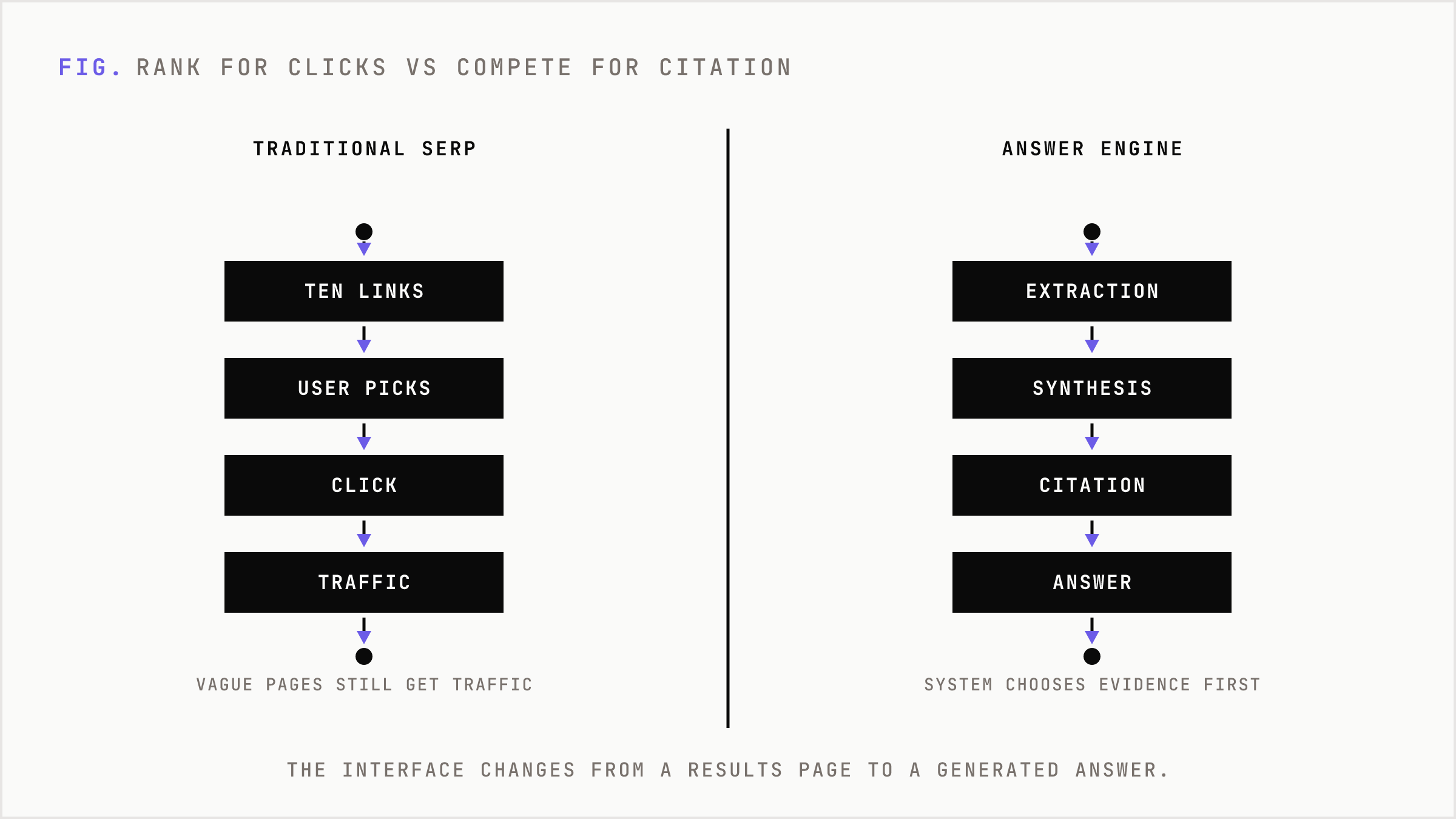
A ranking page can be vague and still get traffic. An answer source cannot. If the model cannot identify the claim, the author, the entity, the date, the context, and the relationship to the question, it has less reason to use the page.
This is where many marketing teams misread the shift. They treat AEO as another content format. They add FAQs, write shorter definitions, and hope AI systems notice. That is not an operating model. It is decoration.
The break is structural. Answer engines reward content that behaves like reliable source material. They need clean definitions, defensible claims, consistent entity data, and visible expertise. They prefer pages that answer a question directly, then explain the conditions, trade-offs, and mechanisms behind the answer.
AEO is source design for machine-mediated buyers
AEO is source design.
Source design is the discipline of making a company’s knowledge easy for machines and humans to verify, quote, and apply.
That definition is important because it pulls AEO out of the content gimmick bucket. The goal is not to trick an AI model into mentioning you. The goal is to build source material that deserves to be used when a buyer asks a serious question.
For senior operators, this changes the unit of work. The unit is not “a blog post.” The unit is an answer asset: a clear response to a commercially meaningful question, supported by evidence, expert judgment, structured context, and a path to action.
An answer asset is a page or content object built to satisfy a specific question and be reusable across search engines, AI systems, sales enablement, and internal decision-making.
Good AEO work asks different questions than generic SEO. What question is the buyer really asking? What answer would a credible operator give? What definitions need to be stated plainly? What claims can we defend? What examples prove the mechanism? What should an AI system cite instead of guessing?
This is why AEO sits close to brand strategy and marketing operations. It depends on how clearly the company understands its category, point of view, proof, and customer language. Thin positioning creates thin answers. Thin answers rarely survive synthesis.
The Nyyon Answer Surface Framework
At Nyyon, we use the Answer Surface Framework to separate AEO from generic content production.
The Answer Surface Framework is a system for turning company expertise into citable answer assets across the questions buyers, search engines, and AI systems actually use.
It has five parts: question architecture, source clarity, entity consistency, proof density, and activation loops.
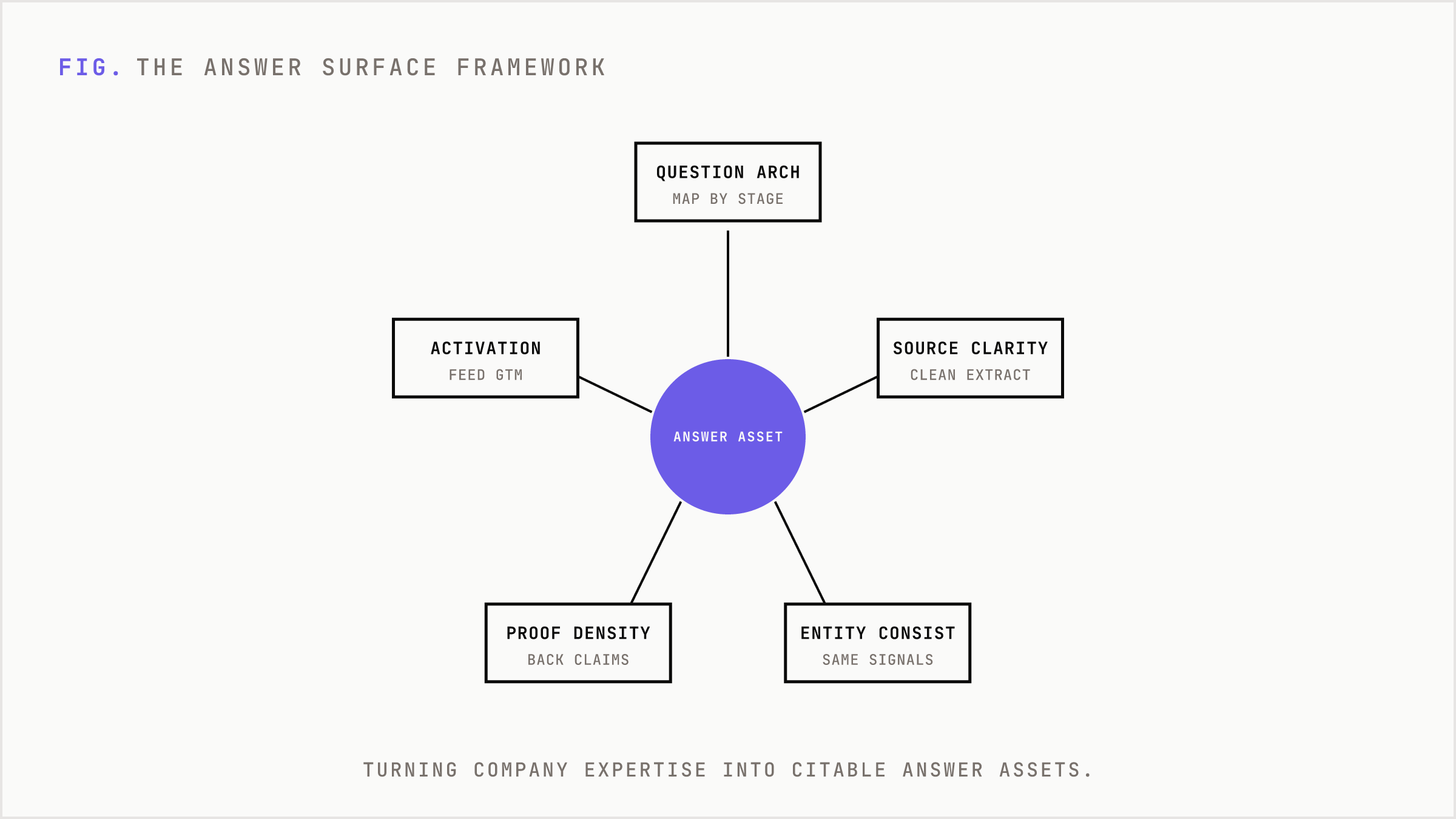
Question architecture means mapping the questions that matter by buyer stage and commercial intent. A definition query like “what is answer engine optimization AEO” needs a crisp answer and conceptual clarity. A comparison query needs criteria. A vendor query needs trust signals. A diagnostic query needs a framework. Each question type deserves a different answer shape.
Source clarity means writing so that the answer can be extracted without distortion. This includes direct opening paragraphs, short definitional lines, named frameworks, specific examples, and claims that do not depend on vague adjectives. If a human has to work too hard to understand the point, an answer engine has no reason to do the work for them.
Entity consistency means making the people, company, products, categories, and relationships clear across your site and third-party profiles. AI systems build confidence from repeated, consistent signals. If your homepage says one thing, your LinkedIn page says another, and your articles use three different category descriptions, you create unnecessary ambiguity.
Proof density means backing claims with evidence. Evidence can be first-party data, customer examples, operator experience, original frameworks, public documentation, or concrete reasoning. AEO does not require every paragraph to cite a study. It does require the page to feel like it came from someone who has done the work.
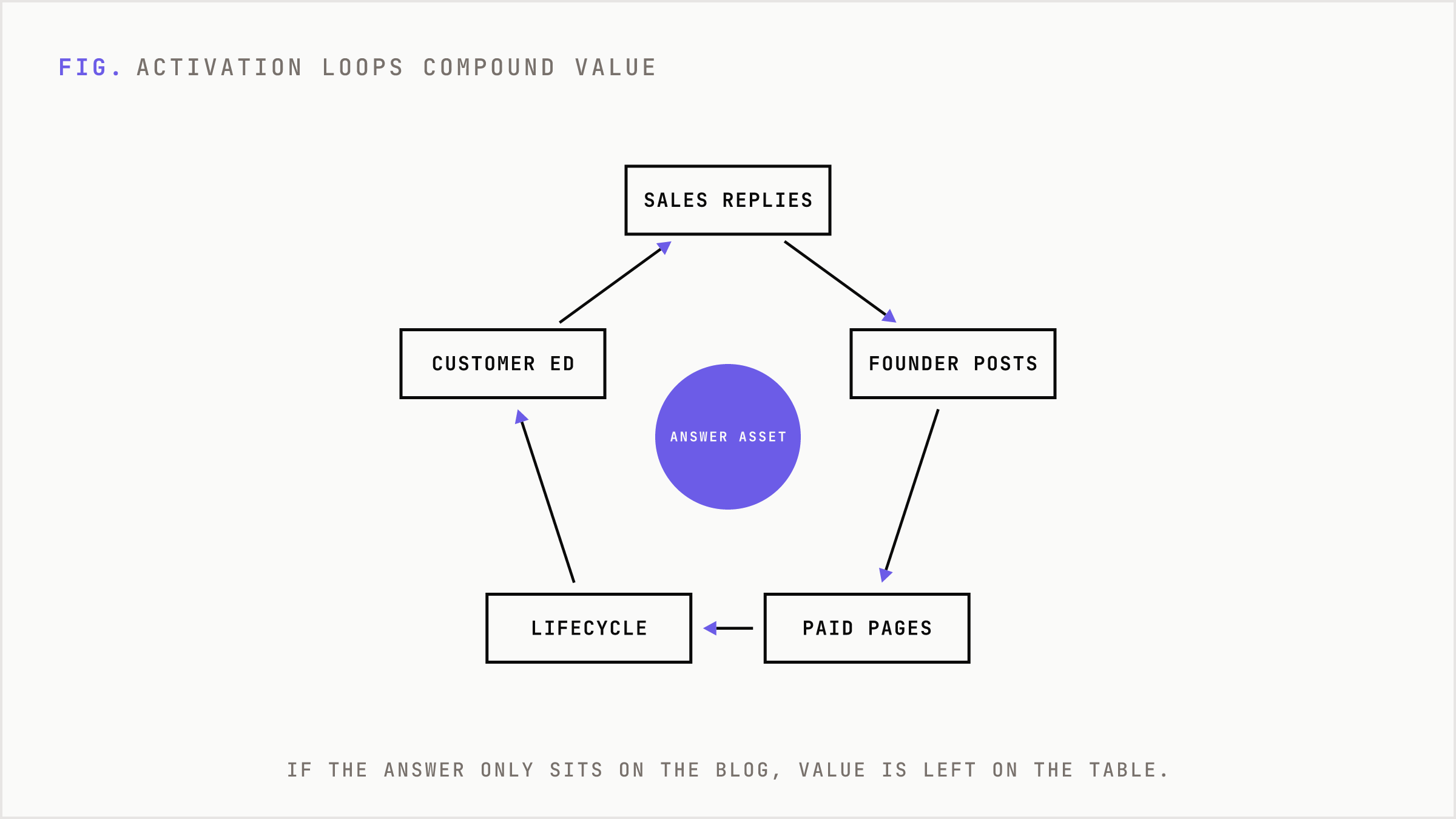
Activation loops mean feeding answer assets into the rest of the go-to-market system. A strong AEO asset should inform sales replies, founder posts, paid landing pages, lifecycle emails, analyst briefings, and customer education. If the answer only sits on the blog, the company leaves compounding value on the table.
How AEO works in practice
Take a B2B SaaS company selling revenue intelligence software. The team wants to be visible when buyers ask, “How do I know if my pipeline forecast is reliable?”
A classical SEO response might be a 2,000-word article targeting “pipeline forecast reliability” with keyword variations, a few best practices, and a CTA. It may rank eventually. It may also sound like every other article on the topic.
An AEO response starts with the answer. “A pipeline forecast is reliable when stage definitions, rep inputs, historical conversion rates, deal inspection, and finance assumptions agree closely enough to support a budget decision.” That line gives an answer engine something precise to lift.
Then the asset defines the core concept. “Forecast reliability is the degree to which pipeline predictions match actual revenue outcomes within an acceptable planning range.” Short. Citable. Clear.
Then it explains the mechanism. The company might introduce a named model: the Forecast Confidence Stack. It could include data hygiene, stage governance, rep judgment, historical win rates, and executive override rules. Each layer would be explained in plain language.
Then it gives a concrete consequence. 1. If stage definitions vary by region, forecast accuracy becomes a political negotiation. 2. If rep inputs are stale, the forecast reflects CRM hygiene rather than buyer intent. 3. If finance assumptions are disconnected from sales inspection, the board sees confidence that the operating team has not earned.
That asset is built for both the buyer and the answer engine. The buyer gets a useful diagnostic. The AI system gets extractable definitions, a named framework, and specific reasoning. Sales gets a sharper way to explain the problem. Paid teams get language for landing pages. Leadership gets a reusable point of view.
This is the practical difference. SEO tries to win the page. AEO tries to become the source behind the answer.
What changes when you adopt AEO
The first change is editorial discipline. AEO punishes vague content faster than old SEO did. A 3,000-word article with soft claims, generic advice, and no original judgment is weak source material. It may still index. It may even rank. But it gives answer engines very little to trust.
The second change is measurement. Rankings are still useful, but they are incomplete. Teams need to watch AI citations, branded mention quality, referral traffic from answer engines, assisted conversions, sales-call language, and the questions that prospects bring into demos. AEO creates influence before the click. Some of that influence will not appear cleanly in a last-click report.
The third change is operating cadence. AEO is not a quarterly content calendar exercise. Answer surfaces shift as models, SERP layouts, competitors, and buyer questions change. The better loop is continuous: identify questions, publish answer assets, monitor answer behavior, improve source clarity, and feed learnings back into positioning.
The fourth change is ownership. AEO cannot live entirely with a junior content team. It needs operator input. The strongest answer assets usually come from interviews with founders, sales leaders, customer success teams, product leads, and analysts who know where buyers get confused. AI can accelerate research and drafting, but judgment has to come from the business.
What stays the same is the need for real authority. AEO does not remove the need for technical SEO, fast pages, clean site architecture, internal links, credible authorship, and distribution. It adds a stricter requirement: the content must be worth citing.
The trade-off is that AEO slows down bad content and speeds up good thinking. It is harder to mass-produce because the work demands sharper claims, better source material, and stronger governance. But the assets last longer because they are built around durable buyer questions, not just keyword gaps.
Who should care about answer engine optimization
AEO matters most for companies in categories where buyers research before they speak to sales. That includes B2B SaaS, fintech, health tech, AI tools, professional services, and considered e-commerce. If prospects ask complex questions before converting, answer engines will influence their shortlist.
It also matters for companies creating or reshaping categories. When the market does not yet agree on the language, answer engines pull from the clearest available sources. If you do not define the category, the model will assemble a definition from whoever does.
The companies that benefit most have something real to say. They have customer evidence, operator knowledge, product depth, and a point of view. AEO amplifies clarity. It does not manufacture substance.
The weak version of AEO is chasing mentions. The strong version is building a governed answer layer for the business.
A governed answer layer is the set of approved definitions, claims, frameworks, examples, and proof points that make a company consistently understandable across human and AI interfaces.
That is where AEO belongs inside an AI-native marketing system. Not as a hack. Not as a rename of SEO. As the discipline of turning company knowledge into trusted source material for the way buyers now search, compare, and decide.