Nyyon · Blog
What Is AI-Native Marketing?
AI-native marketing uses AI as the operating layer across strategy, creative, media, measurement, and learning, with humans governing decisions.
AI-native marketing is marketing rebuilt around AI as the operating system, not AI added as a tool. What is AI-native marketing? AI-native marketing is an operating model where AI systems support research, strategy, creative, media, lifecycle, measurement, and reporting under human governance. The point is not cheaper content. The point is faster, better marketing decisions tied to profit.
The dominant pattern is tool adoption, not operating change
Most companies do not practice AI-native marketing. They practice AI-assisted marketing. Someone writes email drafts in ChatGPT. A designer generates image variants. A media buyer asks an AI assistant for keyword ideas. A content team uses a writing tool to make first drafts less painful.
AI-assisted marketing is useful. It saves time inside isolated tasks. It does not change how the marketing system works.
AI-assisted marketing is the use of AI inside existing workflows.
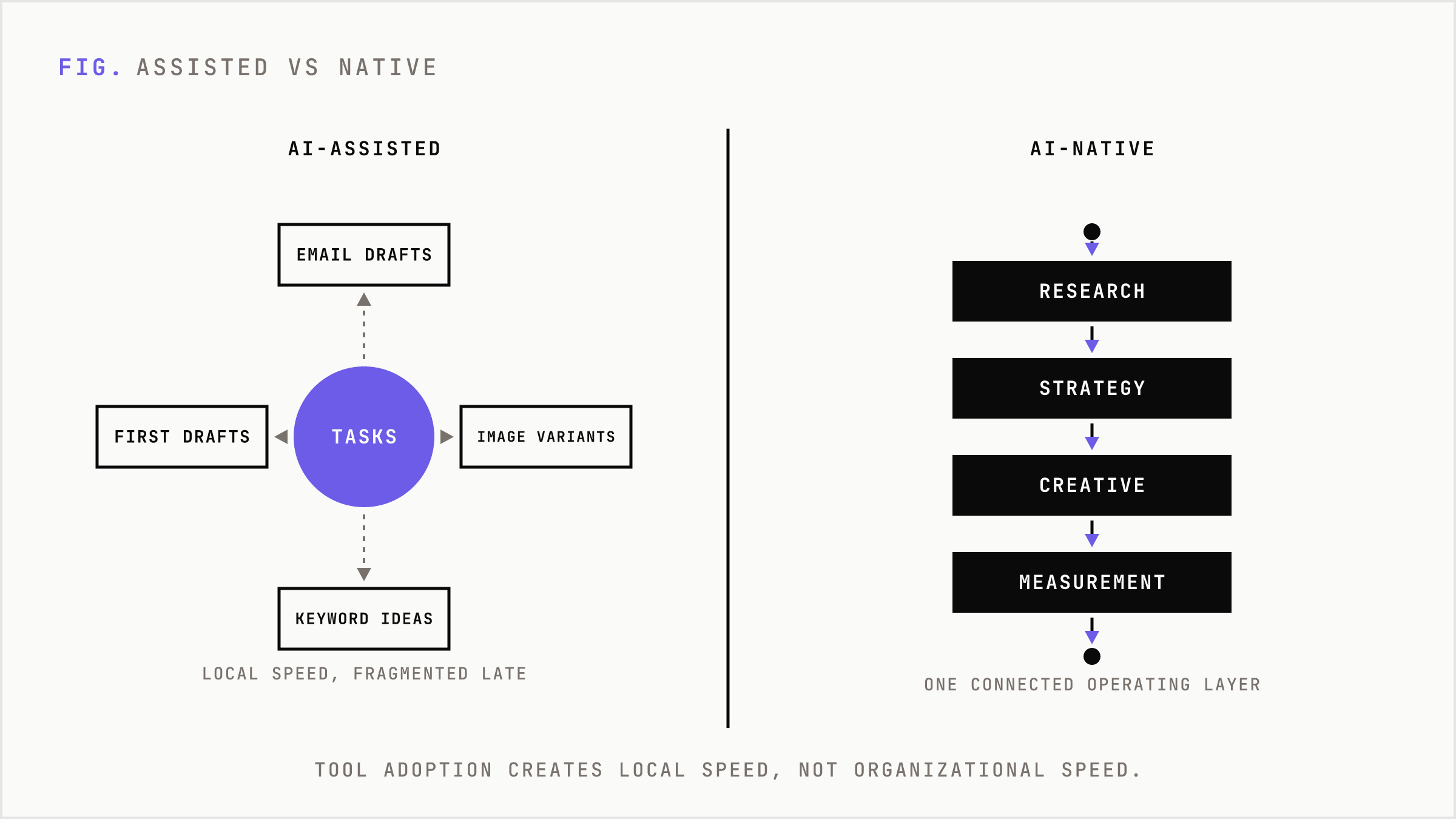
The problem is that existing workflows were built for slower cycles. Research sits in one place. Campaign briefs sit in another. Creative feedback happens in threads. Media decisions happen inside ad platforms. Reporting arrives after the budget has already moved. The team may have ten AI tools, but the operating model is still manual, fragmented, and late.
This is where the dominant pattern breaks. Tool adoption creates local speed. It does not create organizational speed. A content writer may publish faster while paid media still waits for approvals. A performance marketer may produce more variants while the brand team rejects half of them. An analyst may generate summaries while no one changes the budget decision.
That is why many AI marketing programs feel busy but not more intelligent. They increase output before they improve the loop. More assets. More dashboards. More prompts. The business still cannot answer the harder questions: which audience should get more spend, which message is creating qualified pipeline, which offer should be retired, which channel is profitable after margin and sales quality are included.
AI-native marketing changes the operating layer
AI-native marketing starts with a different premise. AI is not a productivity accessory. AI is the connective tissue across the marketing function.
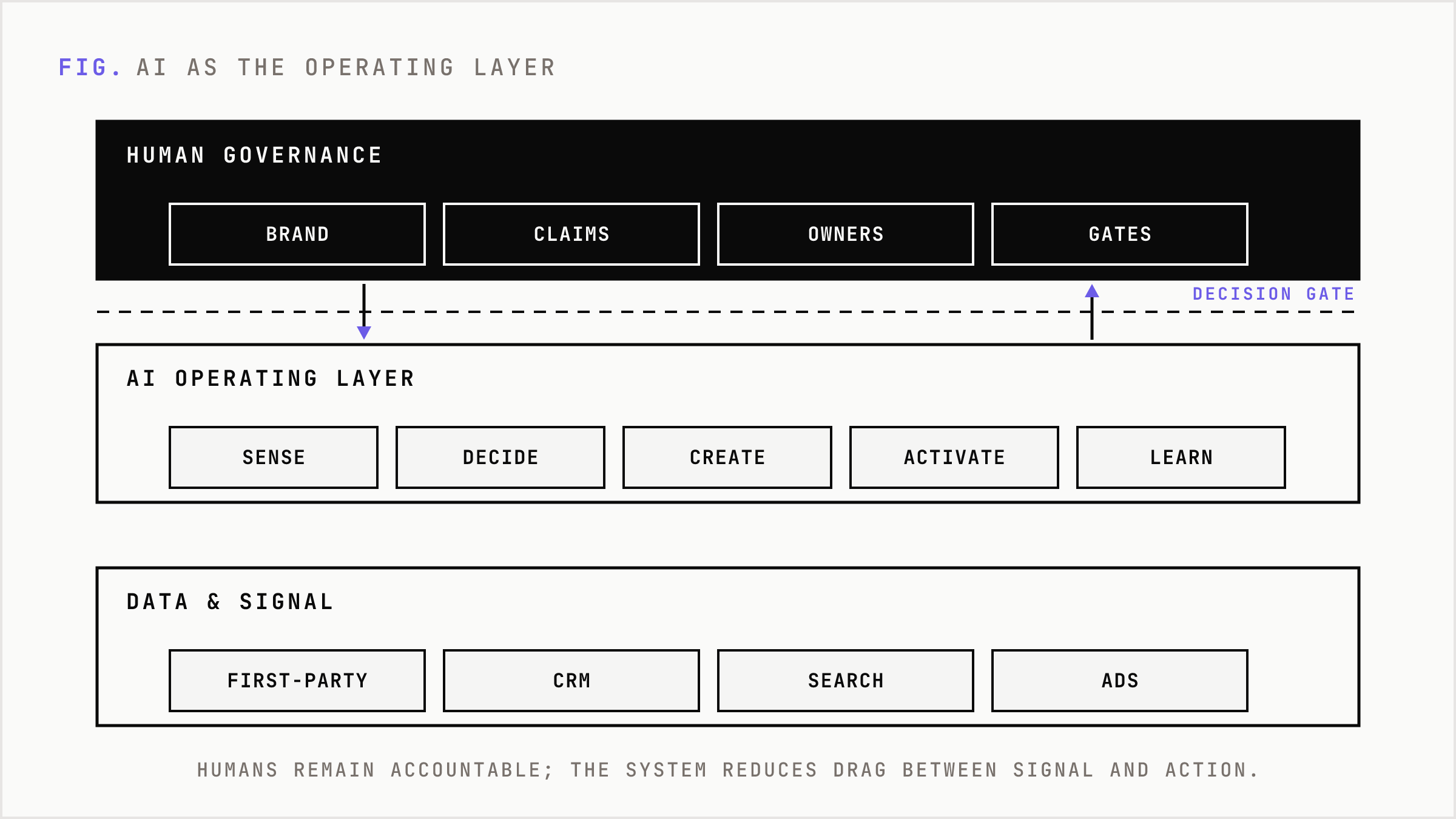
AI-native marketing is a governed marketing operating model where AI systems continuously assist with sensing, deciding, creating, activating, and learning.
The distinction matters. In an AI-native model, AI does not sit at the edge of work. It is wired into how work moves. Customer research informs positioning. Positioning informs creative briefs. Creative briefs inform channel variants. Channel performance informs new hypotheses. Measurement informs the next decision. Humans remain accountable, but the system reduces the drag between signal and action.
This is not about removing strategists, creatives, or operators. It is about changing the ratio of human judgment to manual coordination. Senior people spend less time hunting for context, rewriting the same brief, reconciling platform numbers, and explaining obvious variance. They spend more time choosing the right bet, protecting the brand, reading weak signals, and deciding what not to do.
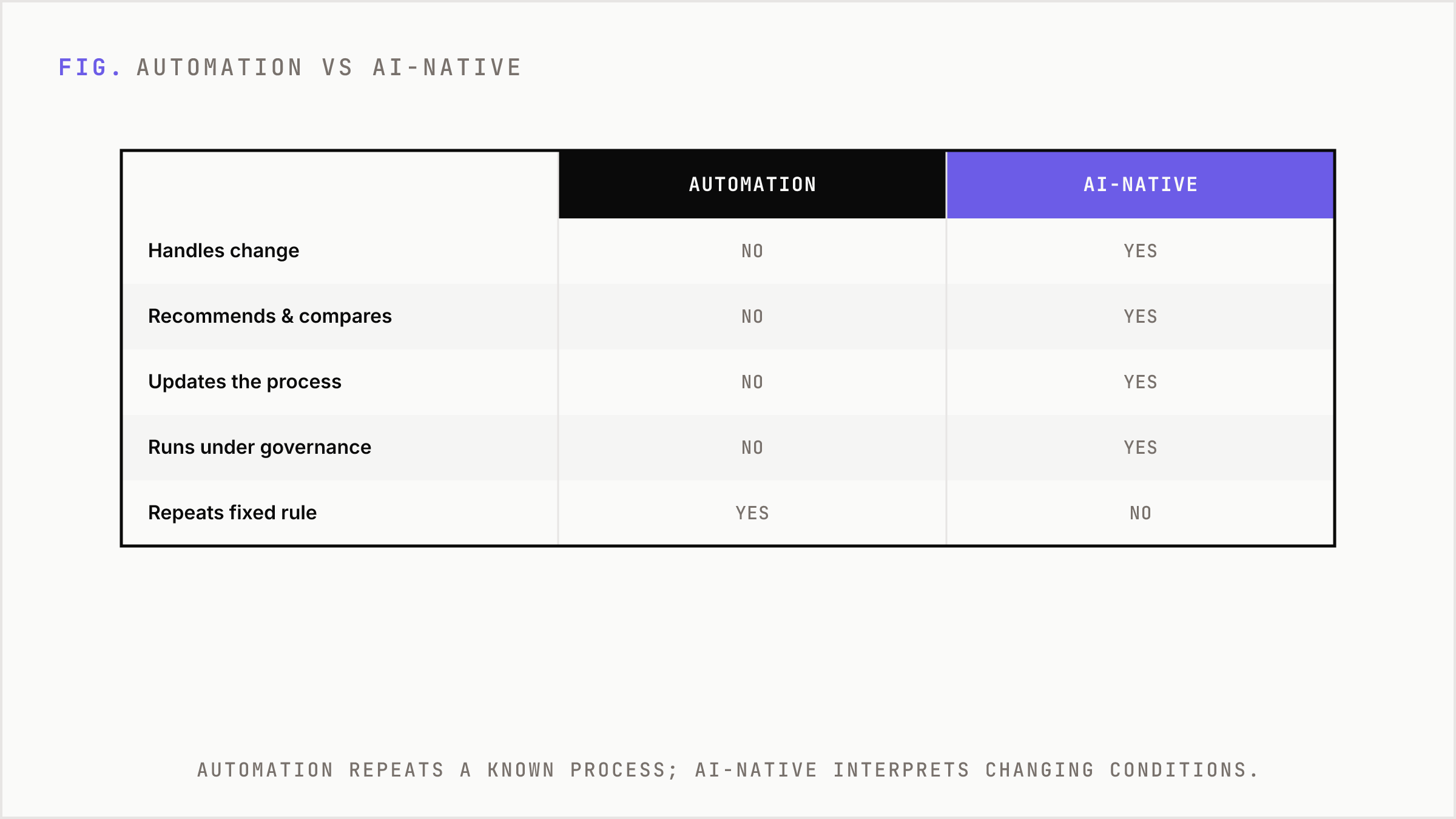
AI-native marketing is also not the same as automation. Automation repeats a known process. AI-native marketing helps the team interpret changing conditions and update the process itself.
Automation is a rule that executes.
AI-native marketing is a learning system that recommends, drafts, checks, compares, and adapts under governance.
That governance is non-negotiable. AI without judgment produces noise at scale. It can flood channels with thin content, chase platform metrics, misread customer language, or violate compliance boundaries. AI inside a real operating system has constraints: brand principles, approved claims, data permissions, measurement rules, decision owners, and review gates.
The Nyyon mechanism: the Campaign Intelligence Loop
Nyyon uses a framework we call the Campaign Intelligence Loop.
The Campaign Intelligence Loop is a governed system that connects market signal, strategy, creative production, activation, measurement, and decision review into one repeating cycle.
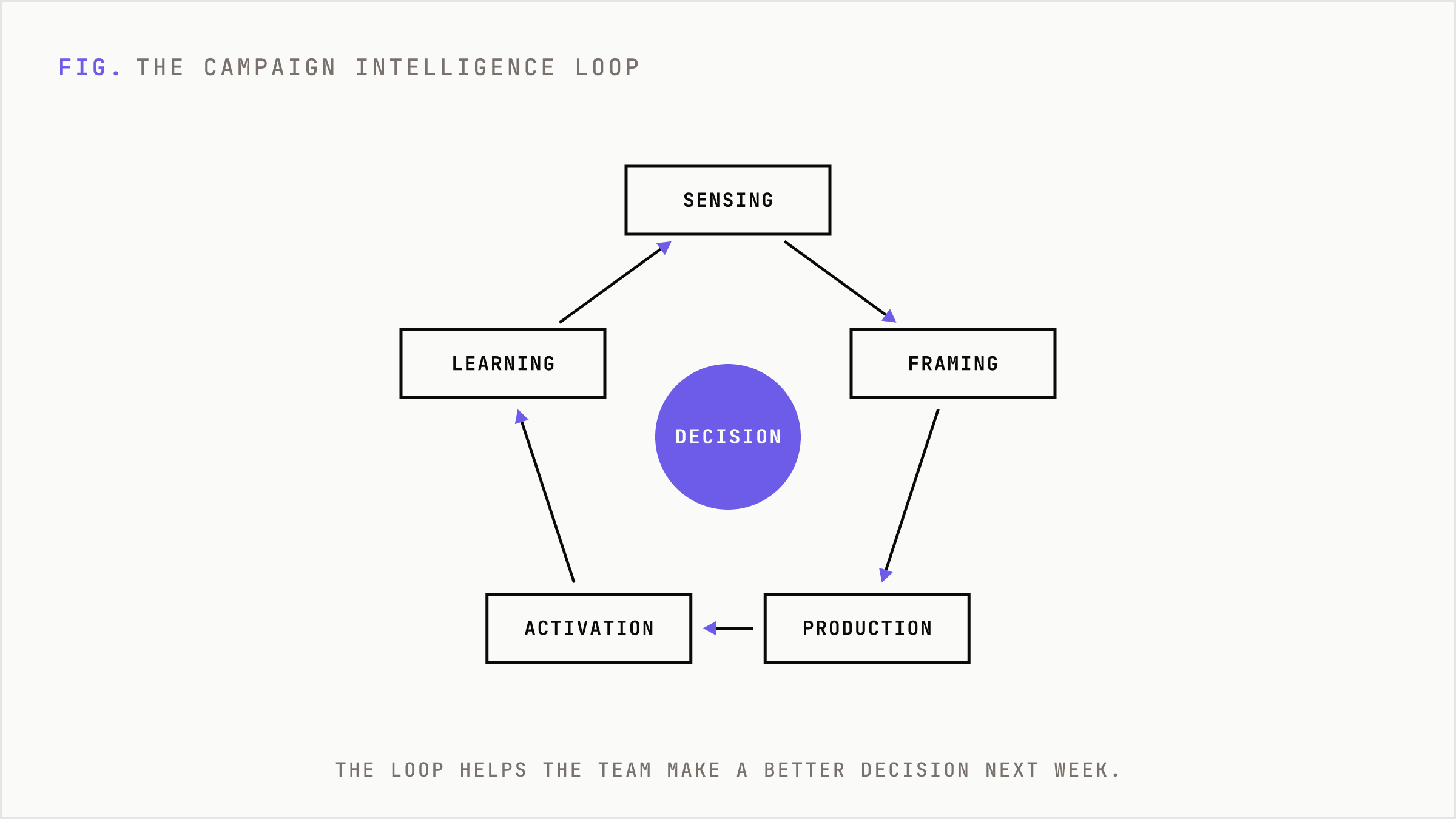
The loop has five moves. The first is sensing. AI systems scan first-party data, customer calls, search behavior, competitor messaging, ad account patterns, CRM movement, and campaign history. The goal is not to collect everything. The goal is to surface useful signal for a specific commercial question.
The second move is framing. Senior strategists turn that signal into a hypothesis. Not a vague theme. A testable bet. For example: enterprise buyers are responding to risk reduction more than speed, but the current landing page leads with speed. That is a strategy claim, not a content prompt.
The third move is production. AI systems generate structured briefs, message variants, landing page drafts, ad concepts, email sequences, and audience-specific angles. Humans edit for taste, accuracy, positioning, and legal risk. The output is faster because the context is already loaded into the system.
The fourth move is activation. Campaign assets move into the channels where they can be tested: paid search, paid social, lifecycle, partner campaigns, outbound, landing pages, or sales enablement. AI can help package variants for each channel, but humans set the budget logic and guardrails.
The fifth move is learning. The system reads performance against the right commercial metric. Not just CTR. Not just ROAS. Not just MQL count. The loop asks what changed in qualified pipeline, margin-adjusted revenue, sales acceptance, CAC payback, retention signal, or another metric that can survive executive scrutiny.
This loop is the difference between AI as a tab and AI as an operating model. The tab helps one person finish a task. The loop helps the team make a better decision next week.
How AI-native marketing works in practice
Take a B2B SaaS company with a pipeline quality problem. Demo requests are coming in, but sales accepted opportunities are flat. The traditional agency response is predictable: refresh creative, add more audience segments, produce a new report, and ask for more time.
An AI-native response starts with the decision. The decision is not whether the team needs more leads. The decision is which message, audience, and offer combination is most likely to create sales accepted pipeline.
On Monday, the system pulls recent sales call themes, CRM stage movement, ad search terms, landing page behavior, and closed-lost reasons. It finds that high-fit prospects mention implementation risk and internal adoption more than feature breadth. The current campaigns lead with feature breadth.
On Tuesday, strategists frame the hypothesis: the core buying anxiety is change management, not functionality. AI systems produce three campaign angles around implementation confidence, adoption support, and time-to-value proof. The team rejects weak claims, tightens the language, and maps each angle to approved proof points.
On Wednesday, the system creates channel-ready variants: search ad copy, LinkedIn ads, landing page sections, email follow-up, sales talk tracks, and a short comparison page outline. A human reviews every claim before anything ships.
On Thursday, the paid team launches a controlled test with budget limits. Lifecycle sends a matching sequence to stalled opportunities. Sales gets a one-page narrative so follow-up language matches the campaign.
On Friday and the following week, reporting focuses on the decision that matters. Did the implementation-confidence angle create better-fit conversations? Did it move opportunities further than the feature-led angle? Did sales use the talk track? Did the campaign attract the right company profiles?
Consequence 1: the team stops treating creative performance as a channel-only question. It connects message, audience, and pipeline quality.
Consequence 2: the team stops waiting for a monthly readout before making the next adjustment. Decision cycles shrink without removing human review.
Consequence 3: the agency economics change. Less time is spent rebuilding context and formatting reports. More time is spent on judgment, testing, and the next commercial move.
What changes and what stays the same
AI-native marketing changes the pace of learning. Teams can move from campaign calendars to campaign systems. Instead of launching a large campaign and defending it for a quarter, they run tighter loops with clearer hypotheses and faster readouts.
It changes creative volume, but volume is not the main advantage. The advantage is variation with memory. A system that remembers past positioning, winning objections, rejected claims, audience nuances, and channel constraints can create better starting points. The human team still decides what deserves to represent the brand.
It changes measurement. The report is no longer a static artifact created after the work. Measurement becomes part of the work. Metrics are defined before activation. AI helps monitor patterns, but the team decides which patterns are causal enough to affect budget.
It changes the role of the agency. Traditional agencies often sell hours, meetings, and production capacity. AI-native agencies have to sell decision quality, operating speed, and accountable campaign systems. That is a harder standard. It is also the only standard that makes sense when execution costs fall.
Some things do not change. Positioning still matters. Taste still matters. Compliance still matters. A weak offer does not become strong because AI rewrote the landing page. A confused strategy does not become clear because a model produced fifty ad variants. A bad data foundation does not become trustworthy because a chatbot summarized it.
The trade-offs are real. AI-native marketing requires cleaner inputs, stronger decision rights, and more disciplined governance. It exposes vague strategy faster. It punishes teams that cannot agree on the metric that matters. It also reduces tolerance for pet tools because every disconnected system adds drag.
The teams that benefit most are not the ones trying to replace their marketers. They are the ones with real products, real customer signal, and a willingness to let evidence change the plan.
Who AI-native marketing is for
AI-native marketing is for companies where speed and judgment both matter. B2B SaaS teams use it to connect positioning, pipeline, and paid media. Fintech and health tech teams use it when governance and approved claims are critical. DTC teams use it when creative testing, margin pressure, and channel shifts demand faster learning.
It is not for companies that want cheap content with no strategic spine. It is not for teams that measure success only by activity. It is not for leaders who want AI to remove accountability from marketing decisions.
The simplest test is this: if your team can name the commercial decision a campaign is meant to improve, AI-native marketing can help. If the campaign exists only because the calendar says something should ship, AI will mostly help you ship noise faster.
The mature version of AI-native marketing is not a stack of tools. It is a governed decision system. Research feeds strategy. Strategy feeds creative. Creative feeds activation. Activation feeds measurement. Measurement feeds the next decision. Humans hold the wheel. AI is the engine.
That is the real definition of AI-native marketing: a marketing organization designed to compound better decisions, not merely produce more work.