Nyyon · Blog
What Is a Marketing Data Spine?
A marketing data spine is the governed system that connects customer identity, spend, revenue, metrics, and activation across tools.
A marketing data spine is the operating system for marketing decisions. What is a marketing data spine? It is the governed data architecture that connects customer identity, events, media spend, revenue, metrics, and activation across the marketing stack. It turns scattered tool data into a trusted decision layer for humans and AI agents.
A marketing data spine is a governed connective layer, not a single dashboard, warehouse, CDP, or attribution tool.
The word spine matters. A spine does not replace every organ in the body. It connects the system, carries signals, and gives the body enough structure to move with intent. Marketing needs the same thing because most teams now run on fragmented signals: platform ROAS in one place, CRM stages in another, web events somewhere else, margin data in finance, and campaign notes trapped in slide decks.
Most teams build tool piles, not spines
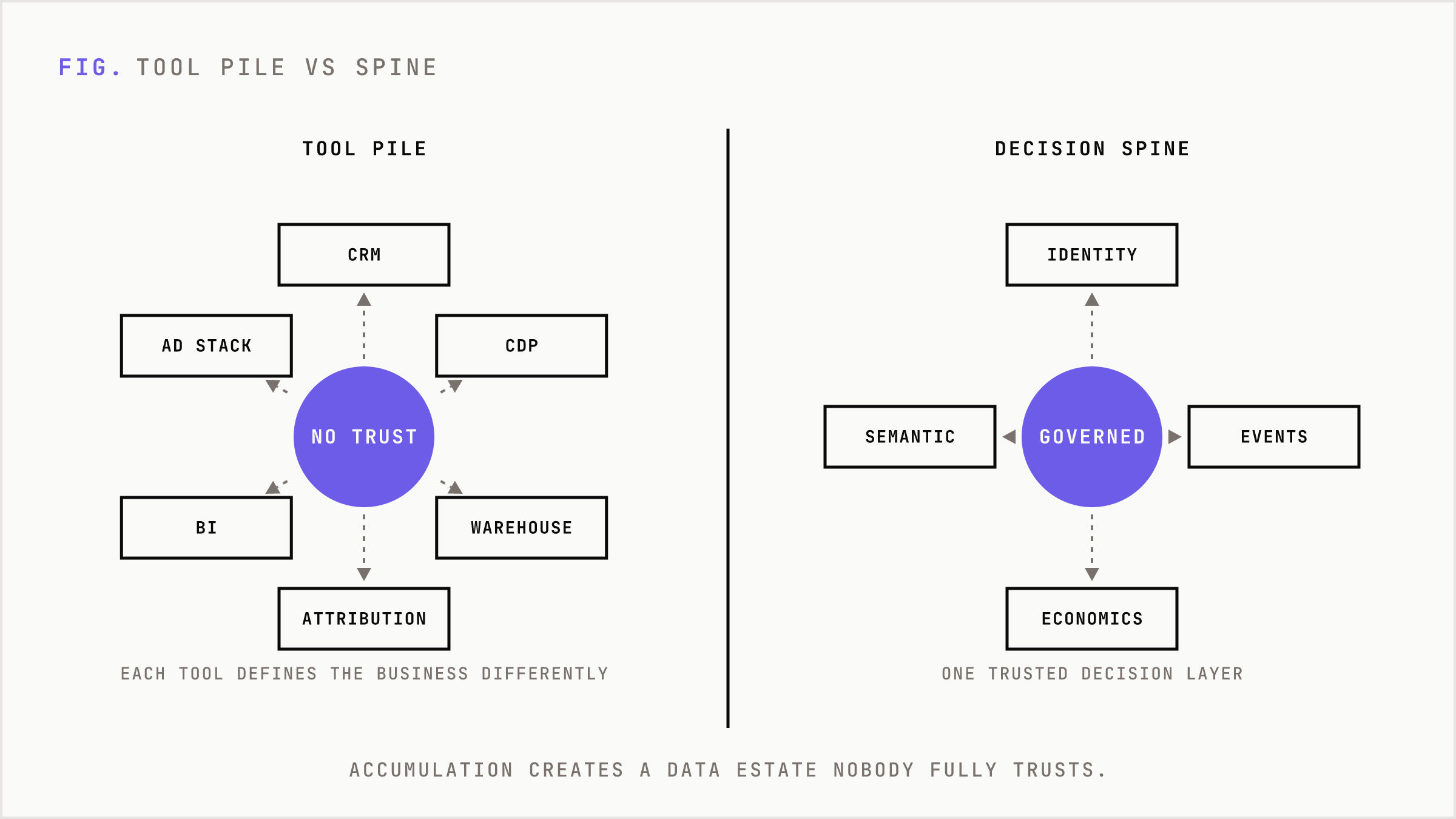
The dominant pattern is tool accumulation. A team buys a CRM, a CDP, a warehouse, a BI platform, attribution software, a lifecycle tool, a paid media stack, and a handful of AI products. Each tool has a useful function. Together, they often create a data estate nobody fully trusts.
The problem is not that the tools are bad. The problem is that each tool defines the business differently. Google Ads sees clicks and conversions. Salesforce sees leads, opportunities, and closed revenue. Shopify sees orders and refunds. Stripe sees payment events. HubSpot sees contact activity. Finance sees margin and cash. Each system is locally rational and globally incomplete.
That breaks the operating rhythm. Marketing meetings become debates over which number is correct instead of decisions about what to change. Paid media teams optimize toward platform conversions. Sales teams complain about quality. Finance asks why CAC moved. Leadership sees five dashboards and still cannot answer the question that matters: where should the next dollar go?
AI makes this worse when the foundation is weak. An AI agent connected to messy, conflicting systems will move faster into confusion. It will summarize bad metrics, recommend budget changes from biased conversion data, and generate confident explanations from incomplete context. Speed without a spine is just faster noise.
The Nyyon Decision Spine gives marketing a governed center
The Nyyon Decision Spine is a framework for turning marketing data architecture into weekly decisions, governed metrics, and agent-ready workflows.
It has one purpose: make marketing data usable for action. Not prettier reporting. Not more tabs. Not another executive dashboard that gets opened before the board meeting and ignored the next morning.
The Decision Spine connects four layers. The identity layer resolves who a customer, account, lead, or household is across systems. The event layer captures what happened: visits, form fills, ad clicks, demo requests, product actions, purchases, renewals, refunds, and sales touches. The economics layer ties spend, revenue, gross margin, payback, and lifecycle value to those identities and events. The semantic layer defines the metrics, rules, and business logic people and AI systems are allowed to use.
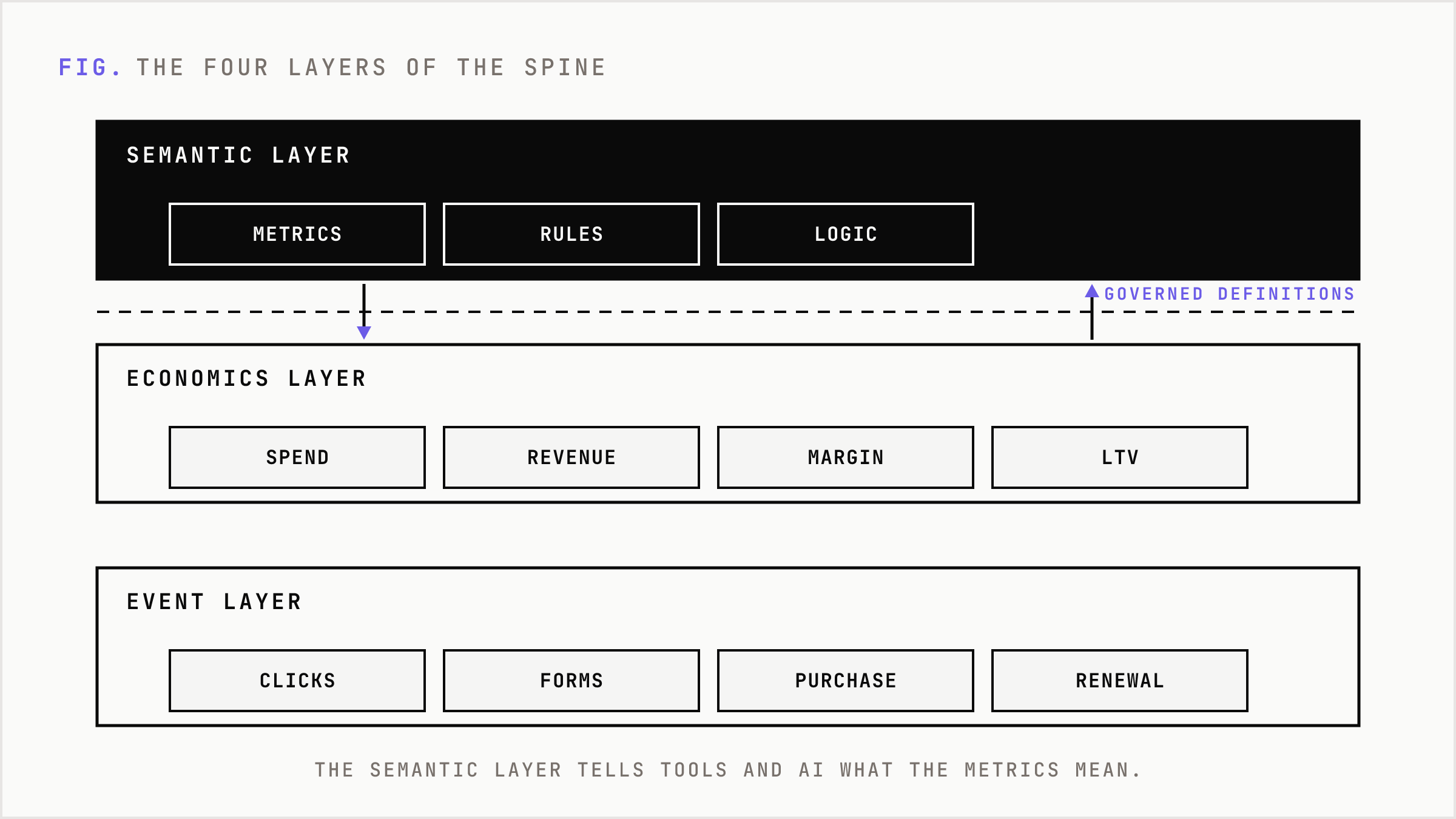
A semantic layer is the governed definition layer that tells tools what metrics mean.
Without that layer, every dashboard becomes an opinion. One team calculates CAC on first-touch leads. Another calculates it on pipeline. Another uses closed-won revenue but ignores discounts. Nobody is lying. The organization just has no metric constitution.
A marketing data spine creates that constitution. It says what a qualified opportunity is. It says when revenue counts. It says how spend is allocated. It says which conversion events are optimization signals and which are reporting signals. It says which fields are trusted, which are directional, and which should not drive budget decisions.
The spine has four jobs
The first job is identity. Marketing cannot make strong decisions if the same buyer appears as a cookie, a lead, an account, a subscriber, a trial user, and a customer with no durable link between them. Identity does not need to be perfect to be useful. It needs clear rules, known gaps, and stable keys that connect the systems that matter.
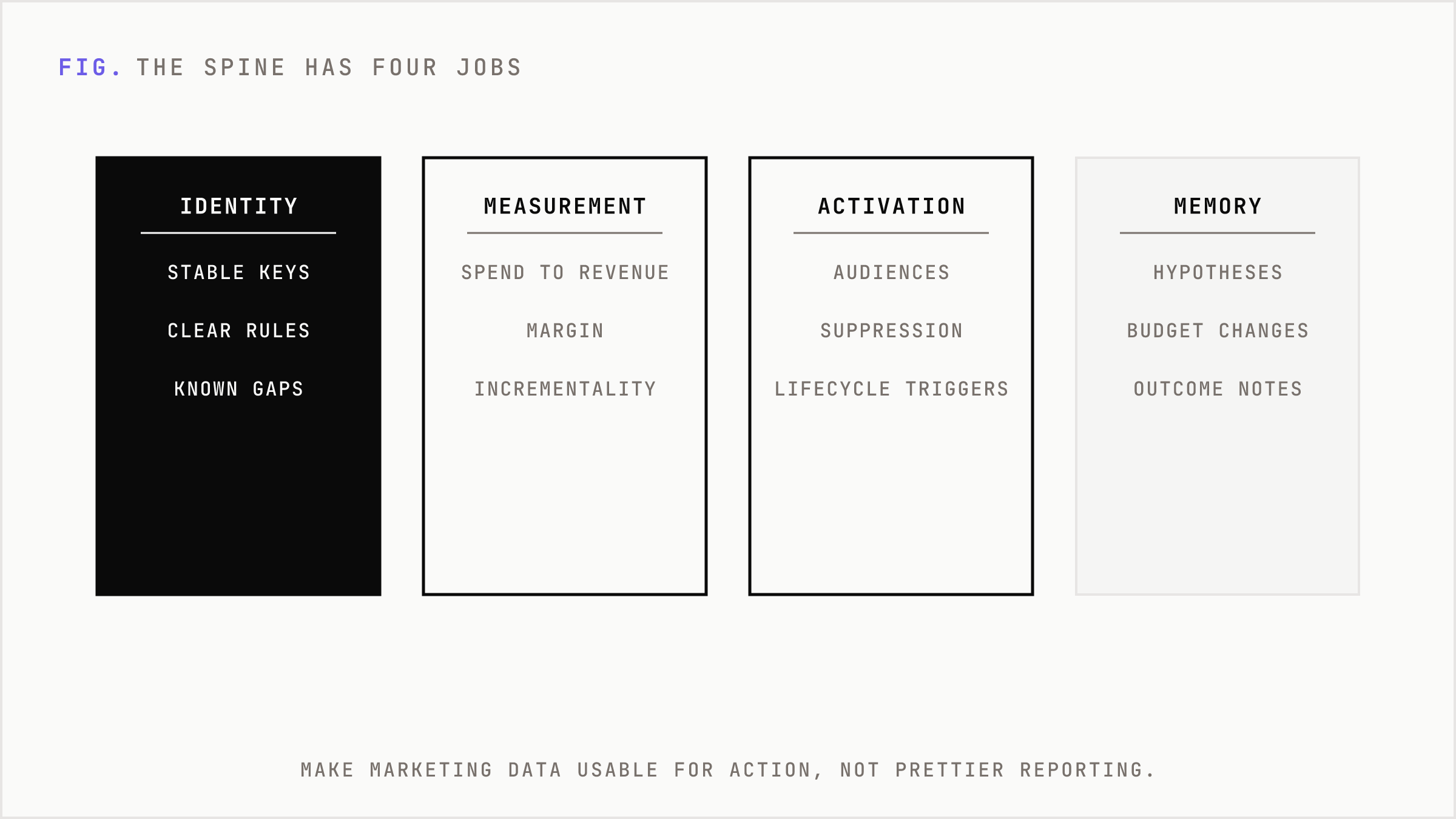
The second job is measurement. A spine separates platform-reported performance from business performance. Platform data is still useful. It tells you what a channel thinks happened inside its own view of the world. It should not be treated as profit truth. The spine ties spend to revenue, margin, pipeline, retention, and incrementality evidence where that evidence exists.
The third job is activation. Data should not sit in the warehouse waiting for someone to export a CSV. A spine sends clean audiences, suppression lists, lifecycle triggers, lead scores, account signals, and experiment assignments back into the tools where work happens. The point is not to centralize everything for its own sake. The point is to create a governed loop between decision and execution.
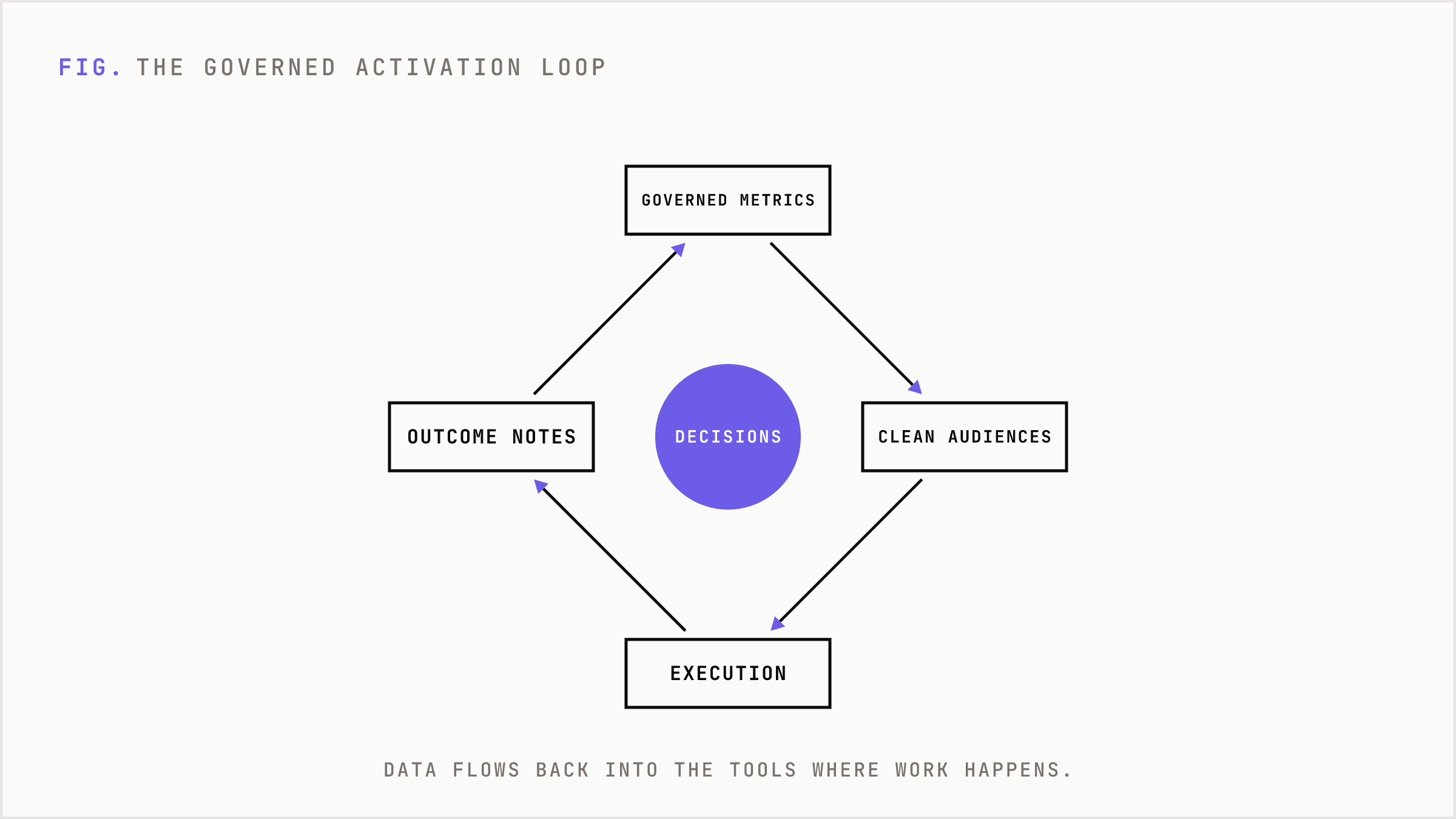
The fourth job is memory. Marketing teams forget why they made decisions. A spine should preserve campaign context, test hypotheses, creative claims, audience definitions, budget changes, and outcome notes. This is where AI becomes more useful. Agents need memory, not just access. They need to know what was tried, what happened, and what the team believed at the time.
Marketing memory is the structured record of decisions, assumptions, experiments, and outcomes that compounds learning over time.
How it works in practice
Take a B2B SaaS company selling to mid-market finance teams. It runs paid search, LinkedIn, partner webinars, outbound, product-led trials, and lifecycle email. The CRM is Salesforce. Marketing automation is HubSpot. Product events live in Segment. Spend comes from ad platforms. Revenue and invoices sit in the billing system. The board wants CAC payback and pipeline quality by motion.
Without a spine, each function optimizes its own slice. Paid search reports efficient conversions. LinkedIn reports high engagement. Sales says webinar leads are weak. Product says trial users from one campaign activate at a higher rate. Finance says payback is getting worse. Every team has evidence. None of it is aligned enough to settle a budget question.
With a marketing data spine, the company defines a shared account key, maps leads and users to accounts, connects campaign touchpoints to opportunity stages, joins spend to channels and offers, and applies one set of metric definitions. Then it creates decision views by motion: sales-led pipeline, product-led activation, expansion, and renewal influence.
Three consequences follow. 1. Budget conversations move from channel preference to marginal business impact. 2. AI agents can monitor anomalies against governed metrics instead of scraping dashboard fragments. 3. Campaign retrospectives become reusable evidence, not one-off narratives.
The concrete shift is simple. The paid media team is no longer asked only whether Google Ads beat LinkedIn on reported conversion cost. The better question is which campaigns produced accounts that moved to qualified pipeline, activated in product, matched the ideal customer profile, and carried acceptable economics. That answer may still support Google. It may support LinkedIn. It may support neither. The spine gives the team enough structure to decide without theater.
What changes when the spine is real
The first change is decision velocity. Teams spend less time reconciling numbers and more time choosing actions. This matters because marketing advantage now compounds through decisions per week: what to test, what to stop, what to scale, what to rewrite, what to suppress, and what to route to sales.
The second change is AI readiness. AI agents can only own useful workflows when the inputs, permissions, and definitions are stable. A campaign intelligence agent can flag spend waste. A lifecycle agent can recommend segment changes. A reporting agent can draft weekly performance memos. But those agents need governed inputs or they become another source of dashboard sprawl.
The third change is accountability. A spine makes it harder to hide behind channel-native metrics. ROAS, MQL counts, open rates, and click-through rates can still be diagnostic. They stop being the final argument. The final argument becomes business movement: profit, pipeline quality, payback, retention, and learning that affects the next decision.
Some things do not change. Teams still need judgment. Creative still matters. Positioning still matters. Sales follow-up still matters. No architecture fixes a weak offer, a confused buyer, or a campaign that says nothing specific. The spine does not replace strategy. It gives strategy a better nervous system.
The trade-off is governance, not tool complexity
The main trade-off is discipline. A marketing data spine requires owners for definitions, data quality, access, and decision workflows. Someone has to decide what counts as a qualified lead. Someone has to maintain channel taxonomy. Someone has to say which metrics are approved for budget decisions. Someone has to document when the rules change.
That work is less glamorous than buying a new tool. It is also where most of the value sits. The companies with strong spines usually do not have the most software. They have fewer unresolved arguments. They have cleaner joins between customer behavior and business economics. They have a clearer line from marketing action to financial consequence.
A spine can be built inside a modern warehouse. It can be supported by a CDP. It can feed BI, paid media platforms, CRM workflows, and AI agents. The specific stack depends on company stage, sales motion, privacy requirements, and data maturity. The principle stays the same: buy fewer isolated tools and build the connective tissue that makes the tools accountable to one operating model.
The wrong question is which platform is the marketing data spine. The right question is whether your marketing organization has a governed system for identity, events, economics, metrics, activation, and memory. If it does, AI can accelerate real decisions. If it does not, AI will mostly accelerate the old argument about whose dashboard is telling the truth.