Nyyon · Blog
What Is a Marketing Agent vs. a Workflow?
A marketing agent is a single-purpose AI function; a workflow is a fixed chain with one entry point and one exit point.
A marketing agent is not a workflow with better branding. A marketing agent is a single-purpose AI function designed to replace or perform a specific function inside a marketing organization. A workflow is a continuous chain with one entry point, one exit point, and a middle that teams rarely enter or rearrange.
That distinction matters because most marketing teams are still building AI systems as rigid process diagrams. They map the journey, automate each step, and call the result an agent. The better model is more modular: build granular agents once, drop into them when needed, and thread them together in different orders through a chat interface, router, or orchestration layer.
The dominant pattern is still the fixed workflow
A workflow is a predefined chain of steps that moves work from trigger to outcome.
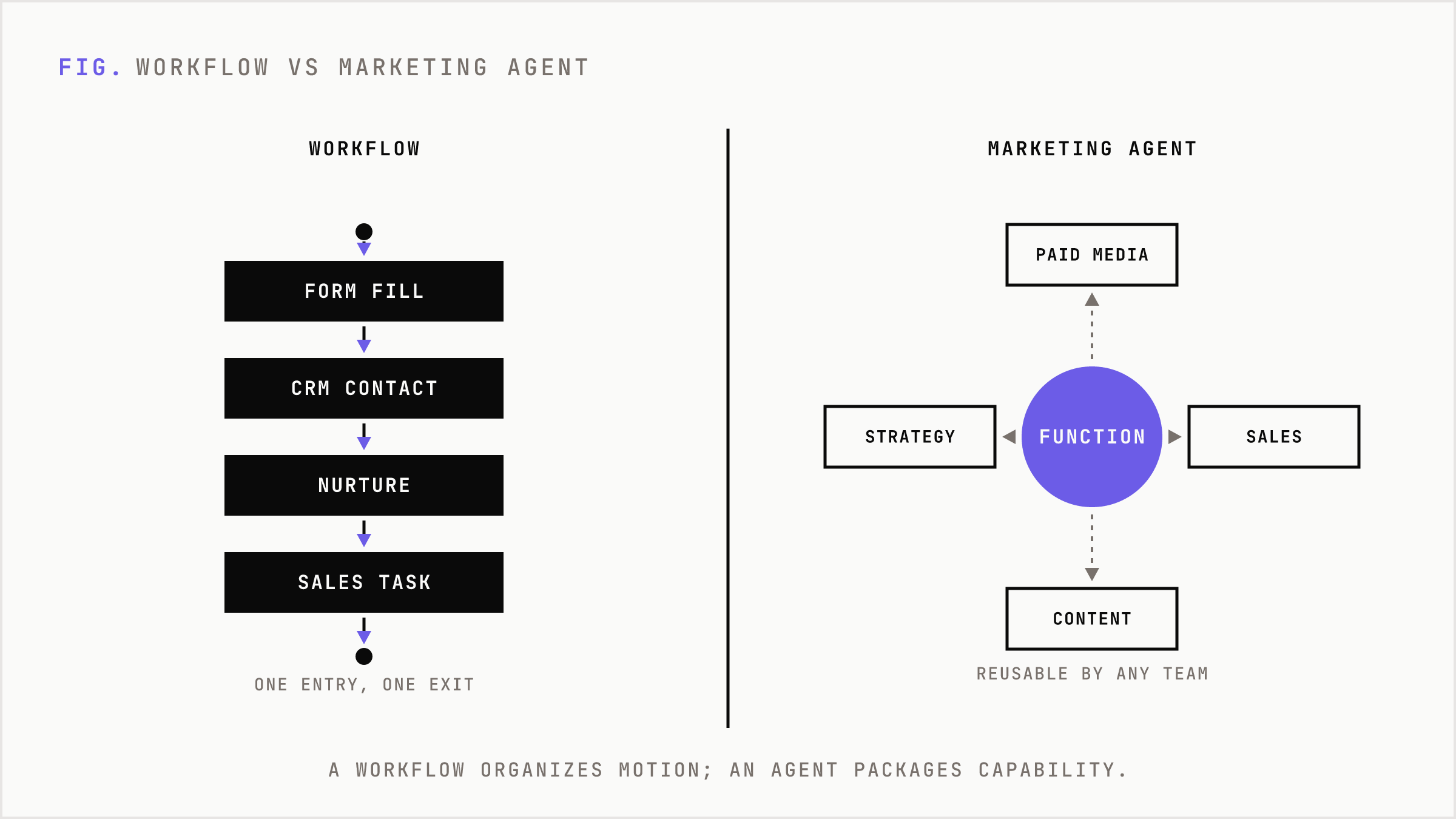
Workflows made sense when marketing automation meant pushing known records through known paths. A lead fills out a form. The CRM creates a contact. The nurture sequence starts. Sales gets a task. Reporting updates the dashboard.
That structure is useful when the work is repetitive and the decision tree is stable. It breaks when the work requires interpretation, adaptation, or multiple possible routes.
Most AI workflow projects fail in the same way. The team starts with a large marketing process, then tries to automate the whole chain. They wire together prompts, tools, and API calls until the system looks impressive in a demo. Then a real campaign introduces an exception. A new offer changes the inputs. A different segment needs a different research path. A channel owner wants to enter halfway through the process instead of starting at the beginning.
The workflow resists that request because it was designed as a continuous chain. It has one entry and one exit. The middle exists to be passed through, not entered, inspected, replaced, or reused.
That is why many AI marketing stacks become brittle. The more sophisticated the workflow becomes, the harder it is to maintain. A small change in one step can break the downstream steps. The system starts to require the same kind of operational babysitting it was supposed to reduce.
A marketing agent is a granular function, not a campaign machine
A marketing agent is a single-purpose AI function that performs a defined marketing task with enough context, tools, and rules to operate reliably.
The practical definition is narrower than the hype. Marketing agents are a broad category of single-function agents that aim to replace specific functions within a marketing organization. They are not magic employees. They are not autonomous CMOs. They are small, useful components.
Good agents are granular. One agent enriches an account. One agent classifies a support thread into churn risk. One agent turns a webinar transcript into a landing page brief. One agent audits a paid search query report for waste. One agent checks whether a draft violates brand rules before it goes to a human editor.
The point is not to build one large agent that owns marketing. The point is to build many single-purpose agents that can be dropped into and out of by anyone with permission.
This is an old-school structure with a new operating layer. Modular systems, functions, services, routers, and queues are not new ideas. What has changed is that language models now make it easier for non-engineering teams to invoke, compose, and govern those functions through natural language interfaces.
That caveat matters. Calling everything an agent makes teams sloppy. The agent label only helps if the function is bounded, testable, maintainable, and useful outside one single chain.
The Nyyon framework: chain versus modular agent stack
The Chain Versus Modular Agent Stack is a framework for deciding whether a marketing process should be built as a workflow or as a set of agents.
Use a workflow when the path is stable, the logic is known, and the business wants standardization more than flexibility. Use a marketing agent when the function is reusable, the inputs vary, and different teams may need to call it in different contexts.
The test is simple: can the middle be useful on its own?
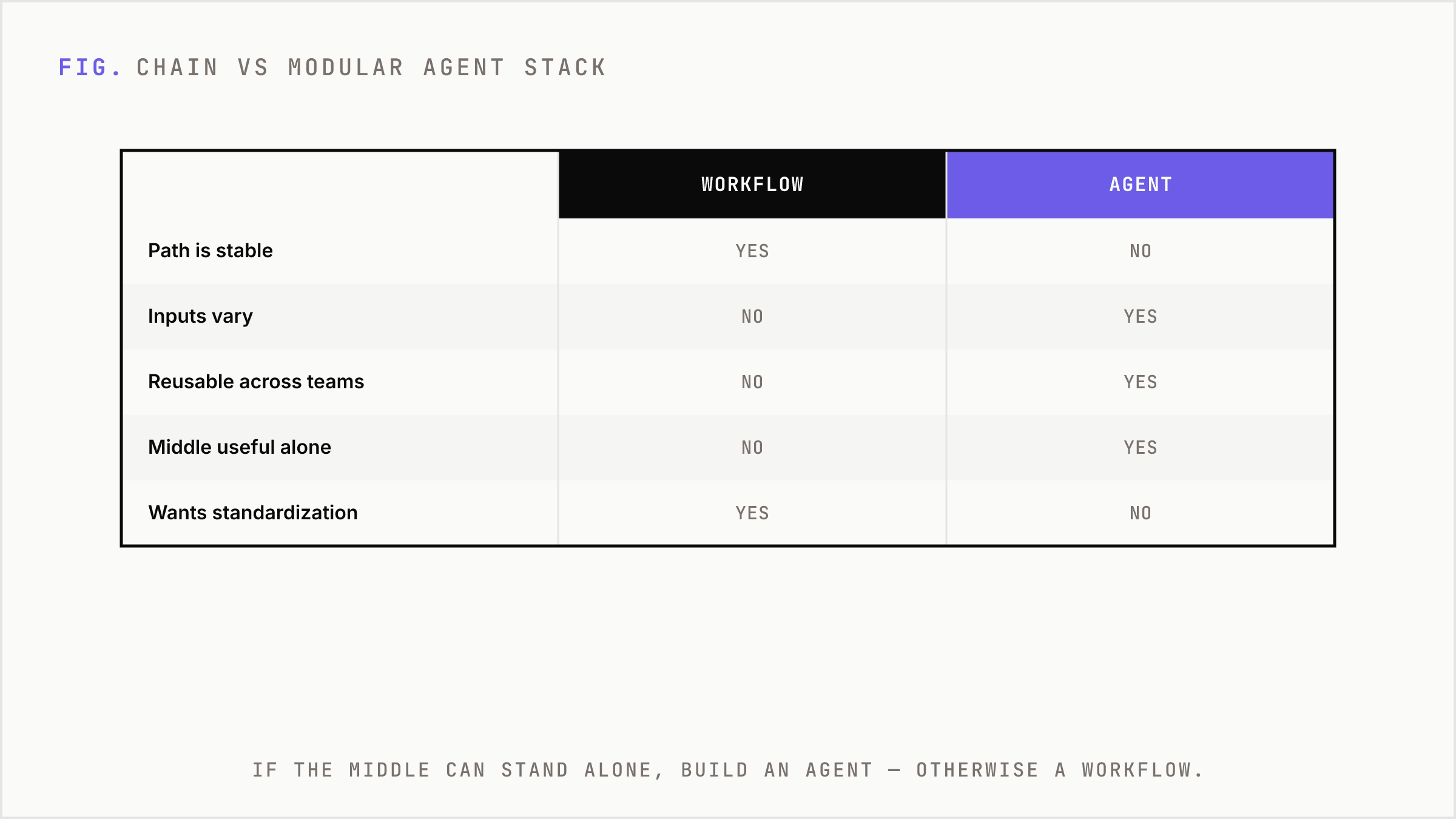
If the answer is no, the work probably belongs in a workflow. If the answer is yes, it should probably be an agent.
A lead routing sequence is often a workflow. A company submits a form, the score is calculated, the record is assigned, the SLA timer starts, and the rep is alerted. The value comes from the sequence.
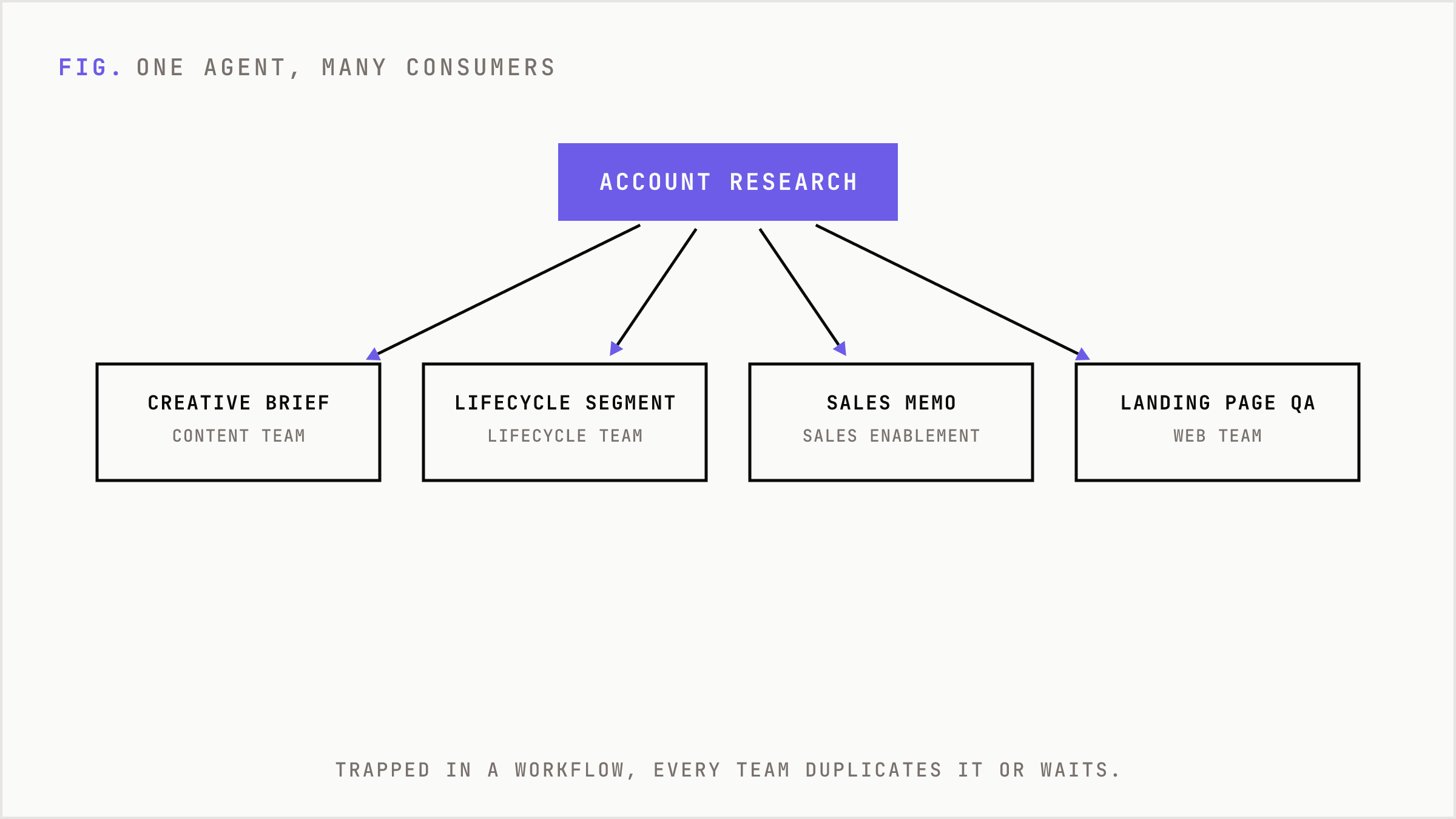
An account research function is better as an agent. Paid media may need it before launching a target account list. Sales may need it before outreach. Content may need it before writing an industry page. Strategy may need it before building a quarterly plan. If it is trapped inside one workflow, every other team either duplicates it or waits for the workflow owner.
This is the core difference. A workflow organizes motion. An agent packages capability.
When you build a marketing stack using agents, modularity becomes the advantage. A chatbot or internal command interface can trigger agents in varying flows and rearrange them according to the need of the work. The same research agent can feed a creative brief, a lifecycle segment, a sales enablement memo, or a landing page QA process.
That is much less rigid than the traditional workflow. It also creates a compounding effect. Every new agent is connected to every other agent because the threads between them can be created as needed, in a fluid state.
How a modular marketing agent stack works in practice
A modular marketing agent stack is a set of small agents connected through a shared interface, data layer, and execution environment.
The stack does not need to be elaborate. A practical version has five parts: a chat interface or command surface, an agent router, a shared data spine, small execution services, and governance rules.
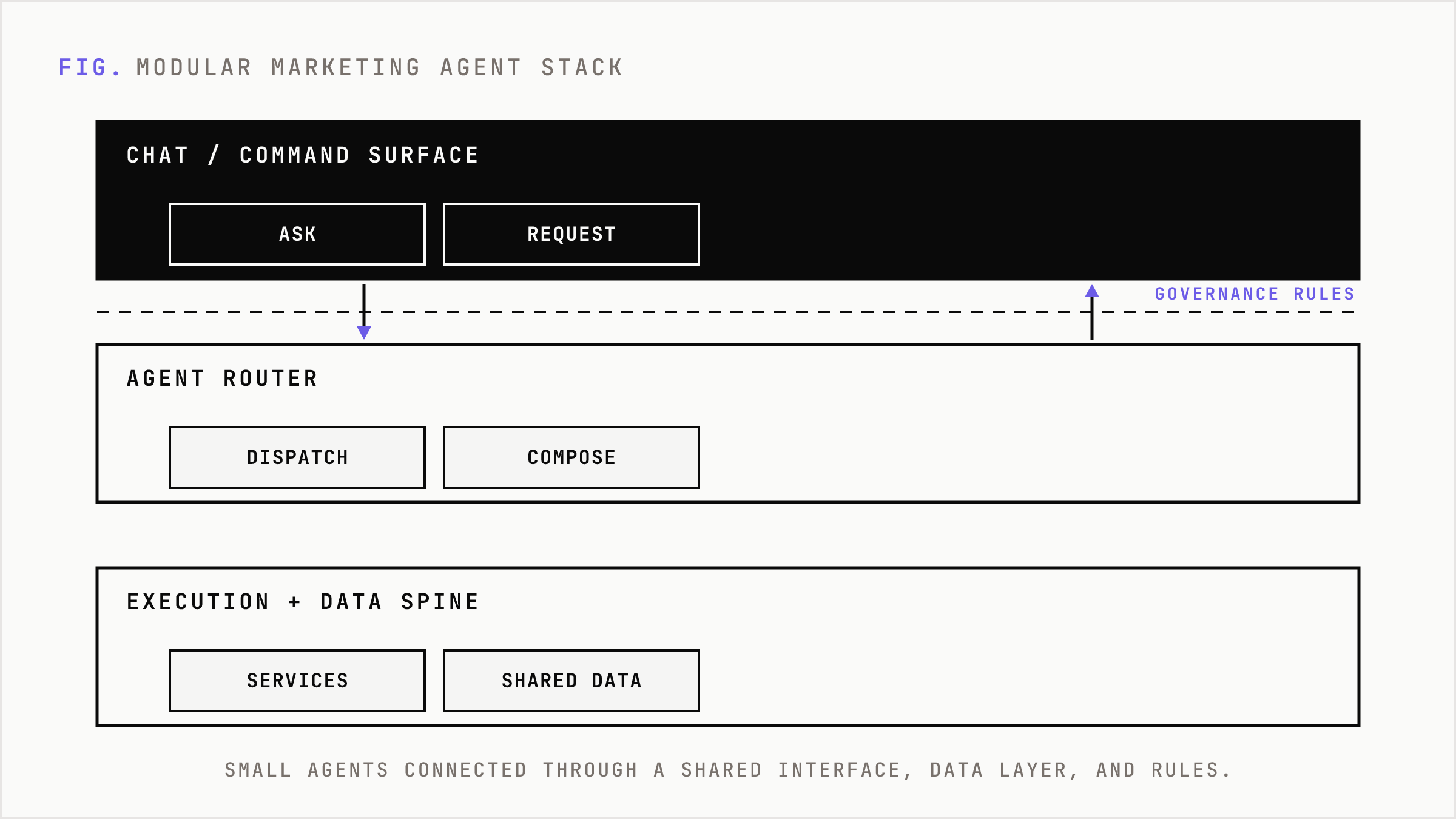
The chat interface is where a strategist, media buyer, lifecycle marketer, or analyst asks for work. The router decides which agent or agents should run. The data spine provides governed access to customer, campaign, spend, revenue, and content data. The execution layer runs the work. The governance layer controls permissions, logs decisions, and keeps humans responsible for judgment.
In our preferred pattern, many agents are simple enough to live in Cloudflare Workers or similar serverless functions. That matters because not every step needs a large model call. A single-function agent can perform complex actions through code, call a model only when judgment or language is required, and avoid excessive token spend.
Token cost is not a side issue. Rigid AI workflows often send too much context to a model too often. They ask the model to hold the whole process in its head. That is expensive and less dependable than it needs to be.
A granular agent can carry a smaller prompt, a smaller context window, and a clearer job. Code handles deterministic work. The model handles interpretation. The output is easier to test because the agent has one job, not twelve.
Consider a campaign launch request from a growth lead: “Build the first pass for a fintech CFO campaign around payment reconciliation pain.” A workflow would push that request through a fixed path. A modular stack can call only the agents that are needed.
1. The account research agent identifies target account patterns and language from the CRM, site data, and call notes.
2. The offer mapping agent matches the pain to existing proof, product features, and objection patterns.
3. The creative brief agent converts the research into angles, claims, exclusions, and required evidence.
4. The paid search agent checks whether there is existing demand and flags waste-prone query themes.
5. The brand QA agent reviews draft copy against voice, compliance notes, and banned claims before a human approves it.
None of those agents has to be locked inside that campaign launch. Next week, the same brand QA agent may review a lifecycle email. The same account research agent may support outbound. The same paid search agent may audit an existing campaign without touching creative.
That is the practical gain. You build them once. They are easier to maintain and fix. They can be threaded together into complex workflows ad hoc with more dependability and malleability than one large process automation.
What changes when agents replace workflow-first thinking
The first change is maintenance. A broken workflow often forces the team to inspect the whole chain. A broken agent narrows the search area because the function is bounded. If the brand QA agent is producing weak flags, fix that agent. The account research agent does not need to change.
The second change is reuse. Workflow automation often produces hidden duplication. Different departments build slightly different versions of the same step because the original step is embedded in a larger process. Agents reduce that duplication because the function is exposed as a callable unit.
The third change is cost control. Smaller agents can use smaller prompts, code-heavy execution, and selective model calls. Some can run largely in a serverless environment with a robust free tier. That structure lowers token waste and makes the system easier to scale without turning every marketing task into an expensive model conversation.
The fourth change is decision velocity. Teams stop waiting for one master workflow to support every edge case. They compose the path they need, run the agents that matter, and hand the result to a human owner for judgment.
What stays the same is accountability. Agents do not remove the need for strategy, taste, measurement, or governance. A bad brief run through five agents is still a bad brief. A weak offer does not become strong because an agent reformats it. Humans still hold the wheel.
The trade-off is design discipline. Modular systems are easier to rearrange only when the modules are clean. If every agent has vague scope, inconsistent inputs, and no logging, the stack becomes a junk drawer. The gain comes from small functions, clear contracts, and a shared operating layer.
How do you build a marketing agent?
Build a marketing agent by choosing one repeatable function, defining its inputs and outputs, giving it access to the minimum tools it needs, and logging every run.
Start smaller than feels impressive. Do not start with “build a campaign agent.” Start with “turn a sales call transcript into three customer-language claims with evidence links.” That is bounded. It can be tested. It can be improved.
The build path is straightforward. First, name the function in plain language. Second, define who can call it and where it can be called from. Third, specify the input contract: transcript, URL, CRM record, campaign ID, product page, or file. Fourth, specify the output contract: JSON, brief, QA report, score, recommendation, or task. Fifth, decide what should be handled by code and what should be handled by the model. Sixth, add logging, evaluation examples, and a human approval step where the output affects spend, claims, or customers.
A simple agent can live as a serverless function. It can receive a request from chat, fetch approved context from the data spine, run deterministic code, call a model for the narrow judgment step, return a structured output, and write the result back to the system of record.
The important rule is that the agent should be useful outside the first use case. If it only works inside one long automation, it is probably a workflow step. If another team can call it independently next month, it is a marketing agent.
When a workflow is still the right answer
Workflows are not obsolete. They are still the right answer for stable processes where consistency matters more than adaptability.
Billing handoffs, compliance approvals, lead assignment, consent management, and routine lifecycle triggers often belong in workflows. The sequence is the product. The organization wants the same path every time.
Marketing agents are better when the organization needs reusable capability. Research, classification, summarization, QA, transformation, routing recommendations, reporting narratives, creative adaptation, and account analysis are strong candidates because they appear across many processes.
The strongest marketing operating systems use both. Workflows handle the rails. Agents handle the functions that need judgment, language, or reusable intelligence. The mistake is forcing one model to do both jobs.
A workflow asks, “What happens next?” A marketing agent asks, “What function should be performed here?” Senior marketing teams need both questions, but they should not build the same architecture for each one.