Nyyon · Blog
What Does a White-Glove AI Marketing Agency Do?
A white-glove AI marketing agency runs strategy, creative, media, data, and reporting through AI systems governed by senior humans.
A white-glove AI marketing agency does not sell AI prompts. What does a white-glove AI marketing agency do? It runs marketing strategy, creative, paid media, content, lifecycle, data, and reporting through AI systems governed by senior operators. The white-glove part is the service model: high-touch judgment, tight communication, and accountable execution instead of a tool handoff.
A white-glove AI marketing agency is a senior marketing team that uses AI as the operating layer for the work, not as a side tool.
That distinction matters because most companies do not need another dashboard, chatbot, or prompt library. They need a faster path from market signal to decision to shipped campaign. The agency earns its keep when it turns AI into a controlled operating system for growth, with humans setting direction and AI increasing the pace of useful work.
The old agency model adds AI to slow machinery
The dominant pattern is simple. A traditional agency keeps the same account structure, the same meeting rhythm, the same creative handoffs, and the same monthly reporting cycle. Then it adds ChatGPT, image generation, or automated media recommendations on top.
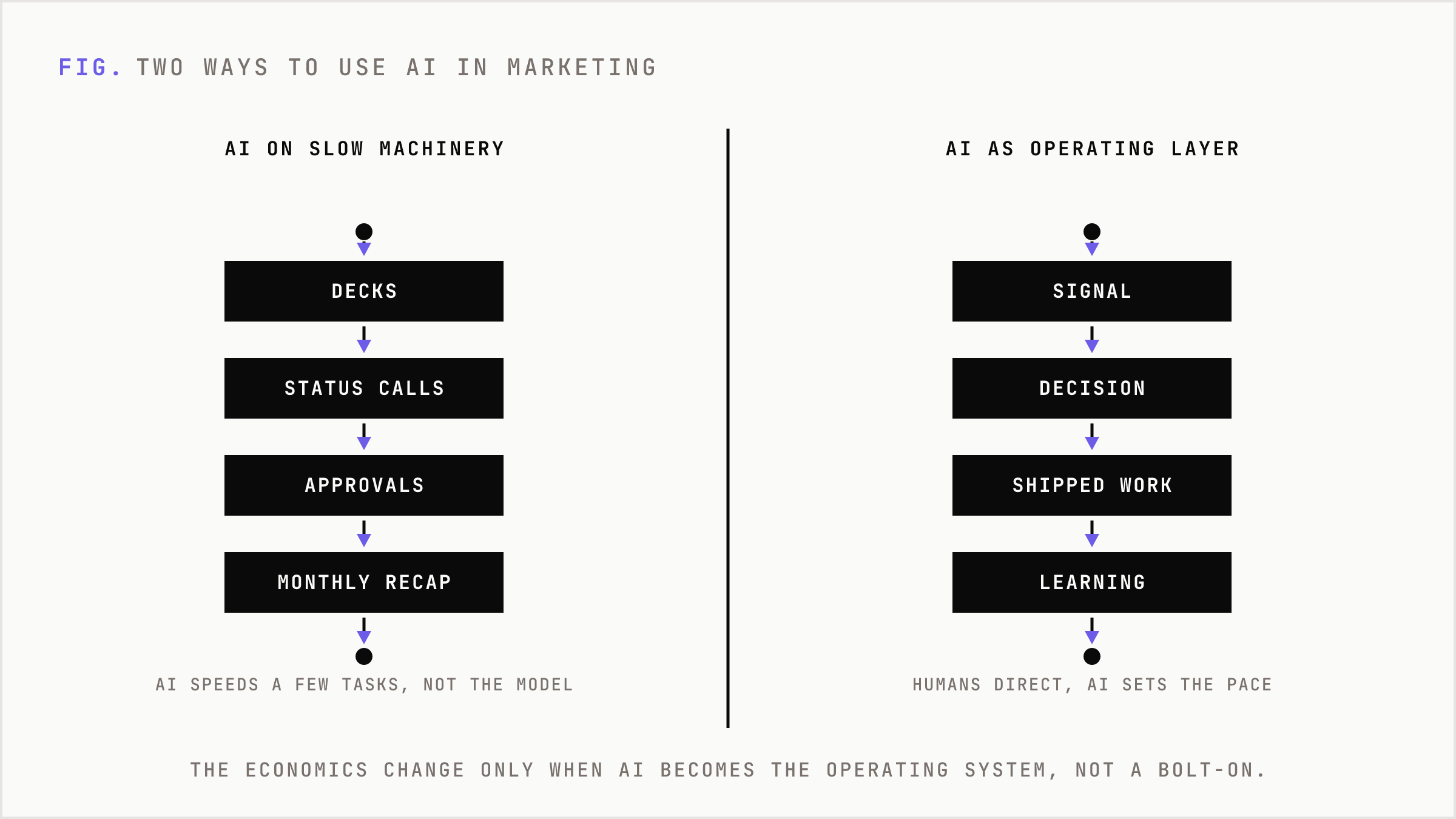
That creates the appearance of modernization without changing the economics. The client still pays for hours. The agency still protects margin by spreading senior attention thin. The work still moves through decks, status calls, approvals, and channel silos. AI makes a few tasks faster, but the operating model remains slow.
This is where the model breaks. Marketing is no longer only a production problem. It is a decision velocity problem.
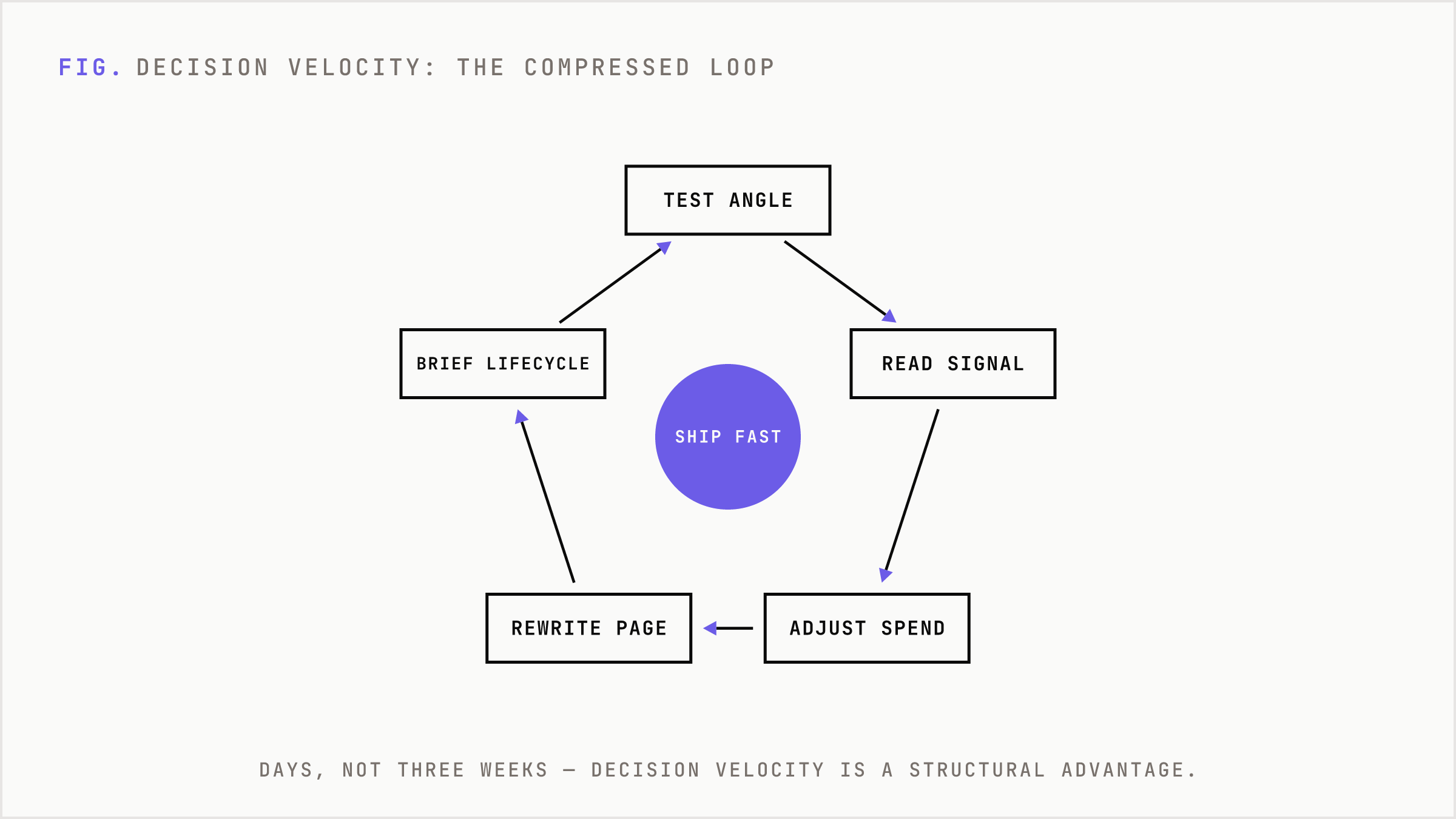
Decision velocity is the rate at which a team makes high-quality marketing decisions and turns them into shipped work.
A company that can test a positioning angle, read signal, adjust spend, rewrite the landing page, and brief lifecycle follow-up in days has a structural advantage over a company waiting three weeks for a campaign recap. AI should compress that loop. If it only helps an agency write emails faster, the client is still buying the old machine.
The second failure is measurement theater. Many agencies optimize toward channel metrics because channel metrics are easy to report. ROAS, MQL volume, click-through rate, and cost per lead can be useful inputs. They are not the business answer. A white-glove AI marketing agency must connect activity to pipeline quality, contribution margin, payback, retention, and the decisions leadership actually needs to make.
White-glove means senior judgment, not concierge fluff
White-glove is often used as a service adjective. It should mean something more concrete.
White-glove service is senior attention applied to the decisions that change outcomes.
In an AI-native agency, white-glove does not mean more calls, more slides, or a larger cast of account managers. It means the client gets access to strategists who can translate business context into marketing decisions, then put AI systems to work against those decisions.
That includes knowing what not to automate. AI can produce hundreds of ad variations. A senior operator decides which claim the market should hear, which audience is worth testing, which constraint matters, and which metric would create a false positive. AI can summarize sales calls. A senior operator decides whether those calls reveal a positioning issue, a pricing issue, a channel issue, or a product gap.
The best white-glove AI marketing agencies also carry governance into the work. They define brand boundaries, approval rules, data permissions, measurement standards, and escalation paths. That sounds less exciting than content generation. It is the reason the output is usable.
AI without governance creates noise at scale. AI inside a managed operating system creates faster execution with fewer random acts of marketing.
The Nyyon mechanism: the AI Marketing Operating System
Nyyon’s mechanism is the AI Marketing Operating System.
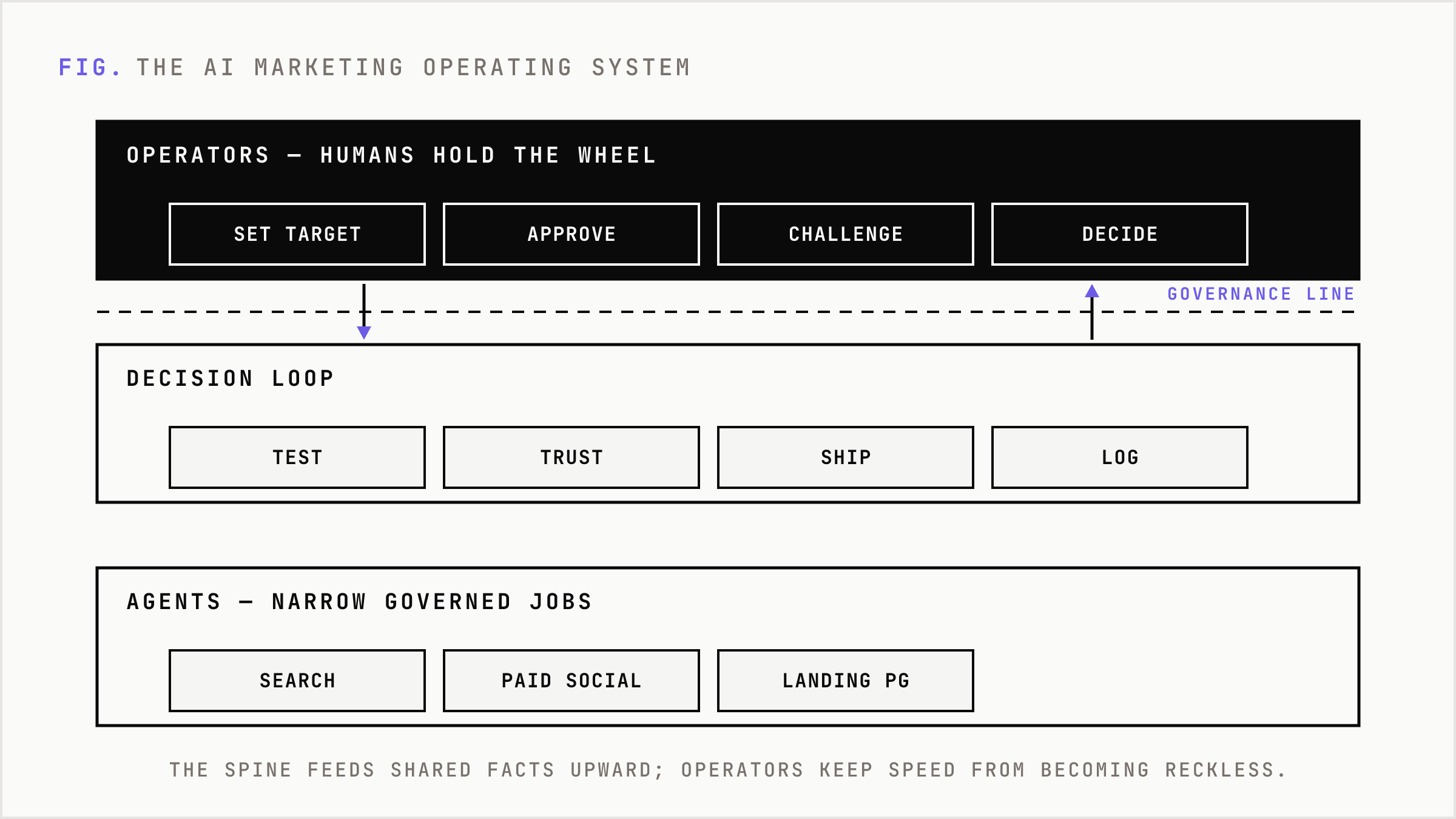
The AI Marketing Operating System is a governed workflow that connects strategy, data, AI agents, human review, campaign execution, and learning loops.
It has four parts.
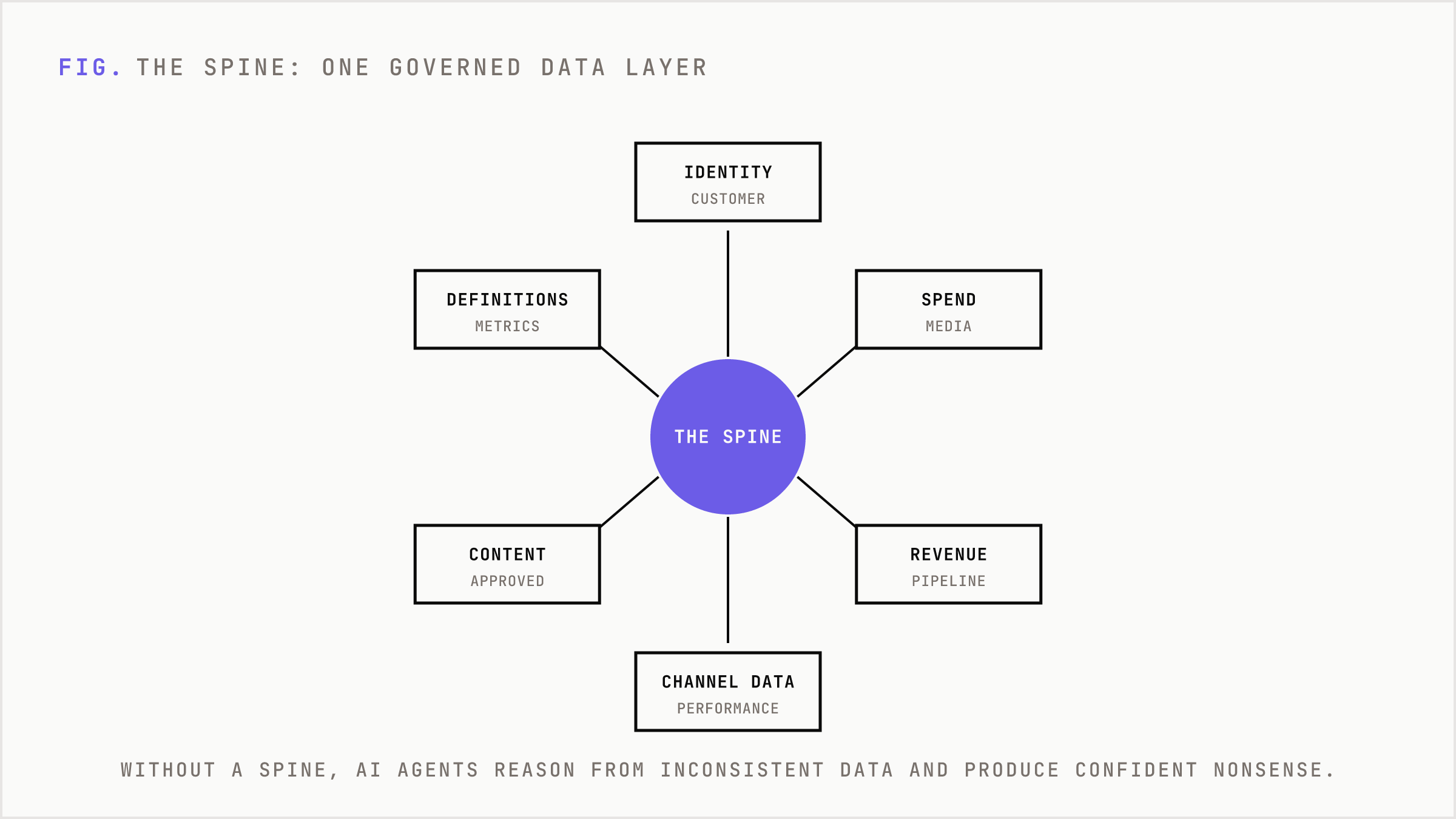
The spine. The spine is the governed layer that connects customer identity, spend, revenue, channel data, content, and performance definitions. Without a spine, AI agents pull from inconsistent data and produce confident nonsense. With a spine, they can reason from shared facts.
The agents. Agents are task-specific AI systems assigned to repeatable marketing work. One agent may monitor search and competitor movement. Another may draft paid social variations from approved positioning. Another may inspect landing page conversion patterns. The point is not to make one general chatbot do everything. The point is to assign narrow jobs to systems that can be governed.
The operators. Operators are the senior humans who set the target, approve the logic, challenge the output, and make the call. Humans hold the wheel. AI is the engine. That division keeps the agency fast without making it reckless.
The decision loop. The decision loop turns signal into action. It defines what will be tested, what evidence will be trusted, who decides, what gets shipped, and what is logged for the next cycle. This is where speed compounds. Every cycle should make the next cycle smarter.
This framework changes the agency relationship. The client is not buying isolated deliverables. The client is buying a managed marketing system that can produce strategy, assets, tests, reporting, and decisions at a pace the old retainer model struggles to match.
How the work runs in practice
A white-glove AI marketing agency typically starts by diagnosing the business model before touching campaign output. The questions are not cosmetic. Where does profit actually come from? Which segments are worth acquiring? Which offers create bad-fit customers? Which channels have scale potential? Which metrics are trusted? Which ones are political artifacts?
From there, the agency builds the operating layer. It aligns on positioning, ICP, offers, funnel stages, metric definitions, brand constraints, data access, and approval rules. Then AI systems are connected to the workflow. Research agents gather market signal. Creative agents generate first-pass variants inside brand boundaries. Media agents surface budget and audience anomalies. Reporting agents convert raw performance into decision-ready briefs.
Consider a B2B SaaS company selling to finance teams. The company has paid search spend, a library of webinars, several landing pages, and a CRM full of messy lifecycle data. A conventional agency might audit the account, refresh creative, and send a monthly performance deck.
A white-glove AI marketing agency would treat the system differently. It would map search intent to buying stage, connect CRM outcomes back to campaigns, identify which webinar themes correlate with higher-quality opportunities, create landing page variants by pain point, and set a weekly decision loop for spend, messaging, and follow-up. AI handles the research, drafting, clustering, anomaly detection, and reporting prep. Senior operators decide which audience to pursue, which offer to promote, which metric to trust, and when to stop a test.
The concrete consequence is operational, not decorative: 1. the same source of truth defines spend, pipeline, and revenue; 2. creative output is tied to approved positioning instead of random ideation; 3. campaign reviews end with decisions, not just observations.
That is the difference between AI-assisted production and AI-native marketing operations.
What changes when the agency is truly AI-native
The first change is speed. Research that used to wait for a strategist’s open afternoon can run continuously. First drafts of ads, landing pages, nurture emails, and briefs can arrive quickly. Reporting can shift from monthly summary to live decision support. This does not remove the need for judgment. It moves judgment closer to the moment it matters.
The second change is cost structure. Traditional agencies often price against time because time is the scarce input. AI-native agencies can price closer to outcomes because repeatable work is handled by systems. Senior humans are still expensive, but they spend less time moving information between decks and more time making calls.
The third change is campaign volume with control. A team can test more angles, audiences, and creative variants without turning the brand into sludge. The condition is governance. Brand voice, claim rules, compliance constraints, and performance definitions must be built into the workflow before volume increases.
The fourth change is learning. In the old model, learning lives in slide decks, Slack threads, and the heads of account leads. In an AI-native model, decisions and outcomes are logged. Agents can reference prior tests. Operators can see why a choice was made. New work starts from accumulated evidence instead of memory.
What stays the same is accountability. The market still punishes weak positioning. Bad offers still fail. Thin data still misleads. No agency can automate its way out of unclear strategy or a product the market does not want.
The trade-off is that clients must be willing to operate with more transparency. AI-native work needs access to data, fast feedback, clear ownership, and honest conversations about what is and is not working. A company that wants a vendor to disappear for thirty days and return with a polished deck will not get the full value from this model.
Who should hire a white-glove AI marketing agency
The best fit is not every company with a marketing budget. It is a company with a real product, a defined growth problem, and the appetite to move quickly.
B2B SaaS companies hire this kind of agency when pipeline quality matters more than lead volume. Fintech and health tech companies hire it when governance, compliance, and speed have to coexist. DTC e-commerce companies hire it when creative testing, margin discipline, and media decisions need to move together.
The wrong fit is a company looking for a magic automation layer. AI will not fix a weak offer, an undefined buyer, broken economics, or leadership that cannot make decisions. A white-glove AI marketing agency can expose those problems faster. It cannot make them disappear.
The right expectation is sharper execution with a stronger decision system around it. Strategy becomes more connected to data. Creative becomes more connected to market signal. Paid media becomes more connected to profit. Reporting becomes more connected to action.
A white-glove AI marketing agency does the work a modern growth team needs done: it builds the operating system, runs the campaigns, governs the AI, interprets the signal, and keeps humans responsible for the calls that matter.