Nyyon · Blog
The Truth About Cheap AI Marketing and Who Is Actually Delivering It
AI marketing is cheaper only when systems replace execution. Learn which agencies deliver real cost savings and where “AI” is just repackaged labor.
Cheap AI marketing is real, but only when software replaces workflow, not when agencies rebrand labor.
The Core Misunderstanding
Most founders hear “AI-driven marketing at a fraction of the cost” and assume autonomy. Fewer people. Less effort. Same or better results.
That is not what is happening.
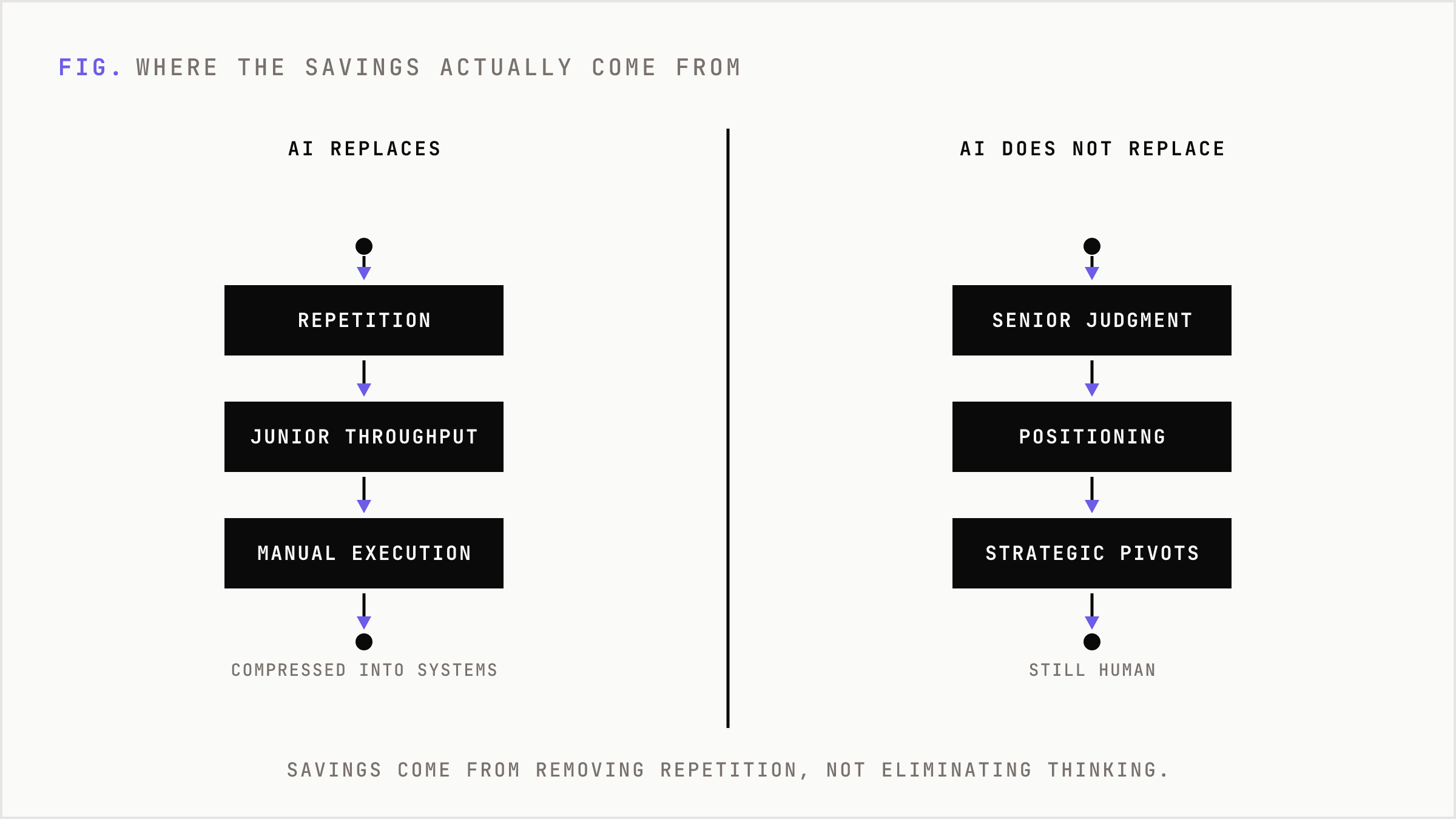
The actual shift is simpler. Execution layers are being compressed. Tasks that used to require teams now run through systems. The savings come from removing repetition, not eliminating thinking.
AI replaces junior throughput. It does not replace senior judgment.
Where the Cost Actually Drops
Look at a traditional agency pod. You typically get a strategist, a media buyer, a copywriter, a designer, and an analyst. Sometimes more. That structure is designed around human bottlenecks.
Now compress it.
Content generation becomes prompt-driven and systematized. Ad variations are generated in batches instead of manually written. Reporting dashboards update automatically. SEO scales through programmatic structures instead of one article at a time.
The result is not magic. It is throughput.
A senior operator with the right stack can now do the work of five to ten people. That is where the cost reduction comes from.
The New Agency Archetypes
The market has already reorganized around this reality.
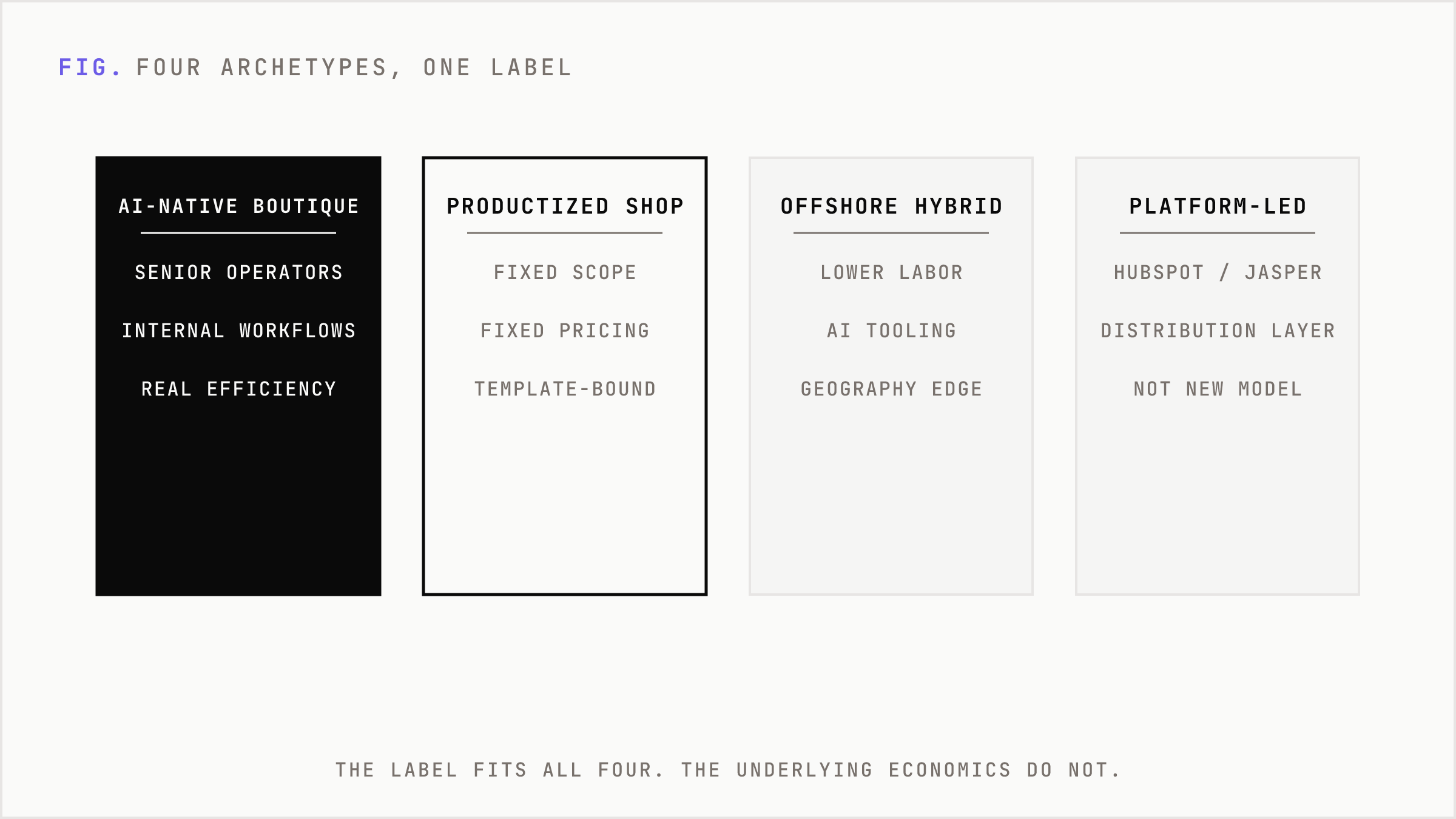
First, AI-native boutiques. These are small teams built around senior operators. They run lean, move fast, and rely heavily on internal workflows. This is where most real efficiency gains exist.
Second, productized growth shops. Fixed scope, fixed pricing, narrow execution. These work if your needs are standardized, but they rarely adapt beyond their template.
Third, offshore hybrids. These combine lower-cost labor with AI tooling. They can look efficient on paper, but the cost advantage often comes from geography, not systems.
Fourth, platform-led partners. Agencies aligned with tools like HubSpot or Jasper. These are distribution layers for software, not fundamentally new operating models.
The label “AI agency” applies to all of them. The economics do not.
What Real Efficiency Looks Like
If you want to know whether an agency is actually AI-native, ignore the branding and look at the workflow.
How much of their execution is automated? Not assisted. Automated.
Are they generating, testing, and iterating creative daily or weekly? Or are they still operating on campaign cycles?
Do they own internal systems, or are they stitching together public tools with manual glue?
How deeply are they integrated into your data layer? Surface-level analytics is a sign of shallow execution.
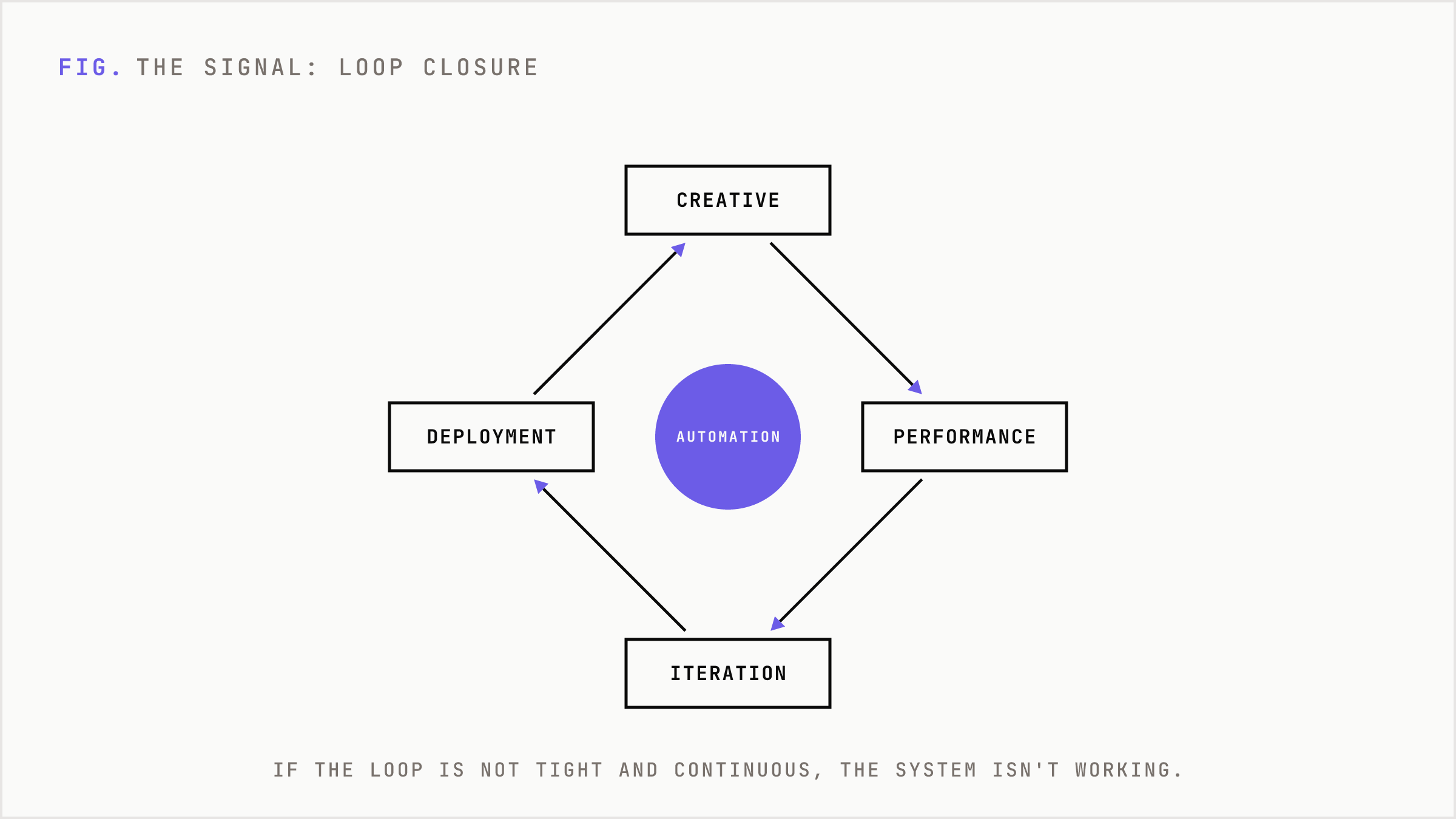
The key signal is loop closure. Creative feeds performance. Performance feeds iteration. Iteration feeds deployment. If that loop is not tight and continuous, the system is not doing much work.
Pricing Tells the Truth
Agency pricing is one of the clearest indicators of what is actually happening under the hood.
Traditional agencies still sit between 8k and 50k per month. The cost is driven by headcount, meetings, and process overhead.
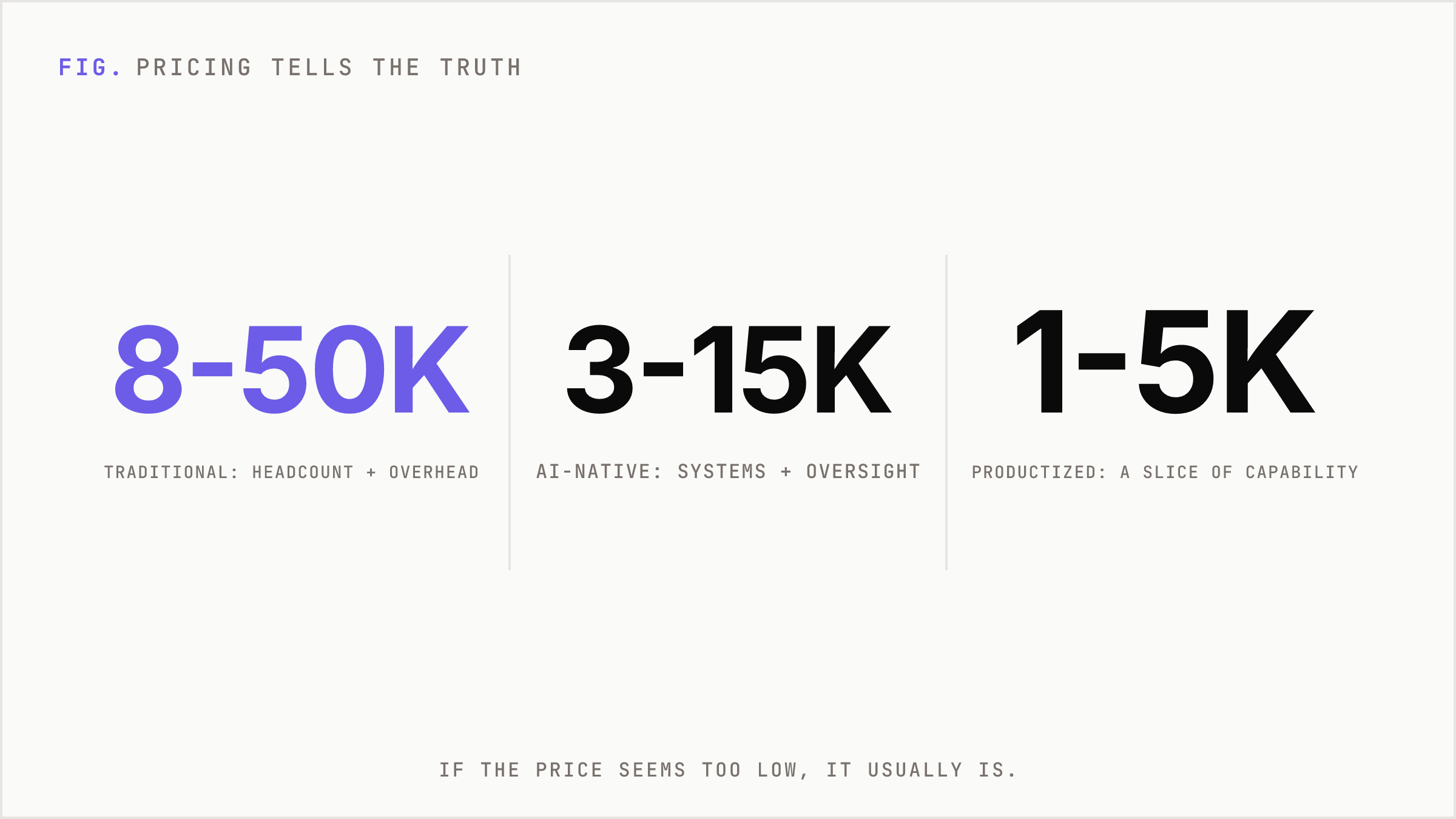
AI-native agencies cluster between 3k and 15k. The pricing reflects leverage. You are paying for systems and oversight, not hours.
Productized offerings drop further, often between 1k and 5k. But you are buying a slice of capability, not a full system.
Anything below that usually means templated outputs with minimal strategic input.
If the price seems too low, it usually is. Either the work is shallow, or the margin is coming from somewhere you cannot see.
Where AI Still Fails
There are clear boundaries to what AI-driven marketing can do today.
Brand strategy remains human. Positioning, narrative, and differentiation require context that models do not consistently maintain.
Creative quality converges without strong direction. Left alone, AI tends toward averages. That is efficient, but not distinctive.
Attribution across channels is still messy. AI can process data, but it cannot fix incomplete or fragmented inputs.
Enterprise environments slow everything down. Legacy systems break automation chains and reduce the advantage of speed.
This is why the senior layer does not disappear. It becomes more important.
The Illusion of Full Automation
Any agency claiming fully automated marketing is selling a story, not a system.
What exists instead are semi-automated pipelines. Content flows through generation systems. Ads are produced and tested at scale. Reports update without intervention.
But decisions still sit with humans.
Budget allocation, positioning shifts, and strategic pivots are not automated in any reliable way. The closer you get to revenue impact, the more human judgment reappears.
Why Some Agencies Still Feel Expensive
Not all AI-enabled agencies are cheaper. Some are just better.
Firms like NoGood or Directive have integrated AI deeply, but they price at a premium. You are paying for experience, not just efficiency.
AI reduces execution cost. It does not eliminate the value of knowing what to do.
This creates a split market. High-end agencies become more effective but not necessarily cheaper. AI-native boutiques become cheaper and faster, but with less brand signal.
The Most Overlooked Option
The most cost-effective model is often not an agency at all.
One strong in-house operator with an AI stack can outperform most external teams on both cost and speed.
This works because coordination overhead disappears. There is no handoff between strategy and execution. The feedback loop is immediate.
The tradeoff is talent risk. You are dependent on one person instead of a team.
Agencies still win when speed matters, when internal capability is missing, or when multiple channels need to be orchestrated quickly.
From Services to Systems
The most important shift is structural.
Agencies are moving from service providers to system operators.
Instead of selling deliverables, they are managing pipelines. Instead of charging for time, they are pricing against outcomes.
You see this in hybrid pricing models. Lower retainers paired with performance incentives. Revenue share. CPA-based structures.
This only works if the system is real. Otherwise, the risk is too high.
What Buyers Should Actually Do
Stop asking what tools an agency uses. That question is no longer meaningful.
Ask how work flows through their system. How fast it moves. Where decisions happen. How results feed back into execution.
Ask what percentage of their workflow runs without human intervention.
Ask how often they ship.
And most importantly, ask how directly their work ties to revenue.
If the answers are vague, you are not looking at a system. You are looking at a repackaged agency.
The Direction of the Market
The gap between real AI operators and everyone else is widening.
On one side, you have system-driven teams compounding efficiency. Faster cycles. Lower costs. Better feedback loops.
On the other, you have agencies layering AI onto old processes and calling it transformation.
Those two models do not converge. One replaces the other.
The outcome is predictable. Costs drop where systems replace execution. Prices hold where judgment and experience still dominate.
Bottom Line
Cheap AI marketing is not about AI being smart enough to replace marketing.
It is about systems being structured well enough to remove most of the work.
The agencies delivering real cost savings are not better at prompts. They are better at building and operating machines.
Everything else is just cheaper labor with better branding.
FAQ
Is AI marketing actually cheaper than traditional agencies?
Yes, but only when systems replace execution work. Real savings come from automation and workflow compression, not simply adding AI tools to existing processes.
What is the biggest red flag when hiring an AI agency?
Claims of fully automated marketing or heavy focus on content volume without distribution, data integration, or iteration speed are strong warning signs.
Are AI-native agencies always better?
They are usually more efficient and cost-effective, but may lack the strategic depth or brand experience of higher-end traditional agencies.
Can a single in-house marketer replace an agency with AI tools?
In many cases, yes. A strong operator with the right stack can outperform agencies on cost and speed, but introduces dependency on individual talent.
How do AI agencies price their services?
Most charge between 3k and 15k per month, with some moving toward performance-based or hybrid pricing tied to outcomes like revenue or CPA.