Nyyon · Blog
The UI Is Dying and Google's CPC Is Next
Interfaces are collapsing into intent, and Google's CPC and traffic-driving power are next, which is a crisis for the unprepared and an opening for builders.
User interfaces, in the way we know them, are coming to an end, and Google Ads is heading for real turmoil around CPC and its ability to drive traffic. The screen full of buttons, the ten blue links, the search box you type into and scroll through, all of that is being eaten by a layer that turns intent into outcome without a page in between. When the interface disappears, the auction that lives on top of it disappears too. That is scary if your growth depends on clicks. It is an opening if you are positioned to build for what replaces them.
I keep saying this out loud because most operators are still pricing the world as if the search results page is permanent. It is not. And the gap between people who see this and people who can actually build for it is where the next two years of advantage live.
The dominant pattern: traffic as the product
For twenty years marketing has been a traffic business. You buy attention, you point it at a page, you measure the click, you optimize the funnel behind it. Google Ads is the purest expression of this. You bid on intent, you win a slot, a human sees a result, a human clicks, you pay the CPC, and the model holds because there is a human staring at a results page with options laid out in front of them.
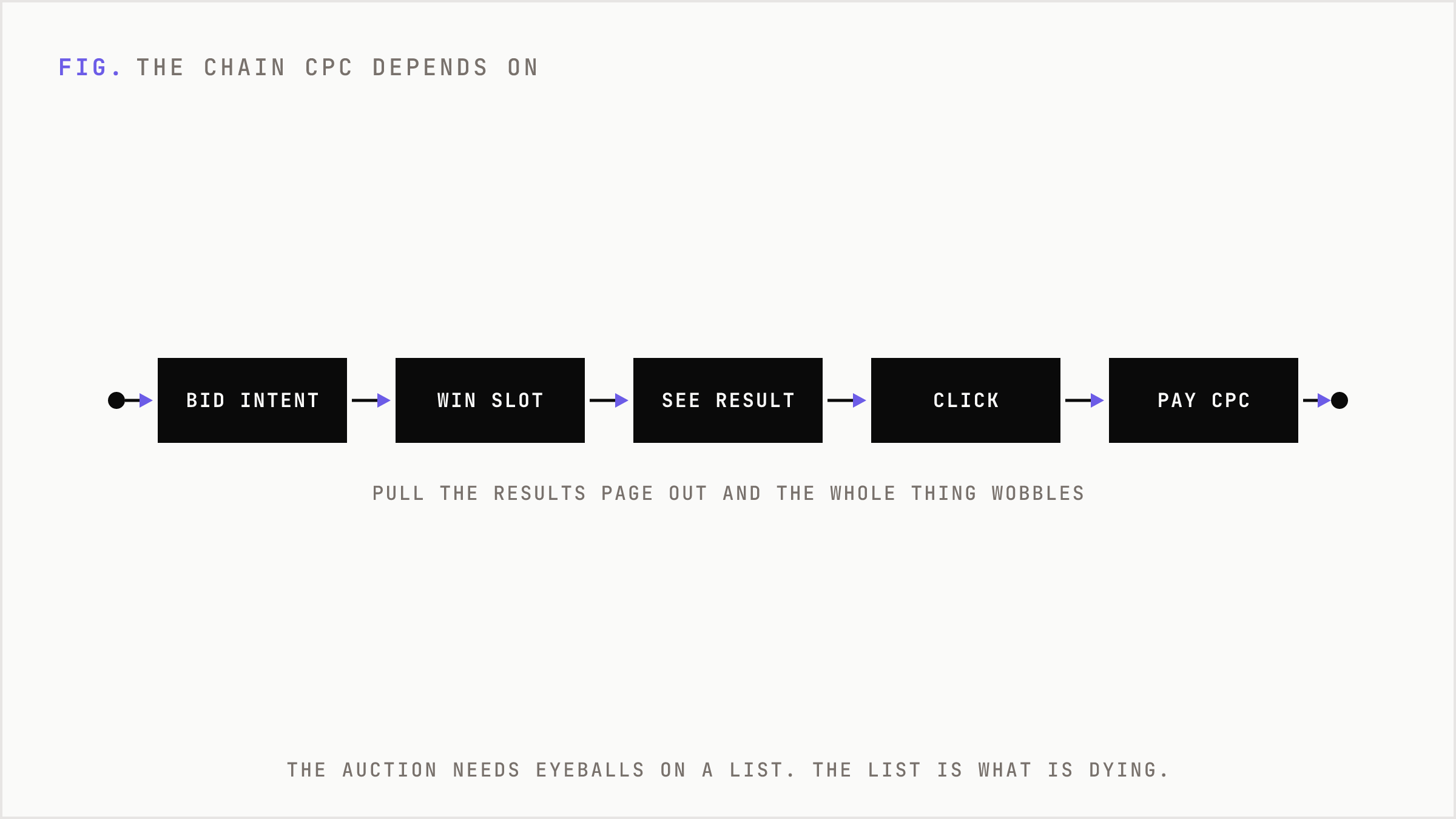
Pull the results page out of that chain and the whole thing wobbles. When an answer engine reads the query, synthesizes a response, and hands back a single resolved outcome, there is no scroll, no comparison set, no ten links, no obvious place to insert a paid slot that a human will actually look at. The auction needs eyeballs on a list. The list is what is dying.
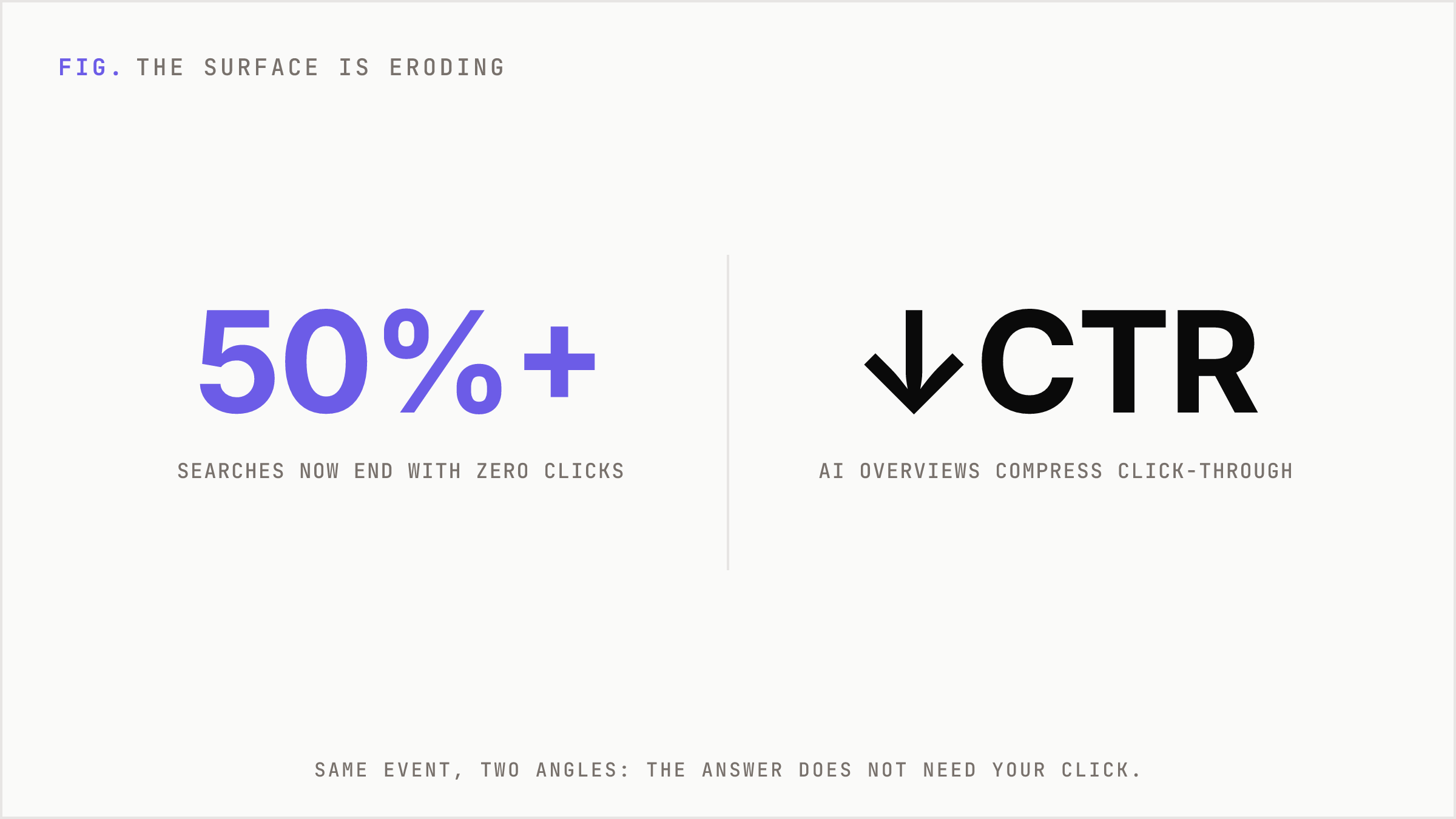
This is already visible in the numbers people quote nervously and then ignore: zero-click searches are now the majority of all searches, and AI Overviews are compressing click-through on the queries that still show links. Both of those are the same event seen from two angles. The interface is being replaced by an answer. The answer does not need your click.
Why CPC is the next thing to break
CPC is a price set by competition for human attention on a surface. Two things have to be true for it to make sense. There has to be a surface, and there has to be human attention on it. Both are eroding at once.
If a person never sees the results page, the surface is gone for that query. If an agent does the searching on the person's behalf, the attention is gone too, because an agent does not get nudged by ad copy, does not have a lizard brain to bid against, and does not click out of curiosity. You cannot run a $4 CPC against software that reads the whole page in a millisecond and ignores the part you paid for.
So the question is not whether CPC goes up or down. It is whether the thing CPC prices still exists. Google has spent years training users to accept synthesized answers at the top of the page. Every time they make that answer better, they make the click below it less necessary, which means they are slowly cannibalizing the surface their own ad business sits on. That tension does not resolve cleanly. It resolves as turmoil, which is exactly the word I would use for what is coming to Google Ads.
What you build when the interface goes away
If the surface is dying, you stop optimizing for the surface and start building for the layer that replaces it. There are two moves that actually matter here, and they are the moves I am making in my own work.
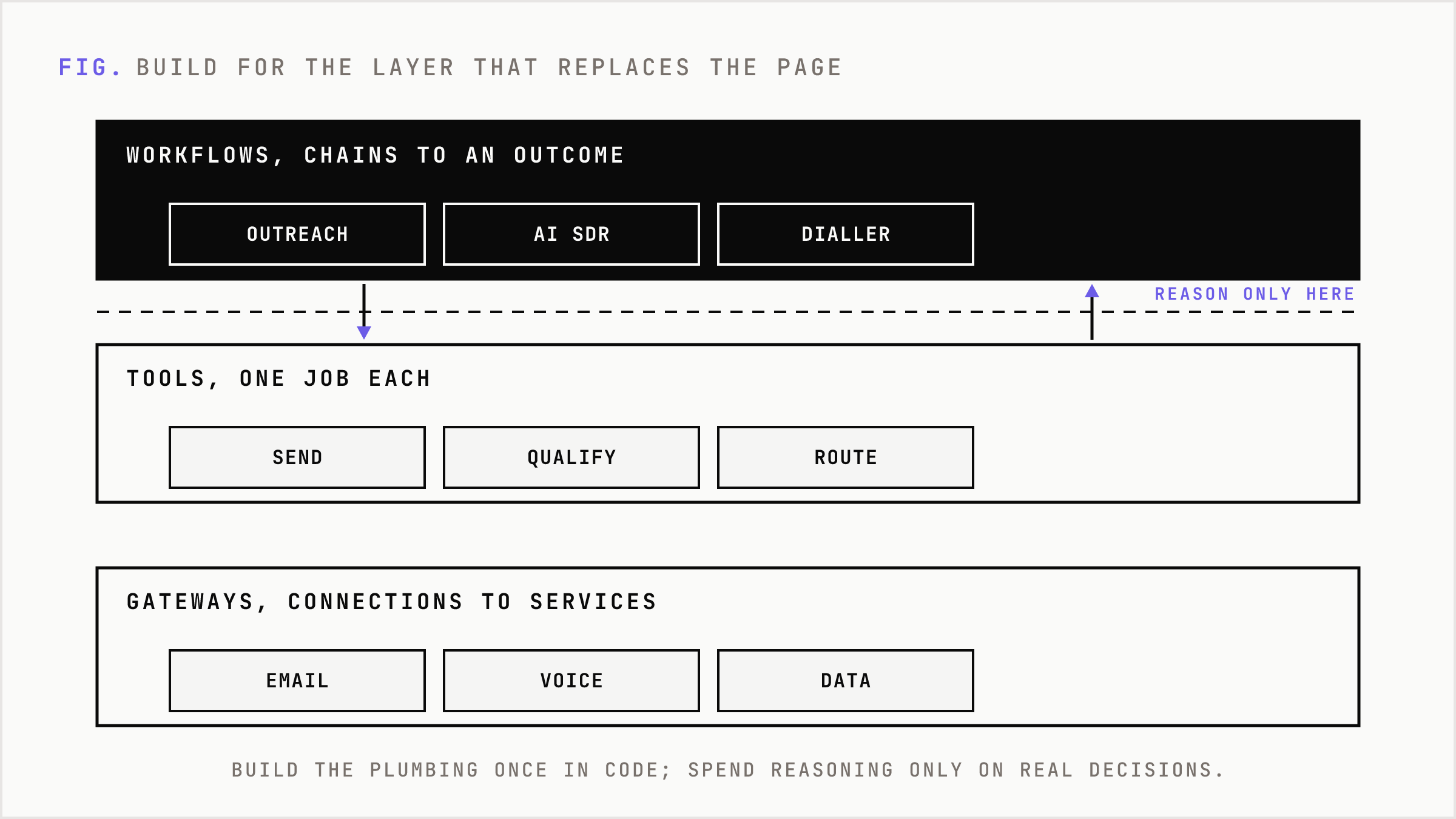
The first is to architect around gateways, tools, and workflows instead of pages and clicks. A gateway is a connection to a service. A tool is a thing that does one job through a gateway. A workflow is a chain that uses tools and gateways to reach an outcome. When I built the command center for a client's funding operation, I ran email outreach, an AI SDR, and dialler operations through that model, and logic that was impossible to manage as a pile of dashboards became manageable as a system. The point is that you build the plumbing once, in plain code, and you spend expensive reasoning only where a decision actually requires it. That is how you operate in a world where the front door is an agent and not a browser.
The second move is to make your brand legible to machines, not just attractive to humans. When the answer engine is the new shelf, the question is whether the engine can find organized, machine-readable proof of what you do and how well you do it. Not authority content stuffed with keywords. Actual evidence from operations and customer interactions, structured so a model can read it and form a confident answer about you. I have been building these evidence layers, and the first thing I systematize is the proof, because the proof is what survives when the click does not.
The scarcity that makes this an opportunity
Here is the part most agencies will miss. The technology to build for the post-interface world exists. The people who can actually build it do not exist in anywhere near the numbers needed. There is a genuine scarcity of effective builders, and that scarcity is the opening.
The hard part is no longer access to AI. It is writing to spec. It is taking the strategic decision a senior operator makes and making sure it lands in the actual product, instead of letting an agent run off and burn half your budget chasing a goal nobody constrained. The same logic I use to route hard problems to big models and easy problems to small models applies to people: give the meaningful decisions to the people who understand the business, give the execution to the builder, and run a loop that checks the builder actually applied the decision. That separation is what makes a small team move faster than an agency selling hours.
So the numbered consequence, concretely:
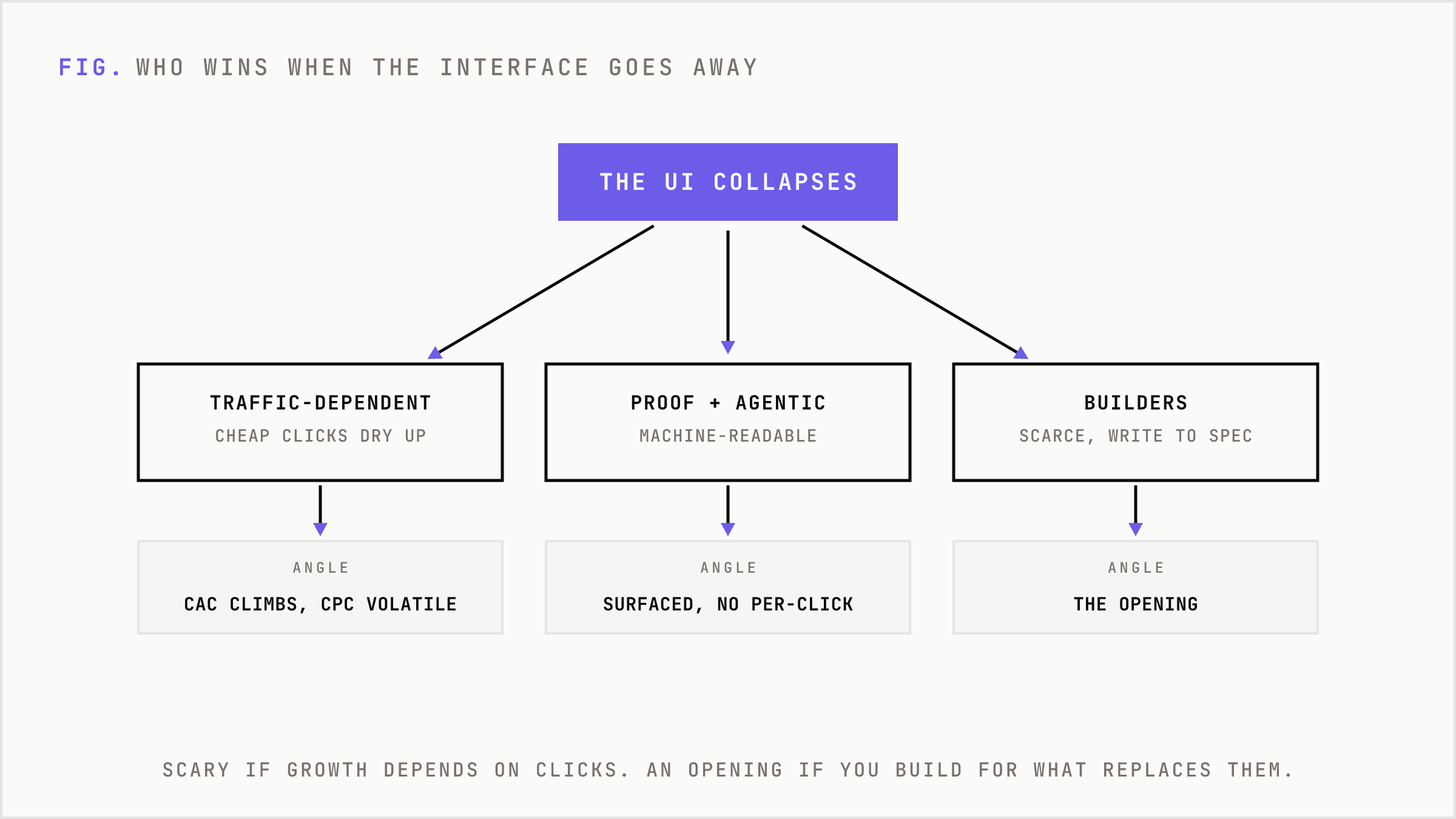
1. Brands that depend on cheap, abundant search traffic will watch their CAC climb as CPC turns volatile and clicks dry up.
2. Brands that have built machine-readable proof and an agentic operating layer will get surfaced by answer engines without paying per click.
3. The agencies that can build that layer, and there are very few, will be able to win clients faster than they can take them on.
What changes, what stays, and the honest trade-off
What changes is the unit of work. You stop buying clicks and start building the systems and the evidence that let agents resolve queries in your favor. The skill shifts from media buying to architecture and proof.
What stays is judgment. The decisions still come from senior operators who understand the business. The builder ships, the executive decides, and the loop keeps the two honest. AI does not remove the human from the wheel. It removes the human from the parts that never needed one.
The honest trade-off is timing. Nobody can tell you the exact month CPC breaks or the interface dissolves. You are building for a transition that is clearly underway but not finished, which means you carry some cost before the payoff is obvious. I am comfortable with that, because the alternative is to wait until the surface is gone and then discover there are no builders left to hire.
The interface is dying. CPC is next. The builders who move now do not have to be tense about what comes after.