Nyyon · Blog
The New Marketing Intelligence Stack
AI agents, semantic layers, clean rooms, and governed metrics are turning marketing analytics from passive reporting into trusted decision execution systems.
Marketing analytics is moving from passive reporting to governed AI systems that monitor, explain, recommend, and trigger revenue decisions.
The old marketing analytics stack was built around delay. Campaign runs. Data lands. Analyst cleans it. Dashboard refreshes. Team reviews it on Tuesday. Someone asks if the spike is real. Someone else exports a CSV. By the time budget moves, the market has already moved.
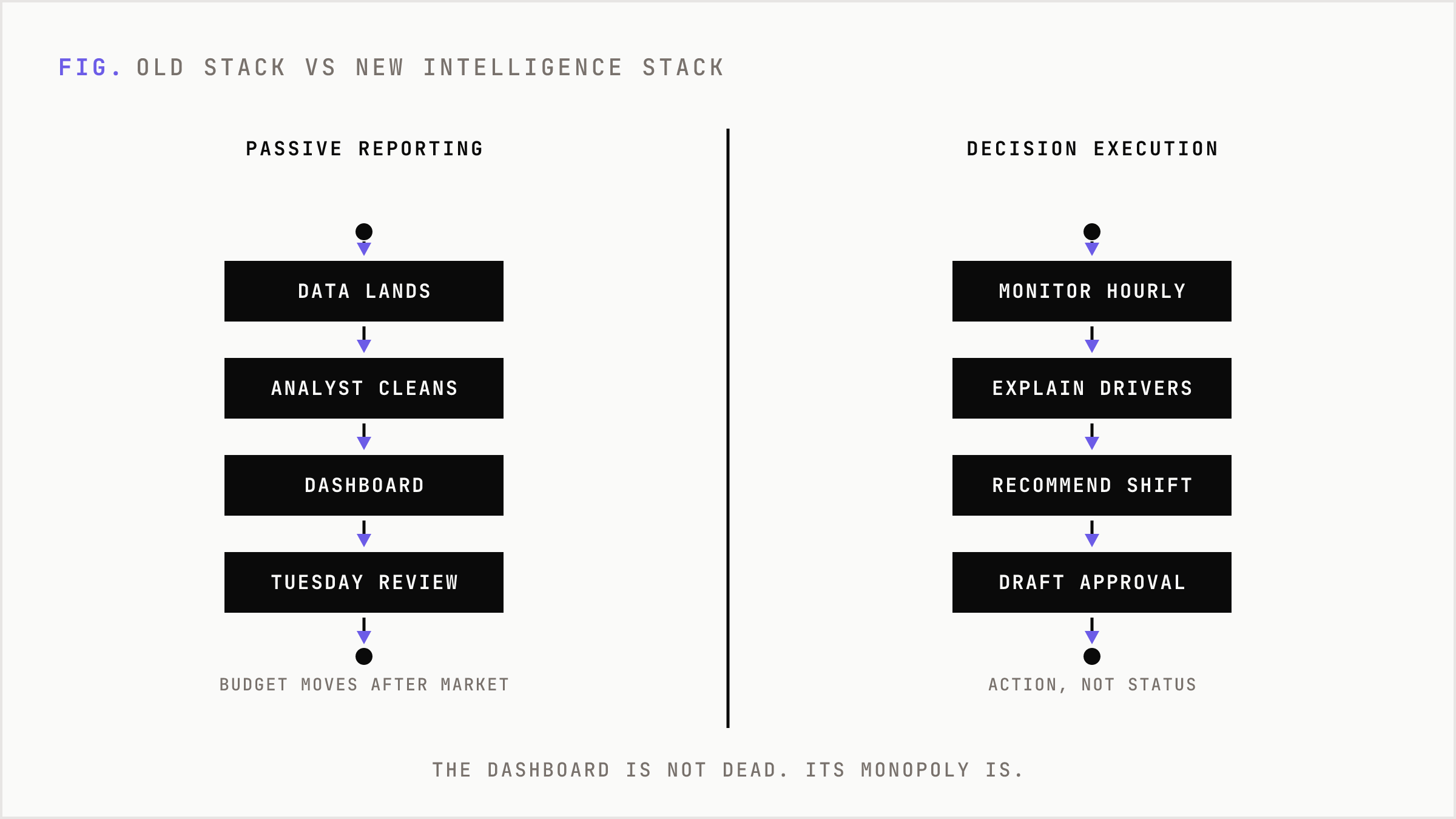
That stack was acceptable when analytics was mostly a reporting function. It is weak infrastructure for an AI operating model.
The new marketing intelligence stack is not a prettier dashboard layer with a chatbot on top. It is a different control system. It combines a governed data core, a semantic layer, privacy-safe collaboration, agentic workflows, and activation paths into the systems where work actually happens.
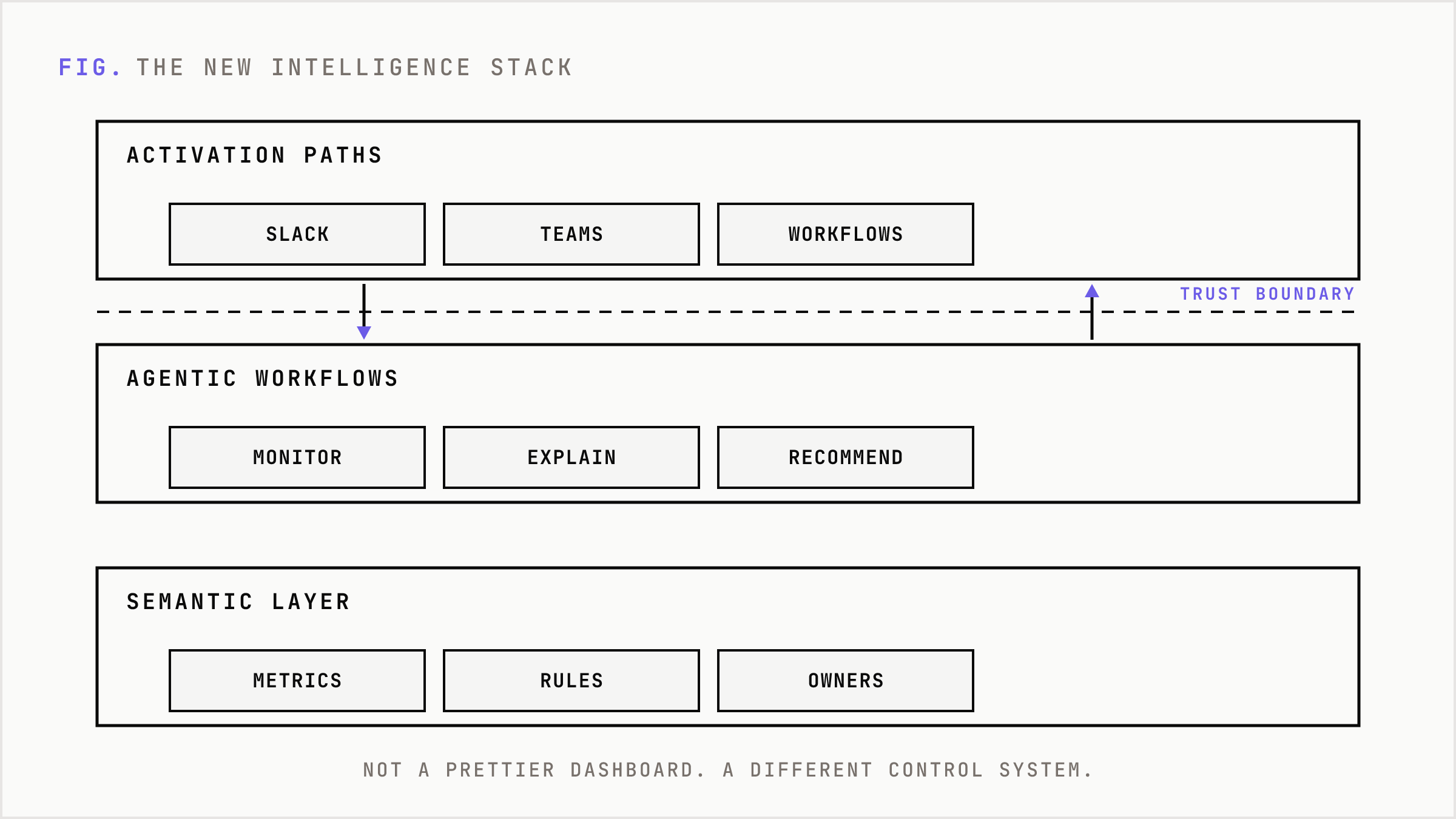
The commercial logic is simple: marketing budgets are too large, media markets are too dynamic, and customer journeys are too fragmented for humans to manually inspect every signal. The buyer no longer wants another dashboard. The buyer wants faster decisions with less risk.
The dashboard is not dead. Its monopoly is.
Dashboards will not disappear. Executives still need shared surfaces. Operators still need scorecards. Finance still needs reconciled numbers.
What is dying is dashboard primacy. The dashboard is no longer the center of the analytics experience. It becomes one surface among many.
The new interface is more likely to be a question inside Teams, a budget alert in Slack, an agent-generated anomaly report, a recommended audience change, or a workflow routed to a growth lead for approval.
This matters because the unit of value changes. A dashboard shows status. An intelligence system changes action.
Consider campaign pacing. The old workflow asks an analyst to check spend, compare it with plan, identify underdelivery, inspect channel performance, and message a media buyer. The new workflow has an agent monitor pacing every hour, detect deviation, explain the drivers, estimate revenue impact, recommend a budget shift, and draft the approval note.
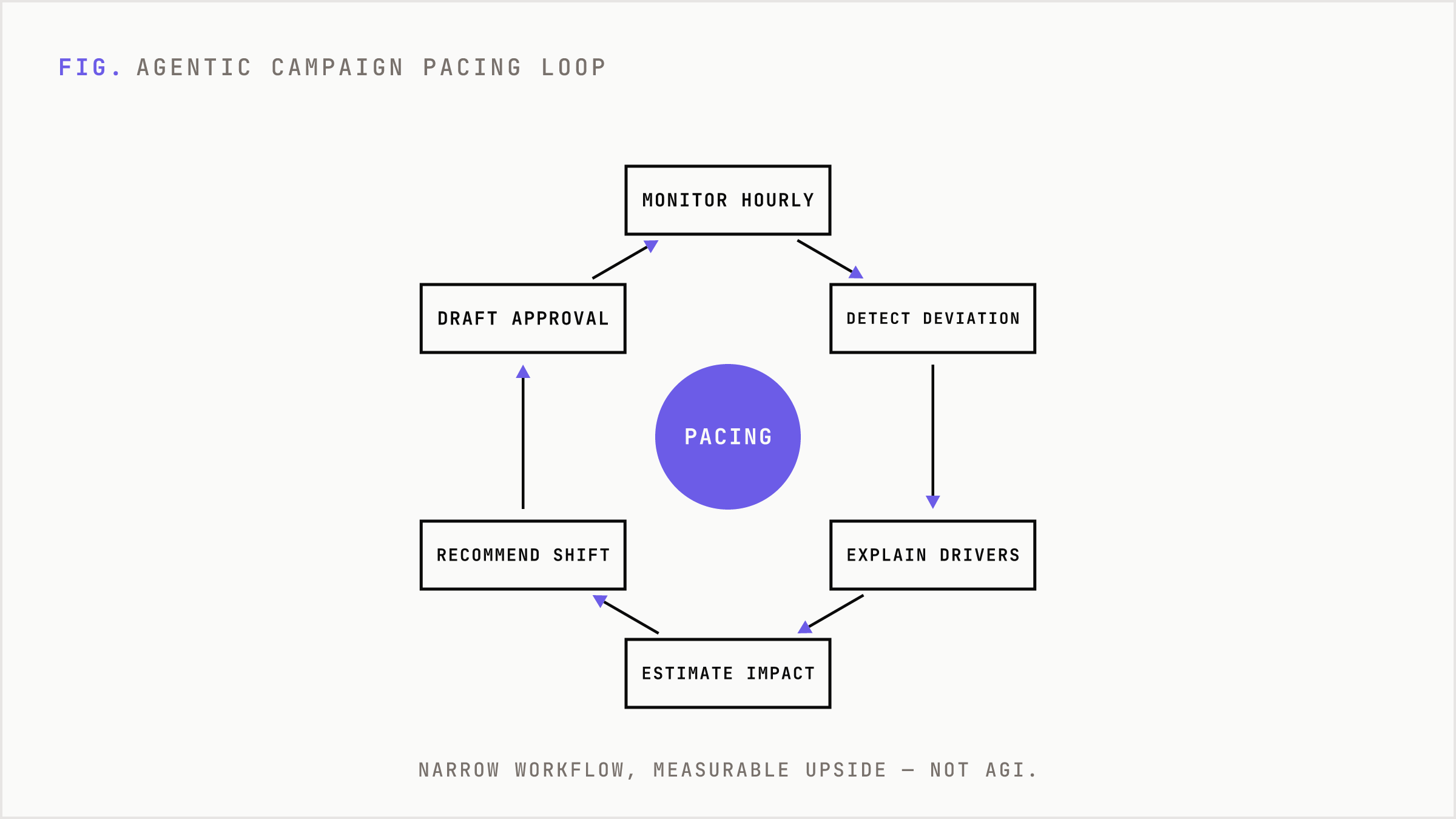
That does not require artificial general intelligence. It requires clean data, metric definitions, permissions, business rules, and a narrow workflow with measurable upside.
The stack starts with governed context
Most AI analytics demos hide the hardest part. The model answers a question. The room nods. Nobody asks whether revenue includes refunds, whether pipeline is sourced or influenced, whether CAC includes agency fees, or whether the user has permission to see customer-level data.
That is where real systems break.
AI does not eliminate semantic ambiguity. It amplifies it. If the company has five definitions of conversion, the agent will produce faster confusion. If campaign taxonomy is inconsistent, the agent will confidently group noise. If permissions are loose, the agent becomes a compliance problem with a friendly interface.
The semantic layer is becoming the foundation of AI analytics because it translates business meaning into machine-usable context. It defines metrics, dimensions, relationships, owners, freshness expectations, and access rules. It tells the system what a qualified lead is, how attribution windows work, and which revenue number the board uses.
This is why metric governance is no longer a back-office concern. It is AI governance. The question what is revenue is now an infrastructure question.
Why agents are entering marketing first
Marketing is an obvious proving ground for agentic analytics because it has recurring decisions, high-frequency signals, and direct budget consequences.
Media spend changes daily. Campaign performance changes hourly. Creative fatigue appears before quarterly reviews. Paid search auctions, social platforms, retail media networks, email flows, and CRM sequences all generate signals that are only useful if they reach the operator in time.
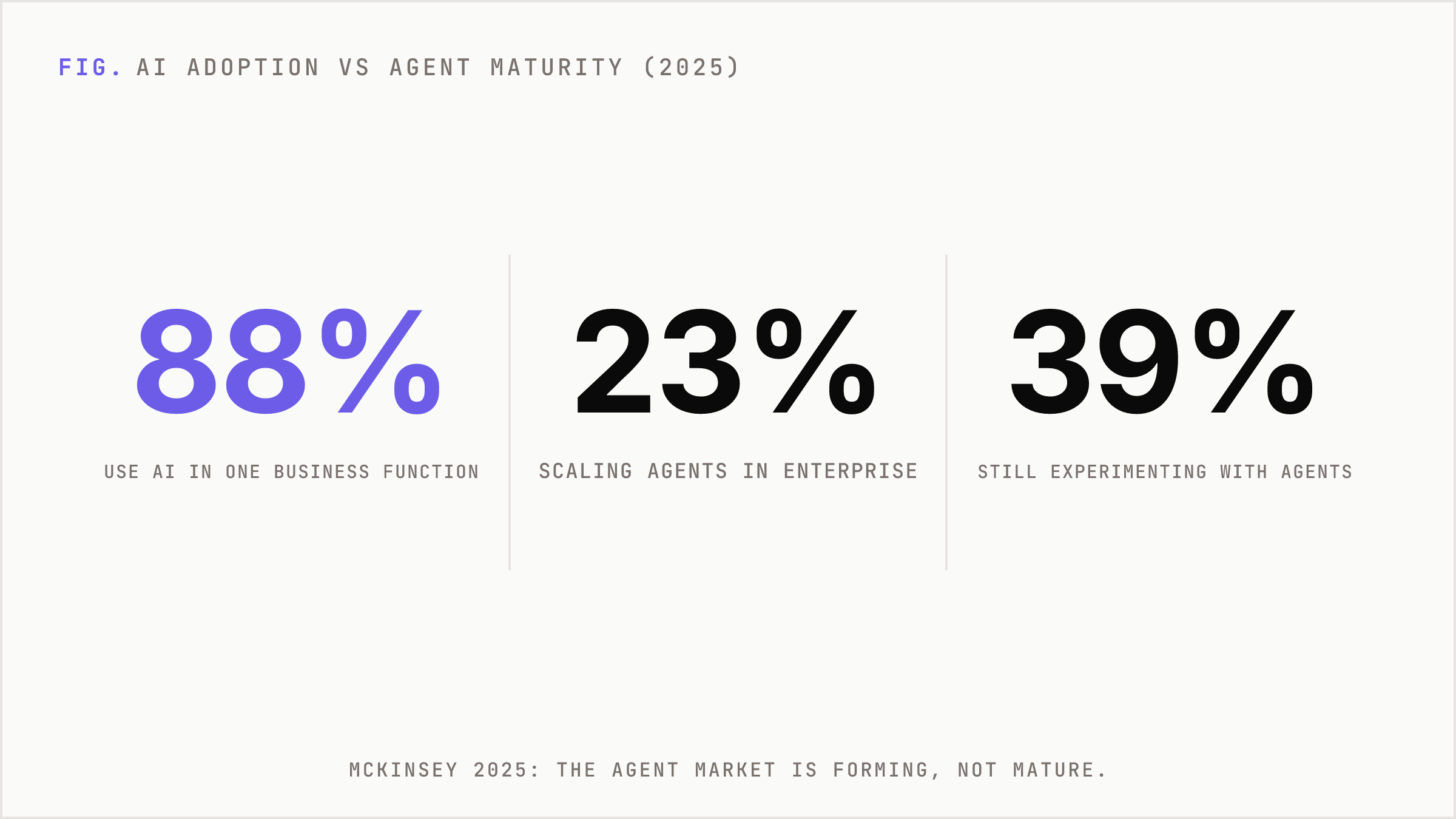
McKinsey reported in 2025 that 88 percent of organizations use AI regularly in at least one business function. But agent deployment remains early. Only 23 percent said they were scaling agents somewhere in the enterprise, while 39 percent were experimenting. That gap matters. The market is not mature. It is forming.
The first durable use cases will not be autonomous brand strategy. They will be operational intelligence:
- Detect a sudden drop in conversion rate after a landing page update.
- Explain why paid social CAC rose in one region but not another.
- Flag campaign names that violate taxonomy before data lands downstream.
- Compare creative variants against audience segments and sales outcomes.
- Recommend budget reallocation when pacing, marginal CAC, and inventory constraints change.
- Draft weekly performance narratives from governed metrics, not spreadsheet fragments.
These are not glamorous tasks. That is the point. They are frequent, expensive, and measurable.
Clean rooms become measurement infrastructure
Marketing analytics has a privacy constraint that generic BI does not. The best data is often distributed across advertisers, publishers, platforms, retailers, agencies, and commerce systems. Nobody wants to hand over raw customer data. Regulators do not want them to. Customers did not consent to a free-for-all.
That is why clean rooms are moving from experimental media plumbing to core measurement infrastructure. They let parties collaborate on data while limiting exposure of raw user-level information.
For a founder or investor, the important point is not the clean room itself. It is what the clean room makes possible: privacy-safe measurement in a world where third-party identifiers are weaker and first-party data is more valuable.
First-party data is not a strategy by itself. It has to be consented, joined, refreshed, governed, and activated. A brand can have millions of customer records and still fail if identity resolution is weak, campaign metadata is messy, or consent rules are not encoded into workflows.
The new marketing intelligence stack treats privacy as a design constraint, not a legal afterthought. That changes vendor selection. Buyers will prefer systems that can prove lineage, enforce access, log usage, and support partner collaboration without creating a data leakage problem.
Real time is useful only when action latency matters
Real-time analytics is one of the most abused phrases in enterprise software. Many businesses do not need sub-second dashboards. They need reliable data by the time a decision is made.
Marketing is different in specific places. Latency matters when spend is live, inventory is scarce, fraud is possible, bids are dynamic, or churn risk is actionable.
A real-time dashboard that nobody watches is theater. A real-time system that pauses a broken campaign, alerts the owner, explains the likely cause, and routes approval for a fix is infrastructure.
The distinction is action latency. If the decision would not change when data arrives in ten seconds instead of ten minutes, real time is probably not the bottleneck. If a delayed signal burns budget, misses demand, or damages customer experience, real time has economic value.
This is where agents make the category larger. They can sit between signal and action. They do not just display what happened. They triage, summarize, prioritize, and recommend. With the right controls, they can execute low-risk actions and escalate high-risk ones.
Unstructured data becomes marketing data
Most marketing analytics still underuses language.
Call transcripts, support tickets, sales notes, product reviews, survey comments, community threads, influencer content, creative briefs, landing page copy, and emails all contain market signal. Historically, this data was expensive to structure and hard to join with performance metrics.
Large language models changed the cost curve. The opportunity is not to ask a chatbot to summarize comments. The opportunity is to connect unstructured context with structured outcomes.
Which creative claims correlate with higher retention? Which objections appear before sales cycle slowdown? Which support themes predict churn in paid acquisition cohorts? Which product messages create high click-through but low quality pipeline?
That is marketing intelligence. It is not reporting on a campaign. It is building a higher-resolution model of demand.
Platform convergence changes the buying motion
The modern data stack expanded for a decade. Warehouses, lakehouses, reverse ETL, catalogs, BI tools, CDPs, observability platforms, experimentation tools, attribution vendors, and AI copilots all fought for budget.
Now the stack is compressing.
Snowflake, Databricks, Microsoft Fabric, Google BigQuery, and other platforms are pulling AI, governance, metadata, orchestration, and business-user interfaces closer to the data core. This does not kill point solutions. It changes their burden of proof.
A point tool now has to answer harder questions. Does it improve the governed context layer? Does it reduce workflow friction? Does it create proprietary signal? Does it enforce permissions? Does it integrate with the activation systems where decisions land?
Tool sprawl used to be a budget issue. In AI analytics, it becomes a risk issue. Every disconnected metric definition, duplicated dataset, and unmanaged workflow increases the chance that an agent recommends the wrong action with confidence.
The budget line moves from reporting to decision execution
Marketing analytics historically lived in a reporting budget. That capped its perceived value. Reporting is necessary, but it is easy to treat as overhead.
The new stack competes for a larger budget line: revenue operations, media efficiency, customer retention, sales productivity, and decision automation.
This is the substitution dynamic that matters. A buyer is not comparing an AI analytics system only against a BI license. They are comparing it against wasted media spend, slow campaign optimization, analyst headcount pressure, agency opacity, compliance risk, and missed revenue.
The strongest business cases will attach to recurring decisions with clear economics. Budget pacing. Lead quality. Retention risk. Offer optimization. Channel mix. Creative testing. Partner measurement. Sales follow-up prioritization.
If an intelligence system can reduce waste by 2 percent on a nine-figure media budget, the software category expands. If it only produces nicer weekly commentary, it remains a feature.
The agency model changes too
Agencies and consultancies should pay attention. Brands are becoming more sensitive to how partners use AI, how data is handled, and whether recommendations can be audited.
Trust becomes a product surface.
An agency that can show AI usage disclosure, metric definitions, lineage, approval gates, prompt and output QA, clean-room strategy, and compliance documentation will look different from an agency selling black-box optimization.
The service opportunity is not just making reports faster. It is building AI-safe marketing operations: data readiness audits, consent mapping, KPI dictionaries, attribution and lift frameworks, agent-safe reporting layers, and workflow redesign.
That is less flashy than a generative campaign demo. It is also closer to the budget owner.
The analyst becomes a decision-system designer
The role shift is already visible. Analysts who only assemble dashboards are exposed. Analysts who understand metrics, experiments, data quality, governance, business process, and AI evaluation become more valuable.
The new role is not prompt engineer. It is context designer.
Someone has to define the metric. Someone has to map the workflow. Someone has to decide when the agent can act and when it needs approval. Someone has to test whether the system gives the right answer under messy business conditions.
That person sits closer to revenue than the old dashboard builder did.
The winning stack is the most trusted, not the largest
The market will not reward the loudest AI layer. It will reward the system that can turn data into action without breaking trust.
That means governed metrics. Strong lineage. Clean permissions. Privacy-safe collaboration. Real-time monitoring where it matters. Agents with constrained tools. Human approval where risk is high. Clear measurement of whether decisions improved.
The moat is not the model. Models will keep changing. The moat is governed context connected to workflow.
For founders, the opening is in the seams: semantic infrastructure, agent evaluation, marketing data quality, privacy-safe activation, decision lineage, and vertical workflows that turn recommendations into approved action.
For buyers, the mandate is simpler. Stop asking which dashboard needs AI. Ask which marketing decisions should become faster, better, cheaper, or more automated.
That is the new marketing intelligence stack. Not more charts. Not magic attribution. Not a chatbot attached to a warehouse.
A governed decision system for growth.
FAQ
What is the new marketing intelligence stack?
It is a marketing analytics architecture that combines governed data, semantic metrics, privacy-safe collaboration, AI agents, and activation workflows to improve decisions, not just reporting.
Are dashboards going away?
No. Dashboards remain useful for shared visibility and executive reporting. What is changing is that dashboards are no longer the primary interface for every decision. Agents, alerts, workflows, and natural-language analysis are becoming part of the operating layer.
Why is the semantic layer important for AI analytics?
AI systems need reliable business context. A semantic layer defines metrics, dimensions, relationships, access rules, and business logic so agents do not invent or misinterpret key numbers.
Where should marketing teams start?
Start with high-value recurring decisions: budget pacing, channel mix, lead quality, retention risk, campaign anomalies, and creative testing. Then define the data, metrics, permissions, workflows, and approval rules required to support them.