Nyyon · Blog
The Lean AI Marketing Stack Agencies Can Actually Profit From
A lean AI marketing stack for agencies: ChatGPT, Make, channel tools, reporting, GEO workflows, and governance without bloated platform fees.
The best low-cost AI marketing solution for agencies is not one tool. It is a modular operating system that cuts coordination cost.
Most agencies are shopping for AI backward. They look for a platform that promises content, campaigns, analytics, social posts, reporting, agents, and strategy in one interface. That sounds efficient. It is usually a tax.
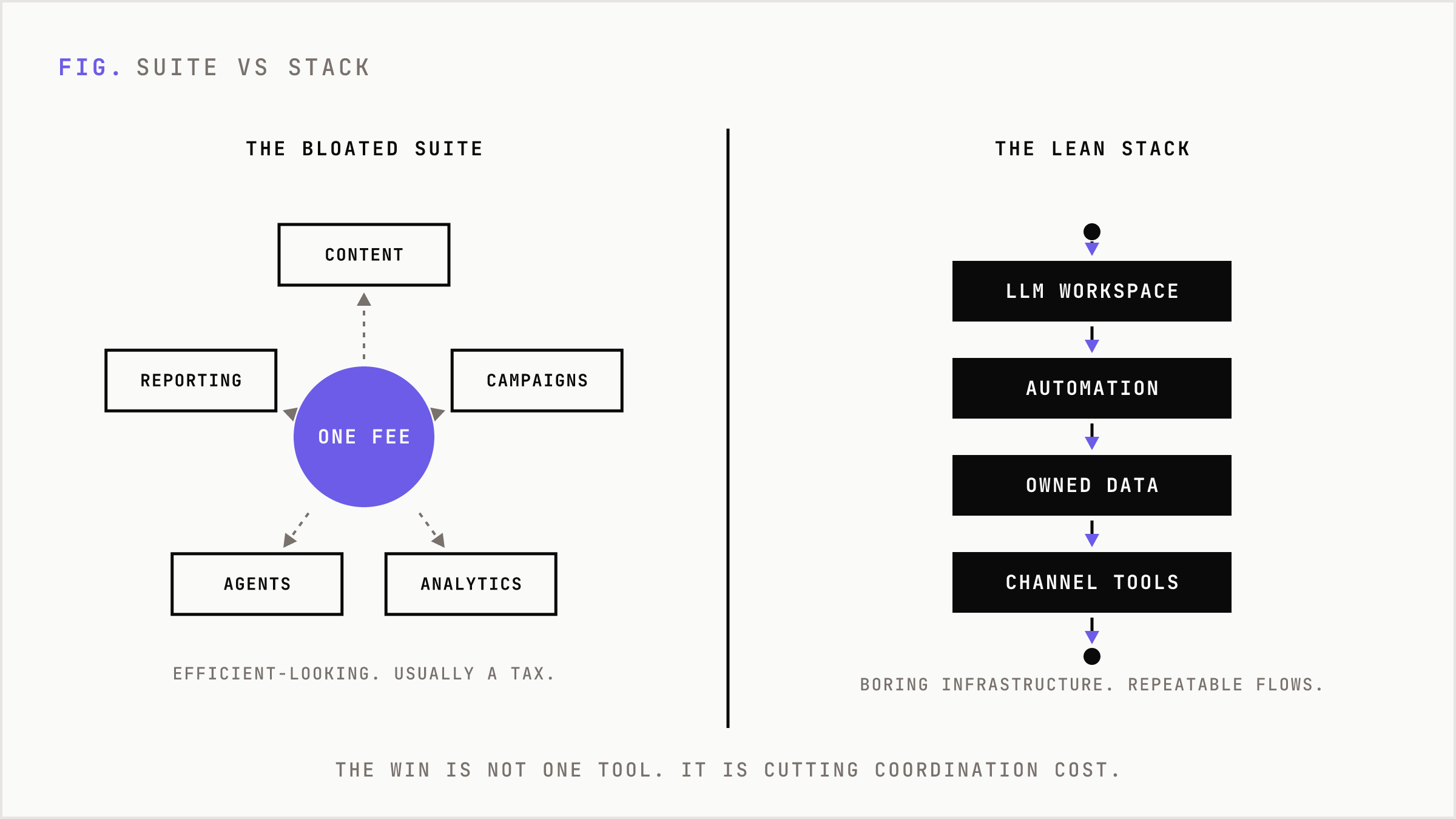
The agency problem is not a shortage of software. It is margin leakage. Briefs get rewritten. Client notes live in calls. Reports require screenshots. Social posts need resizing. Blog drafts need search checks. Campaign data sits in five systems. The profit dies between tasks.
AI changes the economics when it compresses those handoffs. Not when it produces another generic LinkedIn post.
The market is ready, but not mature
AI is no longer an innovation budget line. McKinsey reported in its 2025 global survey that 88 percent of respondents said their organization used AI in at least one business function, up from 78 percent the prior year. Marketing and sales remain among the most consistent users.
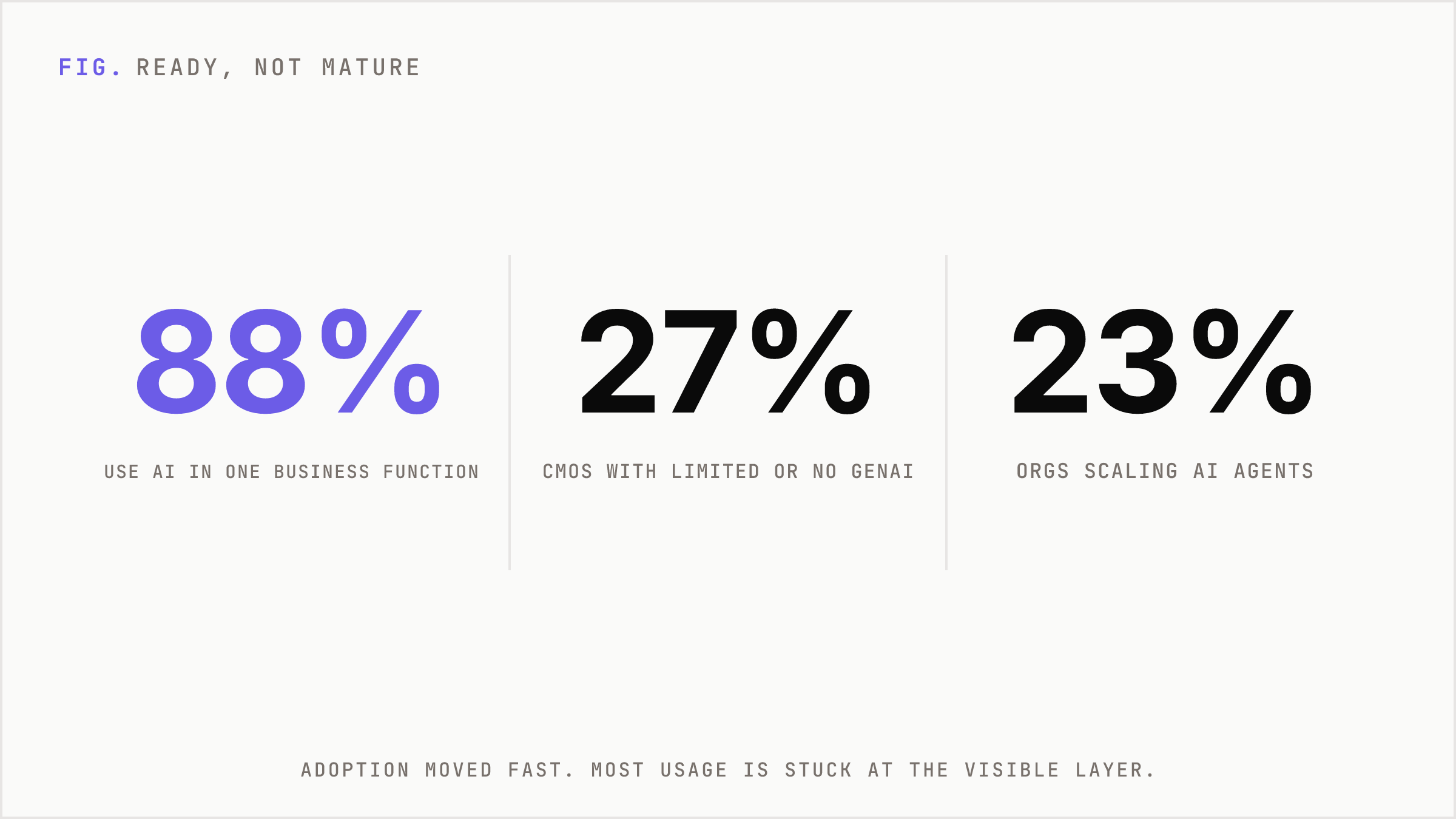
That does not mean the market is sophisticated. Gartner found that 27 percent of CMOs still report limited or no GenAI adoption in marketing campaigns. Among marketers that have adopted it, 77 percent use it for creative development tasks.
That gap matters. AI adoption has moved fast, but most usage is still stuck at the visible layer: copy, concepts, variations, images, subject lines. Useful, but not defensible. Every agency can generate copy. Fewer can redesign the operating model around AI.
Agentic AI is even earlier. McKinsey found that 23 percent of organizations are scaling AI agents somewhere in the enterprise, while another 39 percent are experimenting. That is not a signal to buy an agent platform first. It is a signal to build deterministic workflows, structured data, approval loops, and repeatable SOPs before handing work to semi-autonomous systems.
The stack beats the suite
For most small and mid-sized agencies, the best low-cost AI stack starts with five layers:
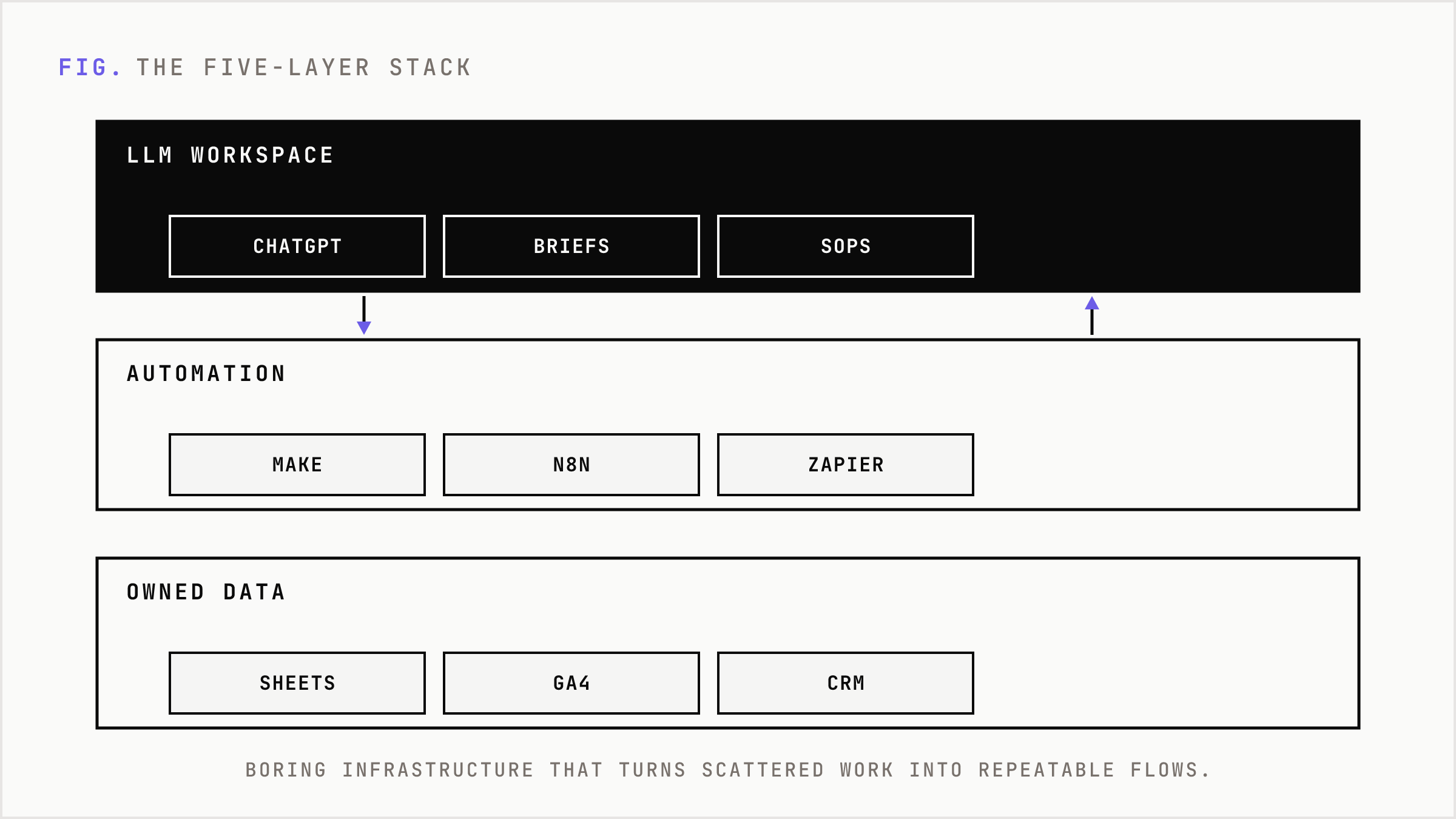
- LLM workspace: ChatGPT Business or a comparable business-grade assistant for research, briefs, drafts, strategy, SOPs, and internal analysis.
- Automation layer: Make, n8n, or Zapier to move work between forms, documents, task systems, spreadsheets, CMS tools, and reporting flows.
- Owned data layer: Google Sheets, Airtable, Search Console, GA4, CRM exports, call transcripts, client docs, and content inventories.
- Channel tools: Buffer, Brevo, MailerLite, Surfer, Semrush Social, or native schedulers based on actual channel volume.
- Reporting layer: Looker Studio first, then AgencyAnalytics or DashThis only when reporting labor becomes a real margin problem.
This is not glamorous. That is the point. The best agency stack is boring infrastructure. It turns scattered work into repeatable flows.
At the time of writing, ChatGPT Business is priced at $20 per user per month on annual billing or $25 monthly, with a two-seat minimum. OpenAI states that workspace data is not used for model training. Make starts at $12 per month for its Core plan. Buffer has a free tier for up to three channels and Essentials at $5 per channel per month. Brevo starts at $9 per month, with a free plan that includes 300 daily sends and large contact storage. MailerLite starts free up to 500 subscribers, then $10 per month for Growing Business.
That gives a solo or micro agency a functional base around $70 to $120 per month before creative or SEO add-ons. A lean AI-native agency with Surfer, Make Pro or Teams, stronger email automation, social tooling, and connector budget can stay roughly in the $175 to $350 per month range.
The important part is not the exact price. Prices move. The structure does not.
Workflow compression is the ROI
The cheapest AI tool is often the one you already bought. The expensive part is the human process wrapped around it.
Take a routine content retainer. The client sends a vague topic. The strategist writes a brief. The writer researches competitors. The editor adds brand voice. The SEO lead checks internal links. The account manager routes approval. The social team repurposes the post. The report later explains whether it worked.
Without a system, every step is a small custom project. With a lean AI stack, the workflow looks different.
An intake form captures ICP, offer, topic, audience pain, competitor URLs, internal links, and CTA. Make pushes it into a content operations sheet and creates the task. ChatGPT Business generates the brief from a locked prompt and client profile. Surfer or manual SERP review adds search constraints. The writer enriches the draft with SME input. A QA checklist checks claims, tone, links, originality, and compliance. Buffer schedules repurposed posts. Looker Studio tracks performance. A reporting prompt converts fixed metrics into a client-ready narrative.
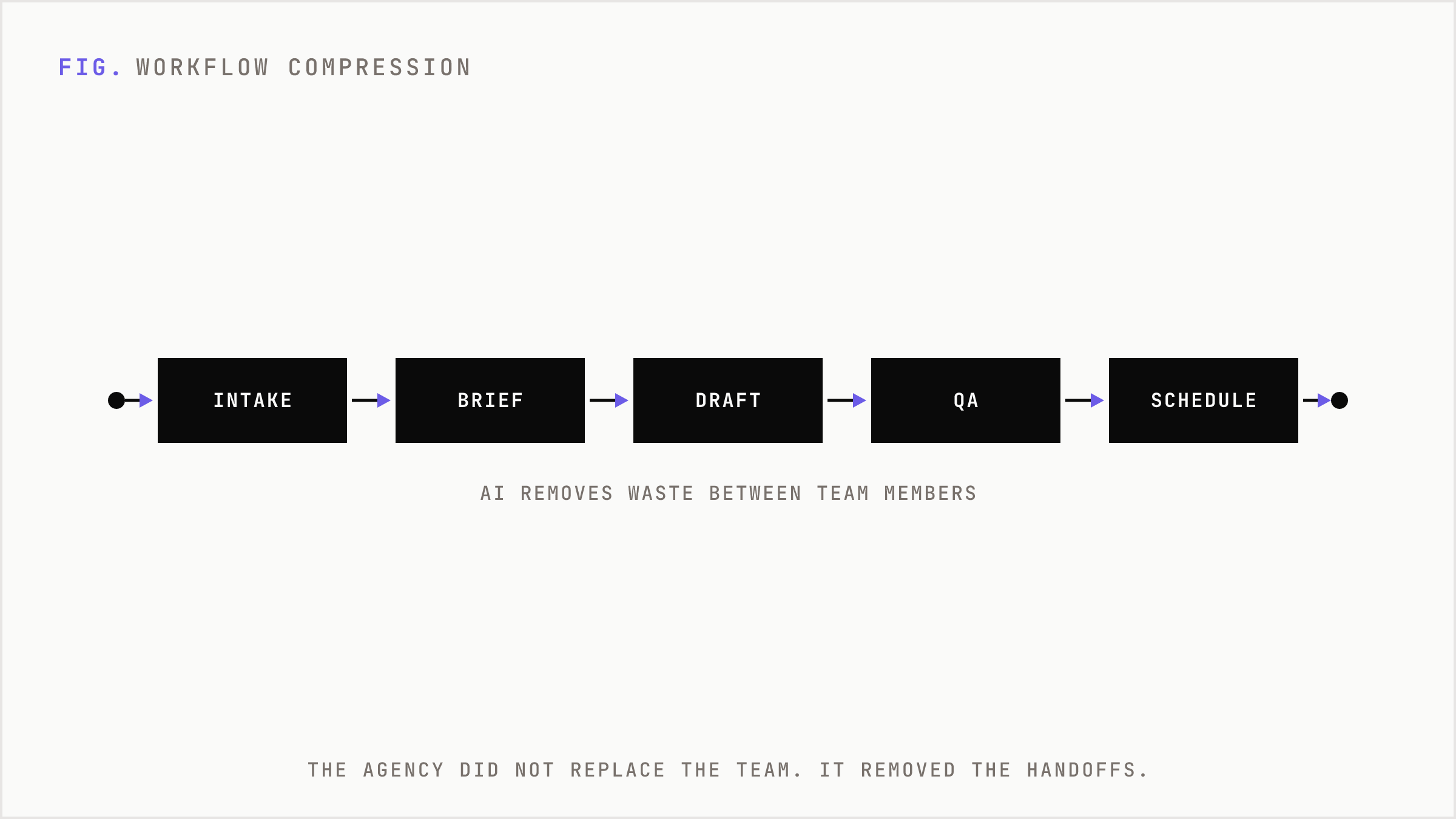
The agency did not replace the team. It removed waste between the team members.
This is why AI writing alone is the wrong benchmark. If a tool saves 20 minutes on a draft but creates 40 minutes of editing, review, and client anxiety, it is not profitable. If automation removes two hours of intake cleanup, reporting assembly, and asset formatting every month per client, it compounds.
Do not buy permanent intelligence for occasional work
SEO software is where low-cost agencies often overspend.
Semrush and Ahrefs are powerful. They are also frequently used like expensive vending machines. An agency logs in once a month, exports keyword data, pulls competitor pages, checks backlinks, and forgets the subscription exists until the card renews.
If SEO is the core retainer, keep the tool. If not, rent the intelligence in sprints. Buy a month. Export keyword, backlink, SERP, and competitor data. Store it in Sheets. Cluster it with AI. Build the roadmap in owned documents. Cancel until the next audit cycle.
That is not being cheap. It is matching cost to usage.
Surfer can make sense as an always-on optimization layer for content agencies, with lower plans starting around $49 per month annually and more capable tiers higher. But even then, the workflow matters more than the score. A page that satisfies a tool and says nothing useful will not build authority. A page that answers buyer questions, earns citations, and gets refreshed on a cadence has a better chance.
AI search changes what low-cost SEO means
AI search is still small in traffic terms. Previsible analyzed nearly two million LLM-driven sessions and found AI traffic was 0.13 percent of total sessions. But the traffic was concentrated on high-intent pages. Pricing pages. Tools pages. Industry pages. Search pages. Evaluation pages.
That is the interesting signal. AI discovery is not just a top-of-funnel game. It intersects with buyer evaluation.
Previsible also found ChatGPT accounted for 84.2 percent of AI referrals in its dataset. Ahrefs reported that pages lose 34.5 percent CTR on average when Google AI Overviews appear. The lesson is not that SEO is dead. The lesson is that low-cost SEO has to get more precise.
Agencies should prioritize comparison pages, pricing pages, category pages, answer-ready content blocks, schema, review-site presence, third-party citations, and content refresh systems. GEO, or generative engine optimization, is not magic. It is the discipline of making a brand easier for AI systems to understand, cite, and compare.
A low-cost GEO audit can be mostly manual. Pick commercial prompts. Test ChatGPT, Gemini, Perplexity, Claude, and Google AI results. Record whether the client appears. Record competitors. Record citations. Identify missing entities, review gaps, category page weaknesses, and third-party mention opportunities. Put the findings in a roadmap.
The software cost can be low. The methodology is the product.
Reporting is where agencies bleed quietly
Reporting looks cheap until you count the labor. A monthly report that takes 90 minutes per client is not a report. It is an unpaid service line.
The correct sequence is simple. Start with Looker Studio, GA4, Search Console, platform exports, and Sheets. Normalize campaign naming. Enforce UTM rules. Define the metrics that matter. Then use an LLM to produce narratives from fixed inputs.
Do not ask AI to interpret messy data. That is how hallucinated reporting happens. Ask it to explain known deltas, anomalies, wins, losses, and next actions from a controlled table.
Paid reporting tools make sense when the math says so. If reporting takes more than 30 minutes per client per month, automation deserves budget. If it takes less, template first. DashThis, AgencyAnalytics, and similar tools are useful once client count creates drag. They are not a substitute for data hygiene.
Governance is the underpriced service
IAB has reported that only about one-third of brands, agencies, and publishers have adopted or plan to adopt formal AI governance tools. That is a commercial opening.
Clients do not only need more AI output. They need rules. What data can go into an LLM? Who approves AI-generated claims? How is brand voice maintained? When should AI use be disclosed? Which prompts are approved? What gets fact-checked? What is banned?
A governance starter kit can include an AI usage policy, client-data rules, prompt library, brand voice guide, claims checklist, approval workflow, and escalation process. This is low-cost to build, high-value to sell, and hard for tool vendors to own because it depends on client context.
Governance also protects margin. Fewer rework cycles. Fewer client escalations. Fewer risky claims. More predictable delivery.
The buying rule is sequence
Agencies should not buy AI tools in the order vendors sell them. Buy in the order the operating system needs them.
- Buy one general-purpose LLM workspace.
- Buy automation.
- Structure owned data.
- Add channel tools when volume exists.
- Add SEO and social intelligence in sprints unless they are core retainers.
- Add reporting software only when reporting labor damages margin.
- Add agents after deterministic workflows exist.
This sequence prevents duplicate AI features from piling up. Many niche AI tools are wrappers around the same underlying models. Some are worth paying for because they add workflow, data, templates, integrations, or vertical UX. Many are not.
The test is blunt: does the tool reduce labor, reduce error, improve output quality, or create a sellable capability? If not, it is theater.
What agencies should sell
The product is not access to AI. Clients already have that. The product is an AI-assisted operating system for marketing.
That system can show up as five offers:
- AI marketing stack setup: tool audit, workspace setup, prompt library, SOPs, automation map, and reporting baseline.
- AI content operations: editorial workflows, AI briefs, brand voice system, SEO and GEO checklist, repurposing process, and QA.
- AI reporting system: dashboards, UTM rules, source normalization, automated summaries, and next-action logic.
- GEO visibility audit: AI answer testing, competitor mentions, citation maps, content gaps, and third-party authority gaps.
- AI governance starter kit: usage policy, data handling rules, approval flows, risk checklist, and claims verification.
These are better agency products than AI blog posts. They are closer to infrastructure. They touch the way work moves, how decisions get made, and how clients evaluate performance.
The real expansion path
Low-cost AI marketing is not a race to cheaper content. It is a path to cheaper coordination. That distinction will separate durable agencies from tool resellers.
As AI becomes standard, buyers will stop paying premiums for novelty. They will pay for faster cycles, cleaner decisions, lower risk, better attribution, and stronger presence in both search engines and AI answer systems.
The agencies that win will not be the ones with the longest software list. They will be the ones with the tightest operating model: one LLM workspace, one automation layer, owned data, disciplined workflows, human approval, and reporting that tells clients what to do next.
That is the lean stack. It is not flashy. It is profitable.
FAQ
What is the best low-cost AI marketing solution for agencies?
For most agencies, the best low-cost setup is ChatGPT Business, Make, Buffer, Brevo or MailerLite, Looker Studio, and free Google data sources. Content and SEO agencies can add Surfer and use Semrush or Ahrefs in monthly sprint windows.
Should agencies buy an all-in-one AI marketing platform?
Usually not at the beginning. All-in-one platforms make sense when workflow volume, client count, and reporting complexity justify the fixed cost. Smaller agencies usually get better margins from a modular stack.
Where does AI create the most agency ROI?
The biggest ROI usually comes from workflow compression: intake, briefs, handoffs, reporting, repurposing, QA, and client communication. Content generation helps, but operational time savings compound faster.
How should agencies approach AI search and GEO?
Start with manual AI answer audits, commercial prompt testing, citation gap analysis, comparison-page strategy, schema cleanup, and third-party authority building. GEO is a methodology before it is a software category.
When should agencies upgrade reporting tools?
Upgrade when reporting takes more than 30 minutes per client per month or when manual reporting increases churn risk. Until then, Looker Studio, Sheets, GA4, Search Console, and disciplined UTM rules are enough.