Nyyon · Blog
The Insight Engine: How AI Turns Marketing Noise Into Better Decisions
Learn how AI can turn noisy marketing data into causal insights, sharper segmentation, better experiments, and faster decisions for growth teams.
AI does not create sharper marketing insights by itself. It creates leverage when it connects messy signals to decisions that can be tested.
Most marketing teams do not have an insight problem because they lack data. They have an insight problem because they have too much disconnected data, too many dashboards, too much platform self-reporting, and too little causal discipline.
The result is familiar. A growth meeting opens with traffic, ROAS, conversion rate, email revenue, pipeline, churn, and creative fatigue. Everyone has numbers. Few people have a decision.
AI is useful here, but not in the way most teams are using it. The best use case is not more copy, more posts, or more versions of the same campaign. The best use case is compressing the distance between signal and action.
The Budget Context Matters
Marketing leaders are not operating in a blank check market. Gartner reported that 2025 marketing budgets stayed flat at 7.7 percent of company revenue, while 59 percent of CMOs said their budgets were insufficient to execute strategy. That is the real backdrop for AI adoption.
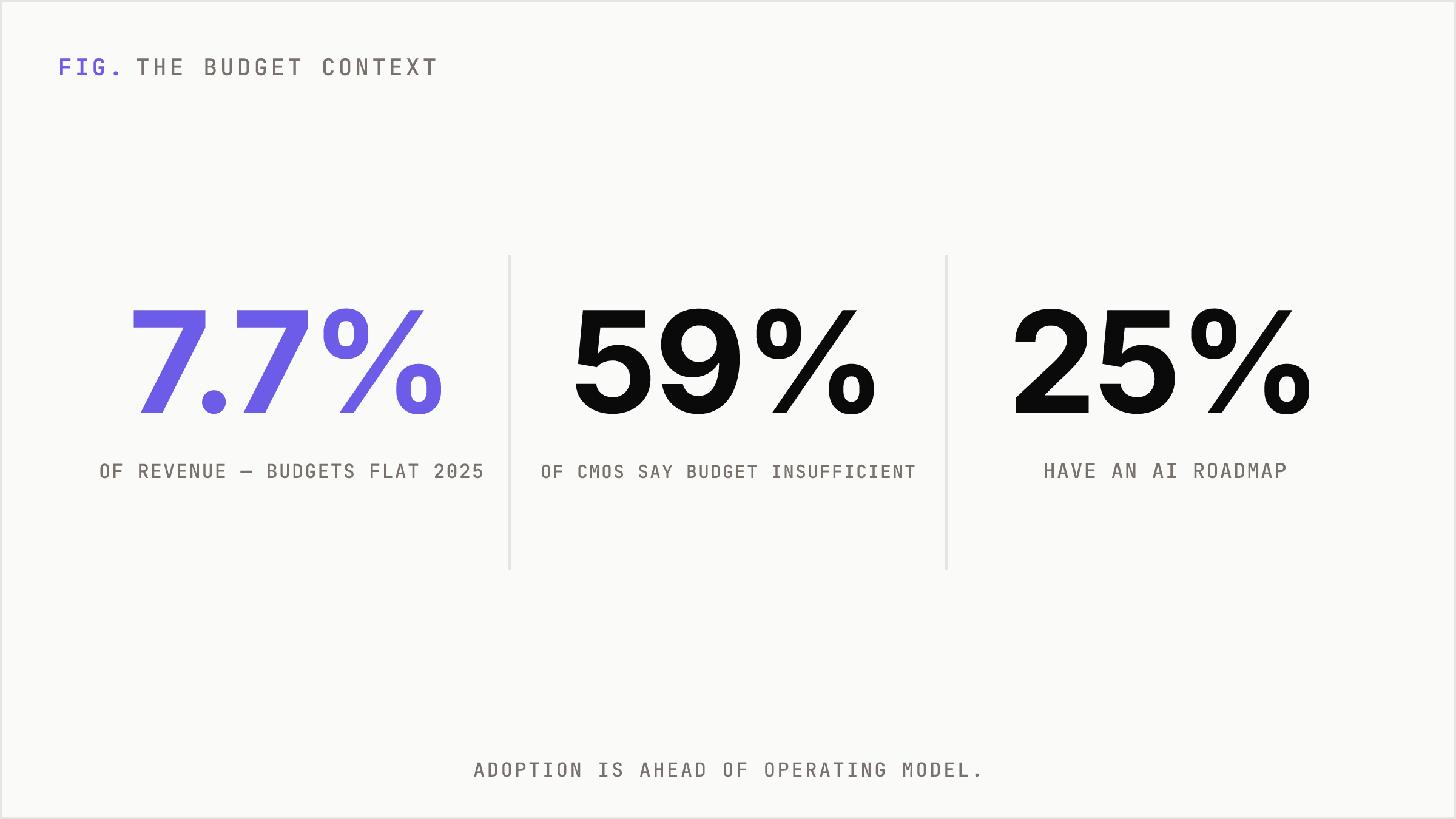
Flat budgets change the job. The winner is not the team that produces the most assets. It is the team that learns which audience, message, channel, and offer actually move revenue with the least waste.
Marketing AI Institute found that 60 percent of marketers are piloting or scaling AI, but only 25 percent have an AI roadmap or strategy for the next one to two years. Adoption is ahead of operating model. That gap is where most value is being lost.
The market is buying tools before it has defined the workflow. That is backward. AI only becomes strategic when it is attached to a decision loop.
Dashboards Describe. Insight Decides.
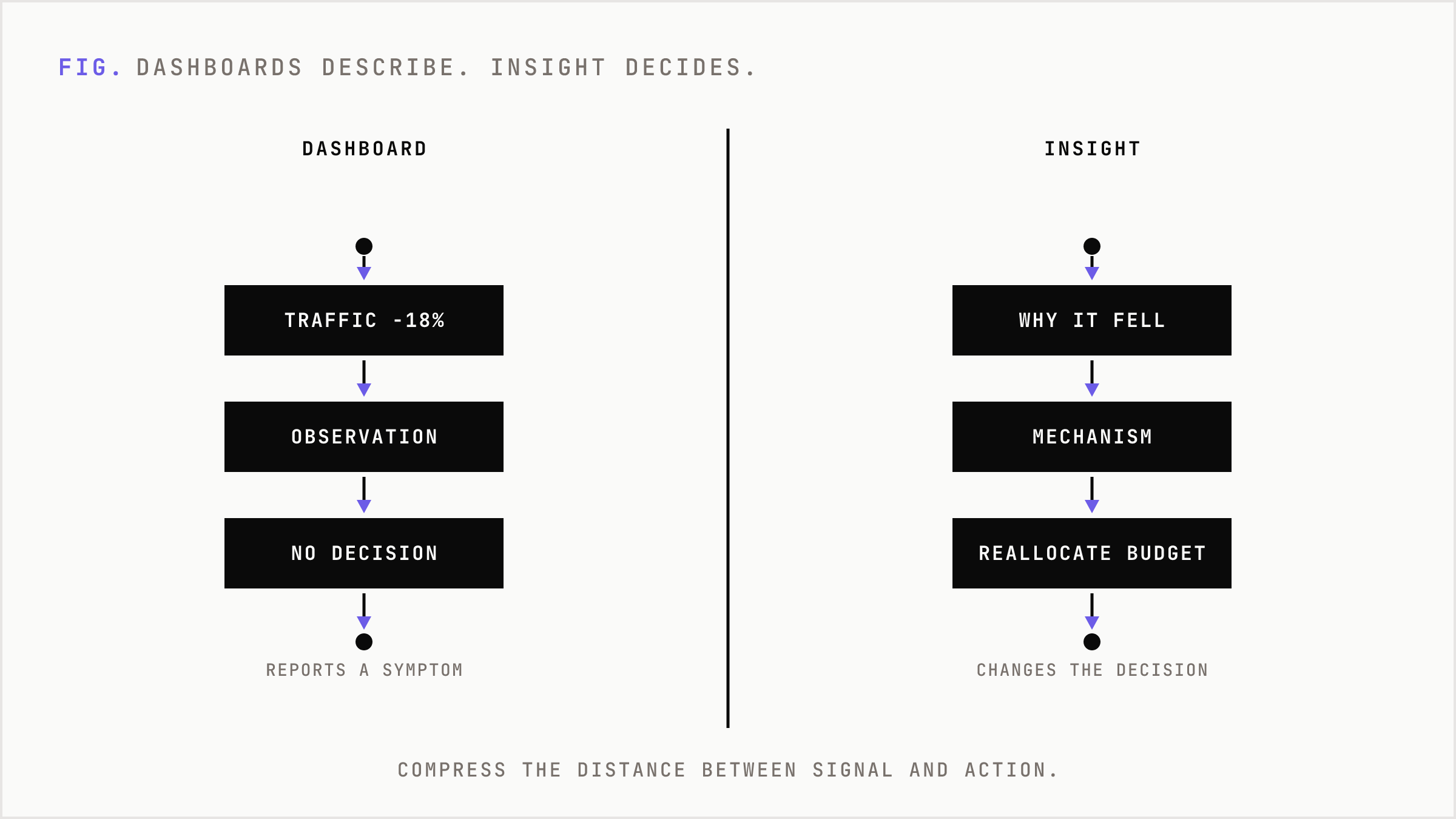
A dashboard tells you website traffic fell 18 percent. That is not an insight. It is an observation.
A stronger output looks like this: traffic is down because AI search and answer surfaces are absorbing low-intent informational queries before the click. The decision is to shift content investment away from generic explainers and toward comparison pages, proof assets, owned community, product-led education, and sources that large language models can cite.
That is the difference. One output reports a symptom. The other explains a mechanism and changes budget allocation.
AI can help with the mechanics. It can detect anomalies, compare changes against seasonality, cluster affected segments, scan source evidence, summarize competitor movement, and propose test plans. But the human standard has to be clear. No source, no insight. No decision, no insight. No test, no insight.
The Core Shift Is From What to Why
Traditional analytics is built around what happened. Impressions. Clicks. Sessions. Conversions. Cost per lead. Return on ad spend.
Those metrics matter, but they do not answer the question a founder or CFO cares about: what caused the change, and what should we do next?
AI-enhanced insight should answer more specific questions. Which audiences changed behavior? Which messages changed belief? Which channels created incremental demand rather than harvested existing demand? Which campaigns looked efficient in the platform but weak in revenue quality? Which offers improved conversion but damaged retention?
That requires more than dashboard summarization. It requires causal measurement, incrementality testing, marketing mix modeling, uplift modeling, and experiment calibration. AI is not a substitute for those methods. It is a way to make them more usable, more frequent, and more connected to operating decisions.
Attribution Is Not Neutral
Platform attribution is convenient because it is fast and flattering. It is also structurally conflicted. Nielsen has warned that in-platform or custom attribution can mean a publisher grades its own homework. That is not a moral critique. It is an incentive problem.
If Meta, Google, TikTok, retail media networks, and affiliate platforms all claim credit for the same sale, the CFO does not have a marketing insight. The CFO has a reconciliation problem.
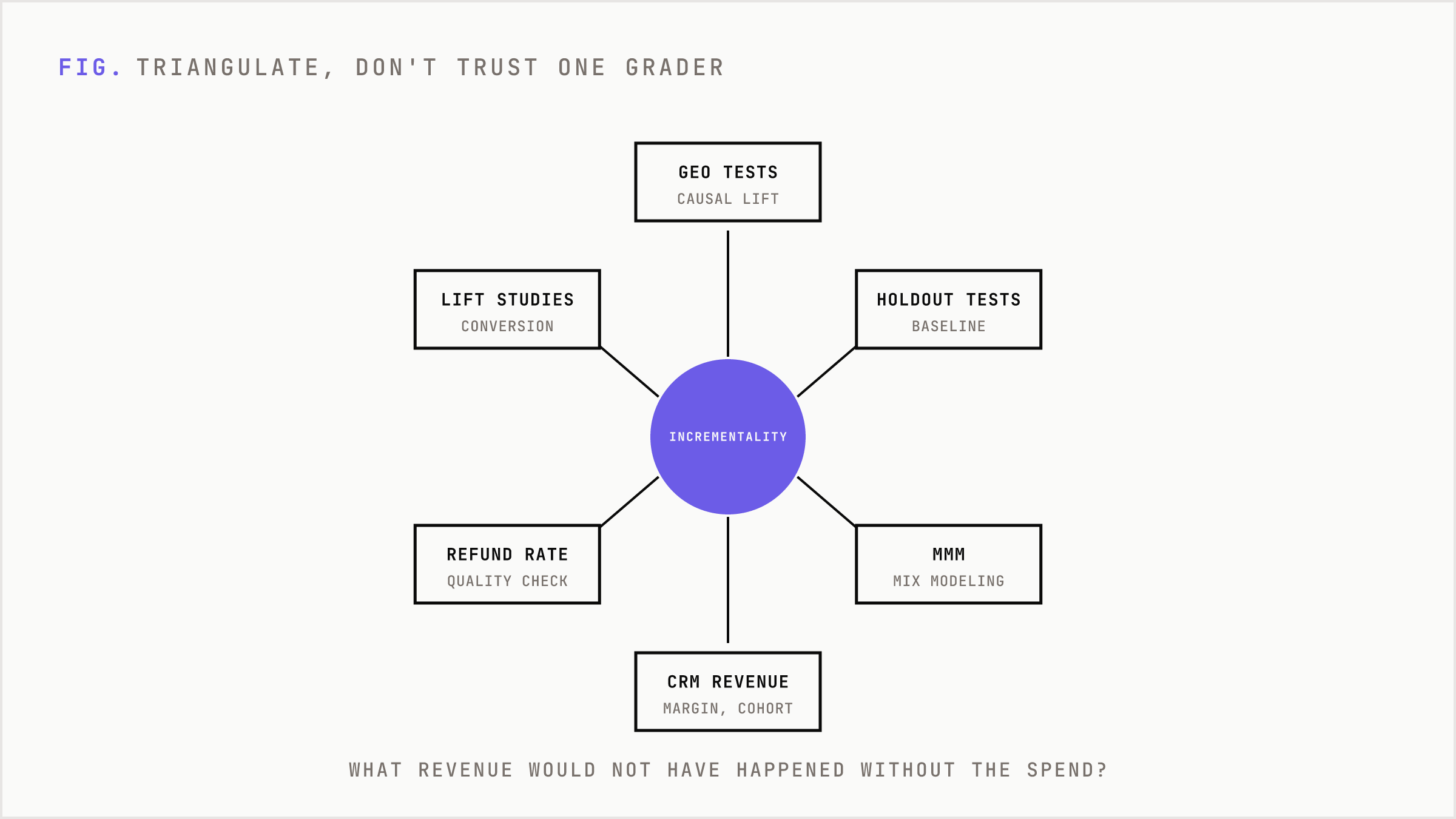
A better AI workflow triangulates platform data with geo tests, holdout tests, conversion lift studies, marketing mix modeling, CRM revenue, margin, cohort quality, and refund rate. The question is not which platform claimed the sale. The question is what revenue would not have happened without the spend.
This is where modern measurement tooling matters. Google Meridian supports Bayesian marketing mix modeling, experiment calibration, geo-level modeling, ROI uncertainty, and marginal ROI analysis. Meta Robyn uses ridge regression, adstock, saturation curves, time-series decomposition, and budget allocation logic. Microsoft EconML supports causal response estimation and individualized treatment effects.
The strategic point is simple. Platform ROAS is not incremental revenue. Treating it that way is how teams scale waste with confidence.
Uplift Beats Propensity
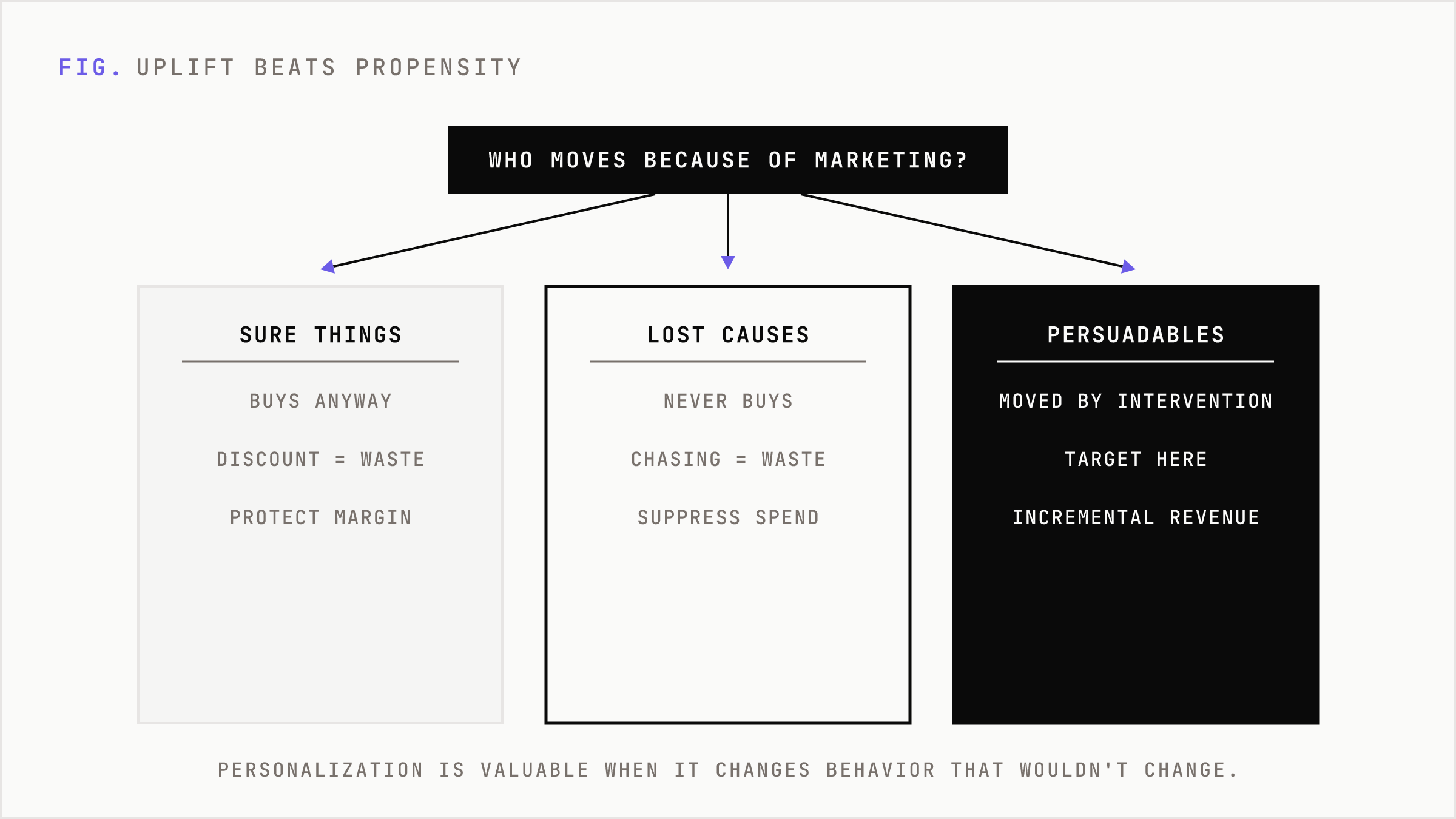
Most targeting still asks the wrong question. A propensity model asks who is likely to buy. An uplift model asks who is likely to buy because of the marketing intervention.
That distinction is expensive.
If you discount a customer who would have bought anyway, you destroy margin. If you chase someone who will never buy, you waste spend. If you suppress a persuadable buyer because their baseline probability looks low, you leave revenue on the table.
AI should help separate sure things, lost causes, and persuadable customers. That changes targeting, frequency, incentive design, and sales follow-up. It also changes the economics of personalization. Personalization is not valuable because it feels clever. It is valuable when it changes behavior that would not have changed otherwise.
Qualitative Data Is the Underpriced Asset
Many companies have their best marketing insights trapped in places the marketing team rarely reads at scale: sales calls, support tickets, refund reasons, reviews, live chat logs, survey open-ends, Reddit threads, competitor reviews, and customer interviews.
AI is extremely useful here because qualitative data is messy, repetitive, and high signal. It can cluster objections, identify buying triggers, surface anxieties, map feature confusion, extract category language, and compare how customers describe pain before and after purchase.
The output should not be a generic persona. The output should be a commercial claim with evidence.
Customers do not object to price. They object to uncertainty about fit.
The winning claim is not speed. It is reduced decision risk.
The strongest conversion language already exists in customer complaints.
Those are actionable. They change landing pages, ads, onboarding, sales scripts, FAQs, and product packaging.
AI Trust Is a Segment Now
Buyer behavior is changing because AI is moving into the shopping journey. IAB and Talk Shoppe found that nearly 40 percent of U.S. shoppers use AI when shopping. Klaviyo found that 41 percent of global consumers had purchased an AI-recommended product in the prior six months, and that AI-referred traffic from sources like ChatGPT and Gemini rose sharply year over year in its platform data.
But adoption is not trust. Klaviyo also found that only 13 percent of consumers fully trust AI, even though 60 percent use it at least weekly.
That makes AI trust a useful segmentation variable. Two buyers with the same age, income, category need, and product interest may respond differently depending on whether AI assistance feels premium or invasive.
An AI enthusiast may want guided recommendations, comparison logic, automated reordering, and proactive support. A skeptic may need human proof, transparent sourcing, clear controls, and less aggressive personalization. Same product. Different confidence architecture.
Search Insight Has Changed
The old SEO question was: do we rank?
The new question is: are we cited, summarized, compared, trusted, and recommended by AI systems when buyers ask real questions?
That changes the insight workflow. Brands need to track mentions in AI answers, inclusion in product comparisons, cited sources, sentiment, hallucinated claims, missing proof points, competitor co-mentions, and prompt coverage across buyer intents.
This is not a vanity exercise. AI search compresses discovery. A buyer may form a shortlist before visiting a website. If the brand is absent from that machine-generated shortlist, the site conversion rate can look stable while upstream demand quietly weakens.
The response is not to spam AI systems. It is to make brand data structured, consistent, crawlable, evidence-rich, and commercially specific.
Creative Intelligence Is Still Primitive
Most teams still judge creative at the asset level. This ad won. That ad failed. That is too shallow.
AI can tag creative by hook, offer, emotion, proof type, visual motif, CTA, problem framing, authority signal, urgency, risk reversal, and audience promise. Then it can connect those tags to thumb-stop rate, CTR, conversion rate, CAC, AOV, LTV, refund rate, lead quality, and sales acceptance.
That creates a more useful layer of insight.
- Founder-led proof beats product-led claims for cold traffic.
- Pain-aware hooks increase CTR but reduce lead quality.
- Discount-led ads acquire lower-retention cohorts.
- Problem and solution framing scales better than feature demos for new category buyers.
The point is not to let AI decide taste. The point is to build a feedback system where creative decisions compound instead of reset every campaign.
The Evidence Ledger Is the Operating System
AI-generated insight needs a ledger. Every claim should carry its source data, sample size, time period, segment, confidence level, causal status, business implication, recommended action, and next test.
Teams should label outputs clearly: observed fact, model inference, hypothesis, causal claim, or recommendation.
This sounds bureaucratic. It is not. It is what prevents AI from turning into a very fast intern with a confident voice.
Salesforce has reported that data and analytics leaders consider a meaningful share of their data untrustworthy. That matters because AI does not repair bad data by sounding fluent. It can make bad data more persuasive.
The answer is not slower work. It is structured work. A clean evidence ledger lets teams move faster because they know which insights are facts, which are hypotheses, and which require testing before budget moves.
The Workflow Is the Product
The agency or internal team advantage is not access to AI tools. Tool access is commoditized. The advantage is designing the insight system.
That system has five parts.
- Data architecture that connects CRM, media, creative, web, product, support, sales, margin, and retention signals.
- Customer language mining that turns qualitative noise into buyer belief maps.
- Causal measurement that separates claimed revenue from incremental revenue.
- Creative intelligence that links message mechanics to business outcomes.
- Decision workflows that convert evidence into tests, budget moves, and product feedback.
This is where AI becomes operationally important. It does not sit beside the marketing team generating content. It becomes connective tissue between research, analytics, creative, media, sales, and customer experience.
The Strategic Implication
AI will expand the marketing surface area. More buyer journeys will include AI assistants. More discovery will happen before the website visit. More competitors will produce acceptable content at near zero marginal cost. More channels will claim attribution. More customer feedback will be available but harder to parse manually.
In that world, volume is a weak moat. Insight velocity is a stronger one.
The best marketing teams will not win because they prompt better. They will win because they learn faster. They will know which claims change belief, which segments need reassurance, which channels are incremental, which incentives protect margin, which creative patterns scale, and which AI-mediated journeys are changing demand formation.
The practical mandate is clear. Stop treating AI as a production shortcut. Build an insight engine.
Feed it real customer data. Force it to cite evidence. Connect it to causal methods. Tie every output to a decision. Close the loop with experiments. Then repeat.
That is how AI turns marketing noise into better decisions. Not magic. Not automation theater. Just a faster path from signal to learning to capital allocation.
FAQ
How should marketers use AI for better insights?
Use AI to connect customer, media, creative, sales, and revenue signals. The goal is not more reporting. The goal is to identify what changed, why it changed, what decision should follow, and what test can validate it.
What is the difference between AI analytics and traditional dashboards?
Traditional dashboards show what happened. AI analytics can help cluster causes, summarize evidence, detect anomalies, compare segments, and propose next actions. It still needs clean data, causal methods, and human review.
Why is platform ROAS not enough?
Platform ROAS shows what a platform claims. It does not prove incremental revenue. Better measurement triangulates platform data with holdouts, geo tests, lift studies, marketing mix modeling, CRM revenue, margin, and cohort quality.
What data should feed an AI insight engine?
Use CRM data, ad spend, creative metadata, sales notes, support tickets, reviews, product usage, churn reasons, cohort retention, margin, LTV, competitor data, search results, AI answer outputs, and customer interviews.
What makes an AI-generated insight trustworthy?
A useful insight includes source data, sample size, time period, segment, confidence level, causal status, business implication, recommended action, and next test. Without evidence and a decision, it is just commentary.