Nyyon · Blog
The Human-Led Campaign Intelligence Playbook
A sharp guide to human-led AI campaign systems that reduce wasted spend, speed learning, protect brand quality, and improve marketing decisions.
AI will not make campaign management disappear. It will make weak campaign management impossible to hide.
The lazy version of the story is simple: marketing teams use AI to make more ads, faster. That is true, but not useful. Faster production is not the bottleneck anymore. The bottleneck is judgment. Which market segment matters. Which offer deserves budget. Which creative idea is merely plausible and which one can carry a quarter. Which metric is signal and which one is platform theater.
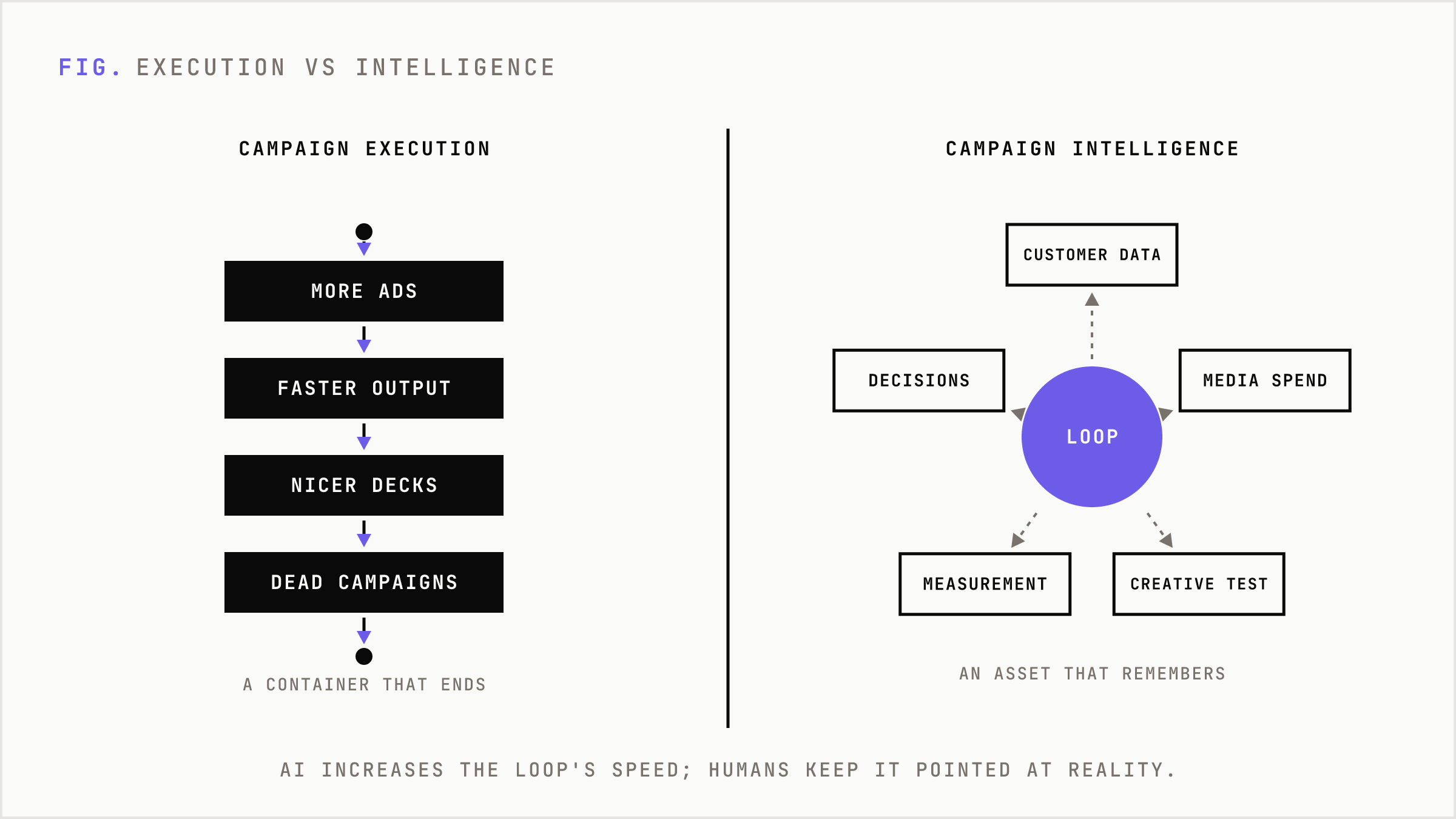
The real shift is from campaign execution to campaign intelligence. Not dashboards. Not prompt packs. Not automated reports with nicer syntax. A campaign intelligence system is a governed loop that connects customer data, media spend, creative testing, offer strategy, measurement, and executive decisions. AI increases the speed and surface area of the loop. Humans keep it pointed at business reality.
The budget line is the tell
Marketing leaders are not buying AI because it is interesting. They are buying leverage because the economics are getting worse.
Gartner reported that 2025 marketing budgets stayed flat at 7.7 percent of company revenue, while 59 percent of CMOs said they did not have enough budget to execute their strategy. Paid media remains the largest bucket at 30.6 percent of marketing budgets. That matters because media inflation means the same spend buys less attention, less reach, and less margin for error.
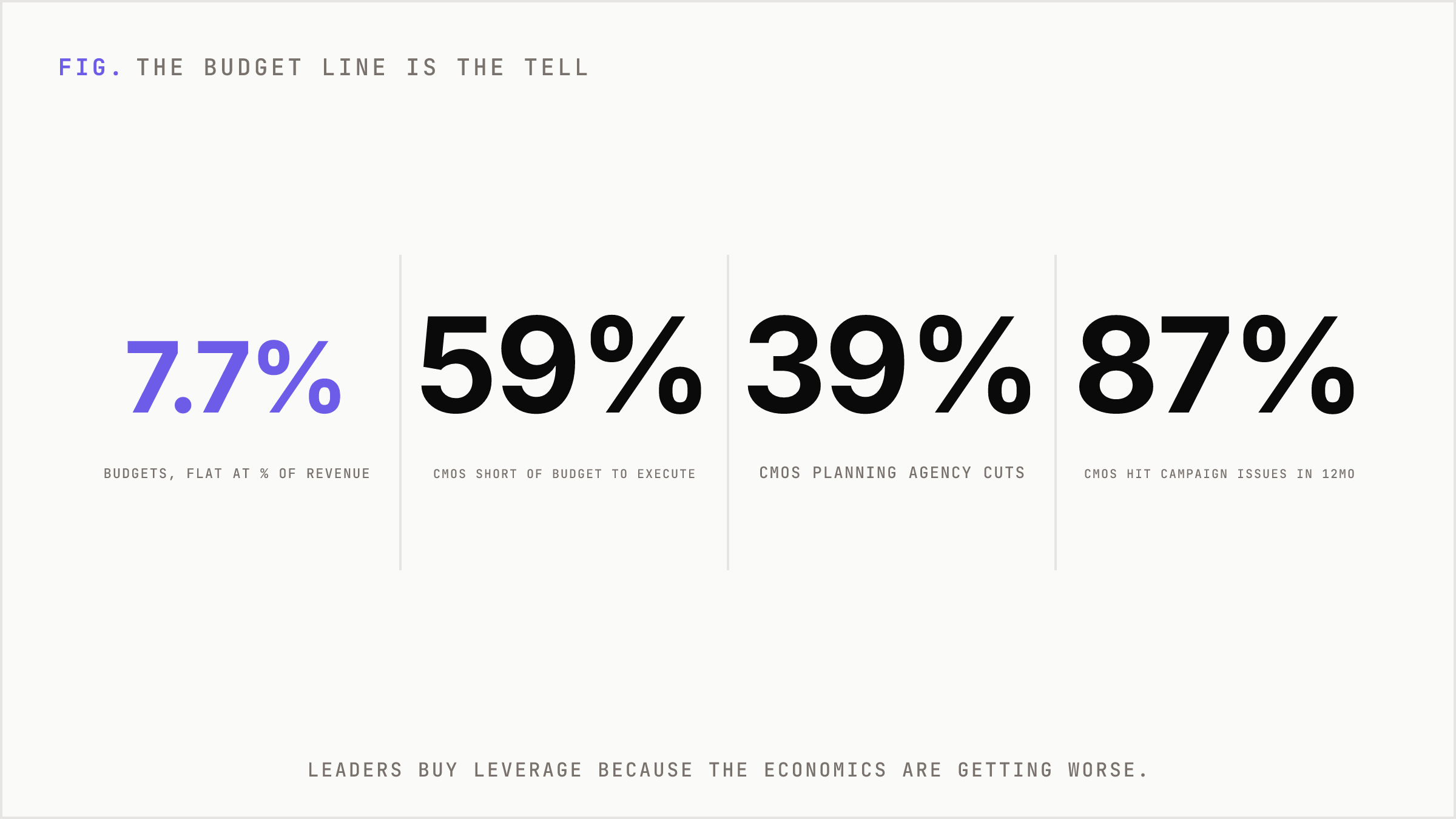
At the same time, agency budgets are exposed. Gartner found that 39 percent of CMOs planned to cut agency budgets, and 22 percent said generative AI had reduced reliance on external agencies for creativity and strategy building. This is not a mood swing. It is a substitution event.
If an agency mainly sells basic copy, generic creative variants, keyword lists, reporting decks, and routine optimizations, AI can compress that value. The client may not bring all of it in-house, but they will question why it still costs the same.
That does not kill agencies. It changes what survives.
The wrong product is more output
More output looks impressive in a demo. It looks worse inside a real marketing operation.
A team that previously tested 12 ad variants can now generate 200. But each asset still needs a reason to exist. It needs a hypothesis, an audience, an offer, a brand constraint, a landing page, a budget allocation, a readout, and a next action. Without that structure, AI does not reduce waste. It industrializes it.
This is why campaign performance remains broken even as tools improve. Gartner found that 87 percent of CMOs experienced campaign performance issues in the prior 12 months, and 45 percent sometimes, often, or always terminated campaigns early because of poor performance. That is not a content shortage. That is a learning system failure.
The buyer does not want AI-generated ads. The buyer wants fewer dead campaigns, fewer surprise CPA spikes, fewer executive meetings where no one can explain what happened, and fewer dollars allocated on faith.
White glove now means managed intelligence
Old white glove was service theater: more meetings, more account people, more manual coordination, more bespoke decks. Some of it was useful. Much of it was friction dressed as care.
AI-native white glove is different. It means the client gets a custom operating layer between strategy, data, creative, media, and measurement. The system watches more signals than a human team can watch manually. It drafts options. It detects anomalies. It summarizes learning. It keeps campaign memory. It proposes tests. It flags risk.
But it does not get unilateral control over consequential decisions.
That distinction is the category. AI handles scale. Strategists handle judgment. The client gets accountability.
White glove should mean less client work, not more touchpoints. Fewer approvals. Cleaner decision memos. Faster launches. Better audit trails. No black box optimization. No surprise repositioning. No sudden creative drift because a model found a cheap click pattern that damages the brand.
The unit is not the campaign. It is the loop.
A campaign is a container. A loop is an asset.
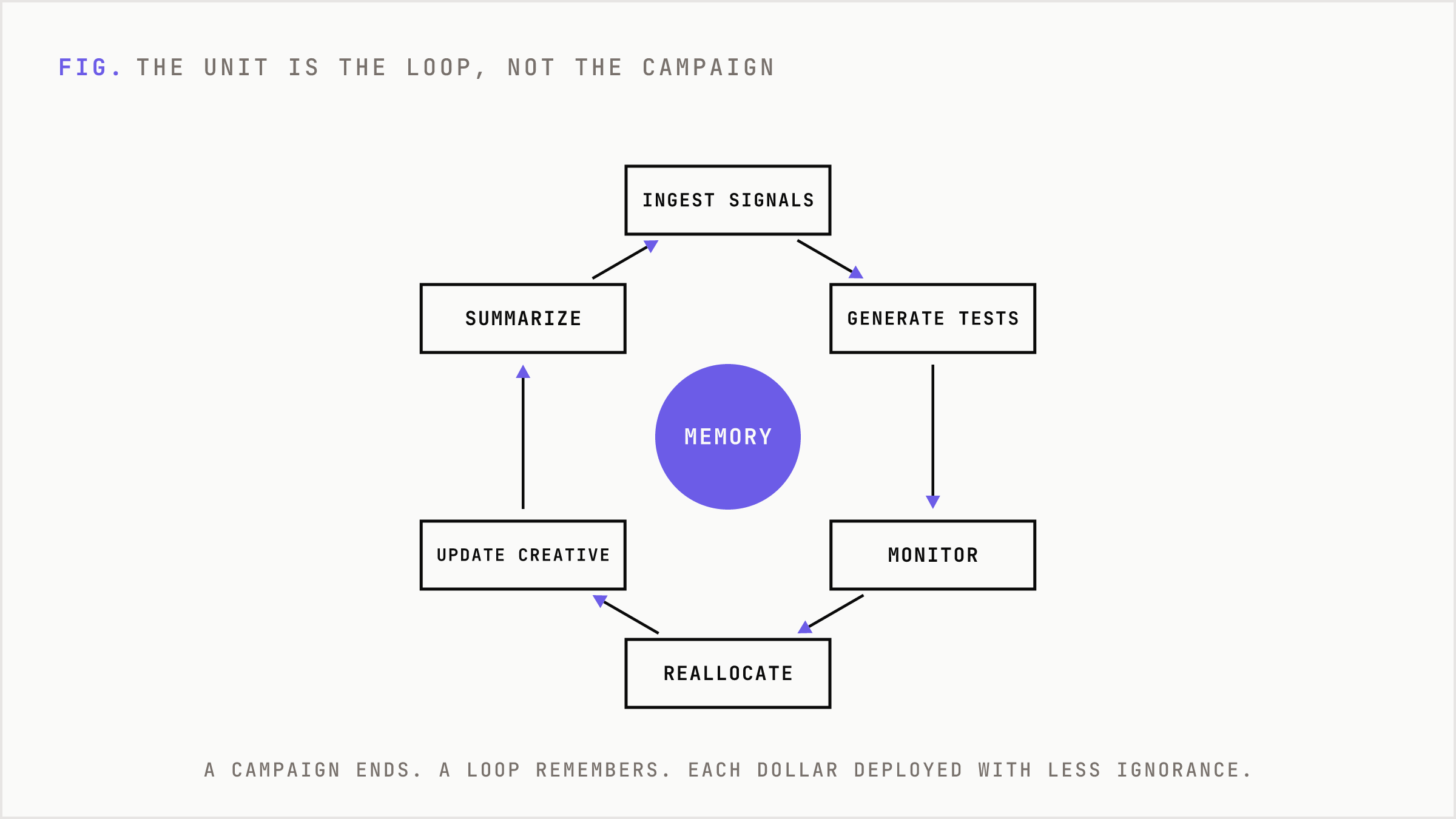
The campaign says: launch this audience, this creative, this budget, this landing page, this channel mix. The loop says: ingest signals, generate hypotheses, launch controlled tests, monitor performance, detect fatigue, reallocate spend, update creative, summarize learning, and feed the next cycle.
The difference is compounding.
A campaign ends. A loop remembers. It remembers that discount-led messaging lifted conversion but damaged average order value. It remembers that founder-led video worked for cold audiences but not retargeting. It remembers that one segment clicked comparison content while another needed proof from customers. It remembers which claims legal rejected, which hooks exhausted quickly, and which landing page friction lowered conversion.
That memory becomes an economic advantage. Not because it is mystical. Because each new dollar is deployed with less ignorance.
The mechanics are concrete
At the task level, AI campaign management is not abstract. It has jobs.
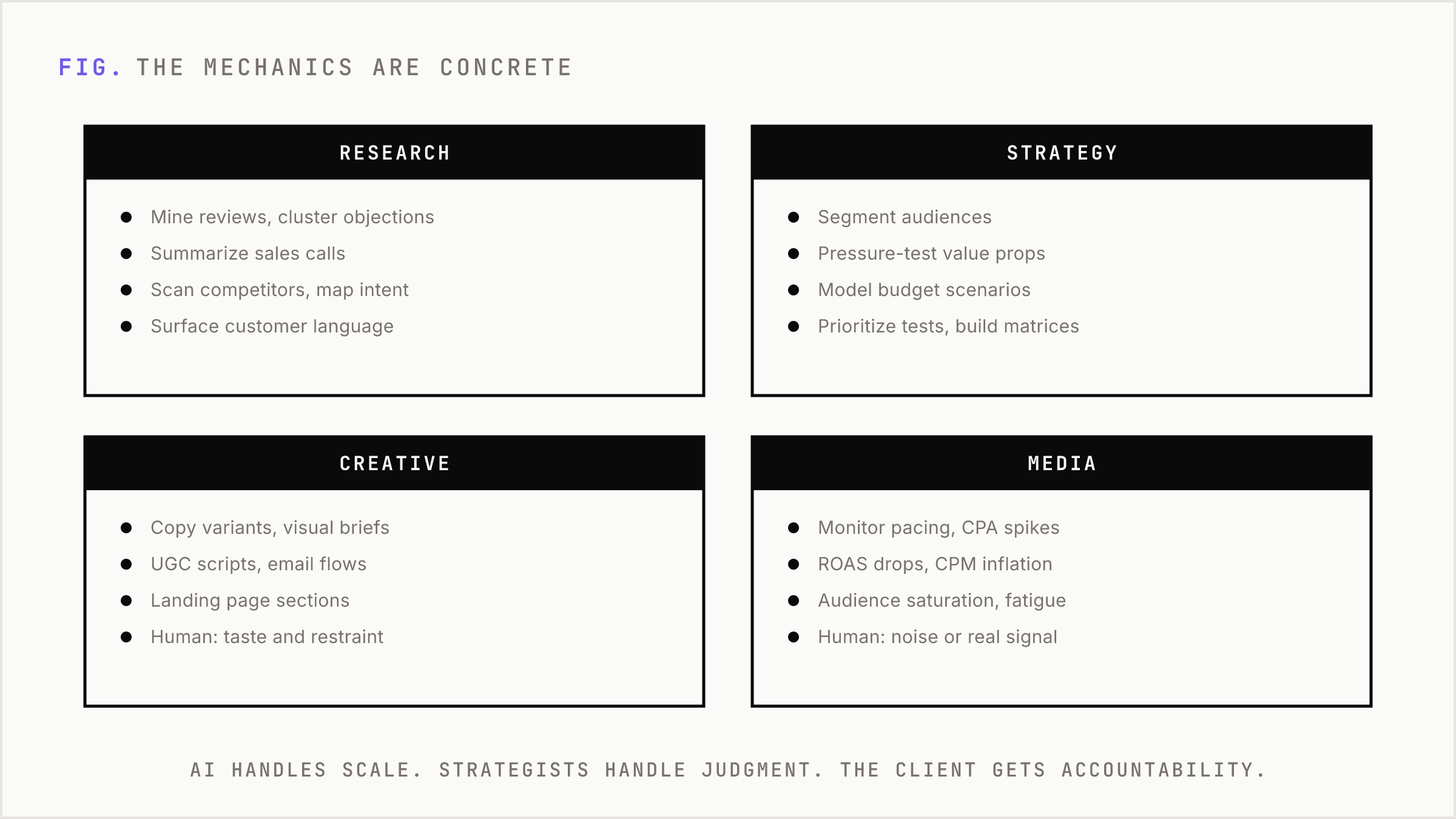
In research, AI can mine reviews, cluster objections, summarize sales calls, scan competitors, map search intent, and surface recurring customer language. That gives strategists better raw material.
In strategy, AI can help segment audiences, pressure-test value propositions, model budget scenarios, prioritize tests, and build message matrices. The human role is to decide which assumptions are worth risking money on.
In creative, AI can generate copy variants, visual briefs, UGC scripts, email flows, landing page sections, and personalization logic. The human role is taste, restraint, and brand memory. The premium decision is often what not to ship.
In media, AI can monitor pacing, CPA spikes, ROAS drops, CPM inflation, audience saturation, negative keyword opportunities, and creative fatigue. The human role is deciding whether a movement is noise, seasonality, channel bias, or an actual budget signal.
In conversion, AI can inspect page friction, form drop-off, checkout patterns, and offer mismatch. The human role is connecting that evidence to positioning, pricing, and product reality.
In reporting, AI can turn scattered metrics into a decision memo: what changed, why it matters, what we did, what we need approved, and what happens next.
The moat is context
The best AI campaign systems are not powered by clever prompts. They are powered by better context.
IAB has reported that only about 30 percent of agencies, brands, and publishers have fully integrated AI across the media campaign lifecycle. The main blockers are not just model quality. Nearly two-thirds cite data quality, data protection, and fragmented tools as major barriers.
That is the real work.
A useful campaign intelligence layer needs CRM data, ad platform data, analytics data, sales or revenue data, call data, product feeds, creative metadata, customer research, brand guidelines, compliance rules, prior test results, and decision logs. Without that layer, AI outputs remain generic. With it, the system can become client-specific.
This is why the defensible agency is not a content factory. It is the owner of campaign memory, measurement logic, creative learning, governance rules, test cadence, and cross-channel narrative.
Governance is not a legal appendix
Autonomous campaign systems sound good until they touch money, claims, pricing, or brand trust.
Some AI actions are low risk: anomaly detection, report summaries, variant drafts, QA checklists, tagging, competitor monitoring, and test recommendations. These should be automated aggressively.
Other actions need human gates: budget reallocations, audience expansion, compliance-sensitive claims, pricing changes, offer changes, landing page edits, influencer approvals, and brand-sensitive creative. These decisions have second-order effects. A model may find a cheaper conversion path that trains the market to wait for discounts. It may write a claim that converts but creates regulatory exposure. It may optimize toward platform ROAS while blended economics deteriorate.
Governance is not anti-AI. It is how AI becomes usable in real companies.
Reporting has to stop being a receipt
Most reporting is backward-looking proof of activity. It shows spend, clicks, impressions, conversions, and a few screenshots. It rarely changes the next decision.
AI-native reporting should behave like decision infrastructure. It should answer three questions: what changed, why might it have changed, and what should we do next?
A useful weekly report might say that CPA rose 18 percent because conversion rate dropped on mobile traffic after a landing page change, while CTR remained stable. It might show that two creatives are fatiguing, one audience is saturating, and a competitor has increased promotional pressure. It might recommend pausing three variants, launching two new concepts, and holding budget steady until a page fix is live.
That is not a deck. It is operating leverage.
Measurement is where false precision hides
Platform ROAS is not truth. It is a platform's view of its own contribution. Every platform has an incentive to claim credit. A campaign intelligence system has to protect the client from that bias.
Better measurement uses incrementality tests, holdouts, geo tests, cohort analysis, CAC payback, LTV by acquisition source, contribution margin, blended MER, and marketing mix modeling where scale supports it. Not every company needs every method. Every company needs a clear view of what is directional, what is causal, and what is merely attributed.
This matters more as personalization scales. McKinsey has reported cases where generative AI accelerated personalized content development dramatically and created major revenue gains through pricing improvements and targeted offers. But personalization is only valuable when tied to economics. Lifecycle stage, margin, intent, product fit, retention risk, and channel preference matter. Cosmetic personalization does not.
Search is no longer just search
Discovery is moving into answer engines.
Pew found that Google users clicked traditional result links in 8 percent of visits when an AI summary appeared, compared with 15 percent when no AI summary appeared. Google AI Mode uses query fan-out, reasoning, shopping data, and follow-up interaction. ChatGPT has also become a product discovery surface through product feeds, pricing, reviews, availability, and merchant-controlled checkout paths.
This expands campaign management beyond SEO and SEM. Brands now need AI visibility audits, entity consistency, product feed quality, structured data, review signals, comparison content, Reddit and YouTube monitoring, citation-worthy assets, and answer-engine positioning.
The machine is becoming part of the buyer journey. It summarizes the market before the buyer clicks. If your campaign system only optimizes ads, it misses the new surface area.
The agency market will split
AI does not remove demand for marketing help. It removes tolerance for expensive task execution.
The lower tier will sell volume: more ads, more posts, more reports, more variants. Margins will compress because the client can see the commodity input cost falling.
The higher tier will sell judgment systems: campaign architecture, offer strategy, experimentation design, data integration, attribution logic, creative filtering, AI governance, and executive decision support. This work is harder to internalize because it spans teams, tools, incentives, and budget lines.
That is the commercial opening for firms like Nyyon. Not to be an AI agency. That phrase is already tired. The opportunity is to be the campaign intelligence layer for teams that need senior judgment, faster cycles, cleaner measurement, and less operational drag.
The buyer behavior is simple
Clients will pay for faster launch cycles, lower wasted spend, better creative testing, clearer reporting, fewer agency meetings, better measurement, brand-safe AI, channel accountability, revenue-linked decisions, and reduced internal workload.
They will not pay a premium for AI-generated ad copy, generic dashboards, automated reports with no decisions, prompt libraries, tool resale, or ungoverned agents pretending to be strategy.
The buyer is not confused. The market is.
The long-term expansion case
Human-led campaign intelligence expands the market because it changes the cost of learning.
When learning is slow, companies run fewer tests. When tests are expensive, teams default to opinion. When reporting is unclear, budget decisions become political. When creative production is constrained, teams over-invest in safe ideas. When measurement is weak, platforms define reality.
AI changes the throughput. White glove management changes the reliability. Together, they let companies run more disciplined experiments without drowning in operational complexity.
The future is not self-driving campaigns. That framing is too neat and commercially naive. The future is human-led campaign intelligence systems: AI for volume, monitoring, synthesis, and recommendations; humans for strategy, taste, risk, and accountability.
The winning agency will not be the one using the most AI. It will be the one that turns AI into better decisions, faster learning, and less wasted spend.
FAQ
What is human-led campaign intelligence?
It is a campaign operating system where AI monitors signals, generates options, summarizes learning, and supports execution, while humans retain control over strategy, budget, brand, compliance, and final decisions.
How is this different from AI-generated ads?
AI-generated ads are one task. Campaign intelligence connects research, creative, media, conversion, reporting, measurement, and decision-making into a governed learning loop.
Where should AI be allowed to act automatically?
AI is safest for low-risk work such as anomaly detection, reporting summaries, QA checks, tagging, competitive monitoring, and draft recommendations. Budget moves, claims, pricing, offers, and brand-sensitive creative need human approval.
Why does this matter for agency selection?
AI compresses the value of commodity agency work. The defensible partner owns campaign memory, measurement logic, experimentation cadence, governance, and senior judgment across channels.