Nyyon · Blog
The End of Wasted Marketing Spend
AI is eliminating wasted marketing spend across media buying, creative, targeting, and conversion, driving structurally lower CAC and faster growth.
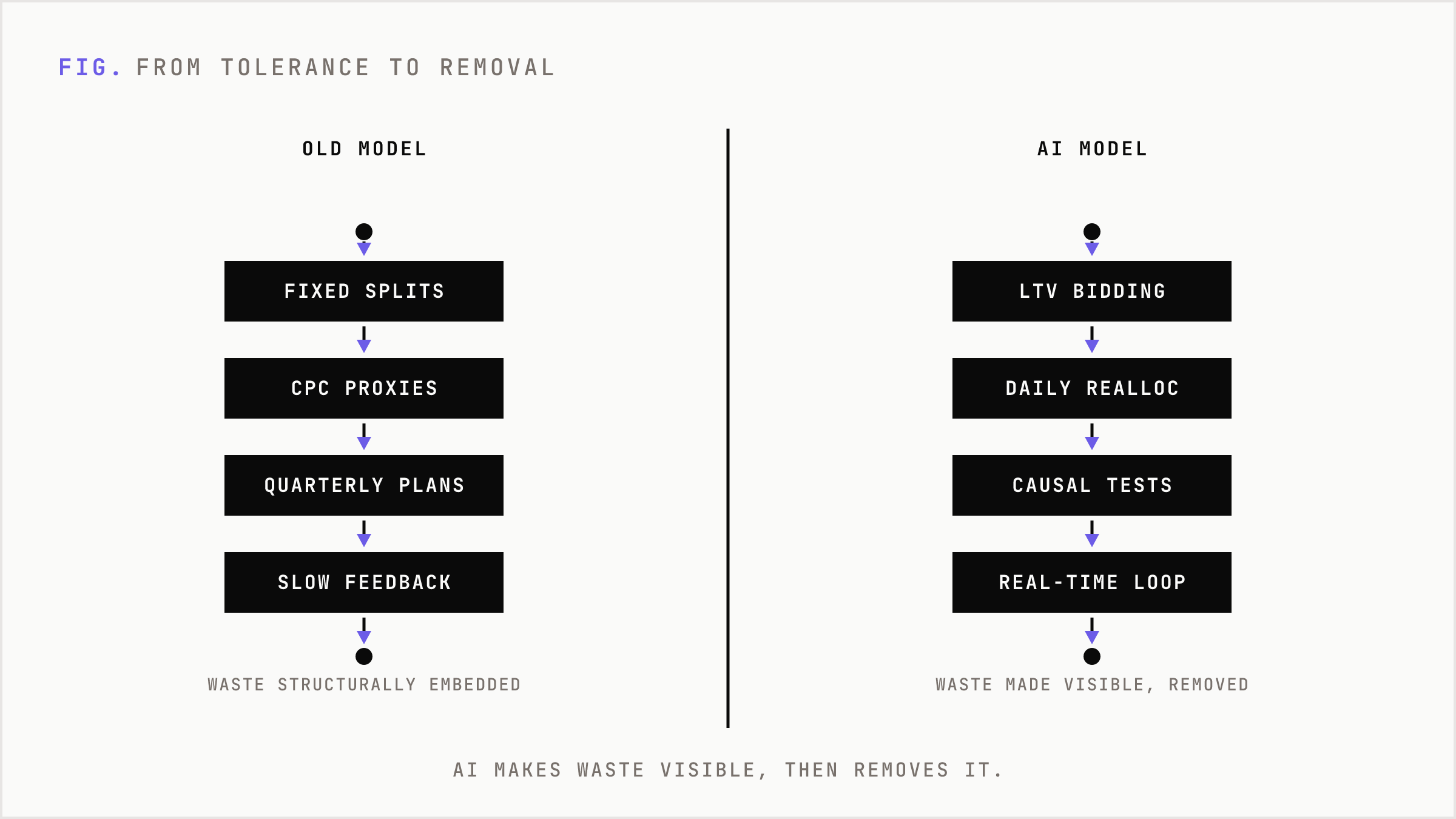
AI is not making marketing cheaper. It is making waste visible and then removing it.
The Old Model Was Built on Tolerance for Waste
For most of the past two decades, marketing economics were shaped by constraints. Limited creative bandwidth. Slow testing cycles. Blunt targeting. Delayed feedback loops.
So teams compensated with heuristics. Fixed budget splits across channels. CPC and CPA targets as proxies for value. Quarterly planning cycles that locked in decisions long after conditions changed.
Waste was not just accepted. It was structurally embedded.
Fifteen to forty percent of spend going to non incremental channels. Creative fatigue dragging down performance before teams could respond. Sales teams working low quality leads because filtering was too slow.
This was not incompetence. It was the cost of operating under human speed.
AI Changes the Unit Economics of Attention
AI does not improve marketing in one place. It compresses inefficiency across the entire system.
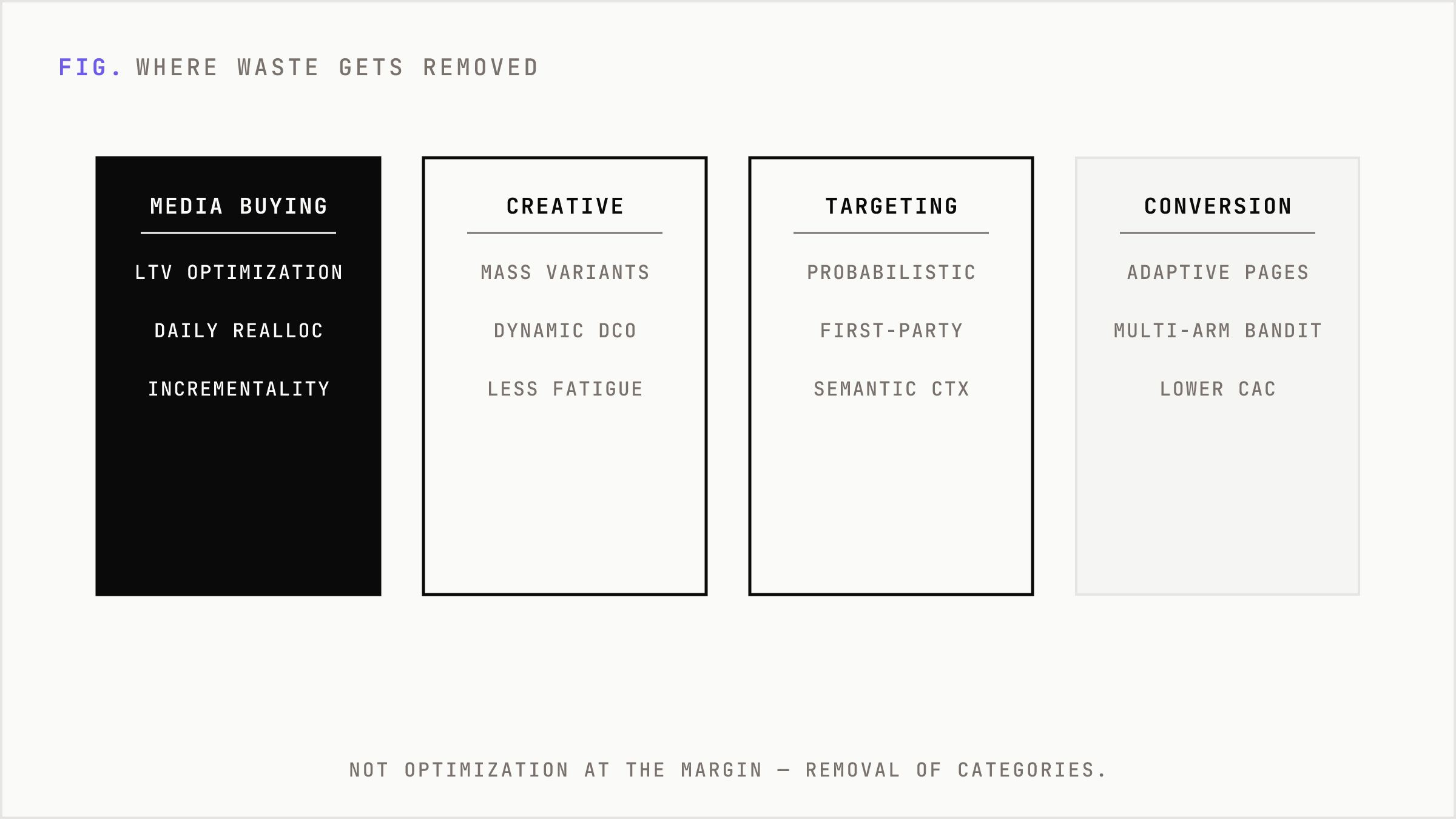
Start with media buying. Instead of bidding on clicks or conversions, models now optimize for predicted lifetime value. Budget allocation shifts daily based on marginal return curves, not static channel splits.
The effect is simple. Money moves continuously toward what works and away from what does not.
Layer in incrementality testing. Geo experiments and causal models identify spend that was never driving outcomes in the first place. That budget disappears or gets reallocated.
This is not optimization at the margin. It is removal of entire categories of spend.
Creative Is No Longer the Bottleneck
Historically, creative production was expensive and slow. Which meant testing was limited. Which meant decisions were made on small sample sizes and intuition.
That constraint is gone.
Generative systems reduce the cost of producing ad variants by over ninety percent. Instead of five creatives, teams can test hundreds or thousands.
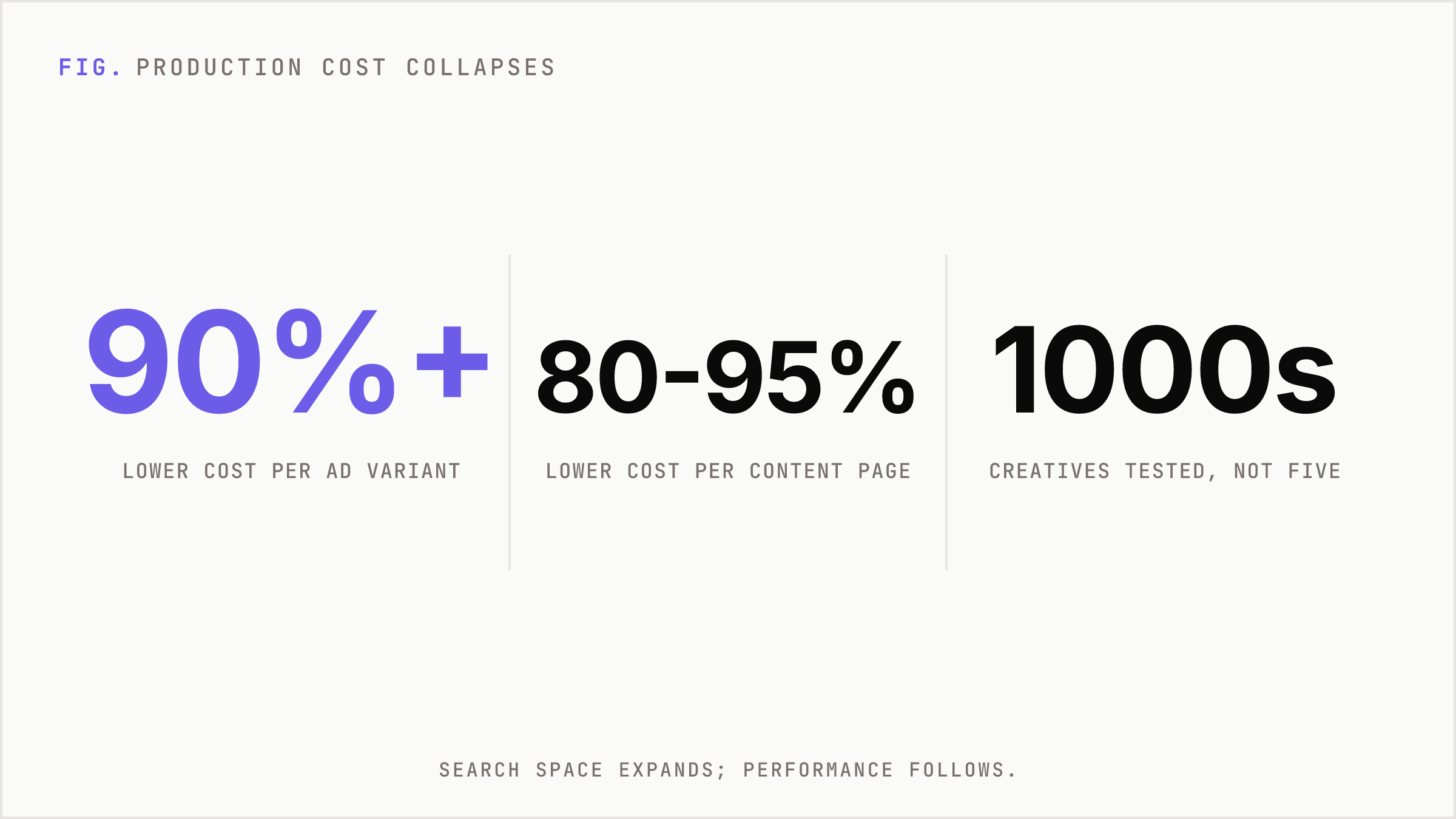
This changes the math. Performance improves not because each idea is better, but because the search space expands dramatically.
Dynamic creative optimization systems then take over. They recombine elements in real time based on performance signals. Headlines, visuals, offers. Constantly adapting.
The result is higher click through rates, lower acquisition costs, and slower creative fatigue.
The important shift is not cost savings. It is that creative becomes a continuous variable, not a fixed asset.
Targeting Moves From Segments to Probabilities
Third party data is fading. But targeting is getting better.
The reason is simple. Models are moving from static segments to probabilistic scoring.
Instead of targeting "fitness enthusiasts" or "small business owners," systems evaluate users based on predicted likelihood to convert or churn. These predictions are built on first party data and behavioral embeddings.
Lookalike modeling becomes more precise because it is grounded in actual outcomes, not inferred interests.
At the same time, contextual targeting improves through language models that understand content at a semantic level, not just keywords.
The combined effect is less wasted reach and more spend concentrated on high probability users.
Conversion Becomes a Dynamic System
Driving traffic is only half the equation. Conversion has historically been treated as a static layer. One landing page. Occasional A B tests.
AI turns conversion into a real time system.
Landing pages adapt based on user intent signals. Copy, layout, and offers shift dynamically. A first time visitor from paid social sees a different experience than a returning user from branded search.
Experimentation also accelerates. Multi armed bandit approaches allocate traffic toward winning variants automatically, reaching statistical confidence faster than traditional tests.
This increases conversion rates without increasing traffic cost. Which directly lowers CAC.
Content Supply Explodes
Content used to be a scarce resource. Now it is effectively infinite.
AI reduces the cost per page by eighty to ninety five percent. That enables programmatic SEO at a scale that was previously impractical.
Instead of targeting a handful of high volume keywords, companies can capture long tail demand across tens of thousands or millions of pages.
Search intent clustering identifies gaps. Content is generated to fill them. Performance data feeds back into the system.
This is not about flooding the internet with low quality pages. The winners are those who combine scale with tight feedback loops and quality control.
The strategic impact is expansion. New surface area for demand that competitors are not covering.
Sales and Marketing Finally Share a Model
One of the most persistent inefficiencies in marketing has been misalignment with sales.
Marketing optimizes for leads. Sales cares about revenue. The gap creates waste.
AI collapses this gap.
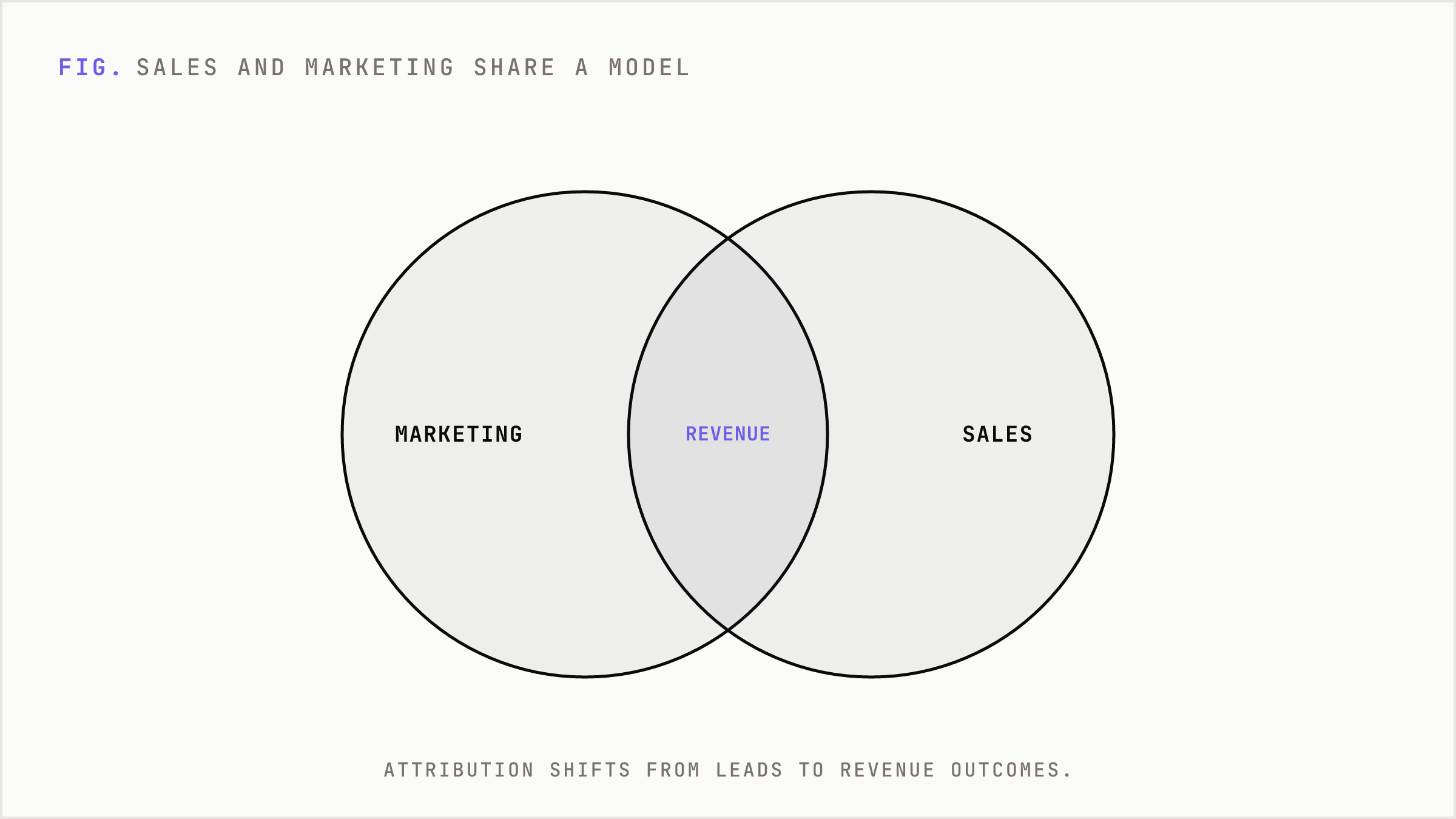
Lead scoring models prioritize prospects based on likelihood to convert. AI driven agents qualify leads continuously, filtering out low quality traffic before it reaches human teams.
Attribution models shift from lead based metrics to revenue based outcomes.
The result is fewer wasted sales cycles and better feedback into marketing spend decisions.
Analytics Becomes Continuous, Not Periodic
Traditional marketing analytics is retrospective. Reports are generated weekly or monthly. By the time issues are identified, money has already been spent.
AI changes this to a continuous process.
Anomaly detection systems flag underperformance in near real time. Budget can be reallocated within hours instead of weeks.
Marketing mix models provide a broader view that does not rely on platform reported return on ad spend, which is often biased.
The key shift is speed. Time to insight drops from days to minutes.
Retention Becomes a First Class Lever
Most discussions of marketing efficiency focus on acquisition. But the largest gains often come from retention.
AI driven lifecycle marketing personalizes communication across email, SMS, and push. Timing and content adapt to user behavior.
Churn prediction models identify at risk users early, triggering targeted interventions.
Increasing lifetime value reduces the pressure on acquisition. Which lowers acceptable CAC thresholds and improves overall unit economics.
The Compounding Advantage of Speed
Individually, each of these improvements matters. Together, they create a compounding effect.
Faster testing leads to faster learning. Faster learning leads to better allocation. Better allocation generates more data. More data improves models.
This feedback loop creates a structural advantage that is difficult to replicate.
Two companies can use similar tools. The one that learns faster will systematically outcompete the other on cost of acquisition.
The New Constraint Is Data Quality
As execution becomes automated, the bottleneck shifts.
Data quality becomes the limiting factor.
Models trained on incomplete or biased data will make poor decisions at scale. AI does not fix bad inputs. It amplifies them.
This is why leading teams invest early in clean data pipelines and unified tracking.
Organizational Structure Collapses
The implications extend beyond performance metrics.
A single marketer with the right AI stack can now execute the work that previously required multiple specialists. Media buying, creative generation, analysis, and experimentation become integrated.
This changes how teams are structured and how agencies price their services.
Labor based models become less relevant. Performance based models become more common.
Where This Actually Leads
The surface level narrative is cost reduction. That is incomplete.
The deeper shift is that marketing becomes more like a high frequency system.
Continuous inputs. Continuous decisions. Continuous adaptation.
In that environment, the companies that win are not those with the biggest budgets. They are the ones with the fastest and most accurate feedback loops.
Wasted spend does not disappear because teams become more disciplined. It disappears because the system no longer allows it to persist.
The Practical Takeaway
This transition does not require a full rebuild.
The highest return comes from targeting specific points of waste first. Creative testing. Bid optimization. Incrementality measurement.
Then building the data foundation to connect them.
Fully autonomous systems are not the goal. Human oversight remains critical, especially for brand, positioning, and long term strategy.
But the execution layer is shifting rapidly.
And as it does, the baseline expectation for marketing efficiency is rising.
What used to be considered strong performance will increasingly look like unrecognized waste.
That is the real change. Not better marketing. Less unnecessary marketing.
FAQ
How does AI actually reduce marketing costs?
AI reduces costs by eliminating waste rather than just optimizing performance. It reallocates budget in real time, removes non incremental spend, and increases conversion efficiency across the funnel.
Is AI replacing marketers?
No. AI replaces repetitive execution tasks but increases the importance of strategic thinking, data quality, and creative direction. Human oversight remains critical.
What is the biggest driver of CAC reduction?
The largest impact comes from combining better targeting, continuous creative testing, and dynamic budget allocation based on marginal returns.
Do small teams benefit from AI marketing systems?
Yes. Smaller teams often benefit the most because AI allows them to operate with the leverage of much larger organizations without proportional headcount.
What is the main risk of adopting AI in marketing?
The primary risk is poor data quality. AI systems amplify bad inputs, which can lead to misallocation of budget and misleading performance signals.