Nyyon · Blog
The Creative Learning Engine Behind High Performance AI Agencies
AI creative testing is not about making more ads. It is a learning system for finding patterns, fighting fatigue, and scaling what works with cleaner data.
AI has not made creative strategy obsolete. It has made weak creative testing impossible to hide.
For years, performance marketing had a quiet production constraint. A team could test only what it could brief, shoot, edit, resize, approve, upload, and measure. That bottleneck shaped the whole operating model. Campaigns moved slowly. Creative refreshes arrived late. Teams overread small tests because they did not have enough variants to see patterns.
Generative AI changed the cost curve. Scripts, cutdowns, thumbnails, captions, product backgrounds, voiceovers, translations, and aspect ratios can now be produced at a fraction of the old cost and time. The immediate reaction was predictable: more ads.
That is not the advantage.
The advantage is building a system that learns faster than competitors. Not a content machine. A creative learning engine.
The Market Moved From Production Scarcity to Learning Scarcity
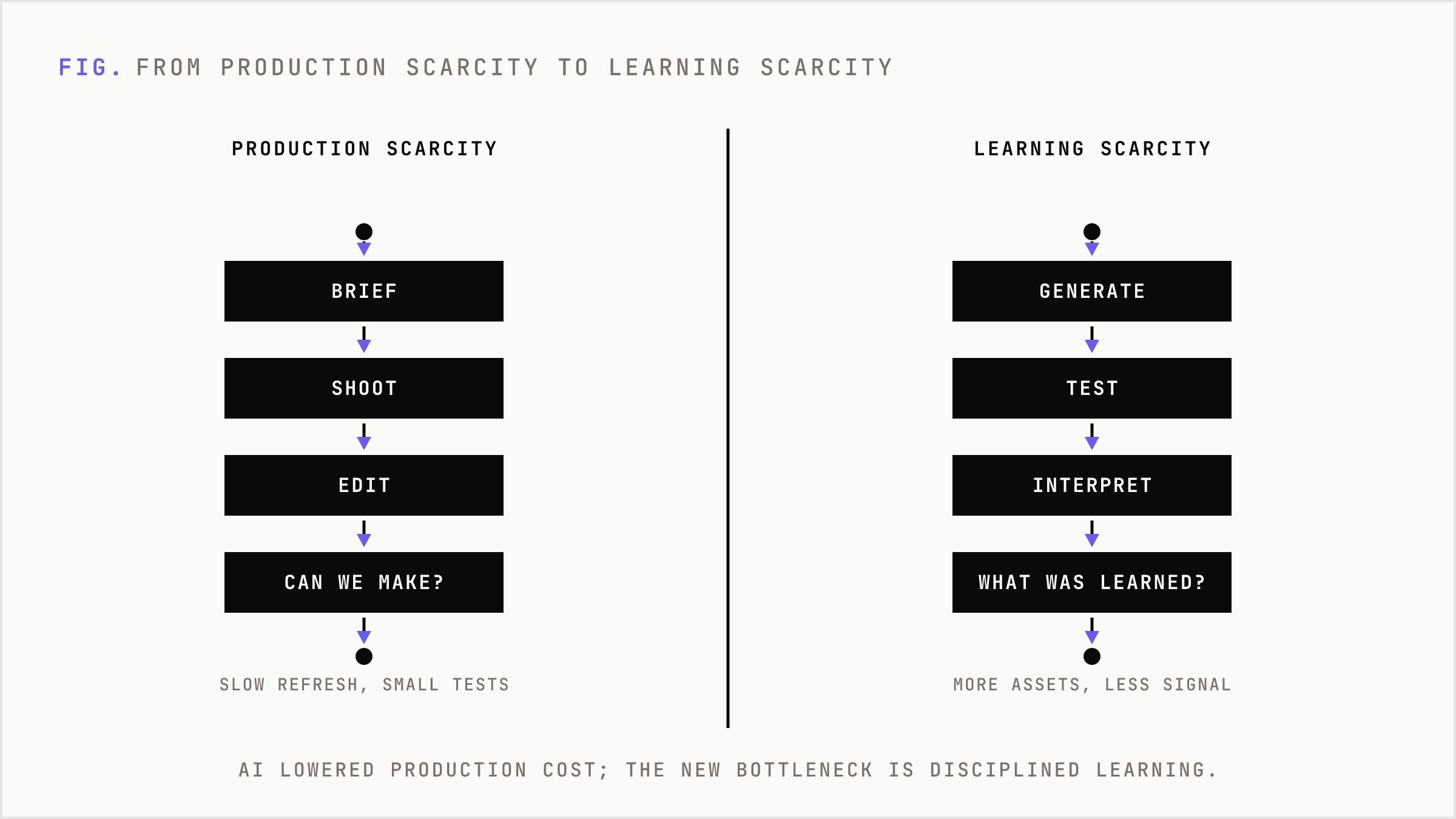
When production was expensive, the hard question was: can we make enough assets to keep the account alive?
Now the harder question is: which assets are meaningfully different, what are they testing, and what did the market actually tell us?
This shift matters because creative is still one of the largest drivers of ad performance. Nielsen has argued that creative quality contributes roughly as much to in-market success as the other measured factors combined. Kantar and WARC have reported that top creative can produce several times the long-term ROI of weaker creative. The exact number matters less than the commercial point: the ad is not decoration on top of media. It is a major variable in demand creation.
AI lowers the cost of exploring that variable. But lower cost creates a new failure mode. A brand can flood Meta, Google, TikTok, and YouTube with synthetic sameness. More assets, less signal. More tests, less learning. More motion, no compounding advantage.
The best AI agencies understand this. They do not sell volume. They sell disciplined learning velocity.
Platform AI Optimizes Delivery. Agency AI Must Optimize Learning
Most creative testing now happens inside black-box systems.
Meta Advantage+ can generate and optimize variations across image, video, copy, background, audio, and placement. Google responsive search ads combine multiple headlines and descriptions, then learn which combinations perform in different contexts. Performance Max assembles assets across Google inventory. TikTok Smart Creative and Automate Creative use AI to combine, enhance, resize, refresh, and prioritize creative assets.
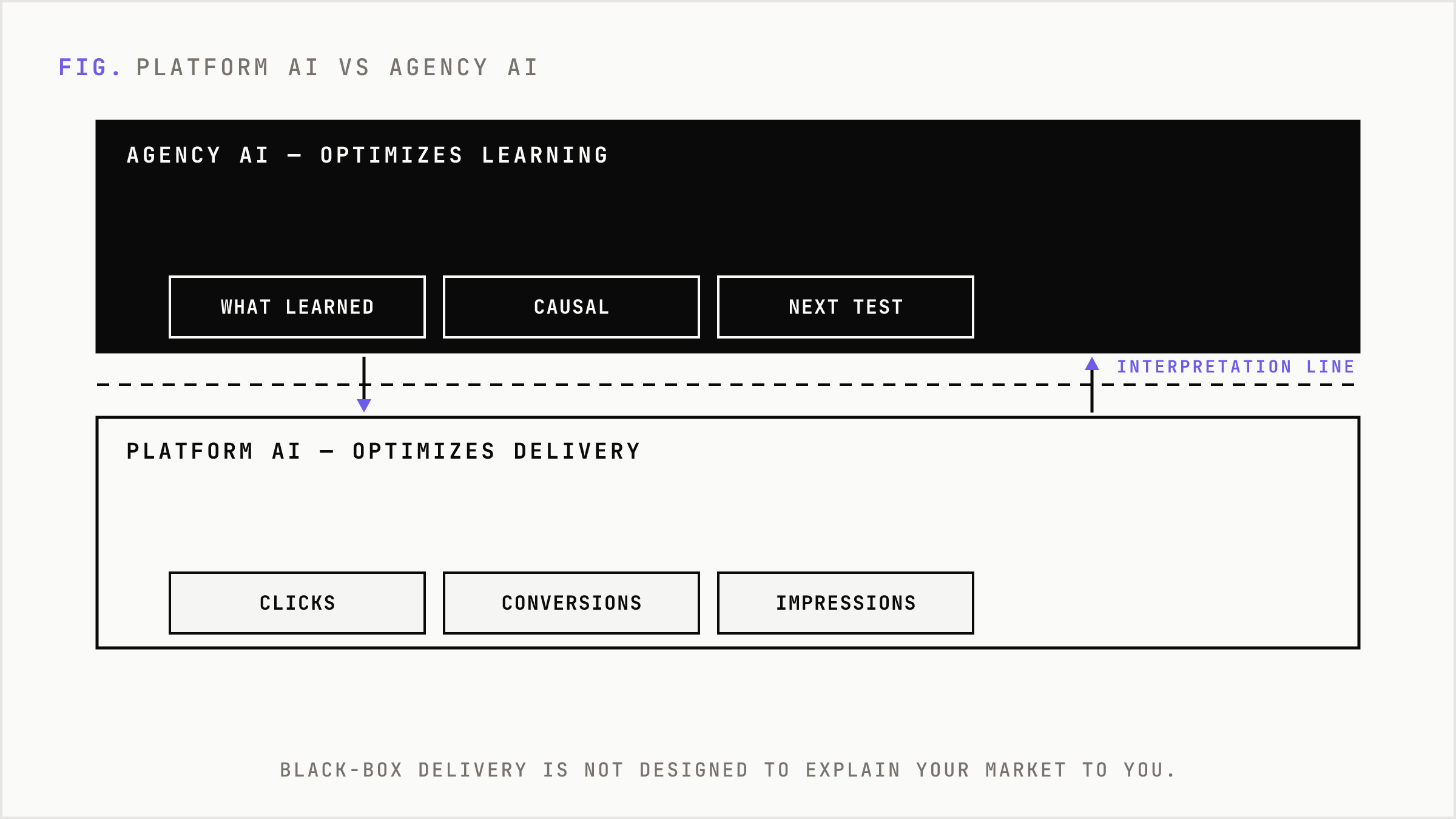
These systems are powerful. They are also not designed to explain your market to you.
The platforms optimize toward delivery goals: clicks, conversions, value, lead volume, purchase events. They decide which combinations get impressions. They shift spend toward what their models believe will work. That is useful for performance, but dangerous for interpretation.
If one ad receives 80 percent of the impressions by day two, did it win because the market preferred it, or because the algorithm favored it early? If an asset has a weak reported CPA, was the concept bad, or was it shown in worse combinations? Google itself warns that asset-level performance metrics in responsive and automated formats are directional because assets perform in combinations, not isolation.
This is the core distinction: platform AI tells you what it served and what happened. Agency AI should tell you what was learned, what is causal enough to trust, and what to test next.
The Unit of Testing Is Not the Ad
Bad creative testing asks which ad won.
Good creative testing asks which belief, pain, promise, proof, mechanism, format, or audience context drove the result.
An ad is a container. Inside it are testable variables: the hook, offer, proof type, persona, objection, creator, visual style, pacing, first frame, claim, CTA, and landing-page match. A founder-led demo is not the same test as a product-only static. A price objection angle is not the same test as an aspiration angle. A testimonial that resolves trust is not the same as a statistic that establishes authority.
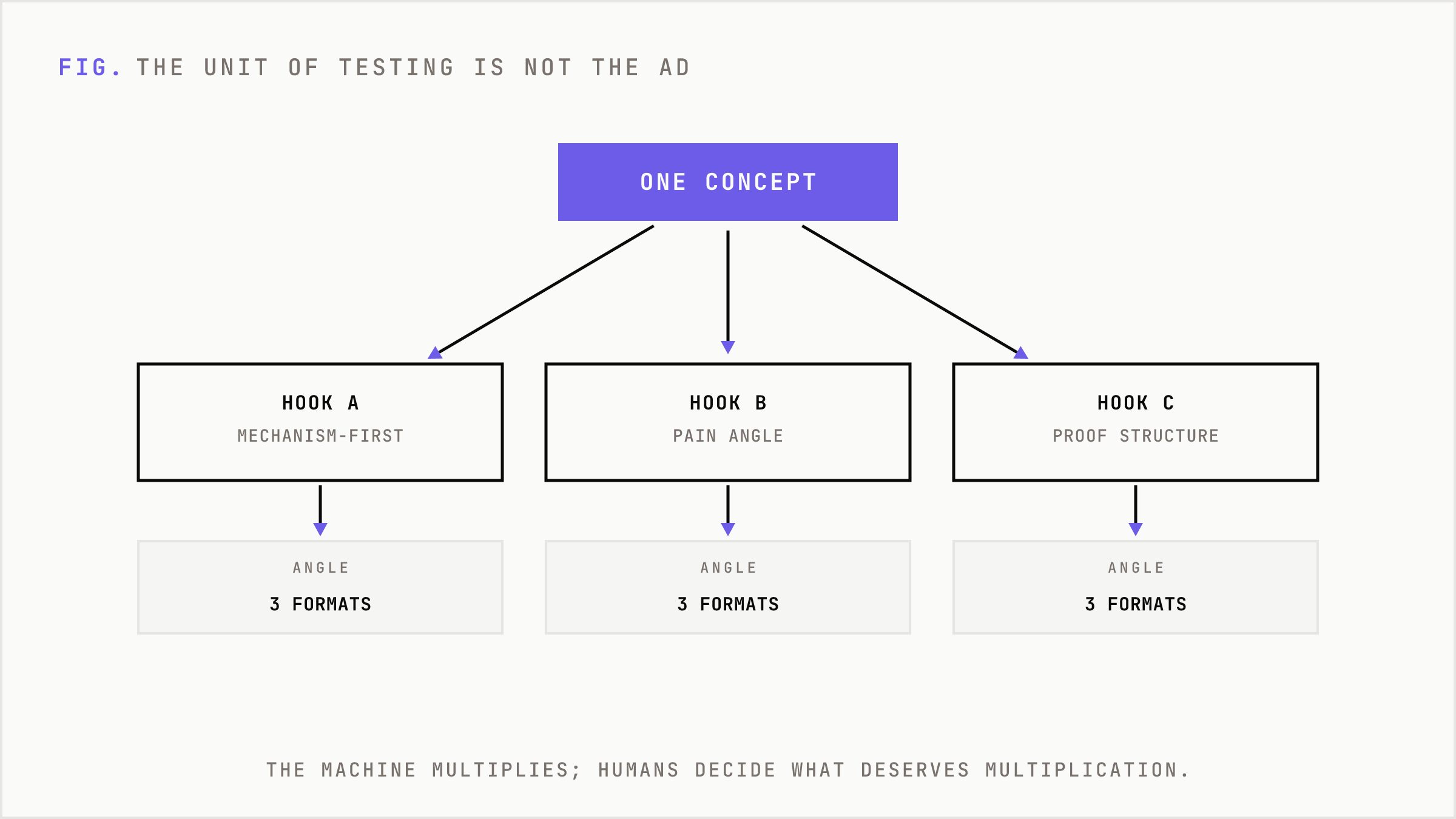
AI helps because it can produce controlled variants quickly. One concept can become five hooks. Each hook can become three formats. Each format can be cut for Meta Reels, TikTok, YouTube Shorts, Stories, and feed. The machine handles the multiplication. The humans decide what deserves multiplication.
That is where many teams fail. They use AI to generate twenty versions of the same ad: slightly different headline, different background, same underlying argument. That is cosmetic testing. It rarely changes the economics.
High-value testing changes the buyer's mental path. It tests a different pain. A different promise. A different proof structure. A different level of awareness. A different reason to believe.
The Taxonomy Is the Moat
Creative velocity without taxonomy is just noise at scale.
Every asset should be tagged before launch. Not after a winner appears. Before. The minimum useful metadata includes platform, audience, placement, format, concept, hook, angle, offer, CTA, first-frame type, visual style, creator source, production method, landing page, spend, impressions, CTR, CPC, CVR, CPA, ROAS, hold rate where available, post-click quality, and fatigue date.
This sounds operational, not glamorous. That is why it matters.
Without tagging, the team learns that Ad 12 beat Ad 9. With tagging, it can learn that mechanism-first hooks beat benefit-first hooks for cold skeptical buyers, but only when paired with a demo landing page. That is a reusable asset. The ad will fatigue. The pattern can compound.
The best agencies build a creative library that behaves more like a trading desk than a mood board. Each asset has a thesis, metadata, performance history, audience context, and decision status: kill, iterate, scale, validate, archive, or recycle later.
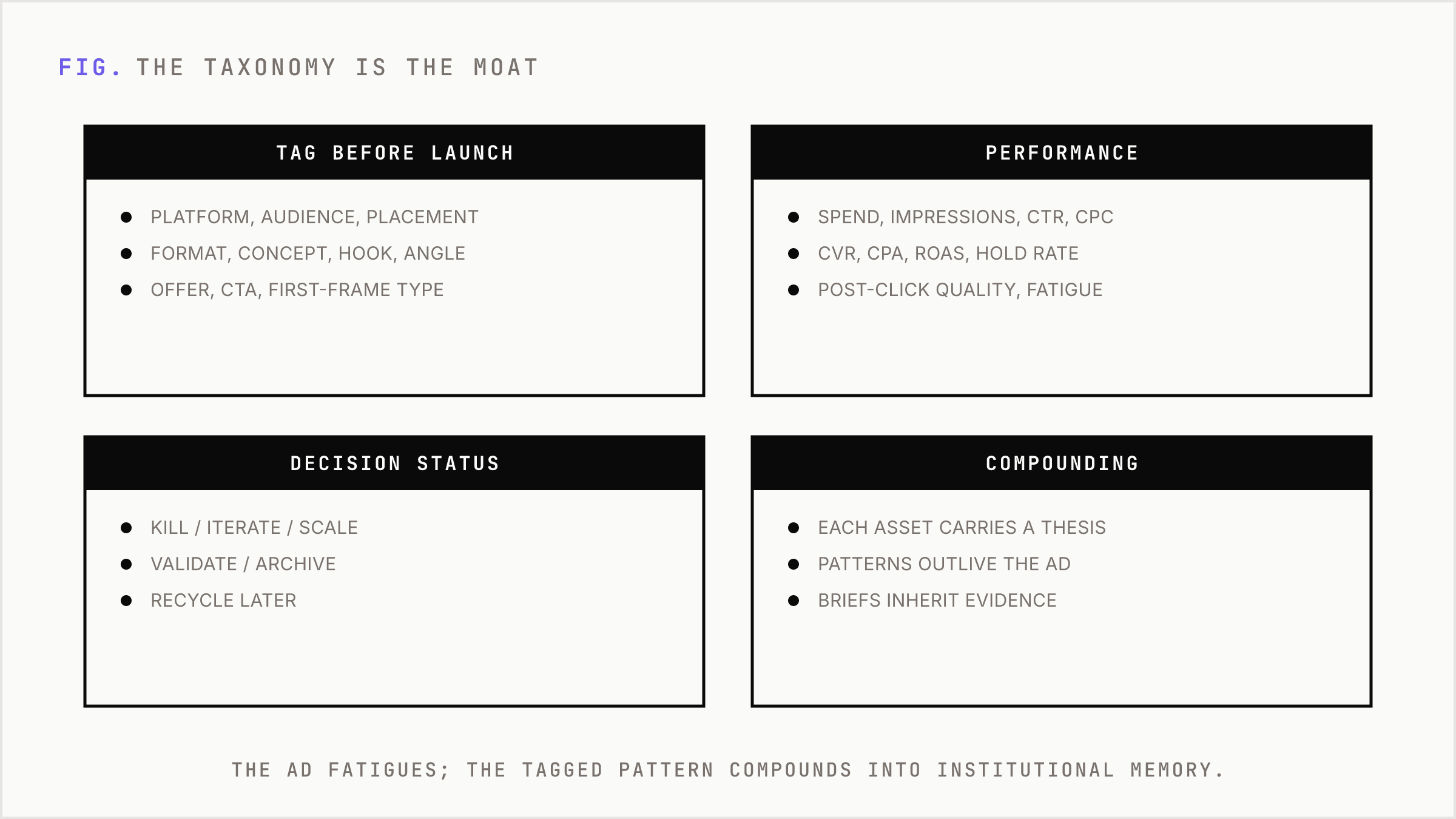
This creates an institutional memory. New briefs stop starting from zero. They inherit evidence.
The Workflow Is a Feedback Loop, Not a Campaign Calendar
A competent AI creative testing system starts before production.
It mines inputs: reviews, sales calls, competitor ads, search terms, customer interviews, support tickets, social comments, Reddit threads, CRM notes, refund reasons, and historic winners and losers. AI is useful here because it can turn messy language into structured themes. Buyers will often tell you the next ad if you know how to read their objections.
Then the agency defines hypotheses. Busy founders respond to time-saving proof. Skeptics need the mechanism before the claim. Enterprise buyers need authority proof, not casual UGC. Price-sensitive customers convert better when the bundle is framed before the discount.
Only then should production start.
A practical batch might include five to ten distinct concepts, three hooks per concept, two formats per hook, and platform-specific cuts. The goal is not to test everything at once. The goal is to create enough difference to learn while avoiding a budget spread so thin that no asset reaches signal.
After launch, analysis happens at multiple levels: ad, concept, hook, offer, audience, landing page, and incrementality. Fast metrics such as thumb-stop rate, hold rate, CTR, and CPC tell the team what deserves more testing. Business metrics such as CVR, CAC, ROAS, AOV, lead quality, LTV, and refund rate decide what can scale. Truth metrics such as lift, geo holdout, matched-market testing, MMM, and blended MER decide what actually created incremental value.
The rule is simple: fast metrics guide attention. Business metrics guide spend. Incrementality guides confidence.
The Budget Lines Need Different Jobs
Founders often ask why an agency needs budget for tests when the goal is performance. The answer is that one budget cannot do every job.
Exploration budget finds new angles. It is supposed to be uncertain. Exploitation budget scales proven winners. Refresh budget extends the life of working concepts by changing hooks, thumbnails, creators, proof points, openings, and formats. Validation budget tests whether platform-reported performance is real enough to trust. Research budget improves the quality of future hypotheses through synthetic pre-testing, surveys, message mining, and customer analysis.
Blending all of this into one spend line creates bad incentives. The team avoids exploration because it might hurt blended CPA. Then the account fatigues. Then performance drops. Then the brand demands more winners from a system that stopped funding discovery.
AI makes this more important, not less. When production is cheap, the temptation is to treat every new asset as performance spend. Strong operators separate learning capital from scaling capital.
Fatigue Is a Pattern Problem
Creative fatigue is usually treated as an ad-level issue. The CPA rises, the CTR falls, someone asks for new creative.
That is late.
AI agencies monitor fatigue by creative, concept, hook, format, and audience. They watch frequency, declining hold rate, weaker first-frame performance, rising CPC or CPM, lower new-user reach, falling CVR, comment quality, saves, shares, and post-click behavior.
The first assets to refresh are usually the first one to three seconds of video, the opening line, the thumbnail, text overlay, creator, setting, proof point, offer framing, CTA, and placement cut. If click quality is strong but conversion is weak, the issue may not be the ad. It may be landing-page continuity.
This is where pattern-level memory pays off. If founder-led demos consistently work but fatigue after ten days on TikTok, the answer is not to abandon the pattern. The answer is to refresh the execution while preserving the causal structure.
AI Pre-Testing Is a Filter, Not a Verdict
Synthetic audiences and AI creative scoring can be useful. They can compare scripts, detect unclear CTAs, flag low product prominence, identify weak openings, assess brand fit, and screen for claim risk before media dollars are spent. Kantar's LINK AI, for example, analyzes large numbers of visual, audio, speech, object, color, and text features to predict creative effectiveness measures.
But pre-testing cannot see auction dynamics. It cannot know whether a landing page will convert. It cannot reliably price trust. It cannot predict cultural timing. It can reward category norms and punish distinctive work. It can produce confident reasons for outcomes that have not happened.
Use it to kill obvious weakness. Do not use it to declare a winner.
The Substitution Dynamic Is Clear
AI does not replace the creative director. It replaces the production drag around the creative director.
It also changes what clients should buy from agencies. The old deliverable was assets. The new deliverable is a learning system that produces assets as a byproduct.
This matters for agency economics. A shop that only sells AI-generated ads will be dragged toward commodity pricing. A shop that owns strategy, taxonomy, testing design, data interpretation, brand governance, compliance, and creative intelligence can expand its value. It is not selling cheaper production. It is selling faster market discovery.
That difference compounds over quarters. The agency learns which hooks work for cold traffic, which proof types attract bad leads, which offers inflate conversion but damage LTV, which formats fatigue fastest, which claims create trust, and which landing pages match which buyer stage.
The output is not just better ads. It is a proprietary map of buyer response.
The Investor View
For founders and investors, the question is not whether an agency uses AI. That will be table stakes. The question is whether the agency has a defensible operating system around AI.
Look for hypothesis discipline. Look for metadata. Look for CRM feedback. Look for separate budgets for exploration and scaling. Look for skepticism toward platform-reported winners. Look for a library of learnings, not a folder of assets. Look for briefs that contain what won, what lost, why it might have happened, confidence level, and the next test.
Red flags are easy to spot. Reports that only show ad-level winners. CTR treated as success. Too many variants with too little spend. No taxonomy. No post-click quality. No incrementality plan. No archive. Endless asset generation with no better questions.
The agencies that win the next phase will not be the ones producing the most ads. They will be the ones that turn every dollar of media spend into clearer judgment.
The Bottom Line
AI creative testing is not AI versus human creative. That frame is small and mostly useless.
The real question is which human strategy plus AI workflow finds scalable market truths faster.
Platform AI will keep getting better at delivery. Generative tools will keep making production cheaper. Buyers will keep ignoring generic ads. The scarce resource will be creative intelligence: knowing what to test, how to tag it, when to trust the data, and how to turn the result into the next brief.
High performance AI agencies are not ad factories. They are feedback systems. They connect buyer language to creative hypotheses, creative hypotheses to controlled variants, variants to platform delivery, platform data to pattern-level insight, and insight back into strategy.
That is the engine. Everything else is output.
FAQ
What is AI creative testing?
AI creative testing is the use of AI to research audiences, generate creative hypotheses, produce controlled ad variants, tag creative elements, analyze performance, detect fatigue, and convert results into the next creative brief.
Does AI replace human creative teams?
No. AI reduces production bottlenecks and improves pattern detection. Humans still set strategy, judge quality, protect brand voice, validate claims, interpret causality, and decide what should scale.
Why is tagging creative assets so important?
Tagging turns ad performance into reusable learning. Without metadata, a team only knows which ad won. With metadata, it can learn which hooks, offers, proof types, formats, and buyer segments drove performance.
What metrics matter most in creative testing?
Fast metrics such as thumb-stop rate, hold rate, CTR, and CPC help decide what to keep testing. Business metrics such as CAC, ROAS, CVR, LTV, and lead quality decide what to scale. Incrementality metrics decide what truly created value.
What is the biggest mistake in AI creative testing?
The biggest mistake is using AI to create many cosmetic variants without a hypothesis, taxonomy, budget structure, or feedback loop. More assets do not create more learning unless the system is designed to learn.