Nyyon · Blog
The Campaign Brain: AI Native Planning for Marketing Leaders
How AI-native campaign planning connects data, creative, media, governance, and learning into an operating system for faster, sharper growth.
The next winning campaign team will not use AI to make more assets; it will use AI to make better decisions faster.
Most marketing AI is still trapped at the surface. It writes headlines. It drafts emails. It makes ten versions of a social post that should probably have been killed at the brief. Useful, yes. Strategic, no.
The larger shift is not from human copy to machine copy. It is from static campaign planning to AI-native campaign systems. That means customer data, market signals, audience intelligence, creative strategy, media planning, budget allocation, experimentation, compliance, and performance telemetry live inside one operating layer.
Call it the campaign brain.
Not a chatbot. Not a prompt library. Not another tab in the martech stack. A decision system that helps a team decide who to target, what to say, where to spend, what to test, when to stop, and what to learn next.
The Wrong Mental Model
The common mistake is treating AI as a production assistant. That is the low-margin version of the market. If every brand can produce more copy, more images, and more variants, the value of raw output falls. Asset volume becomes cheap. Judgment becomes scarce.
AI-assisted marketing makes existing work faster. It turns a blank brief into a draft. It rewrites ad copy. It summarizes research. It helps a strategist look more prepared on Tuesday.
AI-native marketing changes the structure of the work. Campaign decisions become model-informed, scenario-tested, versioned, governed, and connected to live performance. The question is no longer: can we generate 100 ideas? The question is: can we identify the 5 ideas with the best evidence, test them cleanly, and update the plan before the budget is wasted?
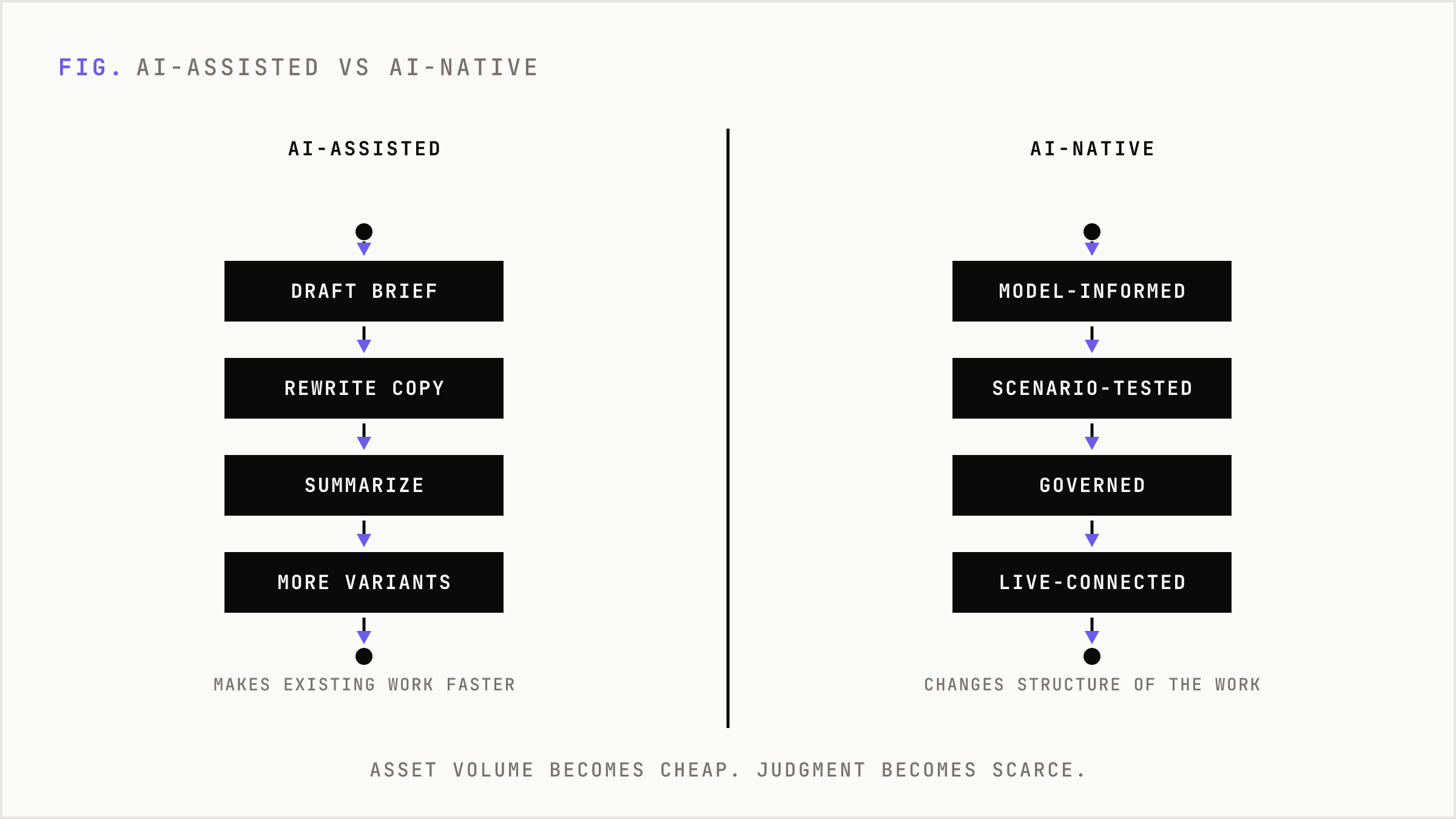
That is a different product. It is also a different agency model.
The Market Is Ready, But Not Mature
The adoption data looks contradictory until you separate experimentation from integration.
IAB's 2025 benchmark found that only 30 percent of agencies, brands, and publishers had fully integrated AI across the media campaign lifecycle. Half of the non-integrated group expected full integration by 2026. At the same time, roughly half the industry still lacked a strategic AI roadmap.
That is the opportunity. AI is mainstream enough that budget owners care. It is immature enough that most teams have not operationalized it.
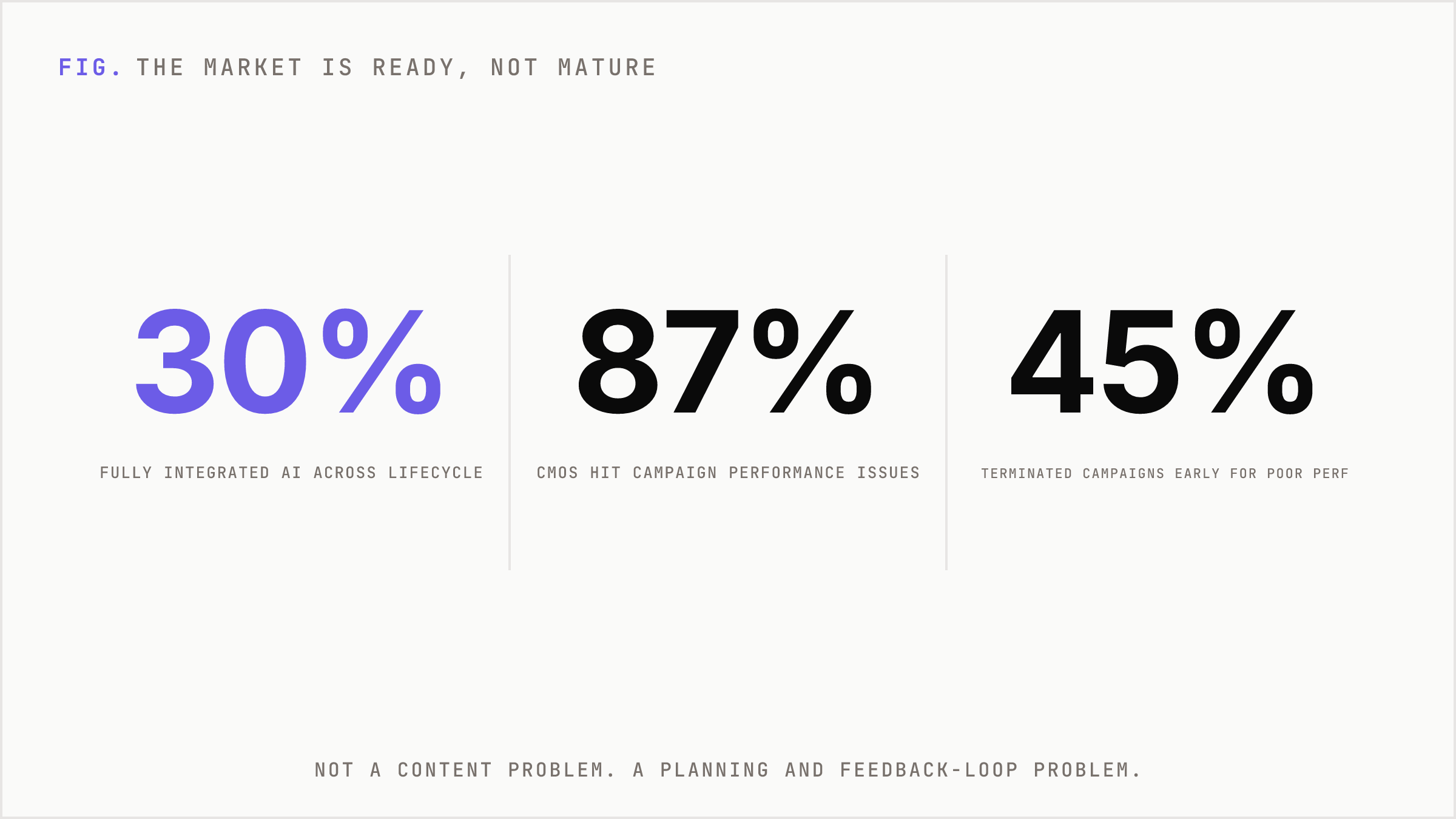
Gartner found that 27 percent of CMOs reported limited or no GenAI adoption in marketing campaigns. Among adopters, the stronger teams were not just using it for content. They were using it for campaign planning and strategy development. Gartner also reported that 44.5 percent of total marketing budget is spent on campaigns and media plans, while 87 percent of CMOs experienced campaign performance issues in the prior 12 months. Forty-five percent terminated campaigns early because performance was poor.
This is not a content problem. It is a planning quality problem. A measurement problem. A feedback loop problem.
The CMO Survey reported that companies use AI and machine learning to optimize and automate marketing efforts 17.2 percent of the time today, with expectations rising to 44.2 percent within three years. The same survey reported improvements from AI in sales productivity, marketing overhead, and customer satisfaction. Nielsen found that 59 percent of global marketers see AI for campaign personalization and optimization as the most impactful industry trend. Among brands with ad budgets above $1 billion, the figure rises to 71 percent.
Large buyers are not asking whether AI matters. They are asking where it belongs in the workflow and who can make it safe enough to trust.
Campaign Planning Is A Budget Line, Not A Brainstorm
Campaign planning sits near the money. It determines media spend, creative investment, landing page work, channel sequencing, test design, and sales follow-up. Bad planning compounds. A weak audience assumption leads to a weak offer, which leads to generic creative, which leads to inefficient media, which leads to a postmortem that blames the channel.
AI can interrupt that chain if it is deployed at the decision layer.
A real campaign brain starts with inputs: CRM behavior, past creative performance, search demand, social conversation, competitor messaging, reviews, sales call objections, product margins, inventory, compliance rules, and channel constraints. It does not ask the model to invent strategy from the internet. It gives the model proprietary context and forces it to reason inside constraints.
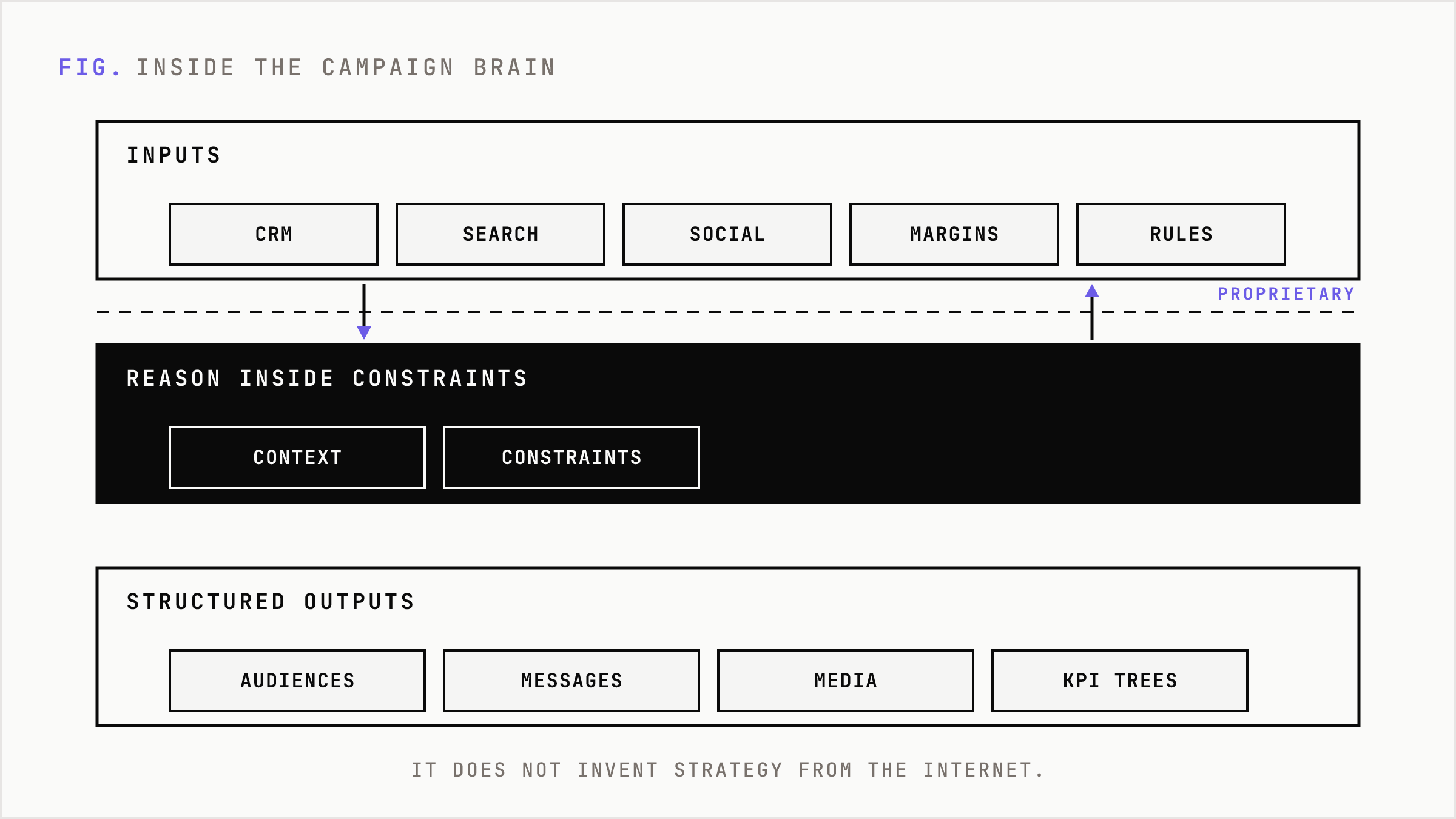
Then it produces structured outputs: audience hypotheses, positioning options, message matrices, offer logic, media scenarios, budget ranges, testing plans, KPI trees, risk registers, and optimization rules.
This matters because campaign planning is not one decision. It is a chain of dependent decisions. If the audience changes, the message changes. If the message changes, the creative route changes. If the creative route changes, the media plan changes. If the media plan changes, the measurement design changes.
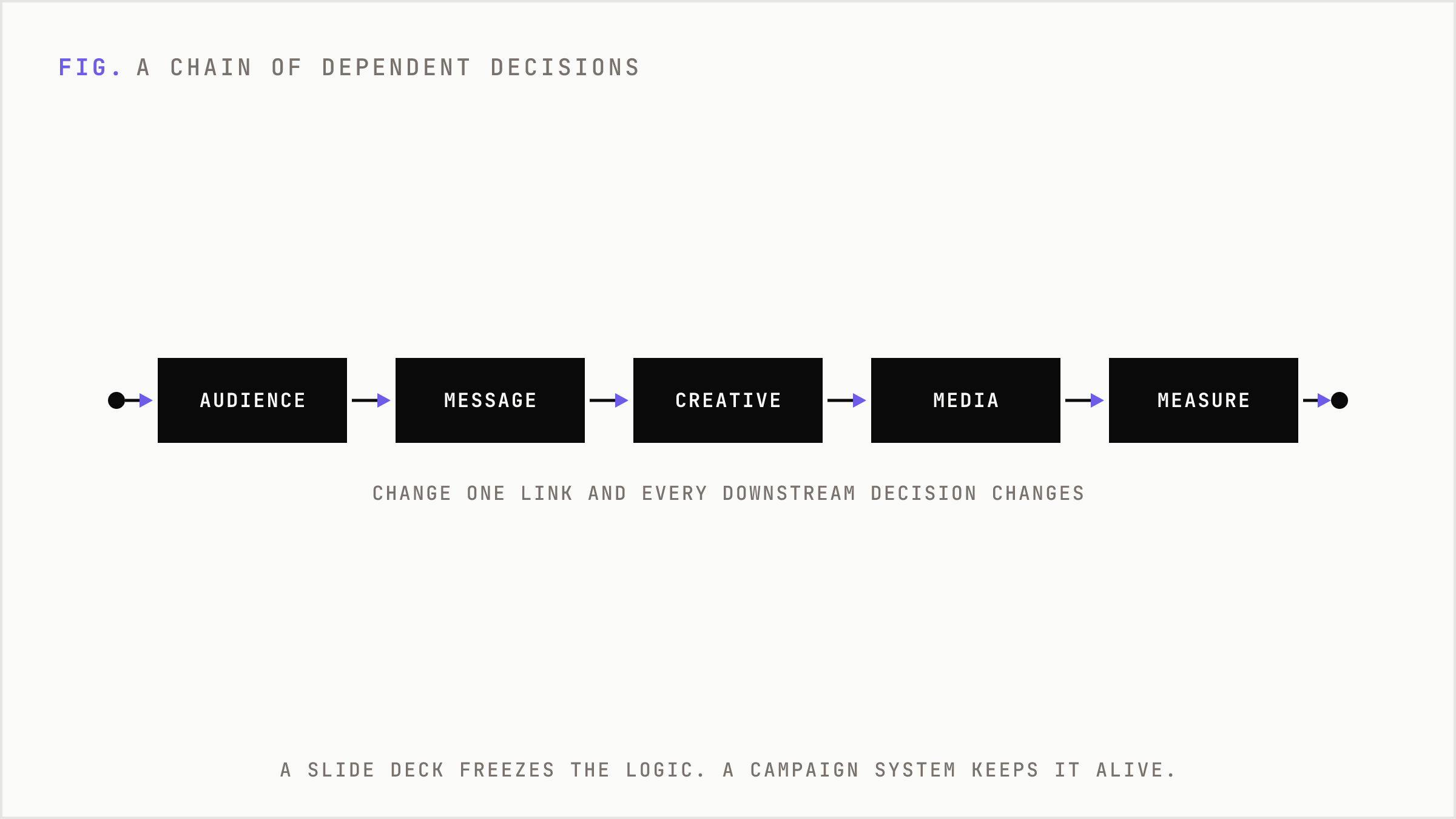
A slide deck freezes that logic. A campaign system keeps it alive.
From Deck To Decision System
The old campaign artifact is the deck. It is persuasive, polished, and usually stale by the time the campaign launches.
The new artifact is the decision model. It explains why this audience, why this promise, why this proof, why this channel, why this budget, and what to test next. Every recommendation carries sources, assumptions, confidence, risk, and decision rules.
This is where AI starts to create leverage. A human team may review ten audience segments. A campaign brain can ingest CRM clusters, search signals, review language, competitor ads, and media performance to generate a ranked audience map. It can identify which segment has clear demand, which has high margin, which has low acquisition friction, and which would require expensive education.
That does not mean the system decides alone. It means humans stop spending senior hours assembling the obvious. They spend them rejecting weak logic, sharpening the bet, and setting the constraints.
That is what premium AI work looks like. Machine scale under human taste.
The Mechanics Are Concrete
At the task level, an elite system has six layers.
First, the signal layer. It pulls demand signals, reviews, competitor campaigns, category news, sales objections, conversion paths, and media performance. The output is a map of what the market is already saying and doing.
Second, the strategy layer. It builds the campaign objective tree, audience priorities, positioning options, proof points, emotional territory, and conversion argument. Each route is scored for brand fit, differentiation, evidence strength, channel suitability, compliance risk, and testability.
Third, the creative layer. It generates concept routes, headlines, scripts, social hooks, email angles, landing page structures, and influencer briefs. More importantly, it filters them. Generic output is not a cost saving. It is a brand tax.
Fourth, the media layer. It creates channel mix scenarios, audience exclusions, sequencing, retargeting paths, budget ranges, and spend guardrails. It simulates CAC, ROAS, reach, frequency, payback period, and conversion-rate sensitivity.
Fifth, the experiment layer. It defines test hypotheses, variables, audience cells, creative cells, minimum spend, stop-loss rules, and success thresholds. This is where most campaigns fail. They test too many things at once and learn nothing.
Sixth, the optimization layer. It monitors fatigue, segment response, CAC, ROAS, MER, funnel drop-off, sentiment, and incrementality. It recommends when to scale, pause, refresh, reallocate, revise the offer, or change the landing page.
This is not futuristic. Pieces of it already exist. The gap is integration.
Synthetic Customers Are Useful, Not Truth
Synthetic audiences will become part of planning. They are too useful to ignore. They can pressure-test messaging, simulate objections, expose unclear claims, and surface alternate buying narratives before money is spent.
But synthetic customers are not customers. They are hypothesis engines.
The right sequence is simple: synthetic panel, expert review, small live test, measurement, model update. Skip the live test and the system becomes theater. It will produce confident answers about imaginary behavior.
This is a general rule for AI campaign planning. Use AI to widen the option set and compress the time to a testable hypothesis. Do not use it to skip the market.
The Buyer Is Changing Too
Campaigns used to plan for human attention inside search results, feeds, inboxes, stores, and sales calls. That is still true. It is no longer enough.
AI answer engines and buyer agents are becoming new intermediaries. They summarize categories. They compare products. They extract structured facts. They may influence discovery and purchase before a person visits a brand site.
That changes creative strategy. Brands need emotional persuasion for humans and structured evidence for machines. The second track includes product data, specifications, FAQs, comparisons, pricing, availability, proof points, review summaries, schema, and answer-ready content.
In practical terms, campaign planning expands. SEO does not disappear. Paid search does not disappear. Social does not disappear. But answer engine optimization joins the mix. The brand has to be legible to people and parsable by agents.
Governance Is A Premium Feature
The fantasy version of agentic marketing is fully autonomous campaigns. Set a goal, connect the credit card, let the agent run.
That is not how serious buyers will buy.
Gartner predicts that more than 40 percent of agentic AI projects will be canceled by the end of 2027 because of rising costs, unclear business value, or inadequate risk controls. IAB has already identified data quality, data protection, fragmented tools, and lack of transparency as adoption barriers. Adobe's 2025 research points to privacy, governance, decentralized IT, unclear data strategy, poor data, and disorganized data as blockers to connected customer experiences.
The practical product is not an autonomous campaign agent. It is a human-approved campaign agent with scoped permissions.
Strategy approval. Brand approval. Legal approval. Spend approval. Launch approval. Audit logs. Data lineage. Permissioning. Model evaluation. Brand safety checks. Compliance constraints.
That sounds boring until a system spends money on the wrong audience, makes an unapproved claim, leaks sensitive data, or produces a campaign that erodes trust. For high-end brands, control is not friction. It is the reason to buy.
The Agency Role Gets Repriced
AI will compress low-end production work. That substitution is already underway. If an agency's value is deck assembly, copy variants, and generic creative routes, margin pressure is coming.
The premium position is different. The agency becomes the architect of the campaign intelligence layer. It designs the workflow, connects the data, defines the decision rules, builds the measurement plan, governs the system, and applies taste.
That shifts the agency from executor to operating partner. From creative vendor to intelligence partner. From campaign builder to growth system designer.
Founders should notice the market structure. Most brands have tools. Few have a planning layer. They have a CRM, CDP, DAM, CMS, analytics suite, ad accounts, project management system, and a growing pile of AI point solutions. The stack is full. The intelligence is fragmented.
The business opportunity is not another asset generator. It is orchestration.
What To Build Now
The adoption path should be staged.
Start with copilots for research, briefing, competitive mapping, and retro analysis. These have clear value and limited operational risk.
Then add scoped agents for audience mapping, message testing, media scenario planning, and experiment design. Keep human approval on strategy and spend.
Then connect performance telemetry. The system should remember what worked, what failed, which audiences converted, which claims triggered friction, which creative fatigued, and which channels produced profitable customers.
Finally, introduce limited autonomy for optimization recommendations. The system can propose reallocations, pauses, refreshes, and new variants. Humans still approve budget, claims, legal risk, and launch.
This is slower than the pitch deck version of AI. It is also how enterprise value gets built.
The Bottom Line
Elite campaign planning is becoming an AI-native operating system. It connects fragmented signals to strategy, creative, media, experiments, and continuous optimization.
The winners will not be the teams that generate the most content. That advantage is temporary and already crowded.
The winners will learn faster, govern tighter, and turn AI-scale options into human-grade judgment. They will use models to reduce untested assumptions, improve creative-market fit, allocate budget with more discipline, and build feedback loops that compound over time.
That is the campaign brain. Not a machine that replaces marketers. A system that makes weak planning harder to hide.
FAQ
What is AI-native campaign planning?
AI-native campaign planning is a workflow where AI connects data, strategy, creative, media, testing, governance, and performance learning inside one operating system. It is not just using AI to write campaign copy.
How is this different from AI-assisted marketing?
AI-assisted marketing makes existing tasks faster, such as drafting briefs or generating ad variants. AI-native marketing changes the decision structure, so campaign choices are scored, tested, governed, and updated from live results.
Should brands use synthetic audiences?
Yes, but only as a pre-test. Synthetic audiences are useful for generating hypotheses and identifying weak messaging. They should be followed by expert review, small live tests, measurement, and model updates.
Why does governance matter in AI campaign systems?
Governance prevents spend errors, privacy issues, unapproved claims, brand dilution, and black-box decisions. For serious brands, approval gates, audit trails, permissions, and compliance checks are core product features.
What should marketing teams build first?
Start with low-risk copilots for research, briefing, competitive analysis, and campaign retros. Then add scoped agents for audience mapping, message testing, media planning, and experiment design with human approval gates.