Nyyon · Blog
The AI Conversion Lift Playbook: How to Separate Real Revenue Proof from Marketing Theater
Evaluate AI agency conversion claims with baselines, controls, attribution, revenue quality, and true incremental lift before you fund a pilot.
AI can improve conversion rates, but only when it changes the operating system behind testing, signals, and attribution.
The market is full of agencies saying AI lifts conversion. Some are right. Most are imprecise. The hard part is not finding a vendor with a percentage on a landing page. The hard part is knowing whether that percentage describes a real change in buyer behavior or a reporting artifact wrapped in machine-learning language.
Founders and investors should treat this category like any other performance market. There is a real asset under the noise. AI can create more variants, route users to better experiences, clean up conversion signals, and move budget faster than a manual team. Those mechanics can compound. They can also inflate dashboards while doing nothing for revenue.
The useful question is not whether AI agencies have proven conversion rates. The useful question is whether an agency can prove incremental revenue lift under your funnel, attribution model, sales cycle, margin structure, and conversion definition.
The Claim Is Cheap
Conversion rate is one of the easiest metrics to abuse because it sounds precise and is not standardized. A Shopify store, a GA4 report, a paid search campaign, and a SaaS demo funnel can all report conversion rate. They may be using different denominators, different attribution windows, different session logic, and different definitions of success.
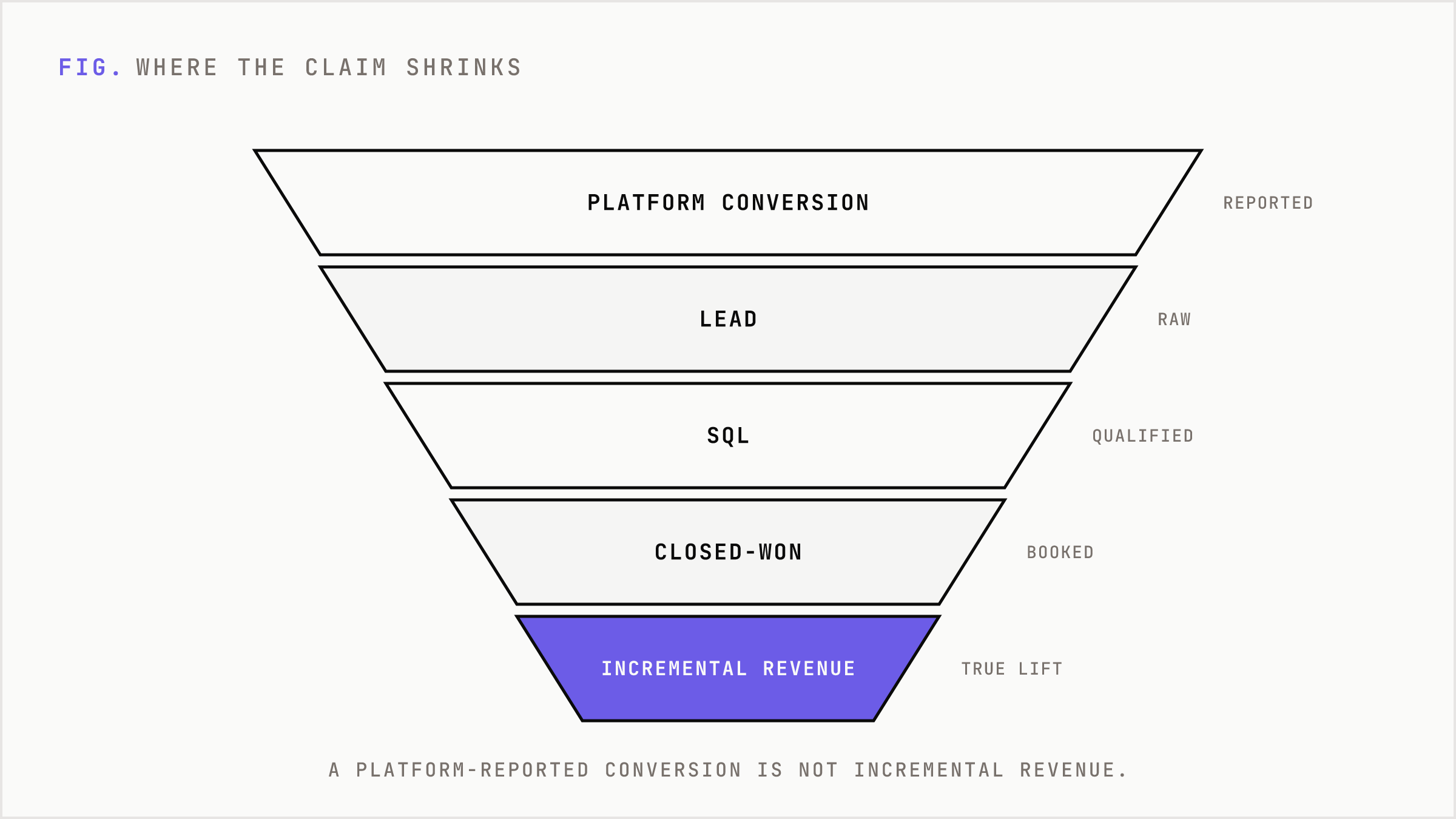
A purchase conversion rate is not a booked-call conversion rate. A lead is not an SQL. An SQL is not a closed-won customer. A platform-reported conversion is not incremental revenue. Once that is clear, most AI conversion claims become less impressive and more testable.
Benchmarks do not solve this. Shopify has cited global ecommerce purchase conversion around 1.6 percent for Q3 2025, while other ecommerce benchmark sources are closer to 2.9 percent depending on sector, device, and traffic mix. WordStream reported an average search ads conversion rate of 6.96 percent across 17,000 campaigns in its 2024 benchmark, but that number has limited meaning outside paid search and varies widely by industry.
This is why industry-average comparison is usually weak evidence. A medspa, a B2B security company, a Shopify apparel brand, and a Ford dealer are not playing the same game. They have different buyers, urgency, ticket sizes, creative constraints, and purchase paths. Any agency that collapses all of that into one universal lift number is selling simplicity, not proof.
The Evidence Stack
There is credible public evidence that AI-assisted marketing systems can increase conversion. It just rarely comes from generic agency homepages.
The strongest evidence comes from controlled experiments, named enterprise case studies, and product-level performance studies. Persado has published enterprise cases with Vodafone Italy reporting a 42 percent average conversion lift across SMS and push campaigns, and Orange reporting a 40 percent conversion-rate lift from AI-selected language versus control messages. BCG and Persado have also described average conversion-rate increases above 40 percent across engagement channels for AI-generated content and decisioning.
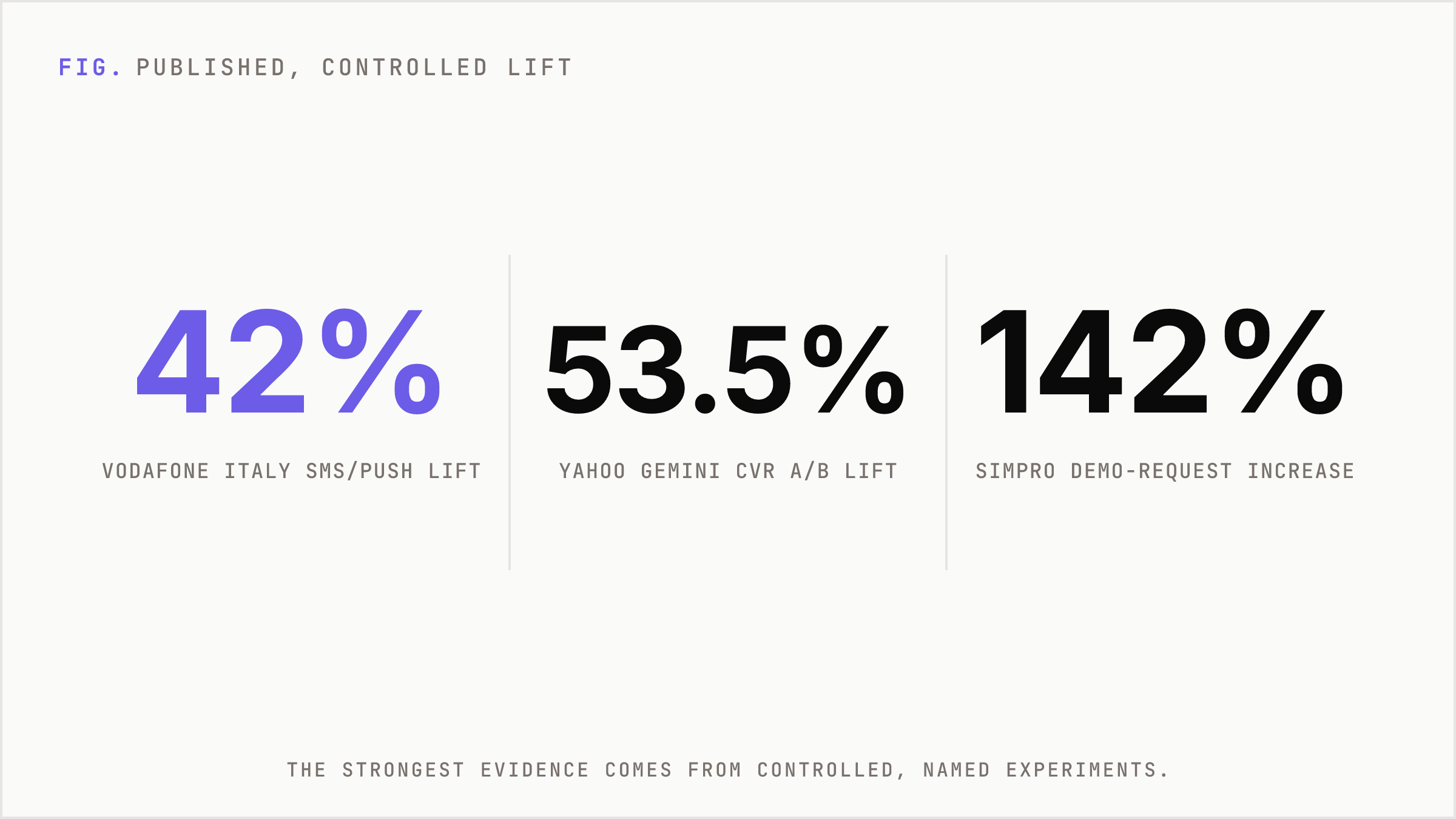
Unbounce Smart Traffic claims an average 30 percent lift in sales and signups by routing users to landing-page variants. Mutiny published a Simpro case with a 142 percent year-over-year increase in demo request conversions and $640,000 in incremental ARR influenced through ABM website personalization. In a more rigorous technical setting, research on Yahoo Gemini native ads reported a 53.5 percent CVR lift in an online bucket A/B test using conversion-predicted dynamic creative optimization.
There are also vertical case studies where the lift comes less from glamorous AI and more from feeding better signals into ad systems. Redpoint reported that a car rental company improved quote conversion rate from 6.9 percent to 8.7 percent after cleaning customer data for Google Performance Max. CF Search Marketing published a dealership case around call classification and GCLID feedback showing lower CPL and higher conversion rates versus industry averages. Affinitiv and Google reported a Ford dealer case with more conversions and lower CPA using Performance Max and Smart Bidding.
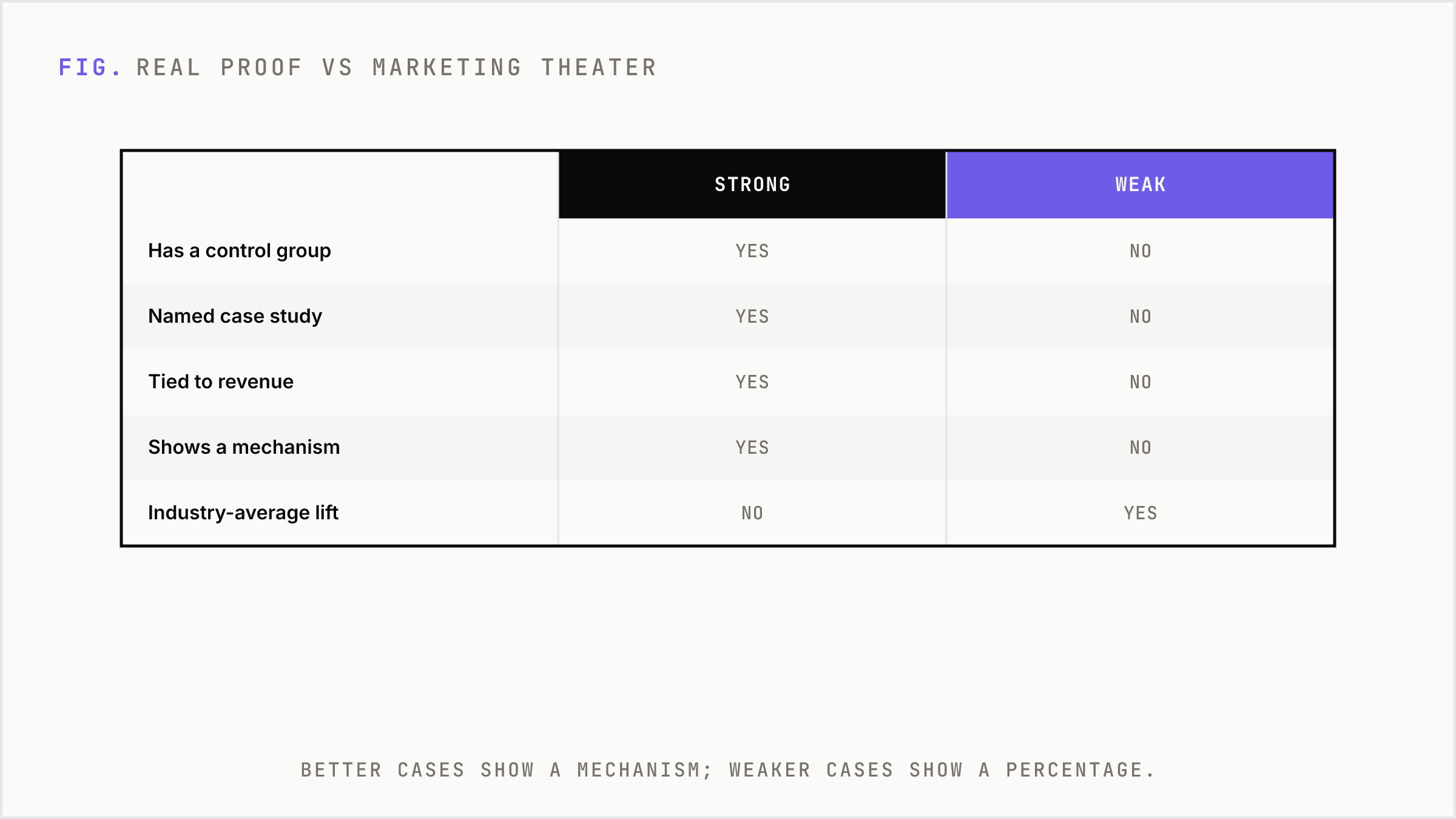
The pattern is obvious: the better cases show a mechanism. The weaker cases show a percentage.
What Actually Creates Lift
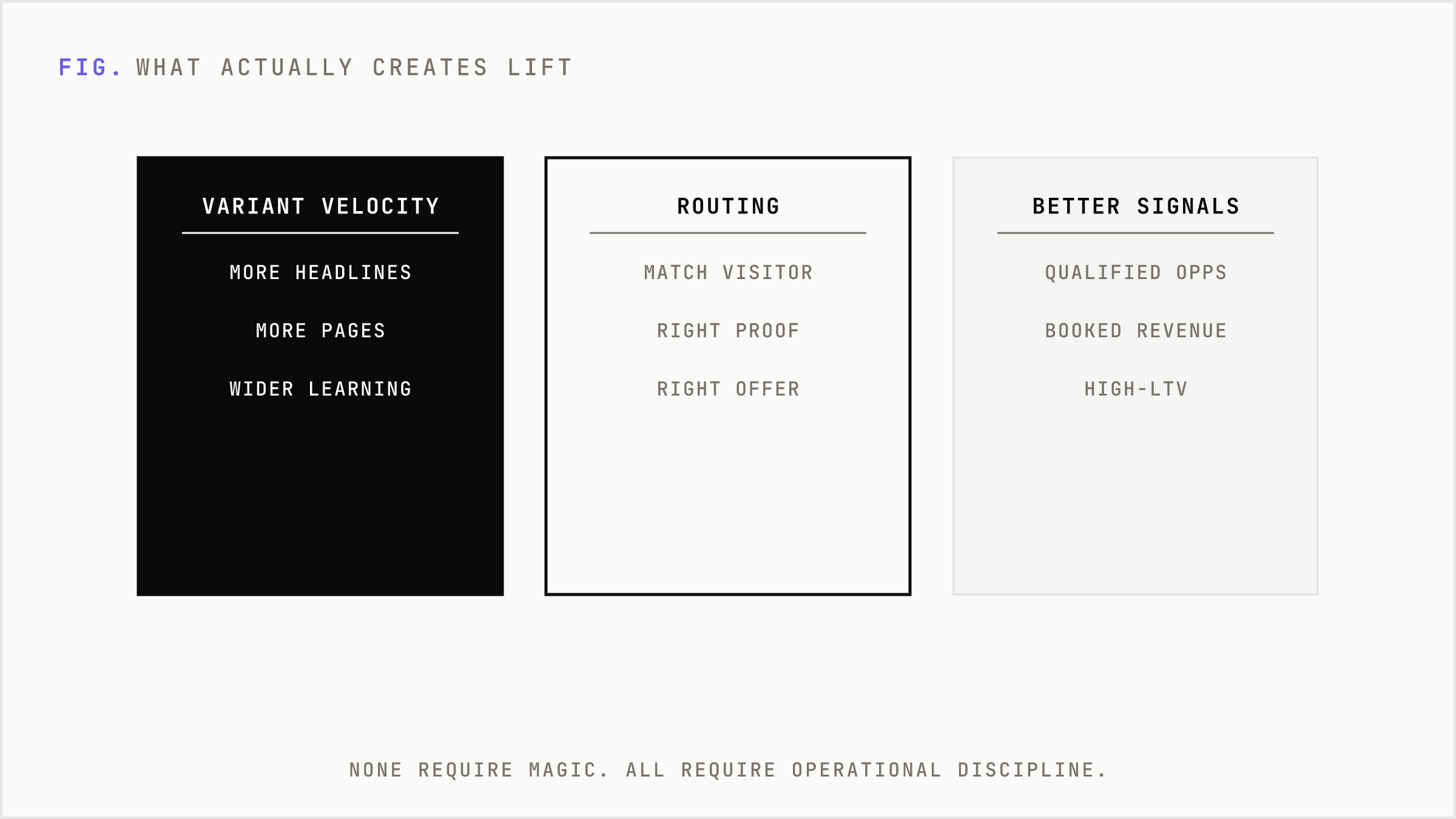
AI conversion lift usually comes from five mechanics. None require magic. All require operational discipline.
1. Variant velocity
Most marketing teams under-test because production is slow. They run one landing page, three ads, and a quarterly creative refresh. AI reduces the marginal cost of generating headlines, hooks, offer angles, product descriptions, email sequences, and page variants.
That matters because conversion is often trapped in untested alternatives. The winning message may not be better in the abstract. It may simply fit a segment, a device, a query, or a buying stage. Faster variant production increases the surface area of learning.
2. Personalization and routing
The old CRO model assumes one winner. AI makes that assumption look primitive. Different buyers need different proof, objections, offers, and next steps. A CFO, a growth lead, and an operations VP should not always see the same page.
Routing systems like Unbounce Smart Traffic and ABM personalization platforms like Mutiny point toward the same structural change: conversion optimization is becoming less about finding the universal best page and more about matching the right experience to the right visitor.
3. Better conversion signals
This is the least sexy and most important mechanic. Ad platforms optimize toward the signals they receive. If the signal is junk leads, the machine will learn to buy more junk leads. If the signal is qualified opportunities, booked revenue, high-LTV customers, or sales-accepted calls, the machine has a better target.
Many AI agency wins are really data plumbing wins. CRM hygiene, offline conversion imports, call classification, server-side events, GCLID matching, and deduplication often matter more than the model. Data quality beats model quality more often than buyers want to admit.
4. Creative-language optimization
Small language changes can move large numbers at scale. This is where Persado-style evidence is relevant. AI can test emotional framing, urgency, clarity, benefit hierarchy, and call-to-action structure across channels. The lift is not because a model writes beautiful copy. It is because the system finds response patterns faster than a human creative review cycle.
5. Budget reallocation speed
Manual media management has latency. Bad campaigns keep spending while teams wait for reporting cycles. Good campaigns often scale late. AI-assisted workflows can compress that loop, especially when connected to downstream revenue data.
This is also where agency economics change. The value shifts from hours spent building assets to the speed and accuracy of decisions. A strong agency becomes a learning engine. A weak one becomes a prompt shop with a reporting dashboard.
Where the Math Breaks
Conversion lift without a baseline is unusable. A 9 percent conversion rate sounds good until you learn the baseline was 8.7 percent and the new traffic mix was warmer. A 100 percent lift sounds great until you realize conversion moved from 0.2 percent to 0.4 percent and CAC is still underwater.
Relative lift hides absolute economics. Lead volume hides lead quality. Platform ROAS hides incrementality. Retargeting-heavy campaigns can harvest existing demand and look brilliant in ad manager while doing little for net-new revenue.
This is why the FTC has been right to scrutinize deceptive AI claims. AI-powered performance claims need substantiation. Not because AI is suspect, but because the market has made it too easy to attach AI language to ordinary optimization and call it a breakthrough.
The most dangerous metric is the one that helps the agency win the renewal but does not help the buyer make better capital allocation decisions.
The Buyer Checklist
A serious buyer should ask for proof architecture before asking for case studies. The proof architecture is the system by which lift will be defined, measured, challenged, and paid for.
- Conversion definition: Is the goal a purchase, booked call, demo request, SQL, opportunity, closed-won deal, renewal, or pipeline dollar?
- Denominator: Is the rate based on sessions, users, clicks, leads, accounts, opportunities, or sales conversations?
- Baseline: What was the exact pre-test conversion rate, over what period, with what traffic mix?
- Absolute and relative lift: Did 2 percent become 2.4 percent, or did 2 percent become 6 percent?
- Sample size: How many visitors, clicks, leads, calls, orders, or opportunities were measured?
- Attribution: Is performance measured in platform reports, GA4, Shopify, CRM, server-side tracking, MMM, or an incrementality test?
- Holdout: Was there a control group, geo split, matched audience, or clean A/B test?
- Revenue quality: What happened to AOV, CAC, LTV, refund rate, churn, sales acceptance, and margin?
- AI role: Did AI generate copy, route traffic, optimize bids, score leads, personalize pages, analyze calls, or just summarize reports?
These questions change the sales conversation. The agency can no longer hide behind screenshots. The buyer can compare vendors on operating capability, not theater.
The Agency Market Will Split
AI is changing agency competition in two directions at once.
First, it substitutes low-end execution. Basic copy variations, audience drafts, landing-page outlines, reporting summaries, and creative resizing are becoming cheaper. Buyers will not keep paying premium retainers for work that software compresses.
Second, it expands the market for high-quality experimentation. When production gets cheaper, the bottleneck moves to strategy, data, measurement, and decision rights. The agency that can design the test, connect the CRM, interpret the signal, and reallocate budget becomes more valuable.
This is the real budget shift. Money moves away from labor disguised as strategy and toward systems that increase speed-to-learning. Media spend does not get smaller. The tolerance for unmeasured spend does.
For founders, this means AI marketing should not be evaluated as a creative feature. It should be evaluated as a revenue operating layer. Does it shorten the feedback loop between market signal and budget decision? Does it improve the quality of the signal? Does it create more qualified experiments per dollar? Does it help the company learn something competitors will not learn for another quarter?
The Right Pilot
The best AI agency pilot is narrow, commercial, and falsifiable. Pick one funnel stage. Define one primary conversion. Set a baseline. Lock the traffic source. Agree on attribution. Decide what counts as success before the work starts.
For ecommerce, the metric might be contribution-margin-adjusted purchase conversion by device and traffic source. For B2B, it might be demo-to-SQL conversion or pipeline created from target accounts. For local services, it might be qualified booked calls with call recordings classified against a sales rubric.
The pilot should also include a kill condition. If the agency cannot beat the baseline with statistical or commercial confidence, the buyer should not scale. If it can, the next budget line is obvious.
This structure is better for both sides. Good agencies get paid for real operating leverage. Buyers get fewer vanity metrics. The market gets cleaner.
The Strategic Point
AI conversion lift is real, but it is not evenly distributed. It accrues to companies with clean data, enough traffic, disciplined testing, strong offers, and the patience to measure downstream revenue. It does not accrue automatically to anyone who installs a tool or hires an AI-native agency.
The winners will not be the teams with the most AI language in their decks. They will be the teams that turn AI into a repeatable conversion system: more variants, better routing, cleaner signals, faster budget movement, and stricter proof.
That is the standard buyers should demand. Not a miracle. Not a dashboard. Incremental revenue, measured against a baseline, with enough evidence to justify the next dollar.
FAQ
Can AI marketing agencies really improve conversion rates?
Yes, but the credible lift usually comes from specific mechanics such as faster creative testing, personalization, better conversion signals, landing-page routing, and budget reallocation. The buyer still needs proof tied to their own funnel.
What is the biggest red flag in an AI conversion claim?
A percentage lift with no baseline, no conversion definition, no sample size, and no attribution method. A claim like 68 percent lift is weak unless you know what changed, over what period, and against what control.
Should buyers trust agency case studies?
Use them as directional evidence, not final proof. Named client case studies are better than anonymous aggregate claims, but the strongest evidence is still a controlled test or a pilot measured against your own revenue data.
What should an AI agency pilot measure?
Measure one commercially meaningful conversion, such as purchases, qualified calls, SQLs, opportunities, or closed-won revenue. Define the denominator, attribution source, baseline, sample size, and success threshold before launch.
Is AI copywriting enough to create conversion lift?
Usually not by itself. AI copy can increase variant velocity, but durable lift comes when copy testing is connected to segmentation, landing-page experience, conversion data, and revenue-quality feedback.