Nyyon · Blog
The AI Commerce Advantage: Why Product Data, Checkout, and Lifecycle Systems Now Beat Ad Volume
AI commerce now rewards product data, checkout intelligence, agent visibility, and lifecycle systems over AI-generated ad volume and media scale.
AI commerce is not about making more ads. It is about making the entire revenue system readable, adaptive, and economically disciplined.
Most ecommerce AI work still starts in the wrong place. A founder asks for more ad variants. A marketing lead wants AI hooks. An agency sells faster creative production. The output looks modern, but the operating model is old. Same funnel. Same product feed. Same checkout leaks. Same attribution fog. Same discount logic. Only the copy is faster.
That is not an AI advantage. That is cheaper content.
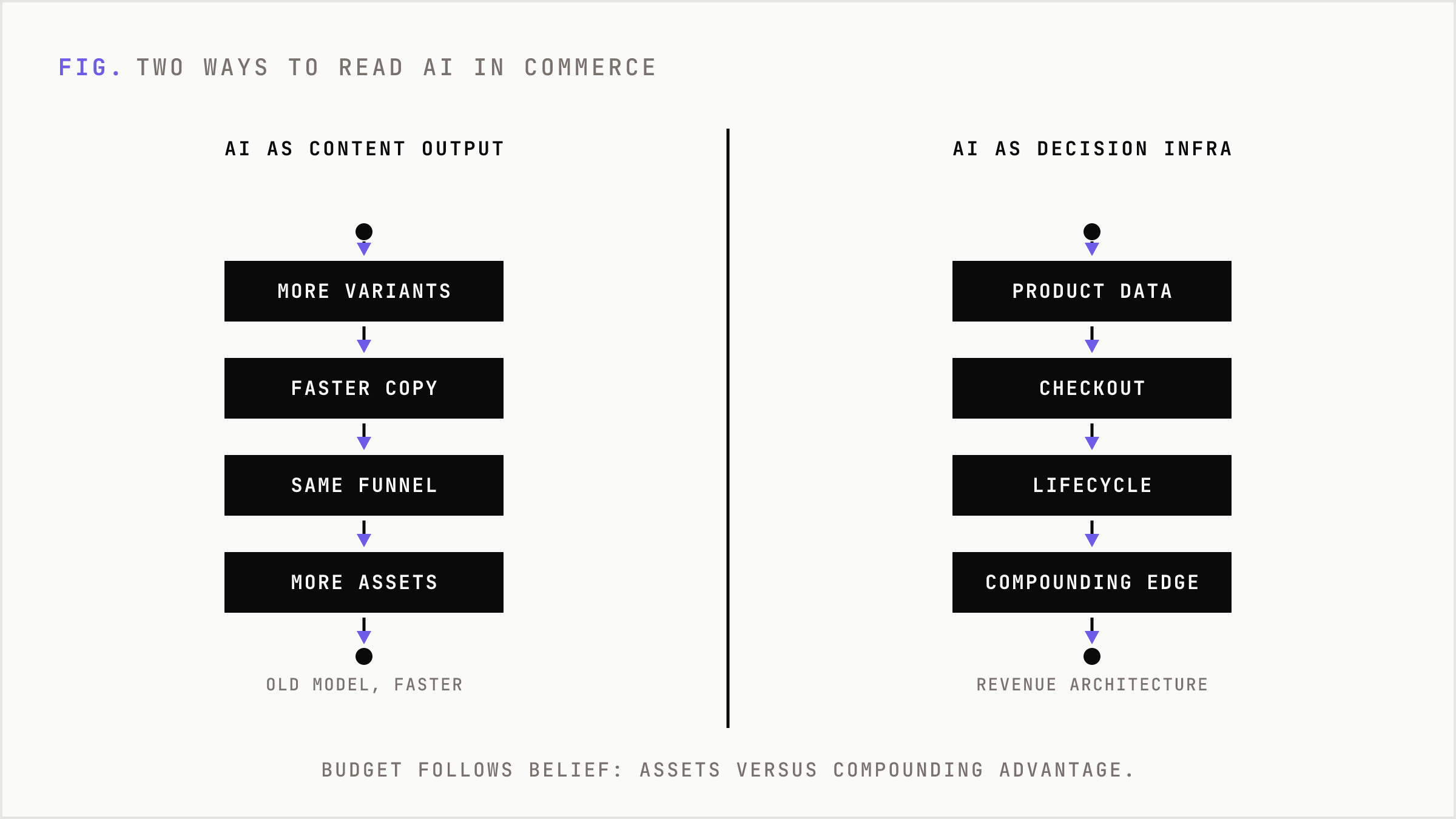
The real shift is lower in the stack. AI is changing how products are discovered, compared, selected, purchased, and reactivated. That means the winning system is not a campaign machine. It is revenue architecture across product data, merchandising, offers, checkout, lifecycle, attribution, and agent visibility.
The distinction matters because budget follows belief. If leadership thinks AI equals content output, money goes into generation tools and creative volume. If leadership understands AI as decision infrastructure, money goes into feeds, first party data, conversion systems, testing loops, and owned channels. One path produces more assets. The other produces compounding advantage.
The market is already moving past AI as a novelty
AI assisted shopping is no longer a lab behavior. Adobe reported that GenAI driven retail traffic rose 693% year over year during the 2025 holiday season. In the same period, AI referrals to retail sites converted 31% higher than non AI sources and produced 32% higher revenue per visit.
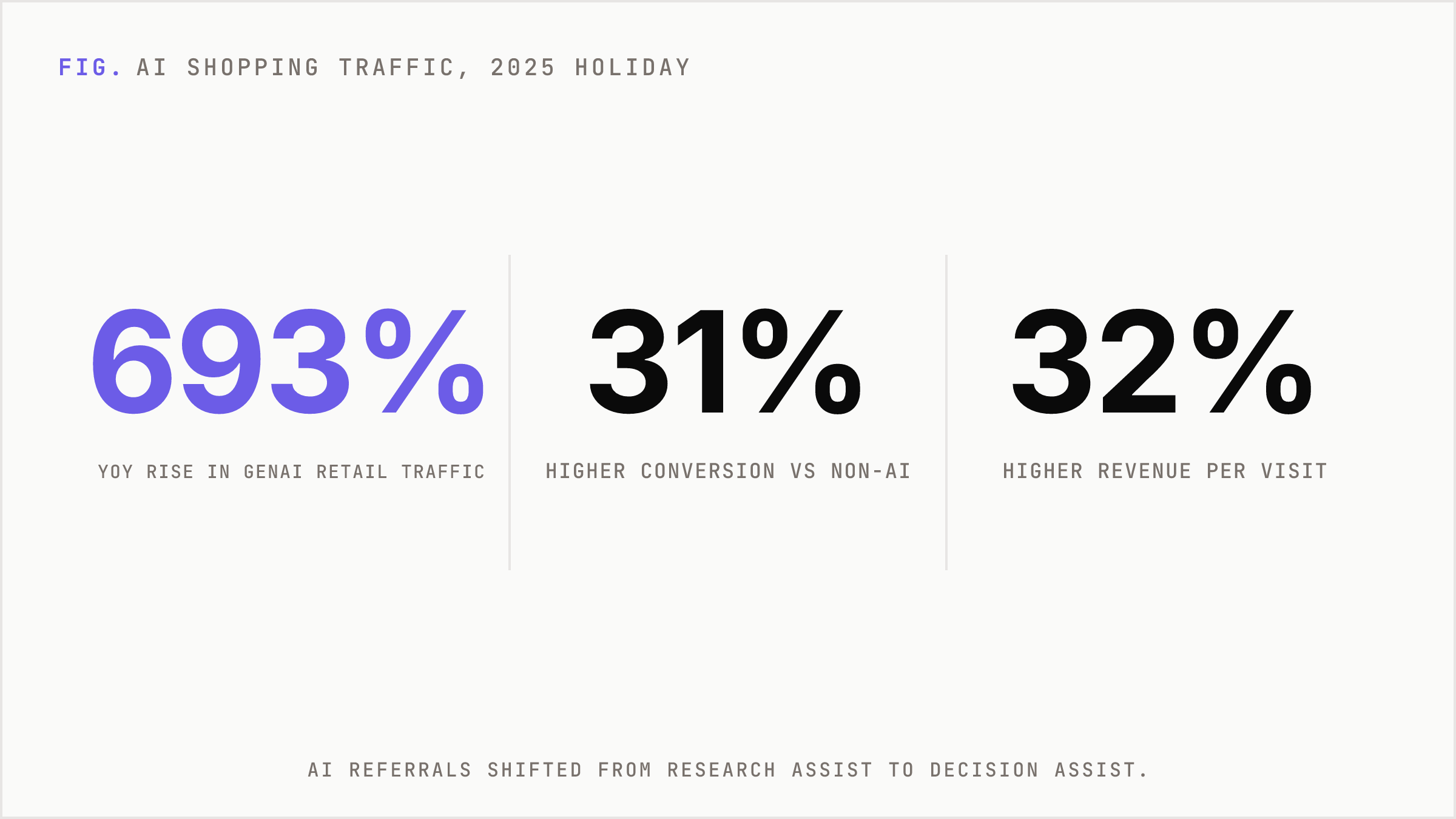
That is the important line. Early AI shopping traffic looked like research traffic. People used assistants to explore, compare, and narrow options, then converted elsewhere or later. Adobe's July 2025 data still showed AI traffic converting below non AI traffic, even while visits were longer, bounce rates were lower, and page depth was higher. By the holiday season, the signal had changed. AI referrals were not just research assist. They were becoming decision assist.
This does not mean every brand should declare a new channel overnight. AI referral traffic is still smaller than paid search, email, and major social platforms for most retailers. But growth curves matter before volume becomes obvious. The first brands to prepare for AI mediated shopping will not be the ones with the most slogans. They will be the ones whose products are easiest for machines to understand, trust, compare, and route to a buyer.
Your product feed is now a performance channel
In classic ecommerce, the product feed was operational plumbing. It pushed SKUs into Google Merchant Center, Meta catalogs, marketplaces, and affiliate systems. In AI commerce, the feed becomes a persuasion surface.
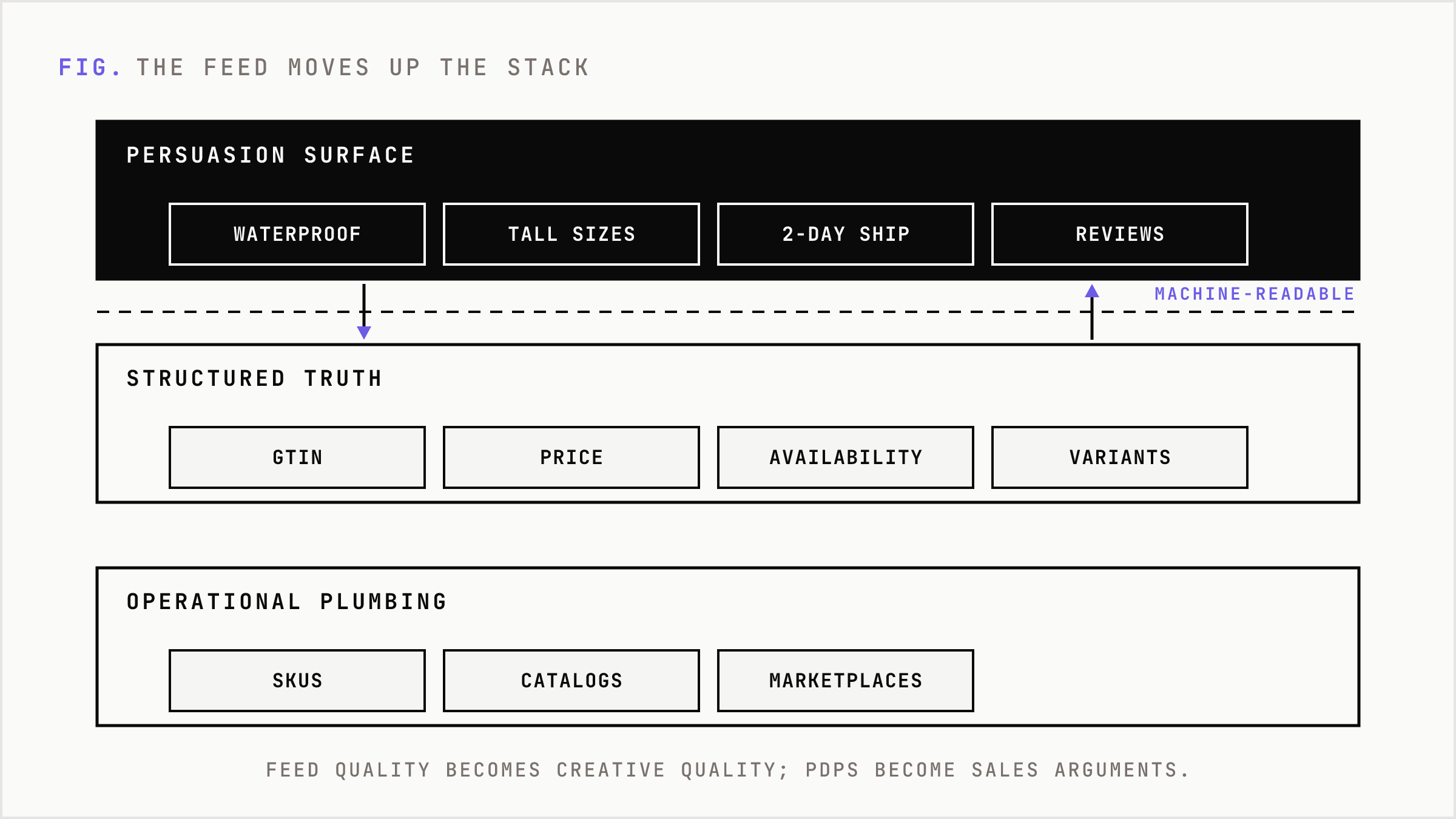
ChatGPT shopping results can show product options with images, details, and purchase links. OpenAI says product results are not ads and that merchant ranking can consider availability, price, quality, whether the merchant is the maker or primary seller, and whether Instant Checkout is enabled. OpenAI also tells merchants to provide direct product feeds so product information stays current. Its feed spec asks for structured data like item ID, title, description, URL, brand, image, price, availability, seller information, variants, shipping, GTIN, category, and media.
Google is moving the same direction through AI Mode and the Shopping Graph. AI Mode supports conversational shopping, visual product discovery, multimodal search, and refinement without traditional filters. Google says its Shopping Graph has more than 50 billion product listings and refreshes more than 2 billion listings every hour.
The implication is simple. If the machine is mediating the comparison, the machine needs structured truth. Vague merchandising becomes expensive.
A page that says a jacket is premium is weak. A feed and PDP that say it is waterproof, breathable, insulated to a specific temperature range, available in tall sizes, ships in two days, has free returns, and is reviewed well by commuters in rainy cities is much stronger. The second version gives an AI system something to match against a buyer constraint.
Feed quality becomes creative quality. PDPs become model readable sales arguments. Reviews become persuasion data. FAQs become machine parsable objection handling.
SEO is splitting into human search and AI selection
Classic SEO was built around ranking pages. AI discovery is different. The goal is to be selected, summarized, compared, and recommended inside an answer layer.
This changes the work. The brand still needs technical SEO, clean pages, internal links, schema, and strong category architecture. But it also needs product data that maps to how people describe constraints. Buyers do not only search by product type. They search by situation.
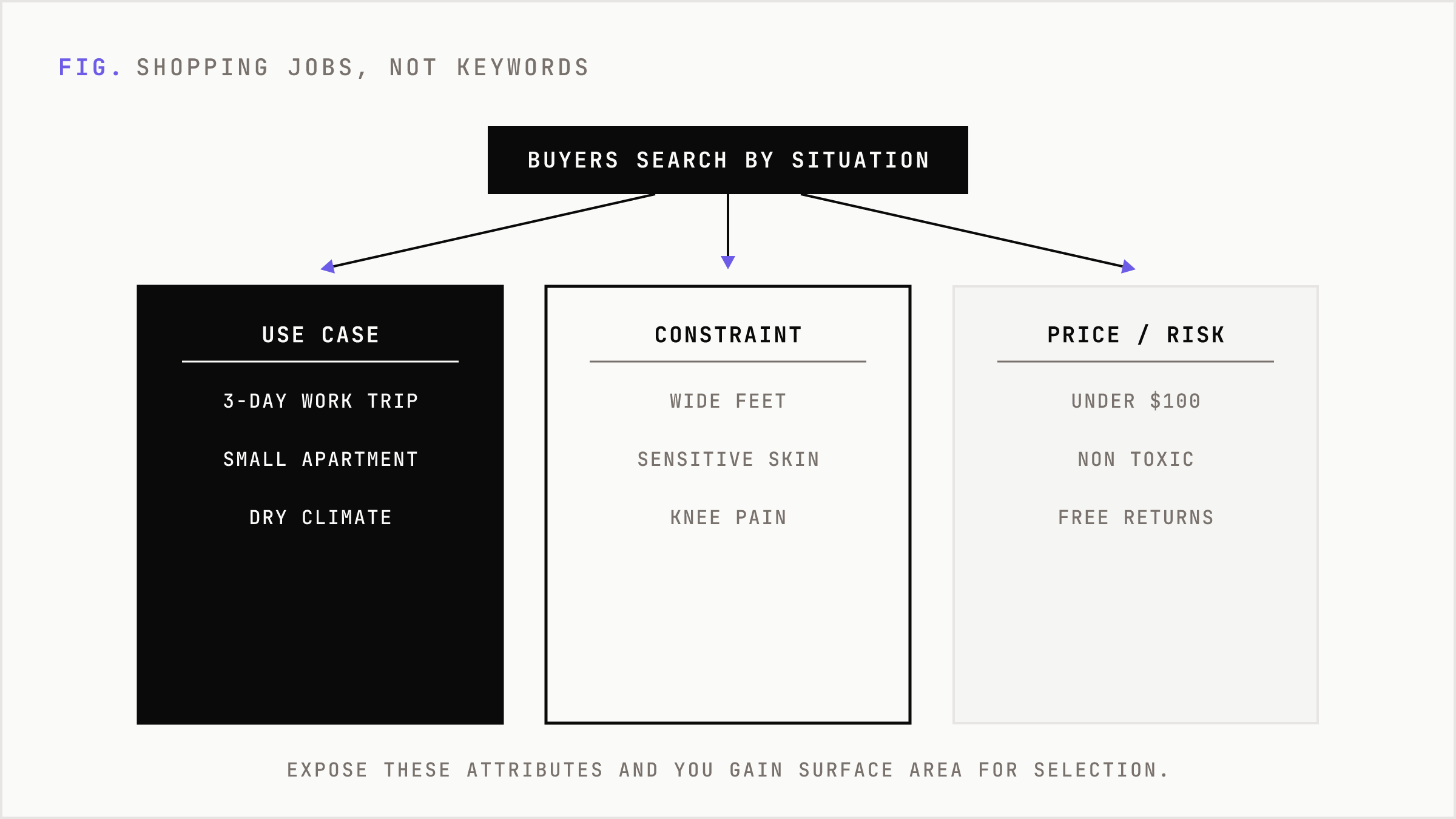
- Best carry on bag for a three day work trip
- Running shoes for wide feet and knee pain
- Non toxic cookware for small apartments
- Gift under $100 for a new parent
- Moisturizer for sensitive skin in dry climates
Those are not just keywords. They are shopping jobs. They include use case, price, risk, context, and tradeoff. AI systems are built to parse exactly that kind of language. Brands that expose these attributes clearly have more surface area for selection.
This is why the next ecommerce battleground is machine readable merchandising. The model's answer may become the first persuasion layer. The PDP is no longer guaranteed to be where the buyer starts forming preference. It may be where the buyer verifies a decision already shaped by an assistant.
Checkout AI may beat media AI
Most ecommerce teams still overinvest before the click and underinvest after it. That is rational when acquisition is the visible budget line. It is also where a lot of margin dies.
Baymard's 2026 benchmark puts average documented cart abandonment at 70.22%. Some abandonment is normal. Many shoppers are browsing. But when Baymard excludes the just browsing group, the top reasons are concrete: extra costs too high, delivery too slow, lack of credit card trust, forced account creation, and checkout that is too long or complicated. Baymard estimates that solvable checkout usability issues alone could produce a 35.26% conversion rate increase for the average large ecommerce site.
No ad model fixes a forced account wall. No AI headline fixes a surprise shipping fee. No creative testing program fixes payment mistrust.
This is where AI can do useful work without theater. It can score checkout sessions for friction. It can detect which cart types are sensitive to shipping thresholds. It can predict abandonment reasons by product, source, device, geography, and basket value. It can personalize recovery flows based on likely objection. It can identify where trust signals should move. It can surface payment method gaps by segment. It can test delivery promise language against conversion and margin.
That is not glamorous. It is revenue.
Personalization should feel like competence
Consumers want relevance, but they do not want to feel stalked. McKinsey has reported that 71% of consumers expect personalized interactions and 76% get frustrated when personalization does not happen. The commercial upside is real: lower acquisition costs, higher revenue, and better marketing ROI. But most personalization still feels shallow because it is built around visible tricks rather than useful decisions.
Bad AI personalization inserts a name, changes a hero image, or over discounts anyone who hesitates. Good AI personalization does less obvious work. It predicts replenishment timing. It adjusts bundles by prior purchase. It suppresses offers for customers likely to buy without them. It recommends sizes based on returns data. It changes post purchase education based on product complexity. It times review requests after likely satisfaction, not immediately after delivery.
The best personalization feels like the company is competent. The right product appears. The right size is easier to choose. The return policy is clear before anxiety spikes. The replenishment reminder arrives when the product is actually running out. The winback offer reflects customer value, margin, and discount sensitivity.
That requires first party data, not just generative copy. Purchase history, browsing behavior, returns, support tickets, reviews, loyalty status, margin, and inventory all have to connect. The model needs context. Otherwise it is guessing with nicer syntax.
Retention AI is more defensible than acquisition AI
Paid media AI is mostly platform controlled. Meta, Google, TikTok, and Amazon automate targeting, bidding, placement, and creative assembly inside their own systems. Brands can provide inputs, but the core learning loop is rented.
Retention is different. Owned data compounds if the brand structures it well. Email, SMS, loyalty, post purchase, replenishment, and customer service all create signals competitors cannot directly buy. A brand that knows which customers return size medium denim twice, which buyers reorder every 43 days, which product combinations reduce churn, and which support complaints predict refunds has an asset.
This changes the role of lifecycle marketing. It is not just newsletters and flows. It becomes a customer operating system.
Klaviyo's flow benchmarks show abandoned cart automations can produce meaningful revenue per recipient, especially as average order value rises. Litmus has cited strong email ROI benchmarks for retail and ecommerce. But the strategic point is not that email is cheap. The point is that owned channels can learn at the customer and product level.
AI should optimize flow logic, segmentation, timing, suppression, next best product, replenishment, churn risk, and LTV. Writing the email is the small part. Deciding who should receive what, when, with which offer, and at what margin is the valuable part.
ROAS is too small a target
AI can scale bad economics quickly. That is the hidden risk.
If the system optimizes for ROAS, it may favor repeat buyers who would have purchased anyway. If it optimizes for CPA, it may chase low quality first orders. If it optimizes for revenue, it may push high return products. If it optimizes for click through rate, it may reward curiosity rather than profit.
AI native ecommerce needs harder constraints: contribution margin, first order profitability, payback period, return adjusted revenue, 60 day and 180 day LTV, repeat probability, inventory liquidation value, and cohort level incrementality.
This is not finance pedantry. It changes execution. A margin aware system may promote one product in paid social, another in email, and a third in AI search optimization. It may discount a slow moving SKU but protect full price demand on a hero product. It may suppress acquisition spend for customers likely to return their first order. It may treat two identical purchases differently because one cohort has high repeat probability and the other does not.
ROAS was a useful dashboard metric for a simpler channel world. It is not sufficient for AI mediated commerce.
The workflow is the moat
McKinsey's 2025 State of AI data showed broad adoption: 78% of surveyed organizations used AI in at least one business function, and 71% used generative AI. It also found that more than 80% still reported no tangible enterprise level EBIT impact. That gap is the whole story.
Tools are easy to adopt. Workflows are hard to rewire.
An elite AI commerce system does not look like a prompt library. It looks like connected loops. Product feed quality affects agent visibility. Agent visibility affects traffic quality. Traffic quality affects landing page logic. Landing behavior affects checkout diagnostics. Checkout outcomes affect recovery flows. Recovery flows affect customer data. Customer data affects next best offer. Returns and reviews feed back into merchandising and product claims.
Each loop needs human judgment. AI can generate variants, detect anomalies, cluster segments, enrich feeds, summarize reviews, and recommend tests. Humans still own positioning, taste, offer architecture, risk thresholds, compliance, and commercial priorities. The premium service is not automation. It is judgment over automation.
The agency model changes
The best AI marketing agency will look less like a media buyer and more like a revenue systems architect.
It will audit product feeds, schema, PDPs, reviews, support data, checkout friction, lifecycle flows, server side events, attribution logic, and margin reporting. It will ask whether every major SKU has clear use cases, comparison points, contraindications, shipping clarity, return clarity, and FAQs. It will check whether ChatGPT, Google AI Mode, marketplaces, and shopping agents can understand the catalog.
It will still make creative. But creative will be downstream of merchandising intelligence. The unit of testing will not just be hook, thumbnail, and CTA. It will be buyer constraint by audience state by product margin by inventory by offer by seasonality by LTV.
Examples: giftable under $100, ships before Friday, wide fit, dermatologist tested, safe for induction stoves, for first time parents, better than the common alternative because of one specific tradeoff. These are not slogans. They are commercial selectors.
What founders should fund
If you run an ecommerce brand, the immediate priority is not to buy every AI tool. It is to find the bottleneck that AI can actually remove.
- Clean the product data. Titles, attributes, variants, availability, images, GTINs, shipping, returns, and category logic need to be current and structured.
- Make PDPs constraint ready. Add use cases, comparison language, FAQs, review themes, limitations, and trust signals.
- Track AI mediated demand. Separate AI referrals, AI influenced organic traffic, comparison traffic, and non click assist where possible.
- Fix checkout friction. Model abandonment by reason, not just rate.
- Connect lifecycle data. Purchase history, margin, support, returns, browsing, and product affinity should inform flows.
- Measure profit. Use margin, LTV, incrementality, and payback alongside channel metrics.
This is not a one quarter growth hack. It is infrastructure for a market where shopping decisions are increasingly mediated by software agents, answer engines, and automated recommendation systems.
The brands that win will not be the loudest. They will be the most legible. Their products will be easy for machines to parse and easy for humans to trust. Their checkout will remove friction before it becomes abandonment. Their lifecycle systems will turn owned data into better timing, better offers, and better retention. Their measurement will optimize for profit, not vanity efficiency.
AI generated ads are a feature. AI native revenue architecture is the advantage.
FAQ
What is AI commerce?
AI commerce is the use of AI across the full ecommerce revenue system, including discovery, product data, merchandising, checkout, lifecycle, attribution, and retention. It is broader than AI generated ads.
Why does product data matter more now?
AI shopping assistants and search systems need structured, current, explicit product information to compare and recommend products. Weak feeds and vague PDPs reduce visibility in machine mediated shopping.
Is AI traffic a meaningful ecommerce channel?
It is still smaller than major channels for most brands, but it is growing quickly. Adobe reported strong growth in AI driven retail traffic and higher conversion during the 2025 holiday season.
Where should ecommerce brands apply AI first?
Start where the revenue leak is largest. For many brands, that means product feed cleanup, checkout friction analysis, lifecycle segmentation, cart recovery, and margin aware measurement before more ad generation.
How should brands measure AI marketing?
Brands should measure contribution margin, cohort LTV, payback period, incrementality, return adjusted revenue, AI referral traffic, and lifecycle performance. ROAS alone is too narrow.