Nyyon · Blog
The AI Agency Margin Map
AI cuts agency costs in specific workflows, but real margin comes from redesigned pricing, staffing, governance, and performance loops, not cheaper drafts.
AI is not making full-service agencies simply cheaper. It is redrawing where margin exists.
The lazy version of the story says generative AI cuts agency costs by replacing writers, designers, analysts, and coordinators. That is directionally true at the task level and often wrong at the business model level.
A blog draft can be produced faster. A paid social matrix can be generated in minutes. A weekly performance summary can be assembled before the analyst finishes coffee. But agency profit does not rise in a straight line from those savings. The agency still has client calls, brand risk, compliance review, creative judgment, strategy, approvals, account management, and commercial accountability.
The useful question is not whether AI saves time. It does. The useful question is where those savings land.
The Unit of Analysis Matters
Most AI cost claims fail because they confuse four different units: the task, the workflow, the service line, and the agency P&L.
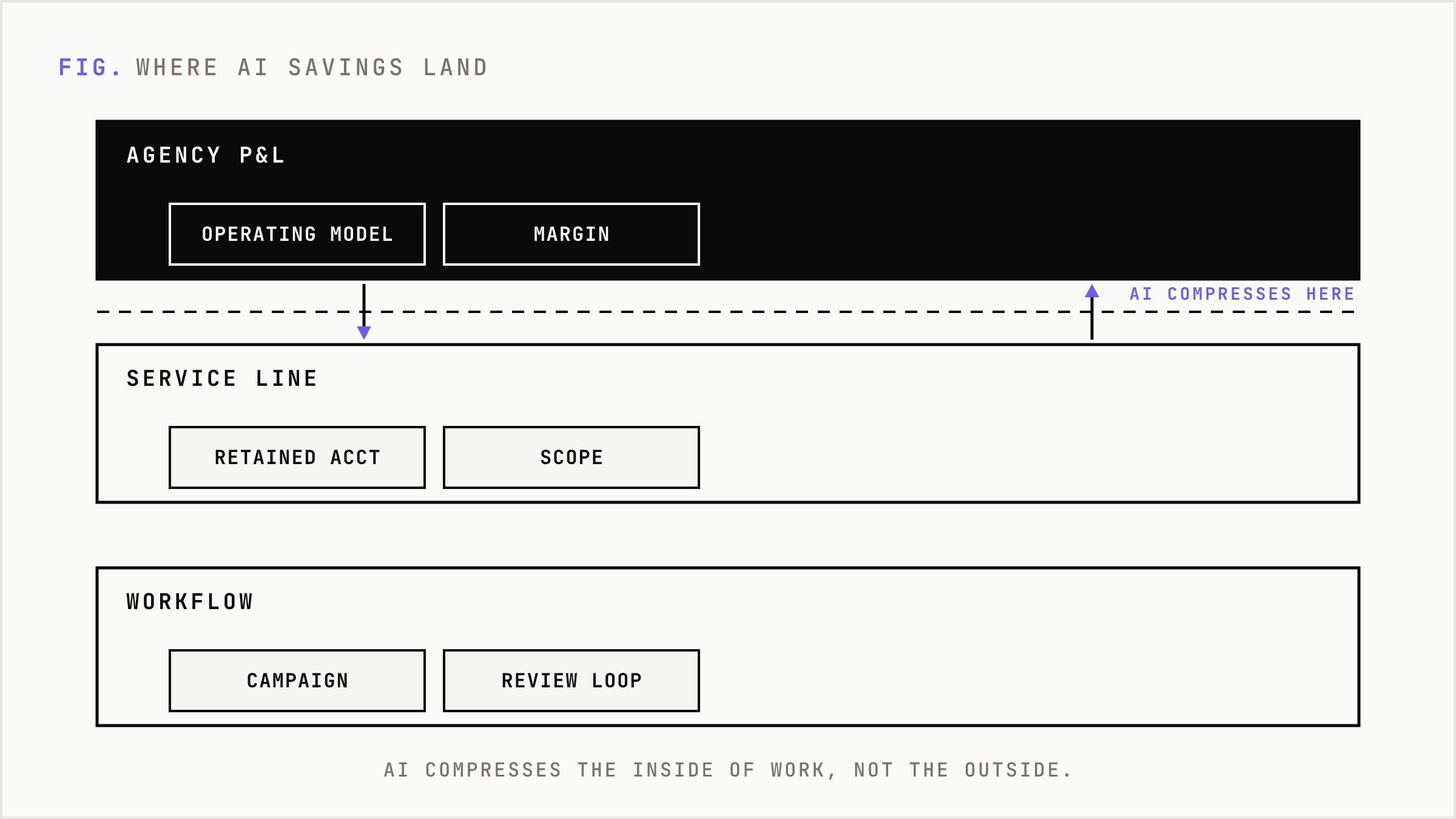
At the task level, the numbers can be dramatic. Accenture Song has reported project contexts with up to 94% savings in production time and 300 to 400% more content versions. The MIT study by Noy and Zhang found professionals using ChatGPT completed writing tasks 11 minutes faster, with quality scores up 18%. AgencyAnalytics found that 58% of agency leaders said AI cut content creation time, and 42% reclaimed 5 to 10 billable hours per week.
Those are real signals. They do not mean a full-service agency becomes 40% cheaper to run.
A task is not a client relationship. A draft is not a campaign. A campaign is not a retained account. A retained account is not an operating model.
AI compresses the inside of work. It does not automatically compress the outside of work: meetings, politics, approvals, brand constraints, legal checks, measurement debates, procurement pressure, and the basic fact that clients keep asking for more once production gets faster.
What Actually Gets Cheaper
The first margin zone is repeatable production.
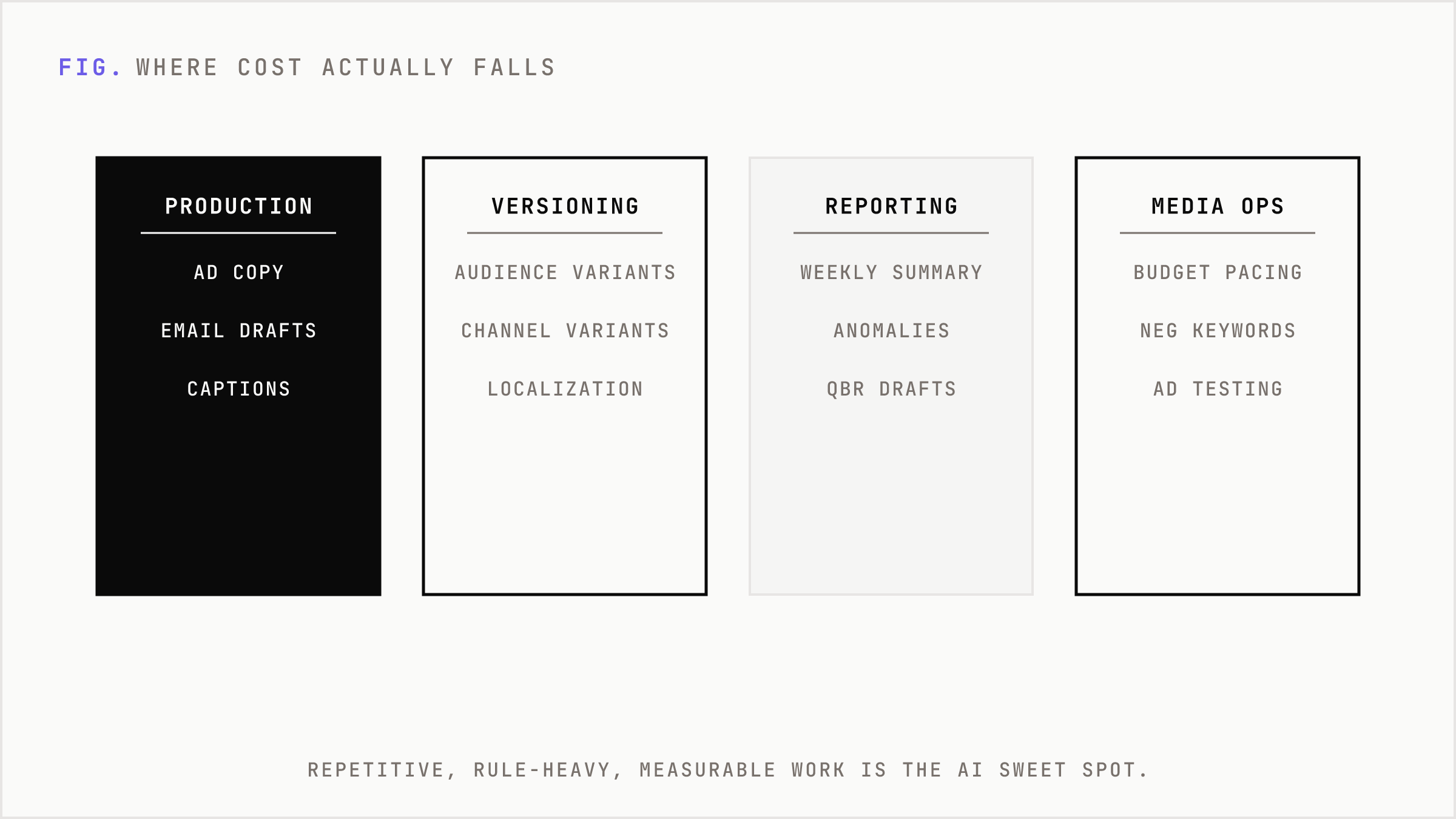
AI is strongest where the work has clear inputs, clear constraints, and a low penalty for a bad first pass. That includes blog outlines, email drafts, ad copy variants, landing page copy, product descriptions, social captions, scripts, summaries, repurposing, localization drafts, and paid social creative matrices.
This is not because the machine has taste. It is because the machine is good at generating acceptable starting points across known formats. The old agency workflow turned junior labor into rough material. The new workflow turns prompts, examples, brand memory, and review loops into rough material.
The second margin zone is versioning. One hero message becomes five audience variants, three channel variants, four tones, and a localization draft. Before AI, this was painful enough that teams under-tested. With AI, the marginal cost of a new version falls sharply.
The third zone is reporting. Dashboards are already structured. The problem is narrative extraction: what changed, why it matters, what to do next. AI can summarize weekly performance, identify anomalies, draft QBR commentary, and turn raw analytics into a client-ready first pass.
The fourth zone is research compression. Competitive scans, SERP summaries, review mining, social listening synthesis, trend notes, and interview analysis all get faster. This does not eliminate strategy. It reduces the cost of getting to the first intelligent conversation.
The fifth zone is media operations. Naming conventions, query generation, budget pacing alerts, negative keyword discovery, ad testing frameworks, and performance summaries are not glamorous. They are perfect candidates for AI-assisted workflows because they are repetitive, rule-heavy, and measurable.
What Does Not Get Cheaper
The expensive layer of marketing is not typing. It is judgment under ambiguity.
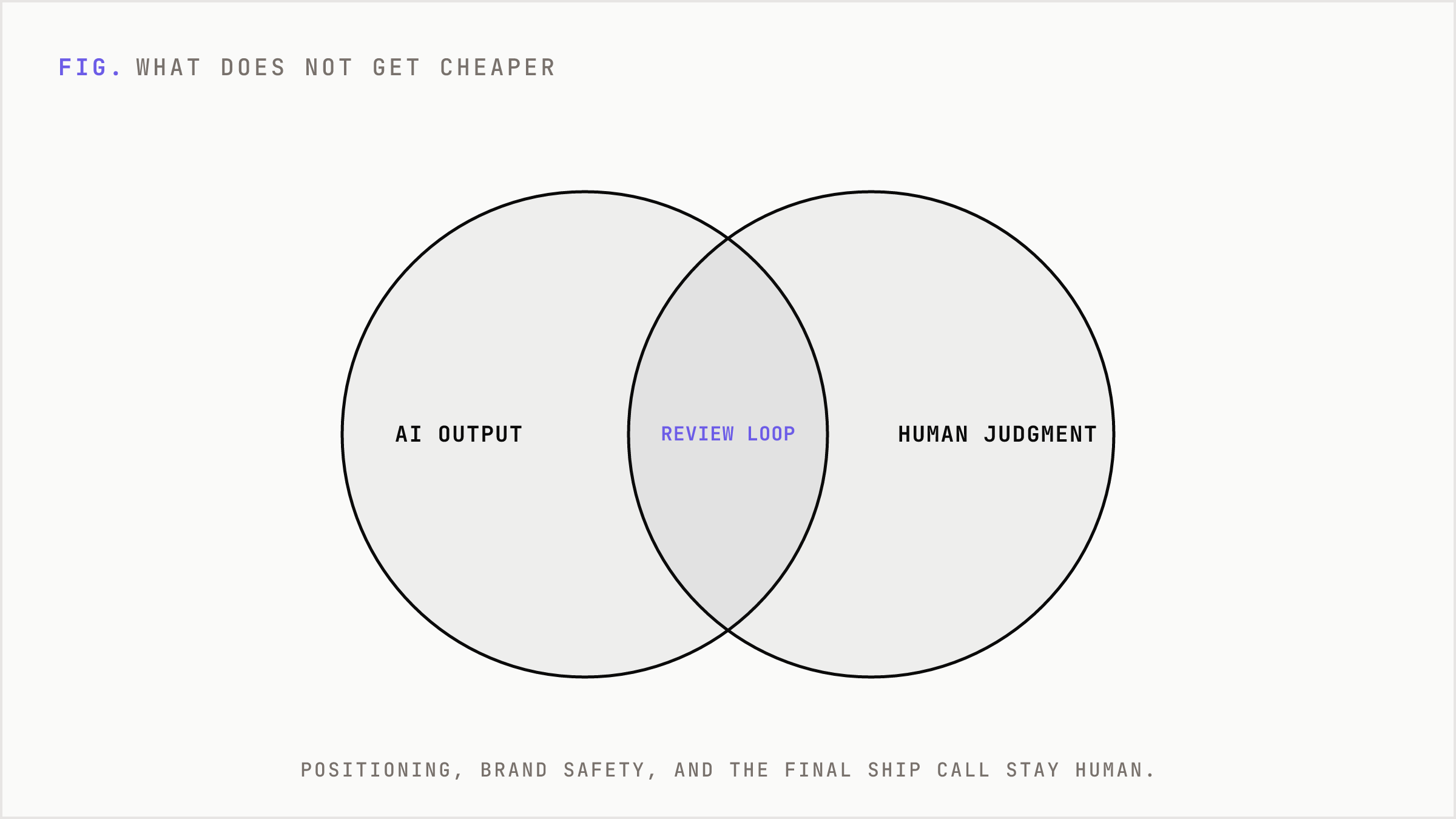
Positioning does not become cheap because a model can write ten taglines. Brand diagnosis does not become cheap because a model can summarize competitors. Creative direction does not become cheap because a model can produce moodboards. High-stakes launch planning does not become cheap because a model can generate a project plan.
The same applies to compliance, factual accuracy, brand safety, reputation risk, stakeholder alignment, offer strategy, and the final call on what should ship. These are not production tasks. They are risk-bearing decisions.
This is where many agencies will misread the market. If they sell AI as cheaper output, clients will push prices down. If they use AI to increase decision quality, testing velocity, and accountability, they have a stronger defense.
The Simple Math
AI savings inside an agency follow a basic equation:
Gross savings = removed labor hours x fully loaded hourly cost
Net savings = gross savings - AI software - training - governance - QA - rework - integration
Margin impact = net savings retained + new revenue from higher output
Client impact = savings passed through under the pricing model
This is why the same AI capability produces different economics in different agencies.
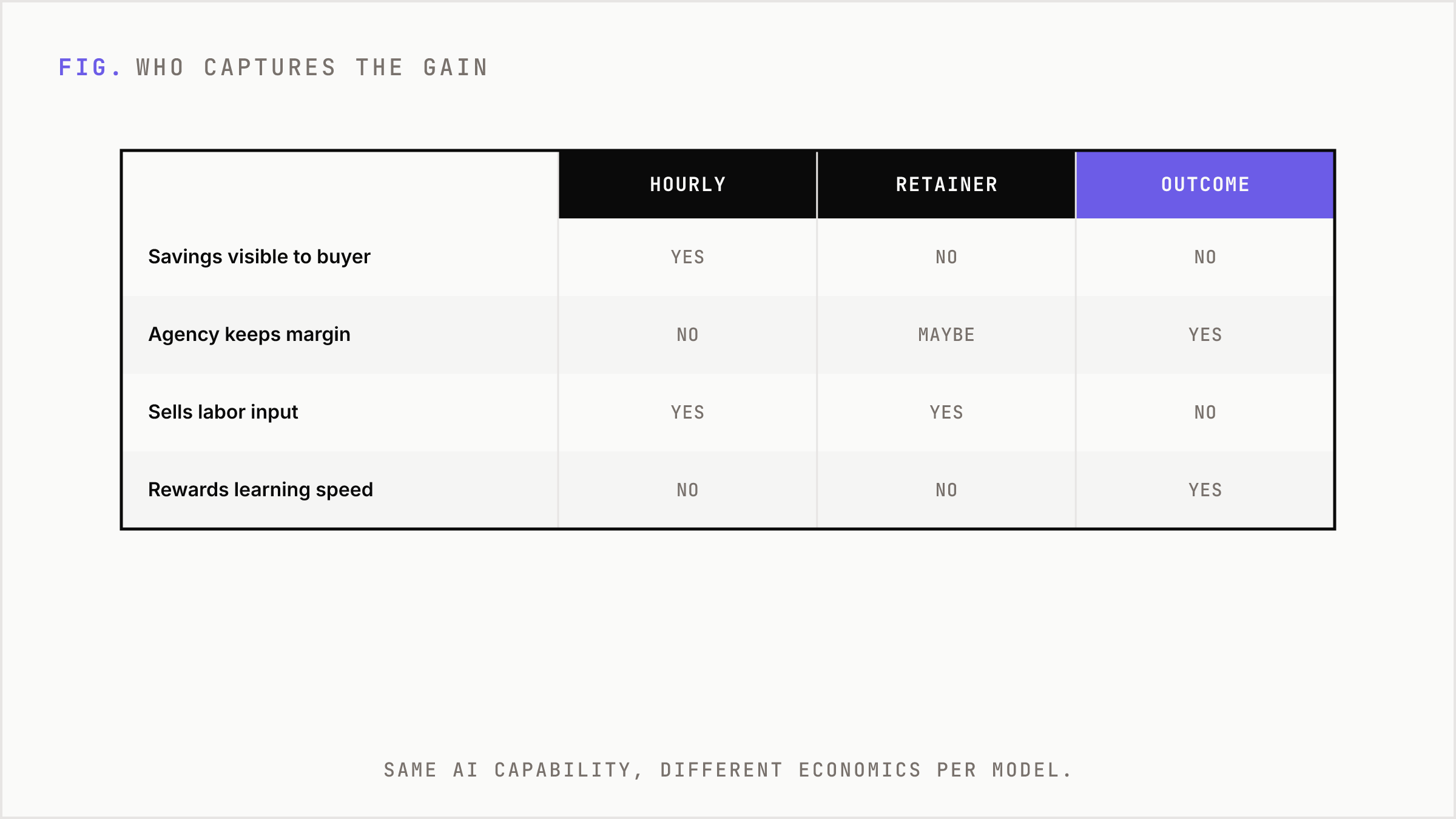
In an hourly model, AI savings are visible. If a task used to take 12 hours and now takes 5, the buyer eventually asks why the bill still shows 12. Hourly billing exposes productivity.
In a retainer model, savings are less visible unless scope is fixed. But scope rarely stays fixed. Faster production usually becomes more versions, more reporting, more channels, more tests, and more internal client requests.
In fixed-fee work, the agency can retain more margin if it can deliver the same or better work faster. In outcome-based pricing, AI becomes more interesting. The agency is no longer selling the labor input. It is selling growth, learning speed, pipeline, conversion, or market share.
The pricing model decides who captures the productivity gain.
The Market Is Already Pricing This In
CMOs know the tools exist. Procurement knows the tools exist. Internal teams know the tools exist.
Gartner's 2025 CMO Spend Survey found marketing budgets flat at 7.7% of company revenue, with 59% of CMOs saying their budgets were insufficient. In the same research, 39% of CMOs planned to reduce agency spend, and 22% said generative AI reduced reliance on external agencies for creativity and strategy.
That is the buyer side of the margin map.
On the seller side, the holding companies are not waiting. WPP has reported heavy use of WPP Open among client-facing employees and continued investment in AI, data, and platform infrastructure. Havas has committed hundreds of millions of euros to data, tech, and AI through 2027. Stagwell has framed AI as embedded workflow infrastructure for content, data, and efficiency.
The large agencies are not investing because AI is a side tool. They are investing because the labor pyramid is changing.
The Junior Layer Gets Compressed
The biggest structural impact is not that AI replaces agencies. It replaces pieces of the junior agency layer.
Junior copywriting, first-pass analysis, reporting assembly, research assistance, presentation building, brief synthesis, and content adaptation are all exposed. These tasks used to justify headcount because the work had to be done by someone. Now a smaller team can do more of it with software.
That does not make senior people less valuable. It makes them more central.
When the cost of producing options falls, the bottleneck moves to selection. Which version is on strategy? Which insight is real? Which campaign can survive the CEO review? Which claim creates legal risk? Which paid social hook is cheap engagement versus actual intent?
AI increases the supply of plausible work. That raises the value of taste, prioritization, and commercial judgment.
Why Savings Disappear
Many agencies will adopt AI and see little net margin improvement.
The reason is simple: they will use AI inside old workflows.
A writer uses AI to draft faster, then creates more drafts. A strategist uses AI for research, then adds more slides. An analyst uses AI for reporting, then adds more commentary. A creative team generates more concepts, then spends more time reviewing them. The account team promises faster turnaround, then clients expect everything faster forever.
Output rises. Expectations rise. QA burden rises. Margin stays flat.
AI becomes leverage only when the workflow is redesigned. That means reusable templates, structured brand memory, prompt libraries, approval rules, automated handoffs, consistent QA, clear human decision points, and fewer unnecessary layers between request and delivery.
Without that, AI is just a faster way to make the same operating model more chaotic.
The Realistic Savings Bands
For most full-service agencies, net savings will fall into practical bands.
Ad hoc AI use produces 0 to 5% net savings. People use tools individually. Some tasks get faster. The agency does not change staffing, pricing, governance, or delivery architecture. Any savings are absorbed by more work and more review.
Embedded AI use produces 5 to 15% net savings. This is the believable middle. AI is integrated into content, reporting, research, and media operations. This range also aligns with McKinsey's estimate that generative AI could increase marketing productivity by 5 to 15% of total marketing spend.
Production-heavy systems can see 15 to 30% delivery-cost reduction. This requires templates, agents, brand memory, automation, defined QA, and fewer handoffs. It is plausible for content engines, localized asset production, email programs, reporting operations, and creative adaptation. It is not a safe claim for a full agency.
Task-level savings of 50 to 90% are possible in narrow workflows. But task-level speed is not agency-level profit.
The Exposed Services
The most exposed agency services are the ones buyers already consider interchangeable.
SEO content farms. Social content retainers. Blog packages. Commodity copywriting. Basic reporting. Simple PPC management. Templated creative adaptation. Junior research. Basic deck building. Stock-like visual generation. Localization drafts. Email campaign assembly.
These services are not going away. Their pricing power is.
If a client can see the task, understand the output, compare vendors easily, and reproduce part of the work internally with AI, the agency loses leverage. This is where the market will compress fees.
The Defensible Premium
Premium fees survive where the agency owns a harder problem.
Market strategy. Category positioning. Founder and CEO narrative. Brand platform. Integrated campaign architecture. High-stakes launch planning. Performance experimentation systems. Media and creative feedback loops. Proprietary audience intelligence. AI search visibility. Governance-safe AI implementation. Data-to-insight-to-action workflows.
These are not just services. They are control points.
The strongest agencies will use AI to make production abundant while keeping judgment scarce. They will show clients a system: faster research, more creative variants, tighter measurement, cleaner governance, and clearer performance accountability.
That is not a cheaper agency. It is a different agency.
The Buyer Behavior Shift
The CMO question has changed.
It used to be: can my agency make the thing?
Now it is: why does this still cost this much, why does it still take this long, and why do I need this many vendors?
That question will not stop at content. It will move into media planning, creative testing, reporting, lifecycle marketing, analytics, and brand management. The internal team will keep more work if the agency cannot explain its value beyond production capacity.
This does not mean in-house teams win everything. Internal teams have their own limits: politics, bandwidth, talent density, tool sprawl, and lack of outside pattern recognition. But the agency must now earn its place as an intelligence and performance layer, not a labor supplier.
The Long Game
AI will reduce the cost of many marketing inputs. That will pressure commodity services. It will also expand the market.
When production gets cheaper, companies run more experiments. Smaller firms buy capabilities they could not previously afford. Campaign cycles shorten. Personalization becomes operationally realistic. Reporting becomes more frequent. Strategy gets updated faster because the feedback loop tightens.
The agencies that win will not be the ones claiming AI makes everything 90% cheaper. That is not credible, and it trains clients to devalue the work.
The winners will have a margin map. They will know which tasks should be automated, which workflows should be redesigned, which humans should stay in the loop, which services should be repriced, and which outcomes deserve premium fees.
AI makes bad agencies cheaper. It makes good agencies stronger.
The difference is whether the agency treats AI as a tool for producing more stuff, or as infrastructure for learning faster than the market.
FAQ
Does AI actually reduce marketing agency costs?
Yes, but mostly in specific workflows such as drafting, versioning, reporting, research synthesis, and media operations. Full-agency savings are smaller because strategy, QA, governance, client management, and final judgment remain human-heavy.
Will clients pay less for agency work because of AI?
Some will. Hourly and commodity production work is most exposed to price pressure. Fixed-fee, strategic, and outcome-based work can still command premium pricing if the agency ties AI to speed, learning, and measurable performance.
Which agency services are most vulnerable?
SEO content packages, basic reporting, social content retainers, simple PPC management, commodity copywriting, templated creative adaptation, localization drafts, and junior research are among the most exposed.
What is a realistic AI savings range for full-service agencies?
Ad hoc use may produce 0 to 5% net savings. Mature implementation often lands around 5 to 15%. Production-heavy workflows can reach 15 to 30% delivery-cost reduction when workflows, QA, templates, and automation are redesigned.
What should agencies do to defend margins?
Agencies need to shift from selling production hours to selling judgment, governance, experimentation velocity, proprietary workflows, audience intelligence, and performance accountability.