Nyyon · Blog
The 57% context failure rate proves agents are not smart, they are just confidently wrong faster.
Half of deployed agents get context wrong because teams bought an agent instead of owning the workflow it plugs into.
When more than half of your deployed agents get context wrong, the model is not the problem. The problem is that you bought an agent instead of redesigning the work it plugs into. VentureBeat reports that 57% of teams get agent context wrong. The failure rate is not proof that agents are stupid. It is proof that a confidently wrong system runs faster than a human, and nobody decided what the system was allowed to assume before turning it on.
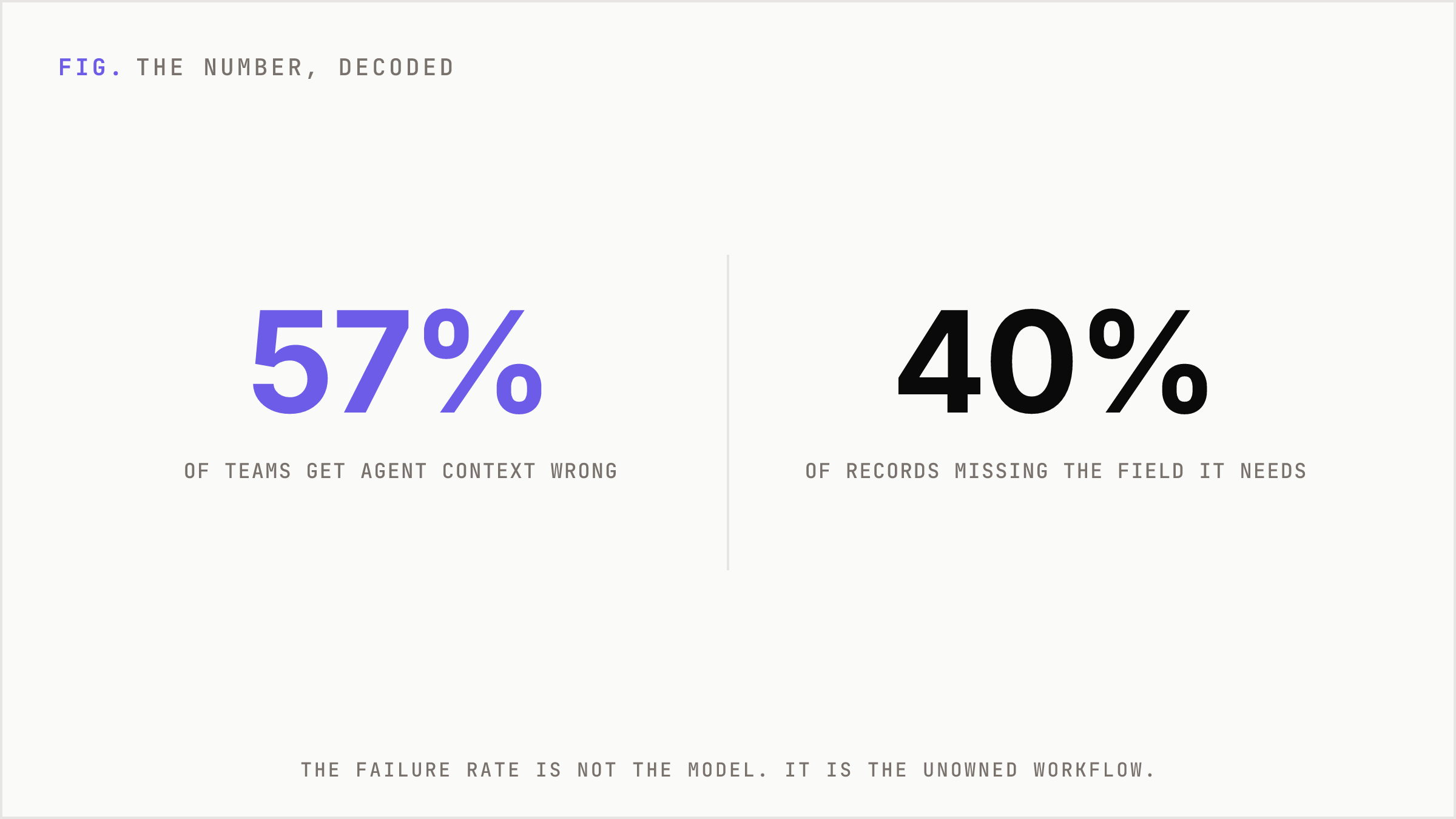
Context is not a prompt trick. Context is an ownership decision about what the system is permitted to assume. Buy an agent without owning the workflow and you have automated your worst guesses, then wired them to a machine that repeats them at speed.
The dominant pattern: buy the agent, skip the redesign
The default move in 2026 is to treat an agent like a hire. You give it a login, a few instructions, and a corner of the process, then wait for it to figure out the rest. Teams assume the model will infer the missing context the way a new employee would over their first month.
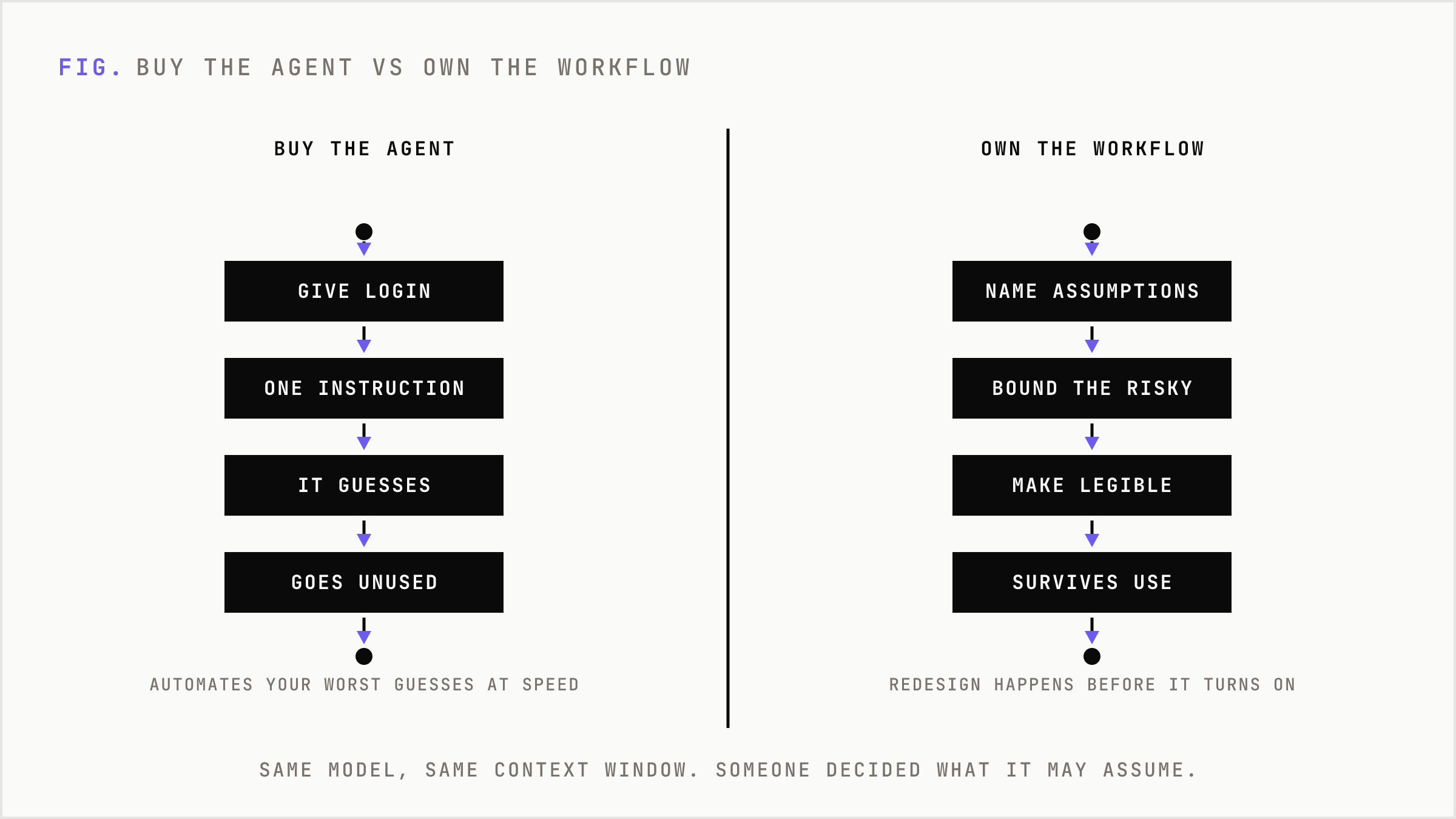
It will not. A human absorbs context by asking the person at the next desk, by reading the room, by noticing that the last three exceptions were all handled a certain way. An agent absorbs whatever you fed it and treats the gaps as settled. Where a person hesitates, the agent commits.
That is why the 57% figure lands the way it does. The same week VentureBeat published it, Towards Data Science ran a piece arguing that teams should redesign work before adding agents. Those two headlines are the same headline. The failures are not scattered model errors. They cluster around the exact spots where nobody decided what the agent should know, so the agent decided for itself.
Confidently wrong, faster
Here is what a 57% context failure actually looks like in a workflow. It is not a crash. A crash would be easy. It is an agent that closes a support ticket because it assumed the refund was already processed. It is an agent that emails the wrong segment because it inherited a stale definition of who counts as active. It is an agent that files a record under last quarter's category because nobody told it the taxonomy changed.
Every one of those is a guess presented as a decision. The agent does not flag its uncertainty, because you never gave it a way to know it was uncertain. It fills the gap with the most plausible assumption and moves on. Multiply that across a few hundred runs a day and the error rate stops being a statistic. It becomes the reason your team no longer trusts the output and quietly goes back to doing the work by hand.
An agent that demos well and gets abandoned is not a smart agent that hit bad luck. It is an unowned workflow that got a faster engine.
The mechanism: own the workflow, then bound the assumptions
The fix is not a bigger context window or better retrieval. Those improve every quarter and they will keep improving. The fix is deciding, before deployment, exactly what the agent is allowed to assume and what it must confirm.
Owning the workflow means three concrete decisions.
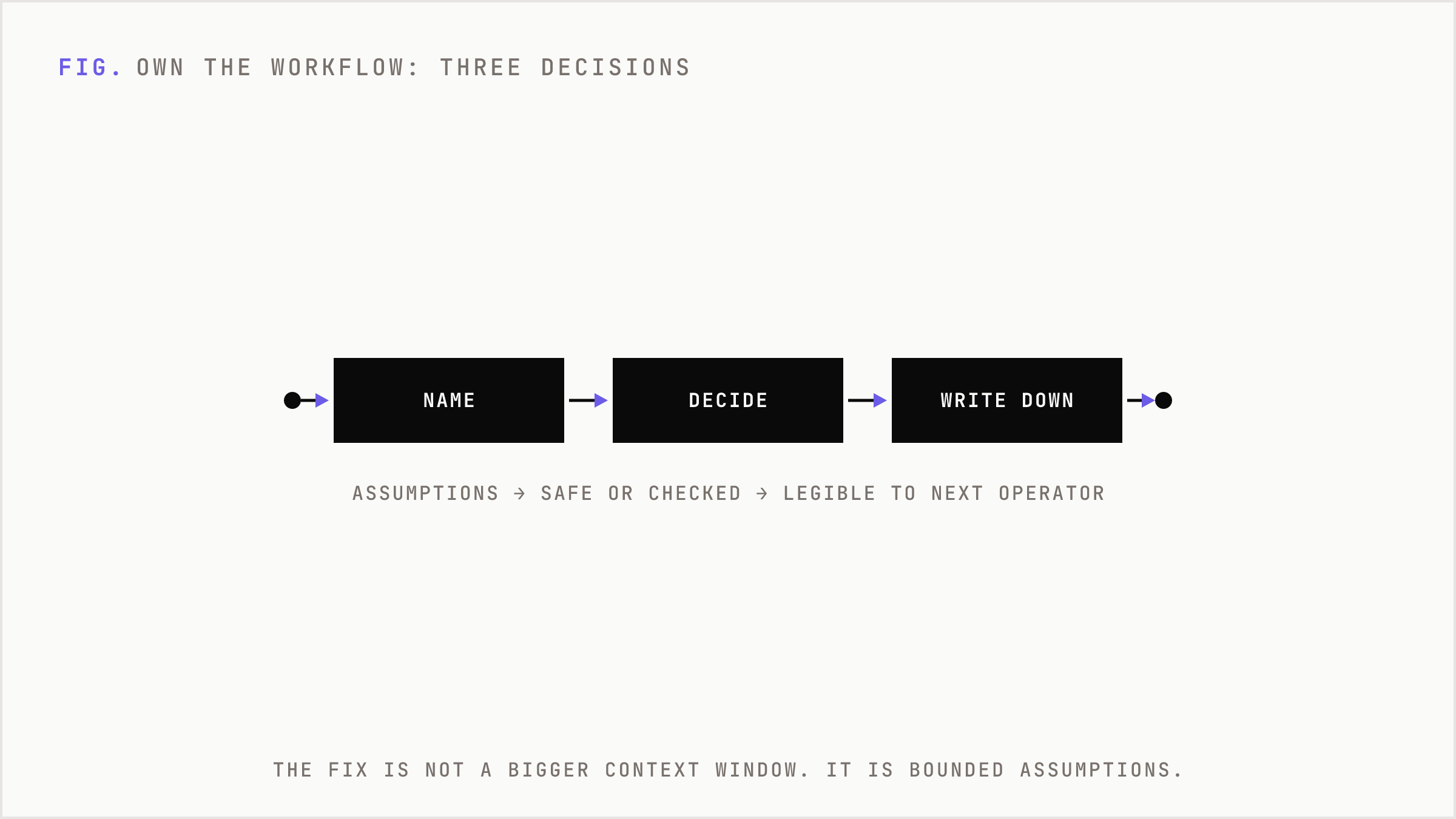
First, name the assumptions. Every place the agent has to guess is a place a human currently uses judgment. Write those down. If your refund agent assumes a ticket means the money moved, that assumption should be a line in the spec, not a surprise in production.
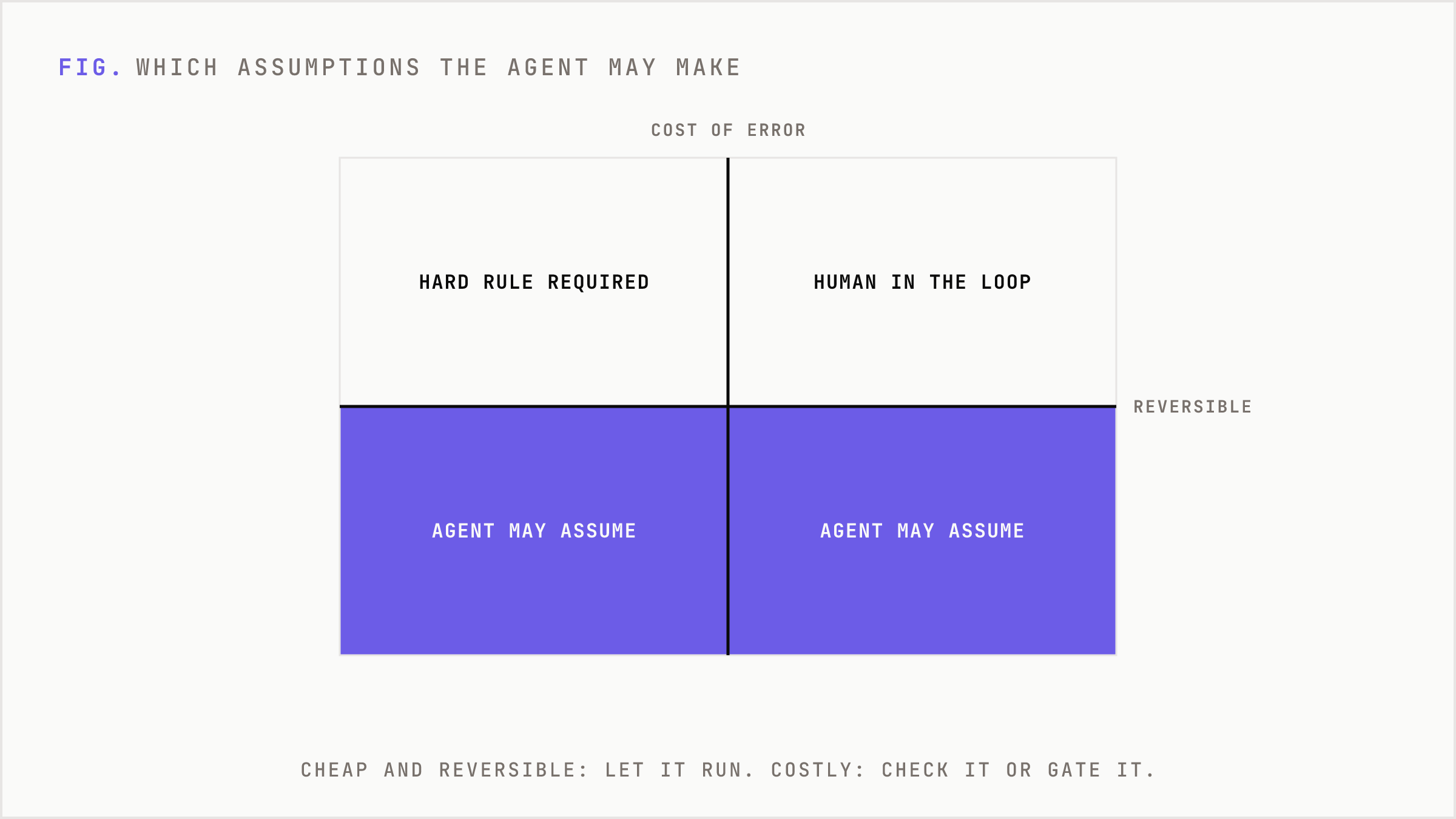
Second, decide which assumptions are safe and which need a check. A safe assumption is one where being wrong is cheap and reversible. An unsafe assumption is one where being wrong costs money, trust, or a customer. Safe assumptions the agent can make. Unsafe ones get a human in the loop or a hard rule.
Third, make the boundaries legible. The person who owns the process after you leave has to be able to see where the agent stops assuming and starts asking. If those boundaries live only in a prompt nobody reads, they will drift the moment reality changes.
Owning the workflow is deciding what the system may assume, checking what it must not, and writing both down where the next operator can find them.
How it works in practice
Take a lead-routing agent, the kind a RevOps team drops in to assign inbound to the right rep. The buy-the-agent version gets a CRM login and a one-line instruction: route leads to the best-fit rep. It runs. It looks fine in the demo. Three weeks later, enterprise leads are going to the SMB team because the agent assumed company size mapped to a field that half the records leave blank.
The owned version starts by naming that exact assumption. Company size drives routing, and company size is missing on 40% of inbound records. That is not a detail the agent should guess. So you decide the rule: if size is present and above the threshold, route to enterprise; if size is missing, the agent does not guess, it enriches from a source you trust or flags for a human. The assumption is now bounded. The failure mode is now visible.
Same model. Same context window. The difference is that someone decided what the agent was allowed to assume before it started assuming. The 57% does not come from the agent. It comes from the 40% of records nobody accounted for.
What changes, what stays, and the honest trade-off
What changes: you stop buying agents as if they were staff and start treating them as the fast engine on top of a process you already control. Deployment gets slower on paper, because the redesign happens before the agent turns on instead of after it breaks. That slower start is the whole return. You are paying up front for the trust you would otherwise lose in month two.
What stays the same: the hard part is still human judgment. Deciding which assumptions are safe, which cost too much to get wrong, and where a person has to stay in the loop is the job. No model does that for you. It decides the tradeoff you specified, at speed, whether or not you specified it well.
The honest trade-off: owning the workflow costs more attention than buying the agent. You cannot outsource the assumption-mapping to the vendor, because the vendor does not know which of your guesses are expensive. If you want the 57% to drop, someone senior has to sit with the process and decide what the system is permitted to believe. That work does not disappear because the tool got smarter. The tool getting smarter just means your unowned guesses run faster.
The counter-argument is that this is a 2025 problem, that context windows and retrieval will close the gap on their own. They will close part of it. A bigger window means the agent can hold more of what you gave it. It cannot hold what you never decided. Retrieval finds documents; it does not tell the agent which stale definition to ignore. Better tools shrink the accidental gaps. The gaps that come from nobody owning the workflow stay exactly where they are.
If you have a problem, if no one else can help, and if you can find them, maybe you can hire Nyyon.