Nyyon · Blog
Targeting Is Dead. Inputs Win: The New Playbook for AI-Driven Growth
AI targeting is now table stakes. Real advantage comes from data quality, creative volume, and signal engineering in a platform-driven ad ecosystem.
Targeting no longer creates advantage. Inputs do.
The Collapse of Targeting as a Differentiator
For a decade, digital advertising revolved around targeting. Agencies sold audience precision as their edge. Better segments meant better performance. That logic no longer holds.
Meta, Google, and TikTok have absorbed targeting into their core systems. Their models train on billions of users, cross app behavior, and continuous feedback loops. No external agency model competes with that data density.
Performance Max, Advantage+, and similar systems do not just assist buying. They replace it. Audience selection is now a suggestion layer at best.
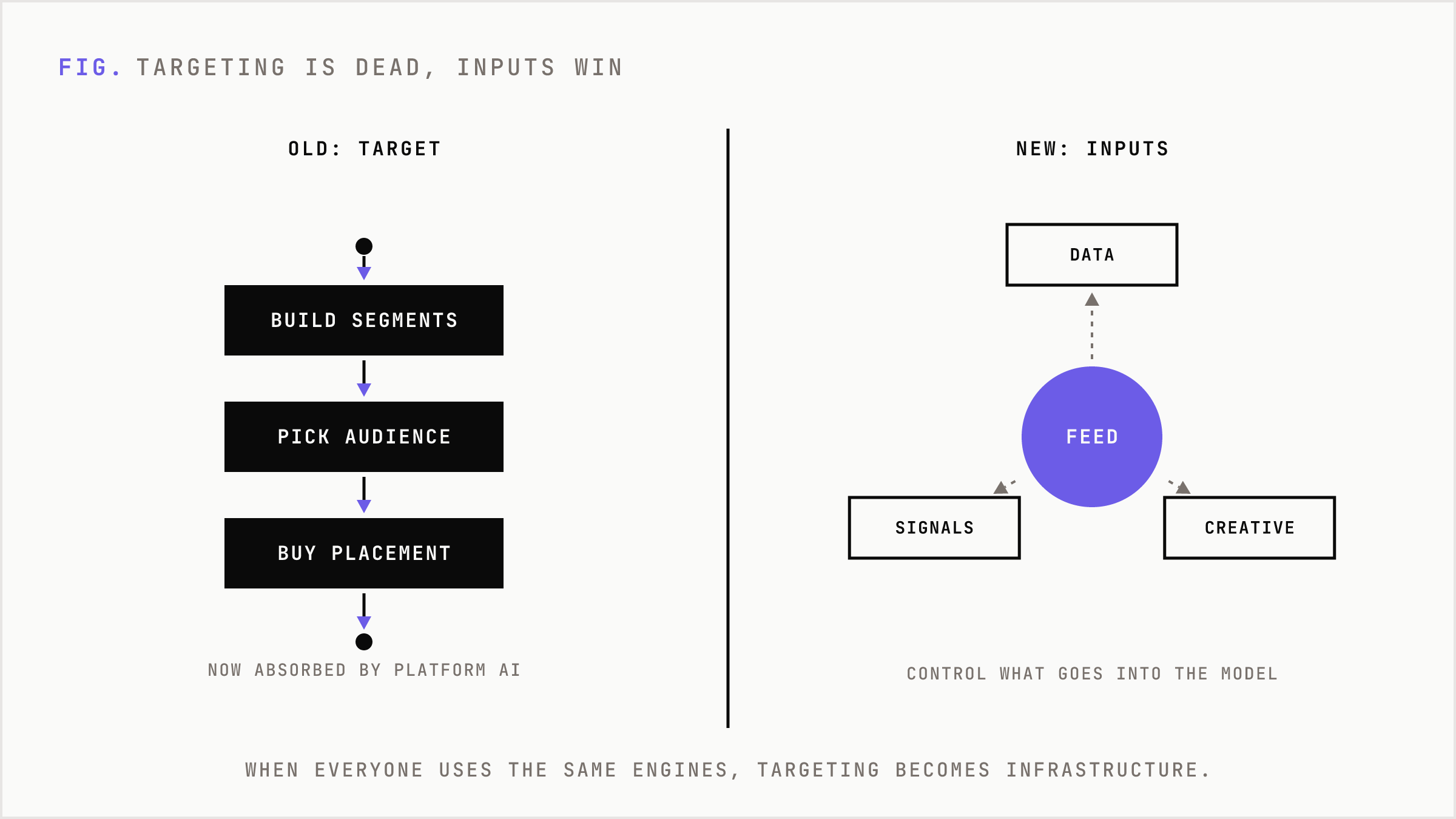
This creates a market reset. When everyone uses the same optimization engines, targeting stops being a lever. It becomes infrastructure.
The Three Types of Agencies
The industry has quietly split into three operating models.
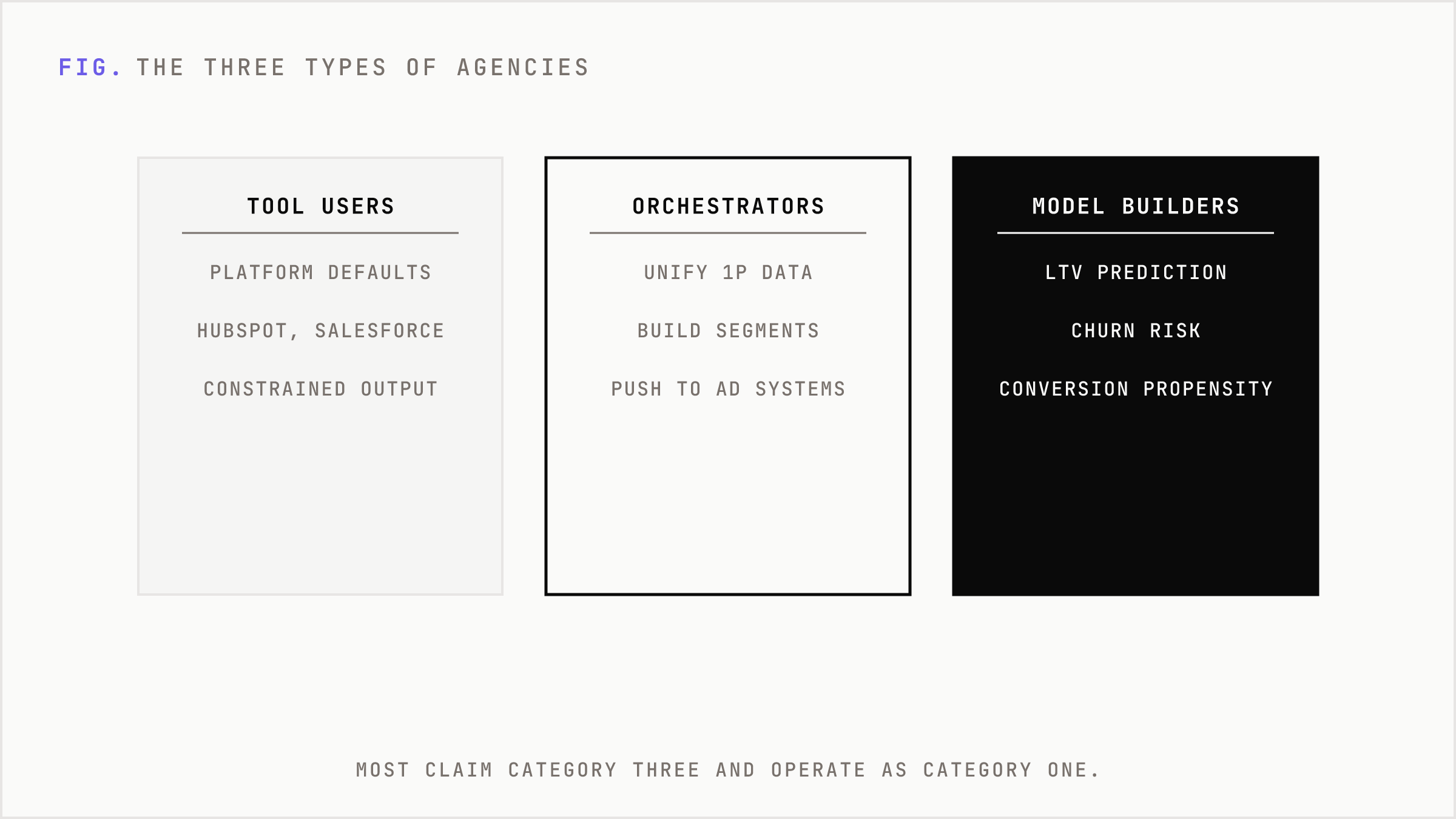
Tool users rely on platform defaults. They run campaigns inside Meta and Google, layer in tools like HubSpot or Salesforce, and call it AI. Their output is constrained by what platforms expose.
Data orchestrators go one level deeper. They unify first party data, create segments, and push those into ad systems. They improve inputs but do not fundamentally change the model.
Model builders are rare. They train proprietary models on client data such as LTV prediction, churn risk, and conversion propensity. This is where differentiation starts, but only when paired with clean data and consistent activation.
Most agencies claim category three and operate as category one.
Platform AI Has Already Won
There is a structural reason targeting moved upstream. Platforms have the data and the feedback loops.
Every impression, click, scroll, and purchase feeds back into their models. They see both intent and outcome across millions of advertisers simultaneously. External systems operate on fragments.
As a result, platform AI consistently outperforms handcrafted targeting strategies. The gap widens over time because the training data compounds.
This changes the question from “who should we target” to “what signals are we feeding the system.”
Inputs Are the New Control Surface
If you cannot beat the model, you control what goes into it.
There are three input layers that now determine performance.
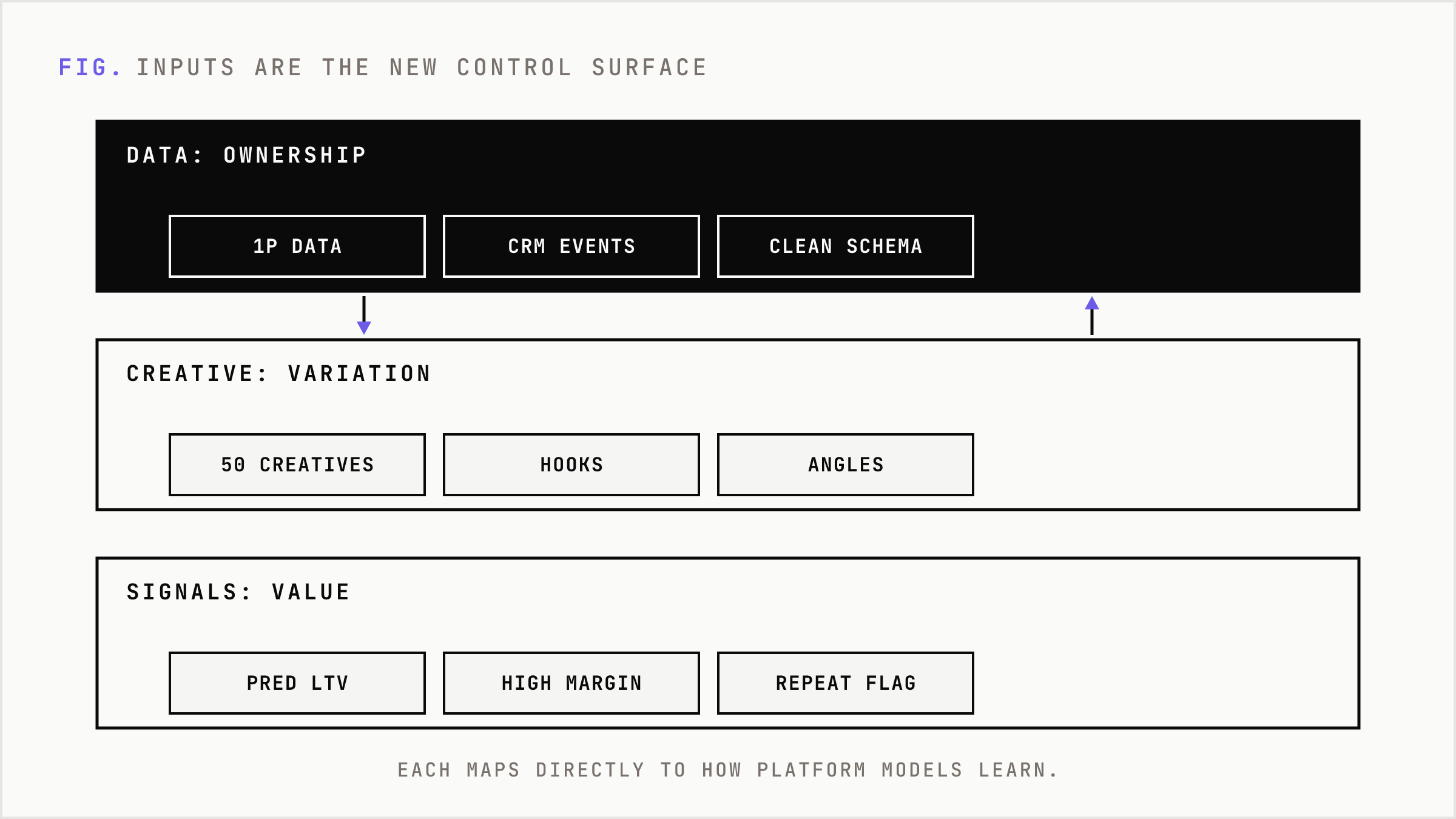
Data. Creative. Signals.
Each maps directly to how platform models learn.
Data: Ownership Over Access
First party data is no longer optional. It is the core asset.
Email lists, purchase history, site behavior, and CRM events are the raw material for optimization. They seed lookalikes, anchor attribution, and define value.
In a post cookie environment, this data replaces third party targeting entirely.
But ownership alone is not enough. Structure matters.
Most datasets are unusable in practice. Missing identifiers, inconsistent schemas, and event duplication break downstream models. This is why many predictive initiatives fail before they start.
Teams that win treat their data layer as product infrastructure. CDPs like Segment or mParticle become central, not auxiliary. Events are versioned, validated, and mapped to business outcomes.
Clean data does not just improve reporting. It improves model behavior.
Creative: The New Targeting Layer
Creative has absorbed the role targeting used to play.
Platforms now match ads to users automatically. The lever is no longer who sees the ad, but which version they see.
This shifts strategy from segmentation to variation.
Instead of building five audiences, high performing teams build fifty creatives. Different hooks, formats, offers, and tones. The system routes each to the right micro audience.
This is not a branding exercise. It is a distribution strategy.
For example, a DTC brand launching a new product might test 30 short form videos across angles like price sensitivity, premium positioning, and problem awareness. Meta’s system learns which users respond to which angle and scales accordingly.
The targeting happens implicitly through creative selection.
Signals: Teaching the Model What Matters
Signals are the most under leveraged input.
Conversion APIs, enhanced conversions, and event prioritization directly shape how models optimize. They tell the system what success looks like.
Most accounts still optimize for shallow events like purchases or leads without context.
High performing teams push richer signals. Predicted LTV, high margin purchases, or repeat customer flags. They filter out noise and emphasize value.
This changes optimization behavior. Instead of chasing cheap conversions, the system learns to pursue profitable ones.
The difference shows up in payback periods and retention curves, not just CPA.
Predictive Segmentation Is the Real Frontier
Segmentation is not dead. It has moved from static definitions to probabilistic models.
The highest value segments today are predictive.
Who is likely to convert in the next seven days. Who will generate high lifetime value. Who is at risk of churning.
These are not derived from rules. They are inferred from patterns across data.
Importantly, most marketing datasets do not require deep learning. Gradient boosting and random forest models outperform more complex approaches in many cases. They are faster to train, easier to debug, and work well with structured data.
The constraint is not modeling technique. It is data quality.
Without consistent event tracking and historical depth, predictions collapse into noise. This is why predictive segmentation remains underutilized despite being widely discussed.
Why Most “AI Agencies” Look the Same
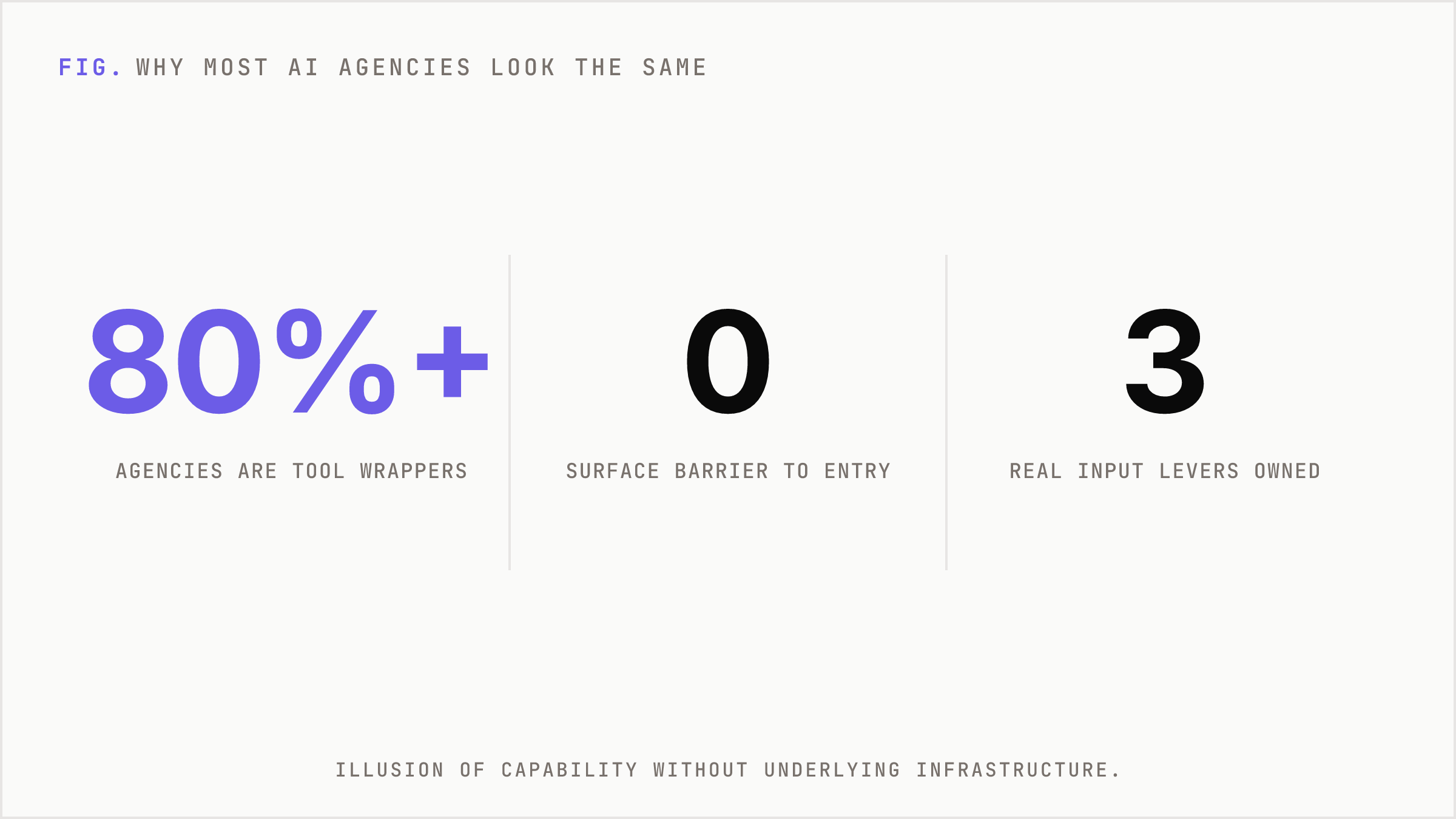
The barrier to entry for AI marketing has dropped to zero at the surface level.
Anyone can generate copy with ChatGPT, images with diffusion models, and campaigns with platform automation.
This creates the illusion of capability without underlying infrastructure.
In practice, over 80 percent of agencies operate as wrappers around existing tools. They do not control data pipelines. They do not own models. They do not influence signal flow.
As a result, their output converges.
Clients see similar performance across vendors because the underlying systems are identical.
Where Real Advantage Still Exists
There are still defensible positions in this market, but they look different.
Owning a vertical dataset is one. Agencies focused on a specific industry accumulate structured data across clients. This creates benchmarking and pattern recognition that generalists cannot match.
Cross client learning loops are another. Insights from one account inform others. Creative patterns, pricing sensitivity, and funnel dynamics become transferable assets.
Speed is the third lever. Teams that can iterate creative, landing pages, and offers quickly generate more learning per dollar spent. This compounds into better model performance.
None of these advantages come from targeting.
The Limits of the Current System
Despite improvements, platform driven targeting has real constraints.
Cold start remains a problem. Without historical data or strong signals, models struggle to find efficient audiences.
There is also a bias toward existing customers. Systems optimize toward what has worked, which can limit expansion into new segments.
Opacity is another issue. When performance drops, debugging is difficult because decision making is abstracted away.
Finally, most systems over optimize for short term conversions. Long term value requires explicit signal design.
These are not edge cases. They define the operating environment.
What This Means for Budget and Teams
Budget allocation is shifting from media buying to input production.
More spend moves into creative generation, data engineering, and tracking infrastructure. Less goes into manual optimization.
Team structures follow. Media buyers become system operators. Data engineers and creative strategists gain leverage.
The workflow changes from campaign setup to continuous input refinement.
This is closer to product development than traditional advertising.
The Next Phase: Simulation and Autonomy
Emerging capabilities point to where this is going.
Synthetic audiences allow teams to test strategies before spending real budget. AI generated personas built from CRM data help simulate responses to creative.
Probabilistic attribution models are replacing last click frameworks, giving a more accurate view of incremental impact.
Autonomous media buying agents are developing, but remain unreliable. They will likely handle execution, not strategy, in the near term.
In all cases, the common thread is not better targeting. It is better system design.
The Strategic Shift
The industry is moving from audience selection to input optimization.
This is not a tactical change. It is a shift in where value is created.
Companies that treat data as infrastructure, creative as a testing system, and signals as strategic inputs will outperform those that rely on platform defaults.
The platforms will keep getting better at targeting. That layer is effectively commoditized.
The only remaining question is what you feed them.
FAQ
Is ad targeting completely obsolete?
No, but it is no longer a primary lever. Platforms handle most targeting automatically, so performance depends more on inputs like data quality, creative, and signals.
What is the most important asset for modern marketing teams?
First party data is the most valuable asset. Clean, structured customer data enables better optimization, stronger signals, and more effective model training.
Why is creative now considered targeting?
Platforms match different creatives to different users automatically. By producing varied creative, advertisers effectively reach different segments without manual targeting.
Do companies need custom machine learning models?
Not always. Many gains come from better data and signal engineering. However, predictive models like LTV or churn scoring can create an edge when built on high quality data.
What should companies invest in instead of targeting tools?
They should invest in data infrastructure, creative production systems, and tracking capabilities like conversion APIs to improve the inputs feeding platform AI.