Nyyon · Blog
ROAS Is Not the Truth
ROAS is not incrementality. Learn how leaders can build governed marketing measurement around clean metrics, causal tests, AI, and budget decisions.
ROAS is not the truth. It is a platform receipt for a version of reality that may or may not have caused growth.
That distinction is now expensive.
For a decade, marketing teams bought software that made measurement feel precise. Dashboards got faster. Attribution windows got configurable. Campaign managers learned to stare at channel ROAS as if it were a cash flow statement. Founders asked for the number. Investors asked for the blended number. Agencies optimized to the number.
Then the number started lying in more visible ways.
Privacy changes weakened user-level tracking. Walled gardens got stronger. Retail media grew. Channels duplicated credit. AI made reporting cheaper and more fluent. The screen became more confident while the causal signal became less stable.
The result is a market full of teams with more dashboards than decisions.
The ROAS Trap
ROAS answers a narrow question: how much attributed revenue did a platform connect to ad spend under its own rules?
It does not answer the question a CEO cares about: what revenue would have disappeared if we had not spent the money?
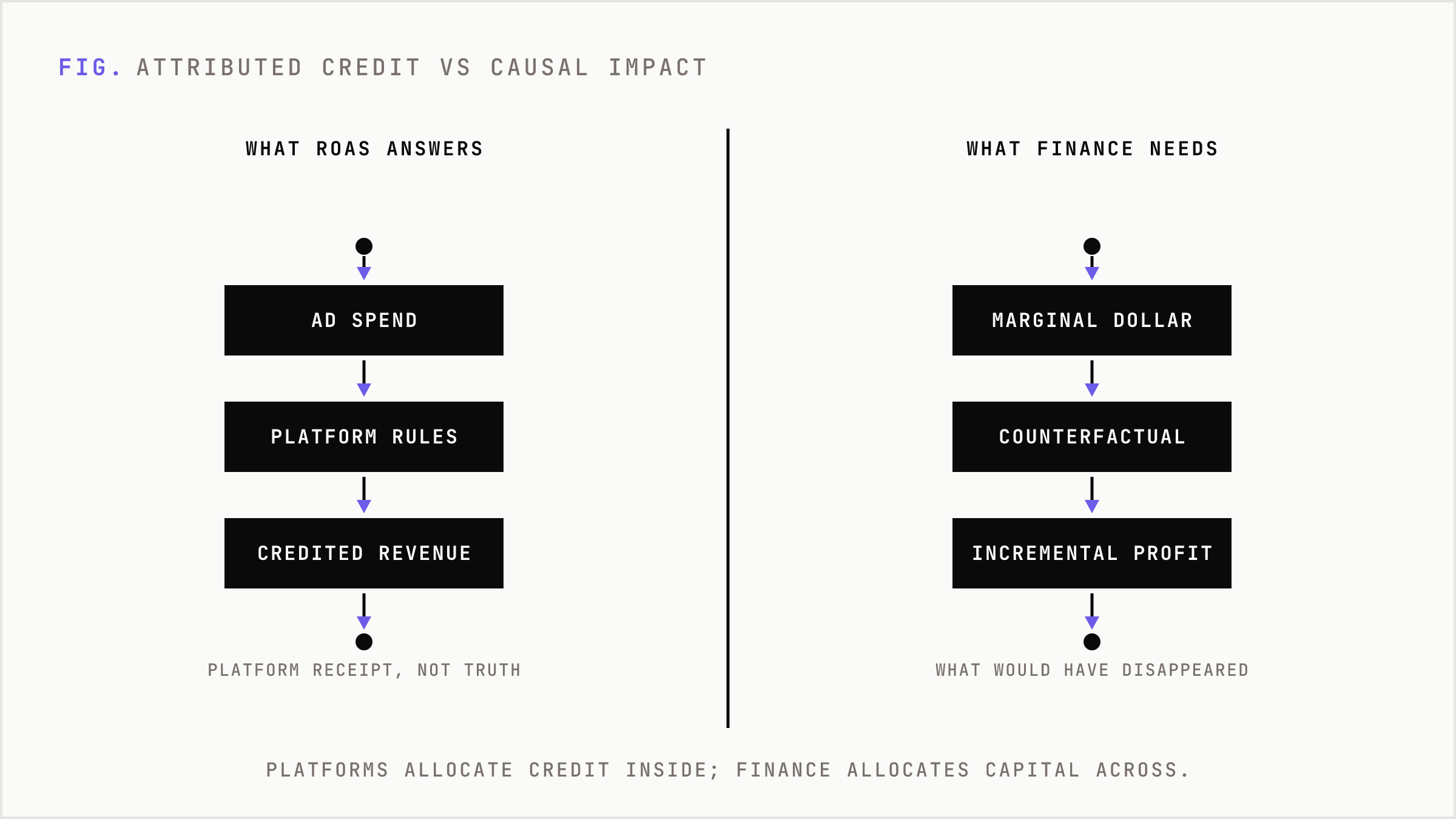
That gap is the whole game.
If a customer searches for your brand after seeing a podcast ad, Google brand search may claim the conversion. If a loyal customer clicks a retargeting ad before buying again, the ad platform may count the order. If Meta, Google, TikTok, affiliate, and email all touch the same buyer, each system can report performance that looks rational inside its own boundary and impossible in aggregate.
This is not fraud. It is incentive design.
Platforms are built to allocate credit inside the platform. Finance has to allocate capital across the company. Those are different jobs.
ROAS is useful for tactical diagnostics. It can show creative decay, audience saturation, landing page problems, or channel-level changes. It is weak evidence for incrementality. It is especially weak in bottom-funnel channels where demand already exists.
The dangerous move is treating attributed efficiency as causal impact.
Marketing Measurement Is a Capital Allocation System
Most companies talk about measurement as analytics. Better companies treat it as capital allocation.
A marketing budget is not a content calendar with dollars attached. It is a portfolio of bets against buyer behavior. Some bets create new demand. Some capture existing demand. Some accelerate purchase timing. Some defend against competitors. Some produce no incremental value but look good because the buyer was already coming.
The measurement system should separate these effects.
That matters because different budget lines have different jobs. Brand spend may expand the future pool of buyers. Paid search may harvest existing intent. Paid social may create demand or chase warm audiences depending on targeting. Retargeting may be useful at small scale and deceptive at large scale. Affiliate may introduce new buyers or tax organic demand. Promotions may lift short-term conversion while training customers to wait.
A single ROAS number flattens all of that into false comparability.
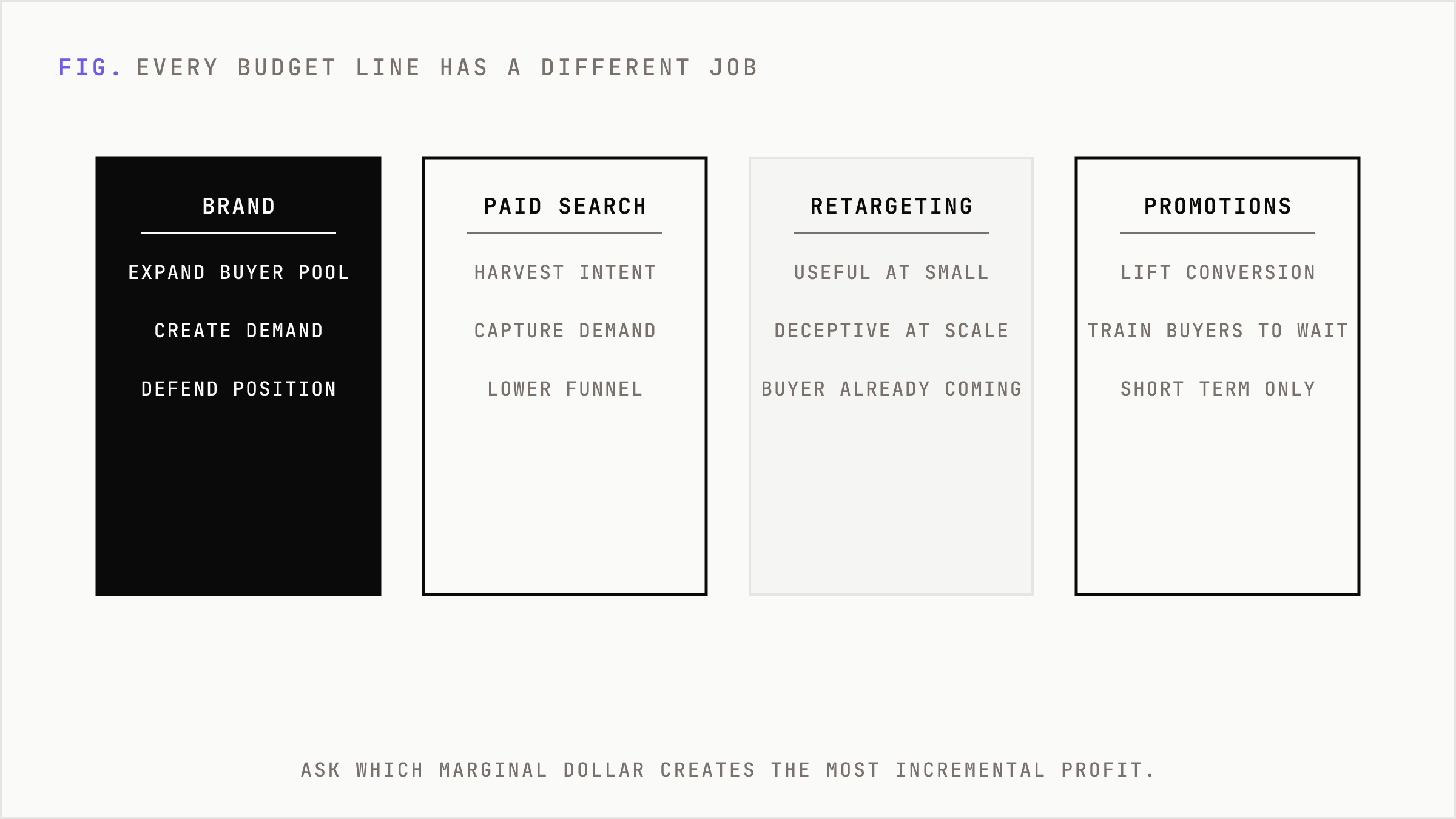
The better question is not which channel has the highest ROAS. The better question is which marginal dollar creates the most incremental profit under current constraints.
That question forces the team to define the buyer, the action, the counterfactual, and the decision threshold.
Start With the Decision
Bad measurement starts with data. Strong measurement starts with a decision.
Not: analyze our campaigns.
Ask this instead: should we move the next 50000 dollars from branded search to prospecting, and what evidence would justify the move?
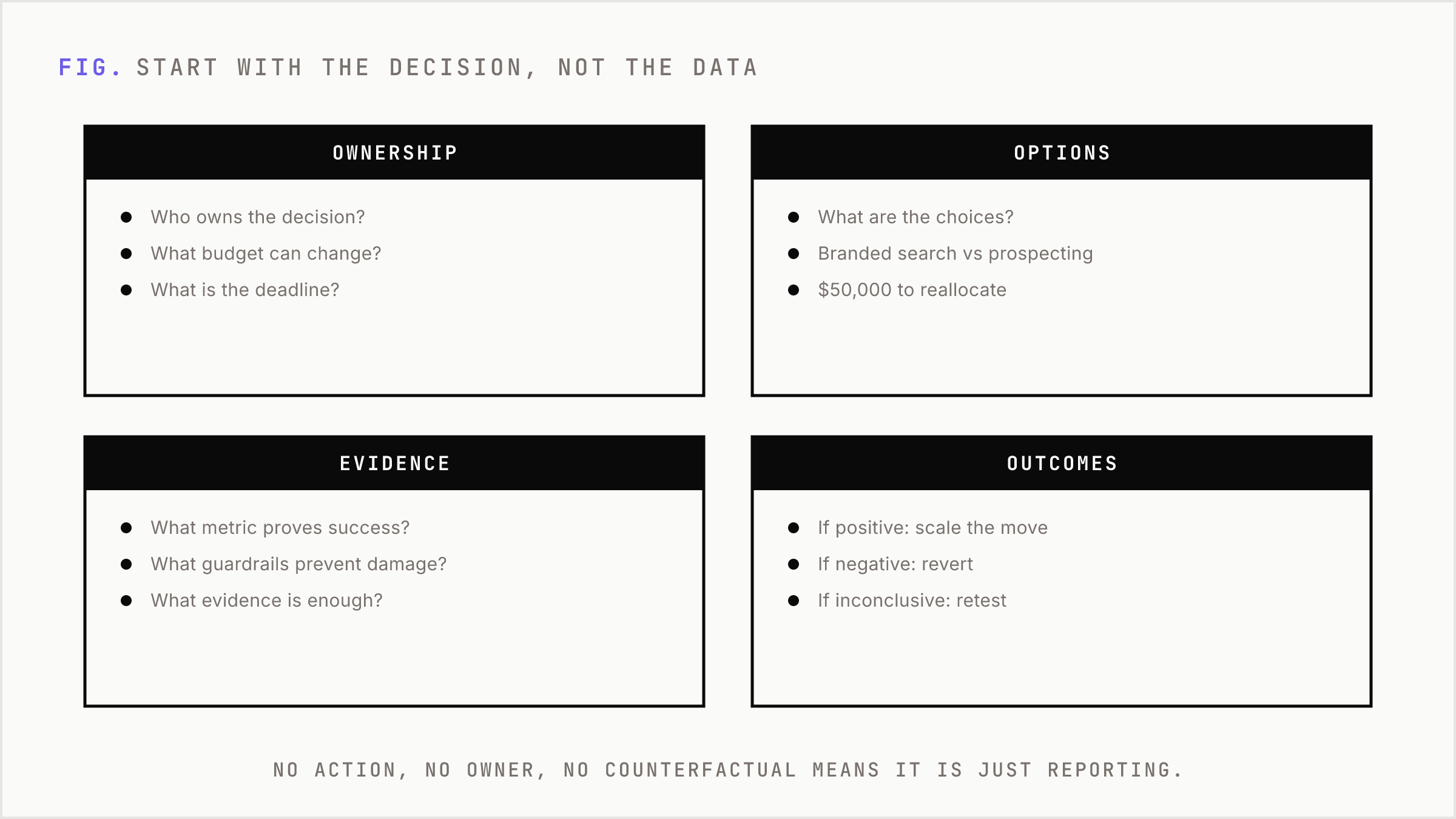
That question has structure. It has an owner. It has a budget line. It has options. It has a deadline. It has a success metric. It has a negative case.
The operating fields are simple:
- Who owns the decision?
- What budget or workflow can change?
- What are the options?
- What metric proves success?
- What guardrail metrics prevent damage?
- What evidence is enough?
- What happens if the result is positive?
- What happens if it is negative?
- What happens if it is inconclusive?
If no action changes, it is reporting. If no counterfactual exists, it is usually correlation. If no owner exists, the insight dies in a slide deck.
This is why better data analysis is not a dashboard problem. It is a decision architecture problem.
Attribution, Incrementality, and MMM Are Not Substitutes
The modern measurement stack needs three different instruments.
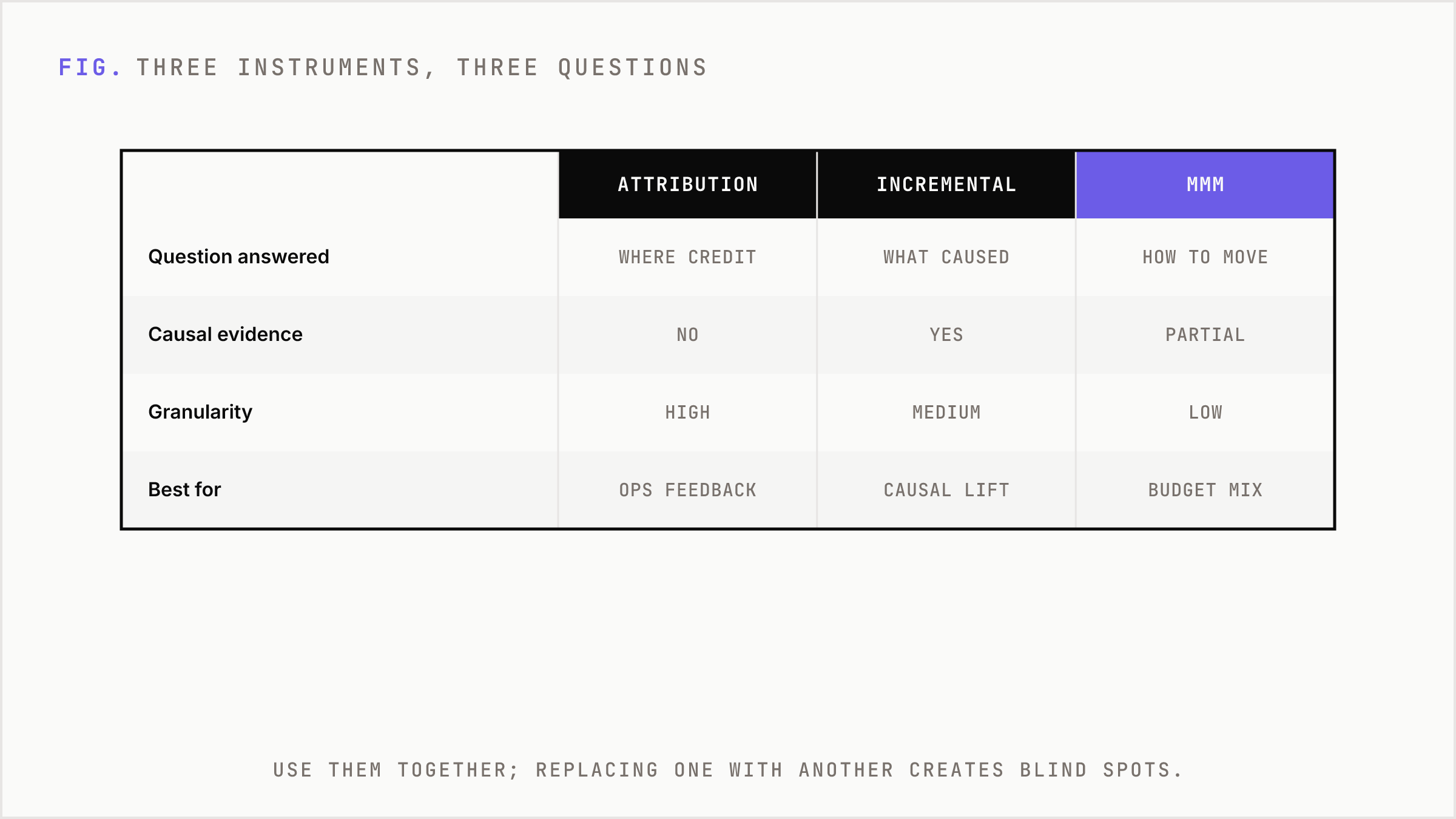
Attribution is useful for operational feedback. It helps teams see which ads, audiences, keywords, pages, or offers are associated with conversion. It is fast. It is granular. It is also biased toward visible, trackable, lower-funnel behavior.
Incrementality measures causal lift. It asks what changed because the intervention happened. The cleanest version is a randomized experiment, such as a holdout group that does not receive the ad. In practice, teams also use geo tests, matched-market tests, difference-in-differences, synthetic controls, and other methods when randomization is difficult.
Marketing mix modeling, or MMM, estimates the relationship between spend and outcomes over time across channels, while accounting for factors like seasonality, pricing, promotions, and distribution. It is not magic. It needs good inputs and disciplined interpretation. But it is valuable for budget allocation when user-level attribution is incomplete.
These tools answer different questions.
- Attribution: where did credited conversions appear?
- Incrementality: what did the marketing actually cause?
- MMM: how should the budget move across channels and time?
Confusing them creates bad decisions. Replacing one with another creates blind spots. A serious measurement system uses them together.
The Counterfactual Is the Product
The most important sentence in marketing analytics is: compared to what?
A campaign grew revenue 18 percent. Compared to what? A market that was already growing 20 percent?
A channel produced a 5x ROAS. Compared to what? A holdout group that bought anyway?
A new creative lowered CAC. Compared to what? A different audience mix? A promotion? A seasonal surge?
Without the counterfactual, the analysis is just a description of the world after money was spent.
This is where many teams break. They want causal answers from non-causal workflows. They ask dashboards to do the job of experiments. They ask platform reporting to make budget decisions. They ask AI to summarize tables that were never fit for the decision.
Better teams build for counterfactuals in advance.
They reserve holdouts. They run geo tests. They check sample size before launching. They define the minimum detectable effect. They choose guardrails. They predefine the decision rule. They run A/A tests to make sure the testing setup is not producing fake lift. They log what was expected and what happened.
This is not academic purity. It is cheaper than scaling the wrong thing.
Data Quality Is Not a Back-Office Issue
There is no advanced analytics layer that survives bad definitions.
If finance, sales, and marketing use different revenue numbers, every growth meeting becomes a negotiation. If CAC means blended CAC in one deck, paid CAC in another, and platform CPA in a third, the company does not have a CAC metric. It has a vocabulary problem.
Data quality is usually described in technical terms: accuracy, completeness, consistency, timeliness, validity, uniqueness. Those matter. But the commercial issue is sharper. Can the company trust the metric enough to move money, people, or roadmap?
That requires a metric contract.
Every important metric should have a name, definition, formula, owner, source, refresh rate, grain, exclusions, caveats, approved use cases, and forbidden use cases. Revenue cannot shift between booked revenue, recognized revenue, gross revenue, net revenue, and cash collected depending on who is presenting. Churn cannot mean logo churn in customer success and revenue churn in finance without disclosure.
The semantic layer is not plumbing. It is the control surface for decision quality.
It becomes even more important with AI.
AI Makes the System Faster, Not Truer
Generative AI is already useful in analytics workflows. It can draft SQL, explain code, generate data dictionaries, flag anomalies, compare metric definitions, summarize verified outputs, and help nontechnical operators ask better questions.
It can also fabricate confidence.
An AI system connected to messy events, conflicting metric definitions, and no lineage will not become a strategic analyst. It will become a faster interface to confusion. It will produce clean sentences over dirty assumptions.
This matters because the near-term substitution dynamic is not AI replacing the CMO. It is AI replacing low-leverage analyst labor inside a governed workflow. Query writing gets cheaper. Dashboard QA gets faster. Narrative reporting gets compressed. Hypothesis generation improves. But causal judgment, metric governance, and budget accountability remain human and organizational responsibilities.
The winning pattern is AI as analyst infrastructure, not analyst authority.
Give AI a governed semantic layer, approved definitions, known caveats, reproducible outputs, and decision context. Then it can compress work. Without that foundation, it amplifies noise.
The Workflow Has to Change
Most marketing teams run a familiar loop.
Spend money. Pull dashboards. Debate attribution. Make a budget move. Repeat.
That loop is too weak for the next market.
The stronger loop looks like this:
- Define the decision and budget action.
- Map the metric and guardrails.
- Check data quality and definitions.
- Select the method: descriptive, diagnostic, predictive, causal, or prescriptive.
- Design the test or model around a counterfactual.
- Set the decision threshold before reading results.
- Make the recommendation with uncertainty.
- Log the decision taken.
- Measure the actual result.
- Update the model and the next decision.
This is the difference between analysis as a service desk and analysis as an operating system.
The service desk answers questions. The operating system improves decisions.
What Investors Should Look For
For investors, the measurement stack is a signal of operating maturity.
A company that scales spend on platform ROAS alone may be buying reported growth, not incremental growth. A company that cannot reconcile revenue definitions across teams will struggle to diagnose unit economics. A company with no holdout discipline may overestimate channel efficiency and underinvest in demand creation. A company that uses AI on top of ungoverned data may report faster and learn slower.
The diligence questions should be practical:
- Which metrics are canonical?
- Who owns each metric?
- How is CAC defined?
- How is payback calculated?
- Which channels have been tested for incrementality?
- How often does the budget shift based on causal evidence?
- What decisions did the analytics team change last quarter?
- Where did the company stop spending because the evidence failed?
The last question is the tell. Real measurement kills bad spend.
The Long Game
The market is moving from reporting tools to decision systems.
The first wave of marketing analytics helped teams see what happened. The second wave helped teams attribute what happened. The next wave will help teams decide what to do, with evidence thresholds, governed metrics, causal measurement, AI assistance, and memory.
That shift expands the market because it moves analytics closer to the budget. Dashboards are a software expense. Decision systems attach to media spend, headcount, pricing, product, and growth strategy. The economic surface area is larger.
Founders should care because the buyer is changing. The buyer does not need another chart. The buyer needs fewer unproductive meetings, cleaner budget moves, better confidence under uncertainty, and a system that learns from outcomes.
The companies that win will not be the ones with the most data. They will be the ones that know what evidence is enough to act.
ROAS still has a job. It is a useful instrument panel. It is not a source of truth. It is not incrementality. It is not strategy.
The question is no longer whether marketing can produce numbers. It can produce too many.
The question is whether those numbers can change the next dollar.
FAQ
Is ROAS still useful?
Yes. ROAS is useful for tactical diagnostics, such as spotting creative fatigue, keyword shifts, and campaign execution issues. It should not be treated as proof of incremental growth.
What is the difference between ROAS and incrementality?
ROAS measures attributed revenue against spend inside a reporting system. Incrementality estimates what results were caused by the marketing that would not have happened otherwise.
Do companies need attribution, MMM, and experiments?
Most mature marketing teams need all three. Attribution supports tactical optimization, experiments measure causal lift, and MMM helps guide budget allocation across channels and time.
How does AI fit into marketing measurement?
AI can speed up SQL, QA, anomaly detection, summaries, and hypothesis generation. It should operate on governed data with clear metric definitions and human review.
What is the first step toward better measurement?
Start with one high-value budget decision. Define the owner, options, metric, guardrails, evidence threshold, and action plan before looking at the data.