Nyyon · Blog
The Rise of AI Native Agencies and Why Most Marketing Teams Are Already Behind
AI native agencies are redefining marketing with closed loop systems, autonomous execution, and LLM visibility. Most teams are already structurally behind.
AI native agencies are not better agencies. They are a different category entirely.
The Definition Everyone Gets Wrong
Most teams think adding AI tools makes them AI driven. It does not.
An AI powered agency uses models inside human workflows. Copywriters prompt. Analysts interpret dashboards. Media buyers adjust budgets.
An AI native agency flips that structure. The model is the workflow.
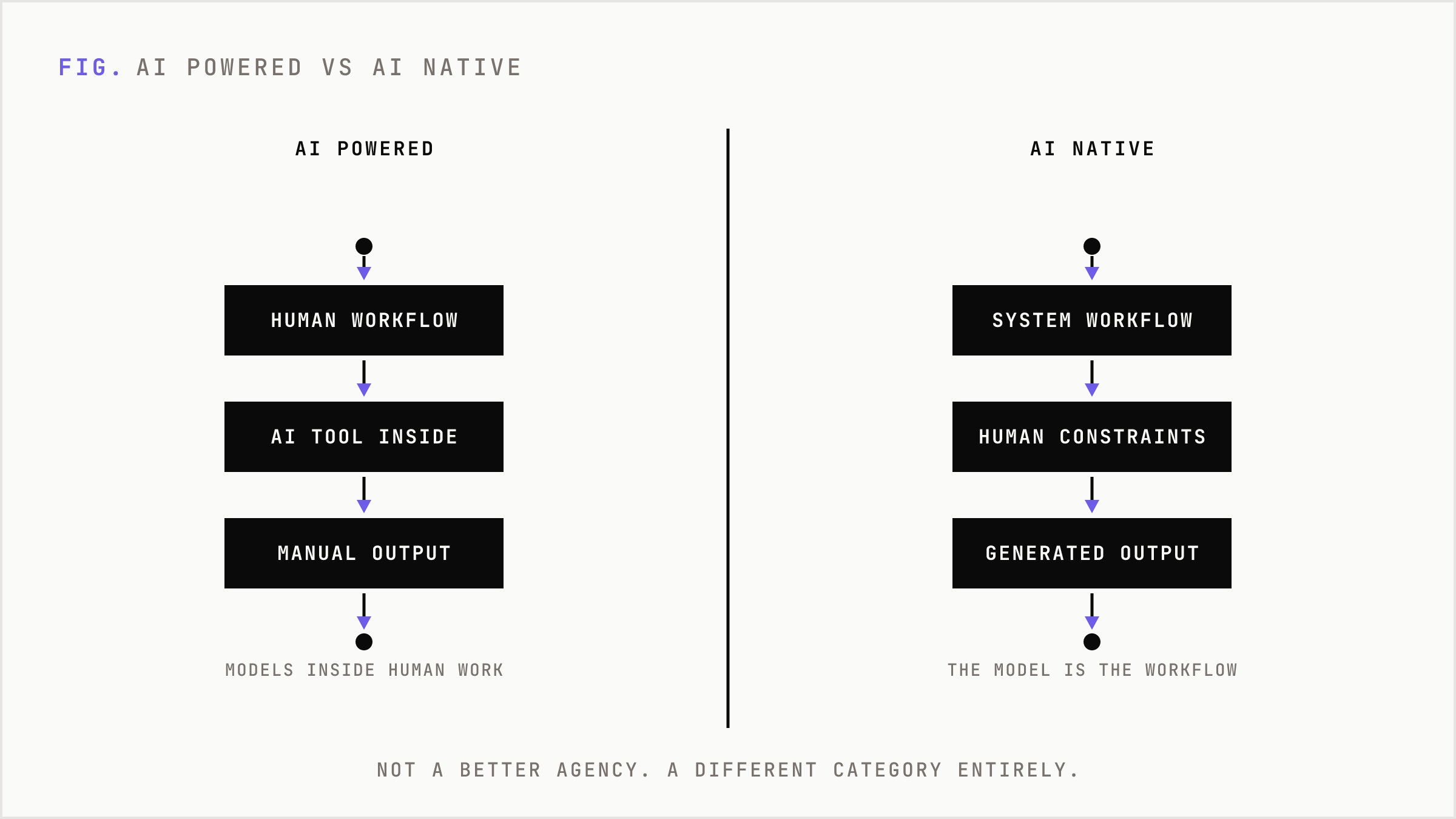
Strategy, execution, and measurement are generated, deployed, and refined by systems. Humans supervise constraints, not output.
This distinction is not semantic. It determines cost structure, speed, and long term defensibility.
What AI Native Actually Looks Like
The easiest way to see the difference is at the task level.
Take creative production. A traditional team produces five to ten variants, tests them, and iterates manually. Even with AI tools, the workflow is still batch based and human paced.
An AI native system generates hundreds or thousands of variants, deploys them automatically, measures performance in real time, and retrains on results. No campaign reset. No manual loop.
Omneky operates close to this model. Creative is not an asset. It is a continuous output of a system tied directly to performance data.
Creatify pushes further. Input a URL, output a set of video ads. No creative brief, no production pipeline, no traditional handoff between roles.
These are not efficiency gains. They remove entire layers of workflow.
The Shift From Campaigns to Systems
Most marketing teams still think in campaigns. Defined start, defined budget, defined assets.
AI native agencies operate continuous systems.
There is no start or end. There is only a loop.
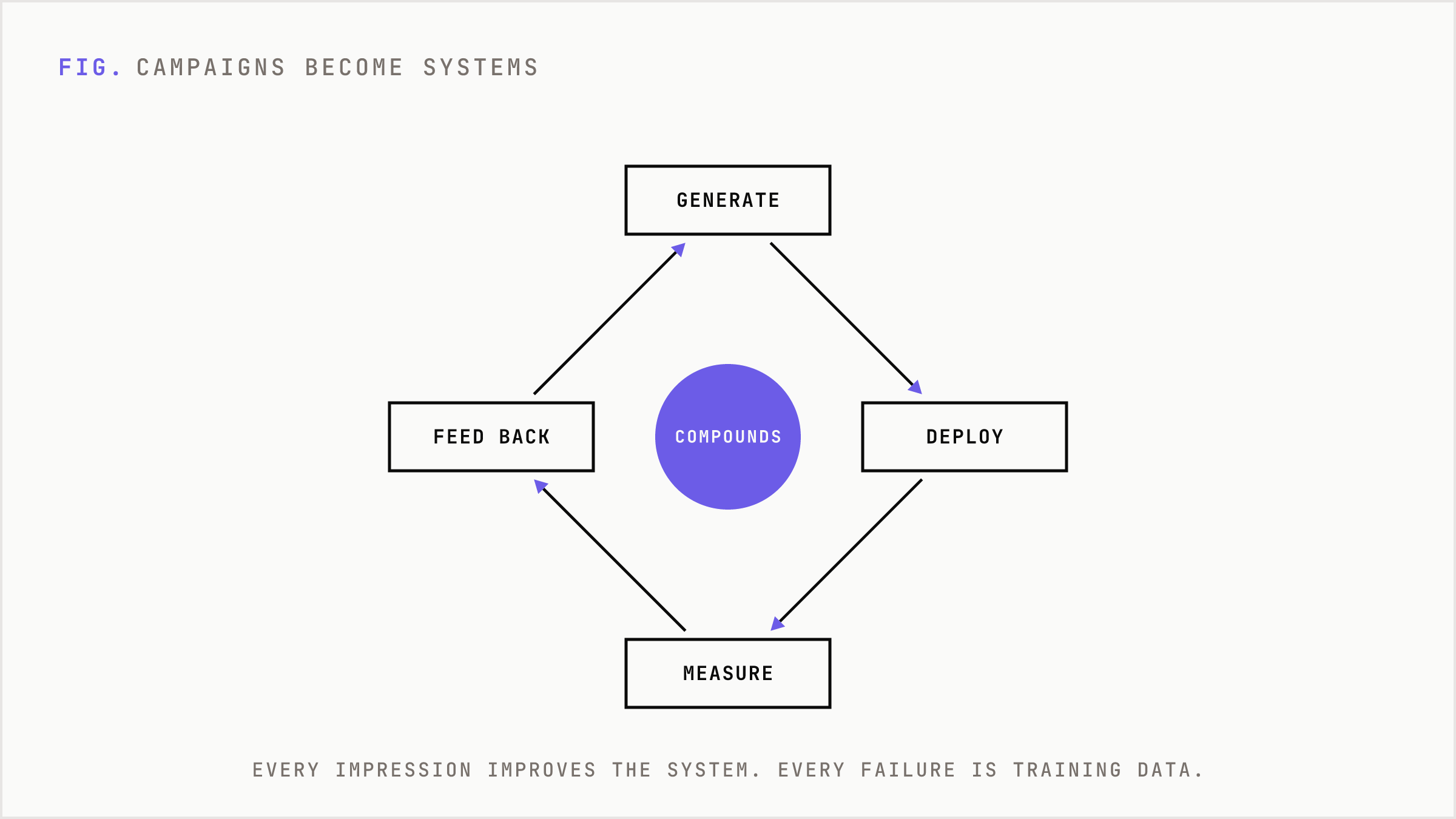
- Generate assets
- Deploy across channels
- Measure performance
- Feed data back into models
This loop compounds.
Every impression improves the system. Every conversion sharpens targeting. Every failure becomes training data.
In a campaign model, data is used for reporting. In a system model, data is used for evolution.
Why Most Agencies Are Structurally Behind
The problem is not awareness. It is architecture.
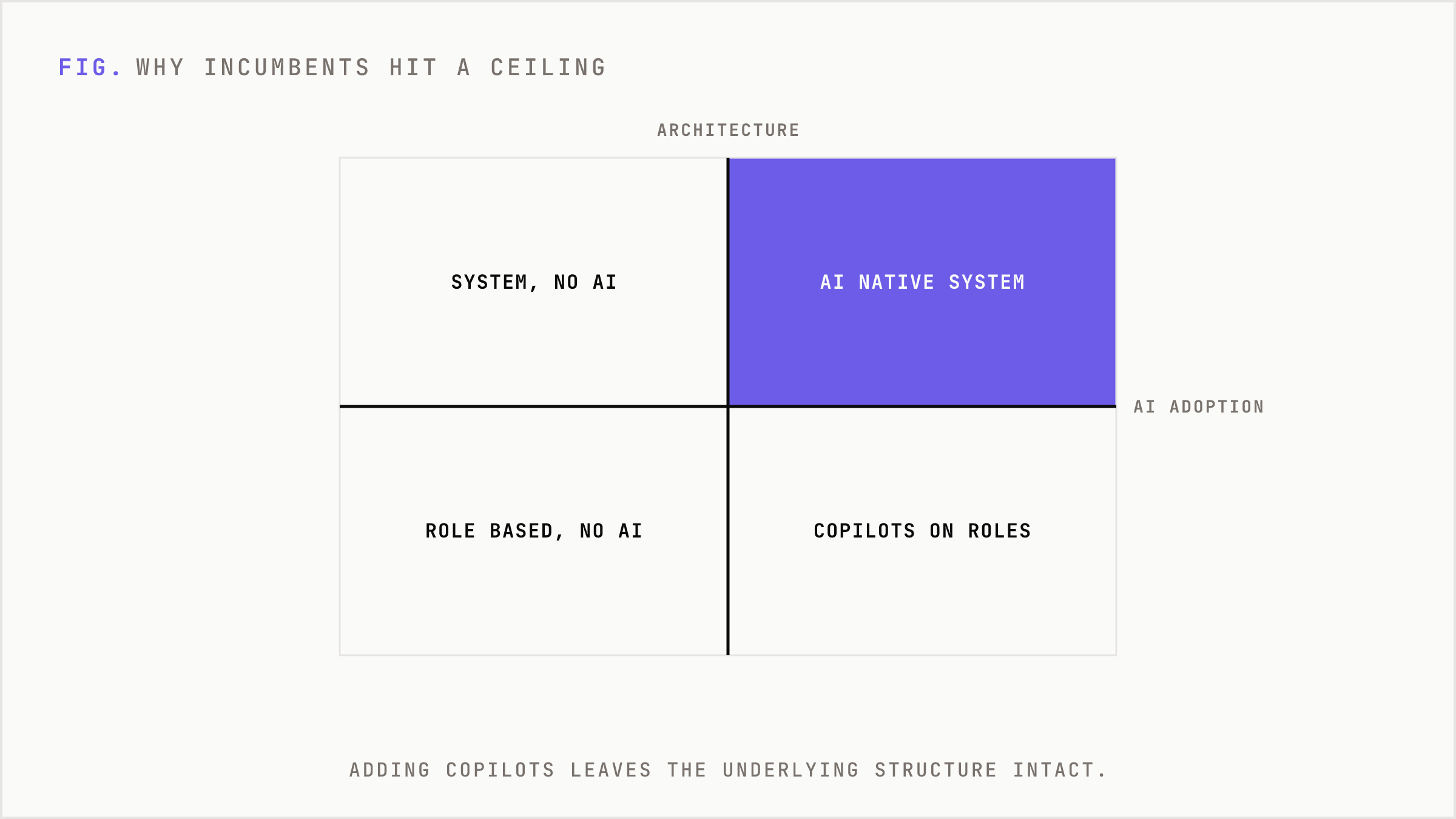
Legacy agencies are built around roles. Strategist, creative, media buyer, analyst. Each role maps to a budget line and a workflow stage.
AI collapses those roles.
A single system can generate strategy, produce assets, allocate spend, and analyze results. That breaks the economic model of the agency itself.
So most incumbents adapt at the surface. They add copilots. They build internal tools. They automate reporting.
But the underlying structure remains intact.
This creates a ceiling. You cannot achieve system level performance with role based workflows.
The New Competitive Layer: Distribution Intelligence
Creative is becoming abundant. Distribution is becoming scarce.
When generating 1,000 ad variants is trivial, the bottleneck shifts to where and how those assets appear.
This is where AI native agencies are focusing.
Companies like Evertune and Bluefish are building around LLM visibility. The goal is not ranking in search results. It is appearing inside AI generated answers.
This changes the entire discovery layer.
Traditional SEO optimizes for links. LLM optimization targets inclusion in generated responses. That requires different data, different feedback loops, and different measurement systems.
It also changes buyer behavior. Users are not browsing ten links. They are accepting one synthesized answer.
That concentrates value at the point of generation.
From Labor to Infrastructure
The most important shift is economic.
Traditional agencies scale with headcount. More clients require more people. Margins are tied to utilization.
AI native agencies scale with infrastructure.
Once the system is built, marginal cost approaches zero. Generating one asset or one thousand has minimal difference in cost.
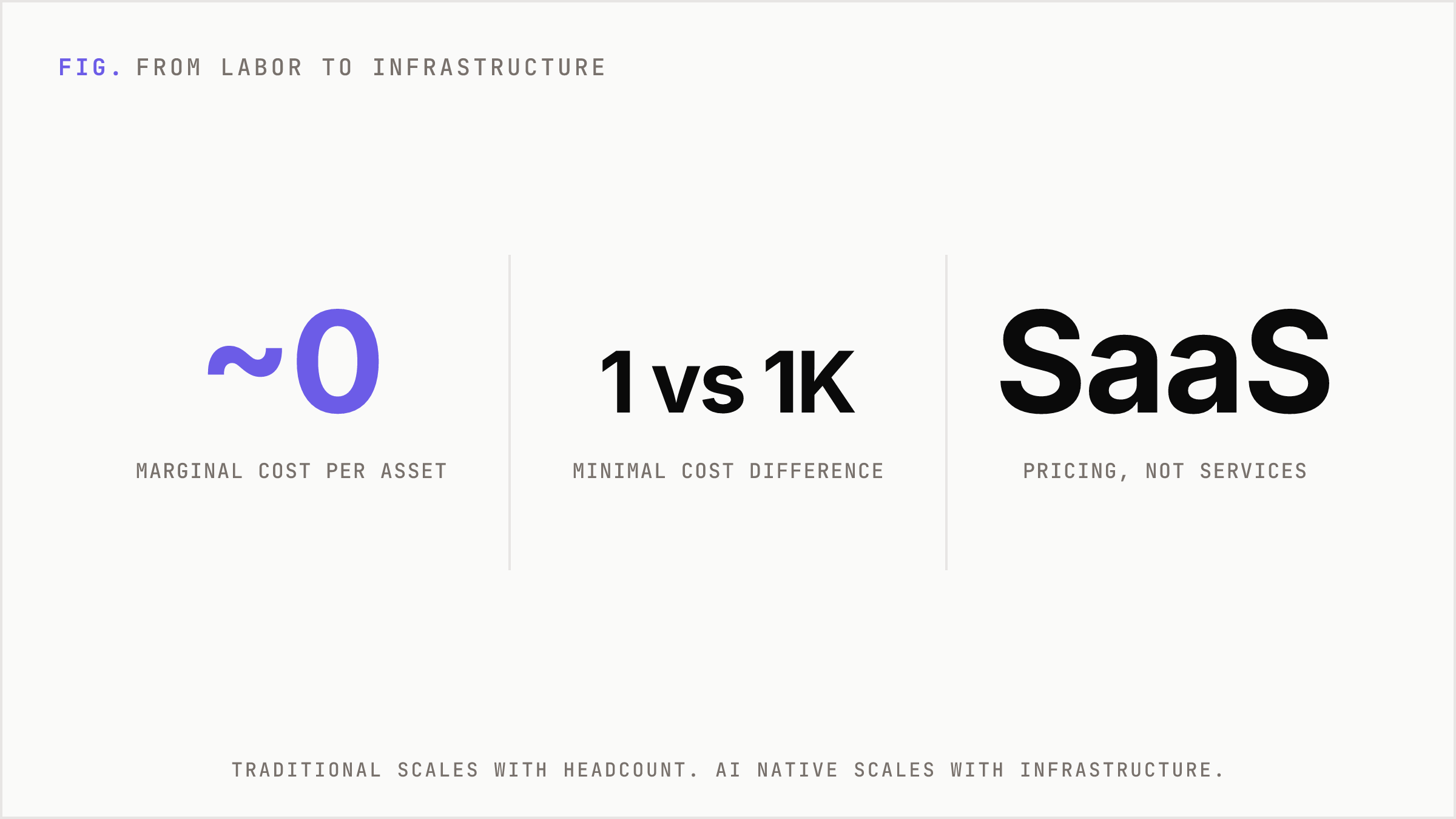
This allows for pricing models that look more like software than services.
Usage based pricing. Performance based pricing. Hybrid models where the system is the product and services are a wrapper.
This is already visible in early players offering outcome driven contracts tied to performance metrics rather than deliverables.
Data as the Only Durable Moat
There is a common misconception that the advantage comes from using advanced models.
It does not.
Base models are accessible. APIs are commoditized. Prompting is not defensible.
The moat is the feedback loop.
Every campaign generates data. Every data point refines the system. Over time, this creates proprietary performance intelligence that competitors cannot replicate.
This is why owning the loop matters.
If an agency relies entirely on third party tools without capturing and structuring performance data, it does not compound. It resets every time.
Agent Based Marketing Operations
The next layer is agent orchestration.
Instead of a single model performing tasks, multiple specialized agents handle different functions. Research, segmentation, creative generation, media allocation, analytics.
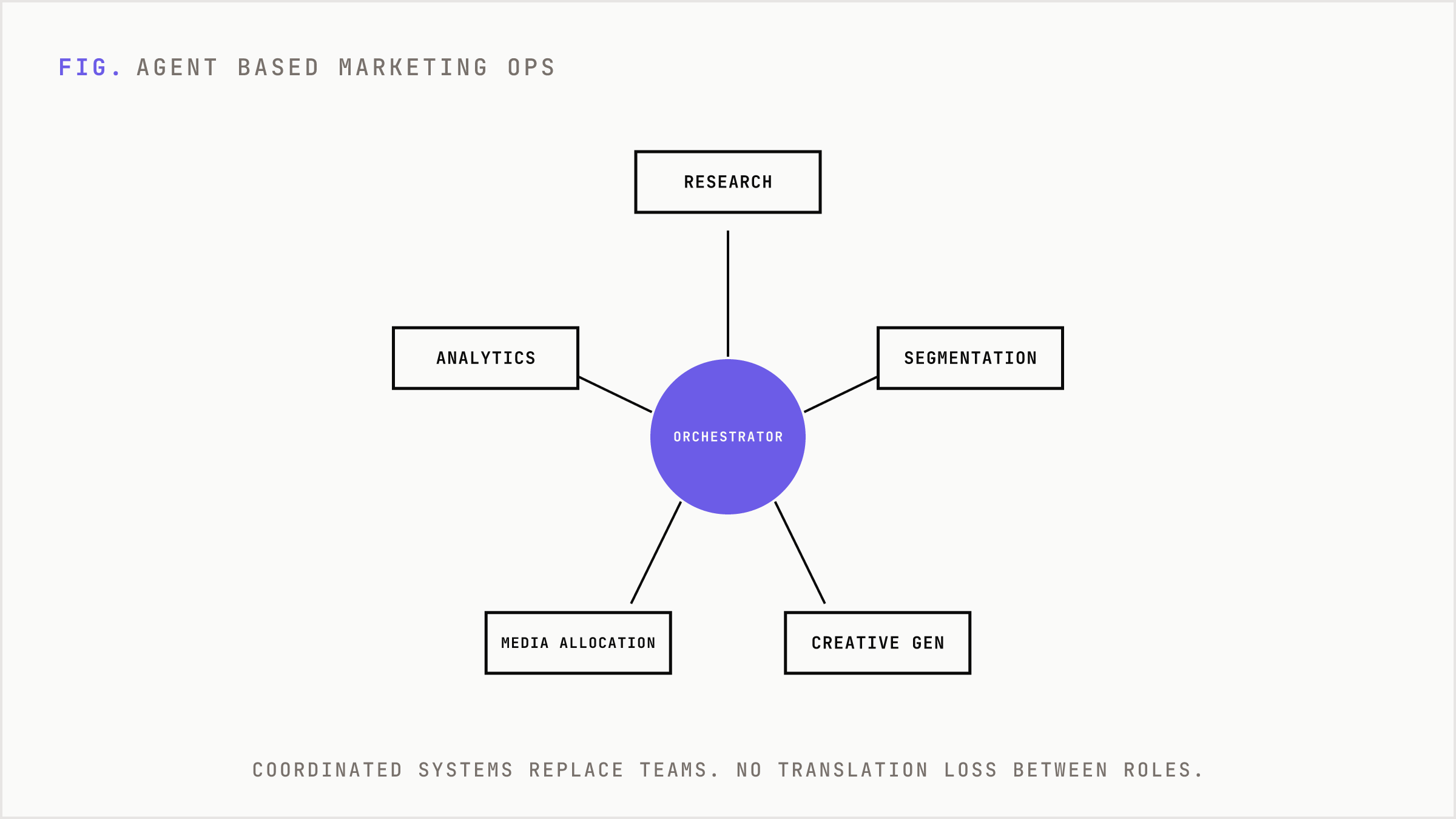
These agents interact, share data, and coordinate execution.
Firms like Monks are moving in this direction with agent based systems spanning the full marketing stack.
This replaces teams with coordinated systems.
The implication is not just efficiency. It is speed and adaptability.
Agents can react to performance signals instantly. No meetings, no delays, no translation loss between roles.
What This Means for Buyers
From a buyer perspective, the shift is already visible in how budgets are evaluated.
Outputs matter less. Outcomes matter more.
No one is paying for a set number of ads or campaigns if a system can continuously optimize performance.
Key metrics become central.
- Customer acquisition cost
- Visibility inside AI generated answers
- Conversion rates across dynamic assets
This compresses sales cycles. The value is clearer. The differentiation is measurable.
It also raises expectations. If one vendor operates a closed loop system, others must match that capability or justify why they cannot.
The Collapse of Category Boundaries
The distinction between SaaS and agency is eroding.
AI native firms often look like software companies with service layers. They build platforms, onboard clients, and run systems on their behalf.
At the same time, software companies are moving into execution by embedding agents that act on behalf of users.
The result is convergence.
Buyers do not care whether the solution is labeled software or service. They care whether it drives outcomes.
Why This Window Matters Now
The category is still forming.
There are very few true AI native agencies. Most players are still transitioning or experimenting.
This creates a positioning advantage.
Early entrants can define the category, establish data advantages, and lock in clients before the market standardizes.
Once feedback loops mature, the gap becomes difficult to close. Not because of technology, but because of accumulated data.
The Strategic Takeaway
The shift is not about adopting AI tools. It is about replacing workflows with systems.
Teams that treat AI as an enhancement will see incremental gains.
Teams that rebuild around AI will operate on a different curve entirely.
The market will not split evenly. It will separate based on structure.
On one side, agencies selling labor with better tools.
On the other, systems that learn, adapt, and compound.
That gap will define the next decade of marketing.
FAQ
What is an AI native agency?
An AI native agency is built around model driven systems where strategy, execution, and optimization are handled by AI, not layered onto human workflows.
How is AI native different from AI powered?
AI powered agencies use tools within existing processes. AI native agencies replace those processes with autonomous systems and closed loop feedback.
Why are closed loop systems important?
Closed loop systems continuously improve by feeding performance data back into models, creating compounding advantages over time.
What is LLM visibility or GEO?
It is the practice of optimizing content to appear in AI generated answers from systems like ChatGPT or Perplexity, replacing traditional search rankings.
Will traditional agencies disappear?
Many will adapt, but those that fail to shift from labor based models to system driven approaches will struggle to compete on cost and performance.