Nyyon · Blog
AI agents create new problem for enterprise software
When the consumer of software becomes an agent, seats and UX give way to work-completed pricing, AX, and a named human owner on every workflow.
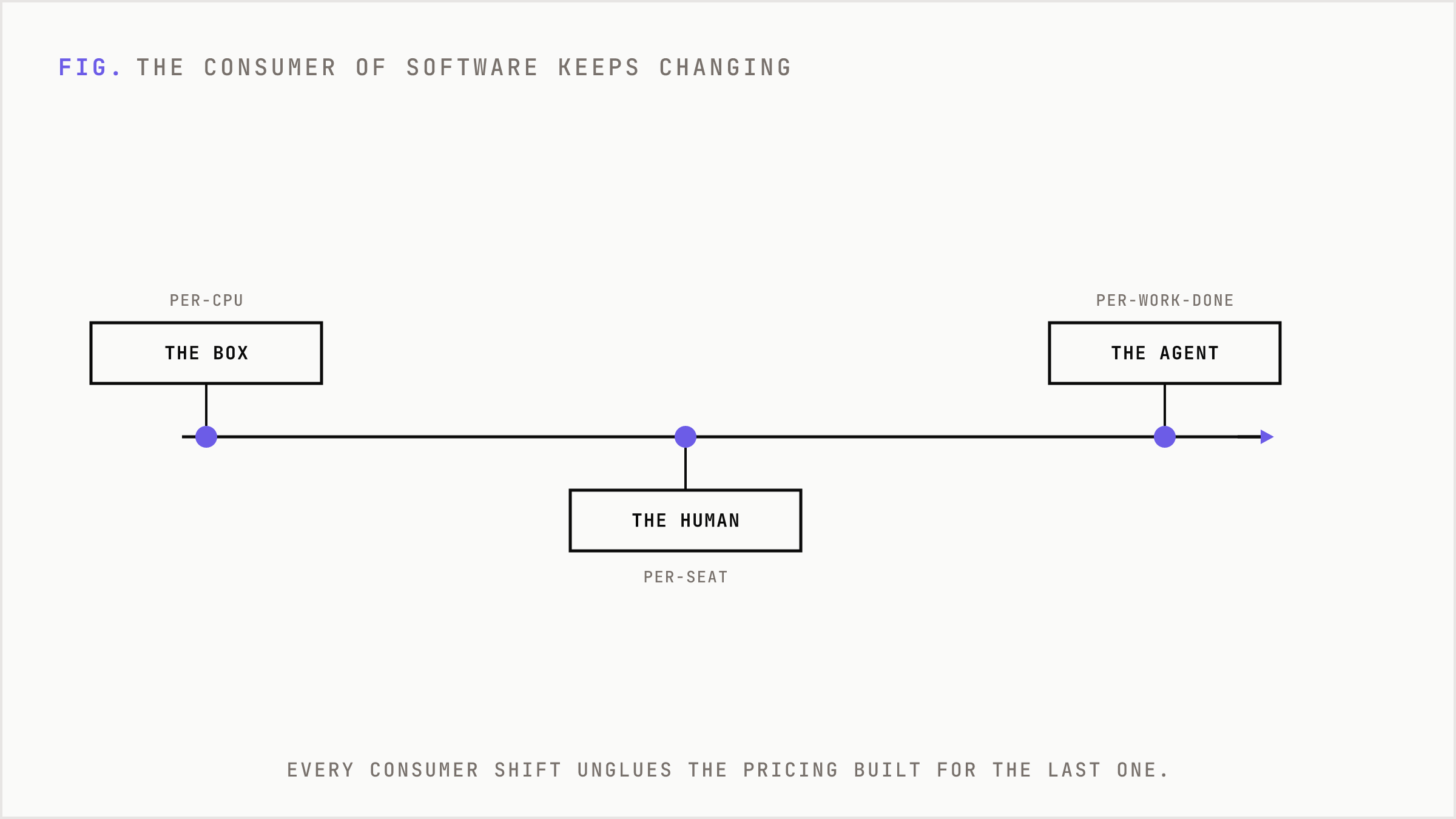
Point an agent at a Zendesk seat and it fires the same login thousands of times a day for a flat $75 a month. A human in that seat clicks a few dozen times. Every time the actual consumer of software changes, the pricing and design built for the last consumer stop matching reality, and the consumer is now an agent. That is the break happening on the SaaS renewals you sign this quarter. Value and price have already come unglued, and the deeper damage is that the workflows an agent runs already have no human owner and no execution trace.
I build these systems for clients, so I watch this from the inside. Buyers keep reading it as a vendor pricing tweak scheduled for some future release. It is the same consumer shift that killed per-CPU licensing, and it is landing on today's contracts.
The consumer changed, so the pricing has to
On-premise software priced per machine and per CPU because the consumer of the software was a box in your server room. That was the honest unit at the time. The vendor sold to a piece of hardware, so the meter ran on hardware.
The cloud made the consumer a human user, and the whole industry rebuilt around that human. Per-seat pricing arrived because a person logging in was the thing consuming the value. A Salesforce seat at $30 to $150 a month made sense when a rep touched it a few dozen times a day.
An agent changes the consumer again. Point it at a Salesforce or Zendesk seat and it drives the same API and UI paths thousands of times a day at the same flat price. The vendor is now selling a fraction of a cent of value per action at a price built for a person clicking a handful of times. Per-CPU billing looks absurd on cloud software today. Per-seat billing on agent-run software will look absurd for the identical reason, and it will look that way faster.
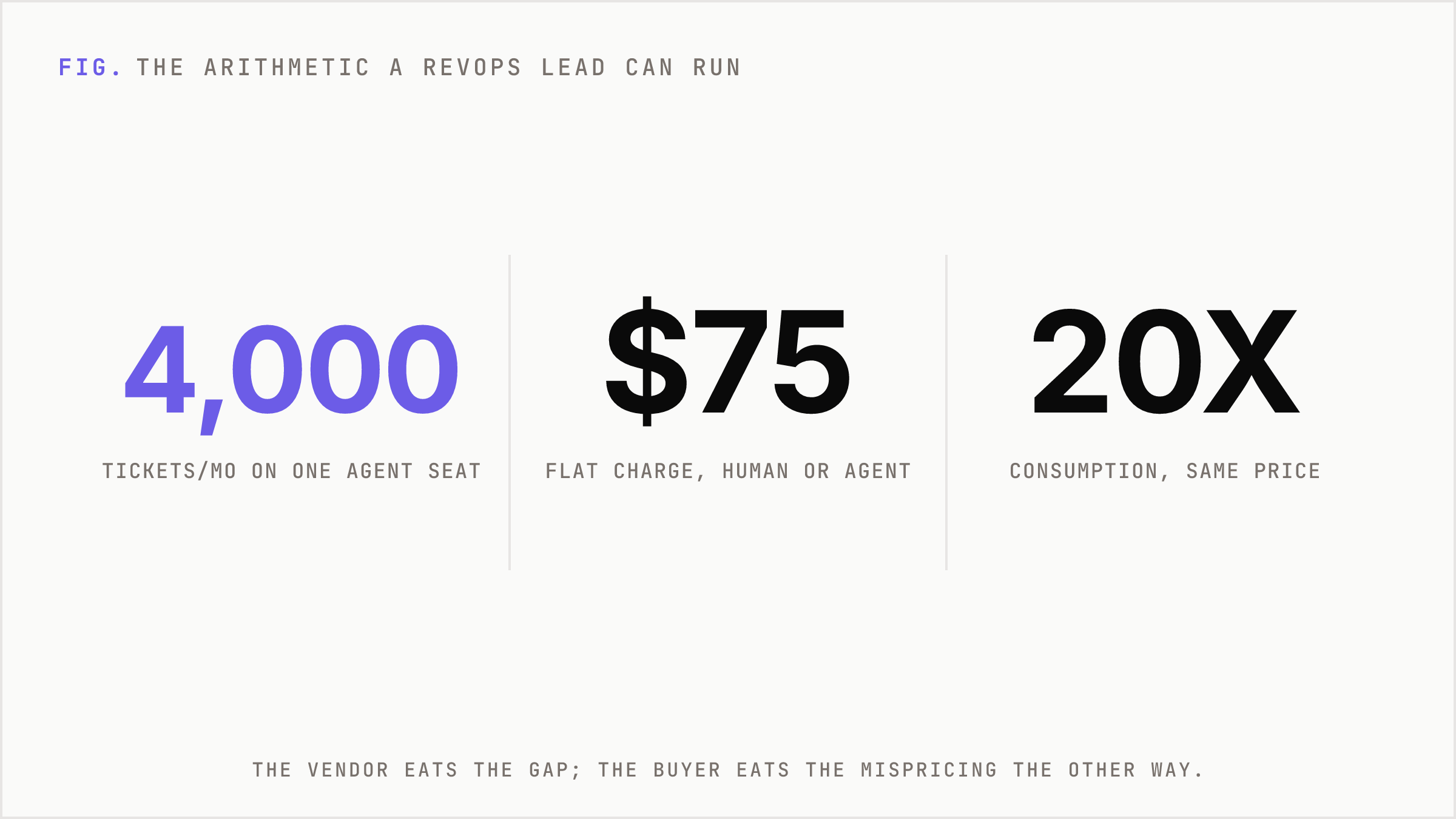
Here is the arithmetic a RevOps lead can run before lunch. A support agent handling 4,000 tickets a month through one $75 seat costs the vendor real compute and delivers real work, and the vendor collects the same $75 it would from a human closing 200 tickets. Twenty times the consumption, one flat charge. The vendor eats the gap until it reprices, and the buyer who locked a three-year seat contract eats the mispricing in the other direction on every workflow the agent has not touched yet.
UX served the last consumer, AX serves this one
Seats and UX were the correct design for a human user. Menus, tooltips, confirmation modals, onboarding flows: all of it built for a person who reads a screen and clicks. The stack assumed a human as the consumer of the product.
The consumer now is an agent. An agent is a runtime configuration of instruction, context, tools, and model that runs on a control plane and does the work a person used to do. It reads no tooltip, waits for no modal, and forgives no clunky flow the way a trained human learns to.
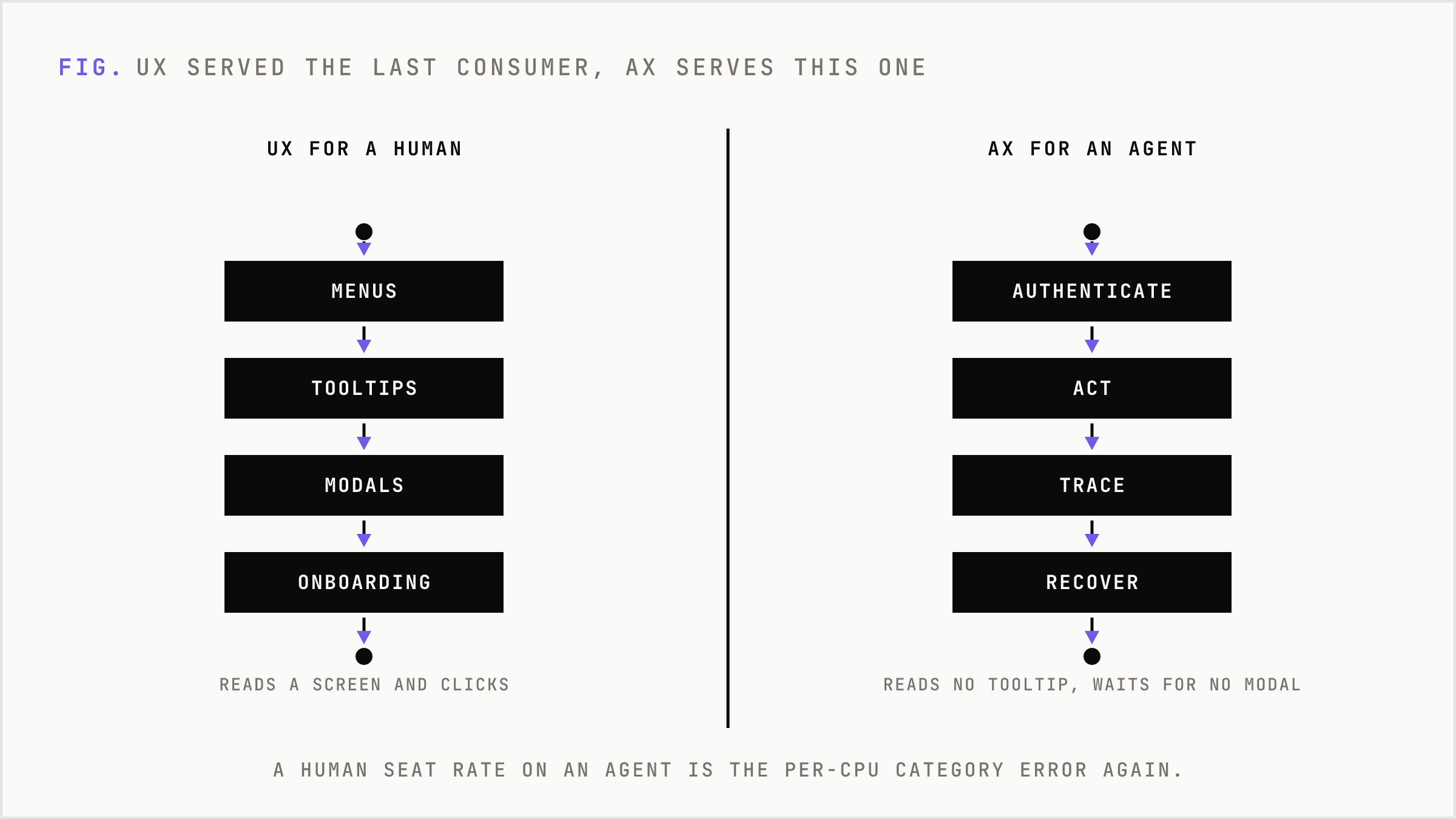
Agent experience, AX, is how a product gets rebuilt around the agent as its actual consumer. AX is the design discipline that treats the agent, not a human bolted onto a login, as the thing signing up, authenticating, acting, and recovering from errors. When you design for AX, the whole stack changes: how the product is priced, how it is accessed, how work is authored, how each action is traced. Charging that consumer a human seat rate is the same category error as charging cloud software a per-CPU fee. You are metering the old consumer while a new one does the work.
The seat that carried a name now carries nobody
This is the sharpest edge, and it is bigger than price. A human in a seat leaves an audit trail with a name attached. When something breaks, procurement can point at a person who approved it, and the org has a place to put accountability.
An agent runs that same workflow through a shared service account. The seat that used to carry a person's name now carries nobody's. When the agent approves a bad refund or mis-files a compliance step, the org discovers it has automated a process that runs itself with no owner and no execution trace. The work happened, the money moved, and the question of who signed off has no answer.
I think that is the real story here, and it is an org-design problem no vendor can price away for you. A repricing fixes the money. It does nothing for the accountability gap. The org has quietly automated away its own answer to the auditor's first question: who approved this.
Rebuild for the agent, keep a named human on the hook
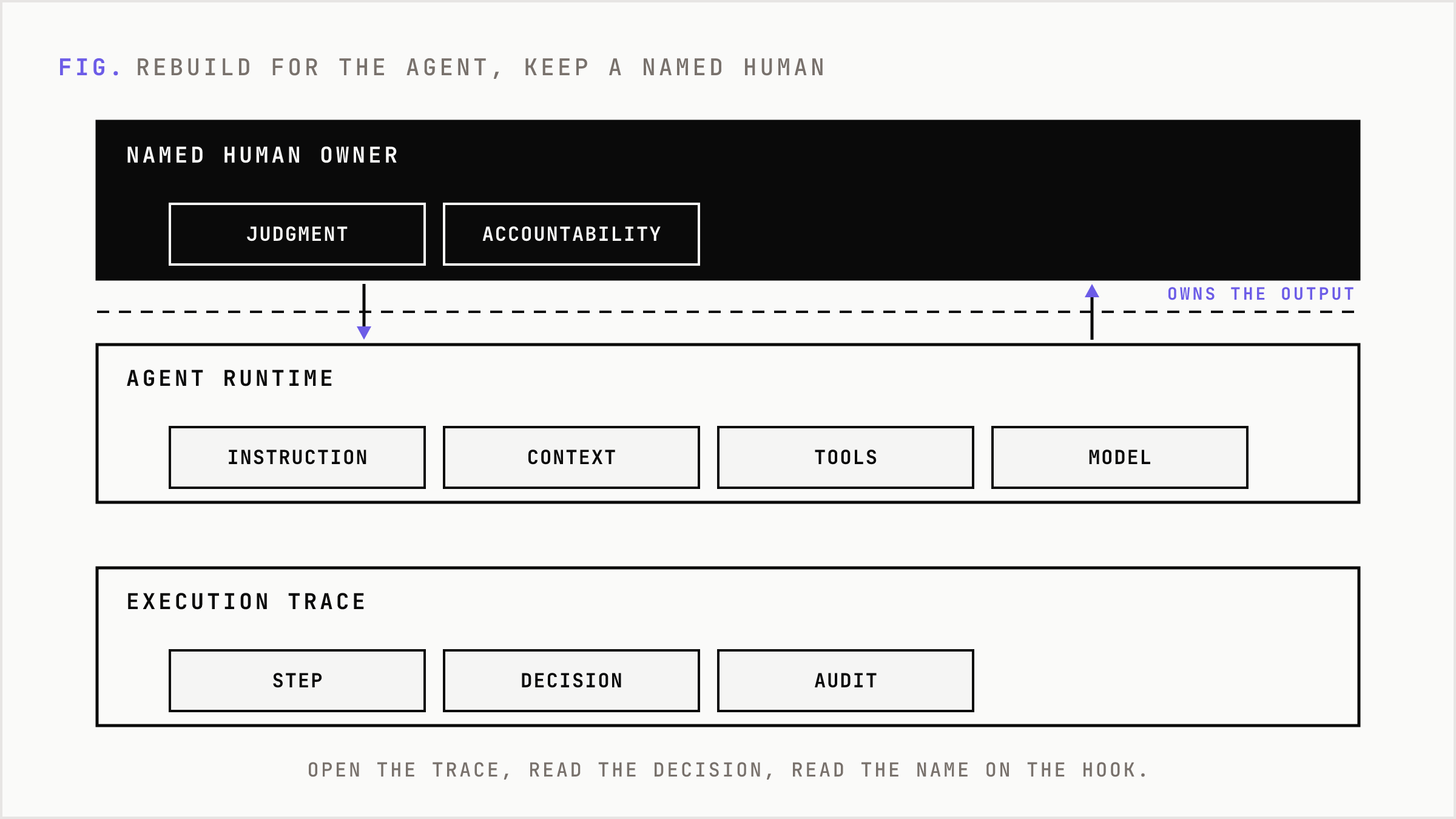
The rebuild is the workflow redesigned around the agent as the consumer, with usage metered honestly and priced on work completed. The agent does the typing. A named person supplies the judgment and carries the accountability.
On your control plane, every agent runtime configuration running in production maps to one human who owns its output, plus a complete execution trace of what it did, step by step. When the refund goes wrong six weeks from now, you open the trace, read the decision the agent made, and read the name of the person accountable for that agent's conduct. That is the difference between an incident you can close in an afternoon and a quarter of forensic reconstruction across a service account nobody owns.
The objections a skeptical buyer will raise
Vendors will add usage-based tiers and the pricing problem evaporates. True for the money, and some vendors are already moving. Retrofitting metering onto a product architected around named human seats is slow and contentious, and it settles nothing on the accountability side, which stays your problem to solve on your control plane.
Enterprises have run automated jobs through service accounts for decades, so agents change nothing. The service-account pattern is real, and here is where it breaks. A cron job does one scripted thing you wrote and can read line by line. An agent makes open-ended judgment calls across a whole workflow, so the blast radius and the ambiguity of ownership are categorically larger. When a cron job fails, you read the script. When an agent fails, you are reconstructing a decision that had no author.
Small vendors will price agent usage fairly and the market self-corrects. Maybe, over years. The buyer signing a three-year enterprise renewal this quarter eats the mispriced contract now and runs untraceable workflows the whole time. Waiting for the market to correct is a decision to overpay and to stay unaccountable while you wait.
What to do this week
Pull your top three SaaS contracts and count how many seats an agent already touches or is about to. Where an agent runs the workflow, open the renewal conversation now on work-completed pricing instead of seats, the same way you would refuse per-CPU billing on cloud software today. Then, on your control plane, write one human's name against every agent runtime configuration running in production, and attach a complete execution trace to each one, before an auditor asks who signed off. Skip both and you renew a seat contract an agent makes absurd, and you run workflows no auditor can trace to a person.
If you have a problem, if no one else can help, and if you can find them, maybe you can hire Nyyon.