Nyyon · Blog
Owning Outcomes in the Age of AI Marketing
AI marketing is shifting from tools to outcome ownership, where agencies run full-stack systems tied directly to revenue, CAC, and pipeline performance.
The real shift in AI marketing is not automation, it is ownership.
The Collapse of the Deliverables Model
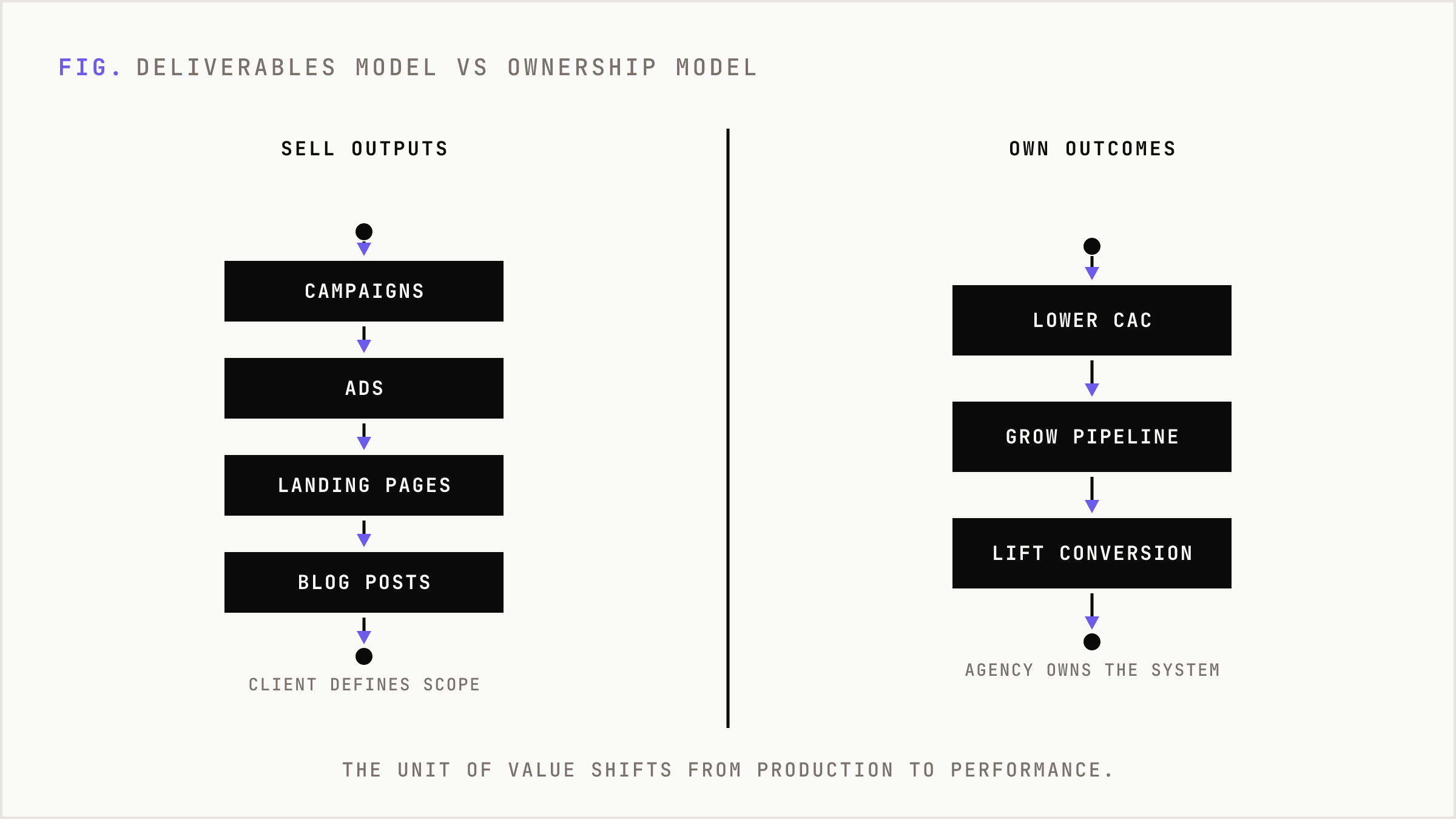
For two decades, agencies sold outputs. Campaigns, ads, landing pages, blog posts. The unit of value was production. The client defined scope, the agency fulfilled it.
AI breaks that model at the root.
When content generation, ad variations, and even campaign structures can be produced at near zero marginal cost, selling outputs stops making sense. The constraint is no longer production capacity. It is decision quality and system design.
Buyers are adjusting fast. They are less interested in how many assets get produced and more focused on whether CAC is falling, pipeline is growing, and conversion rates are improving.
This shifts budget logic. Spend moves away from line items like “content” or “paid social management” and toward unified performance ownership.
From Tools to Systems
Most AI marketing offerings today are thin wrappers around tools. Prompt libraries, content generators, workflow templates. They reduce effort but do not change outcomes in a durable way.
The difference with high-end AI marketing is systemization.
A system is not a tool. It is a loop.
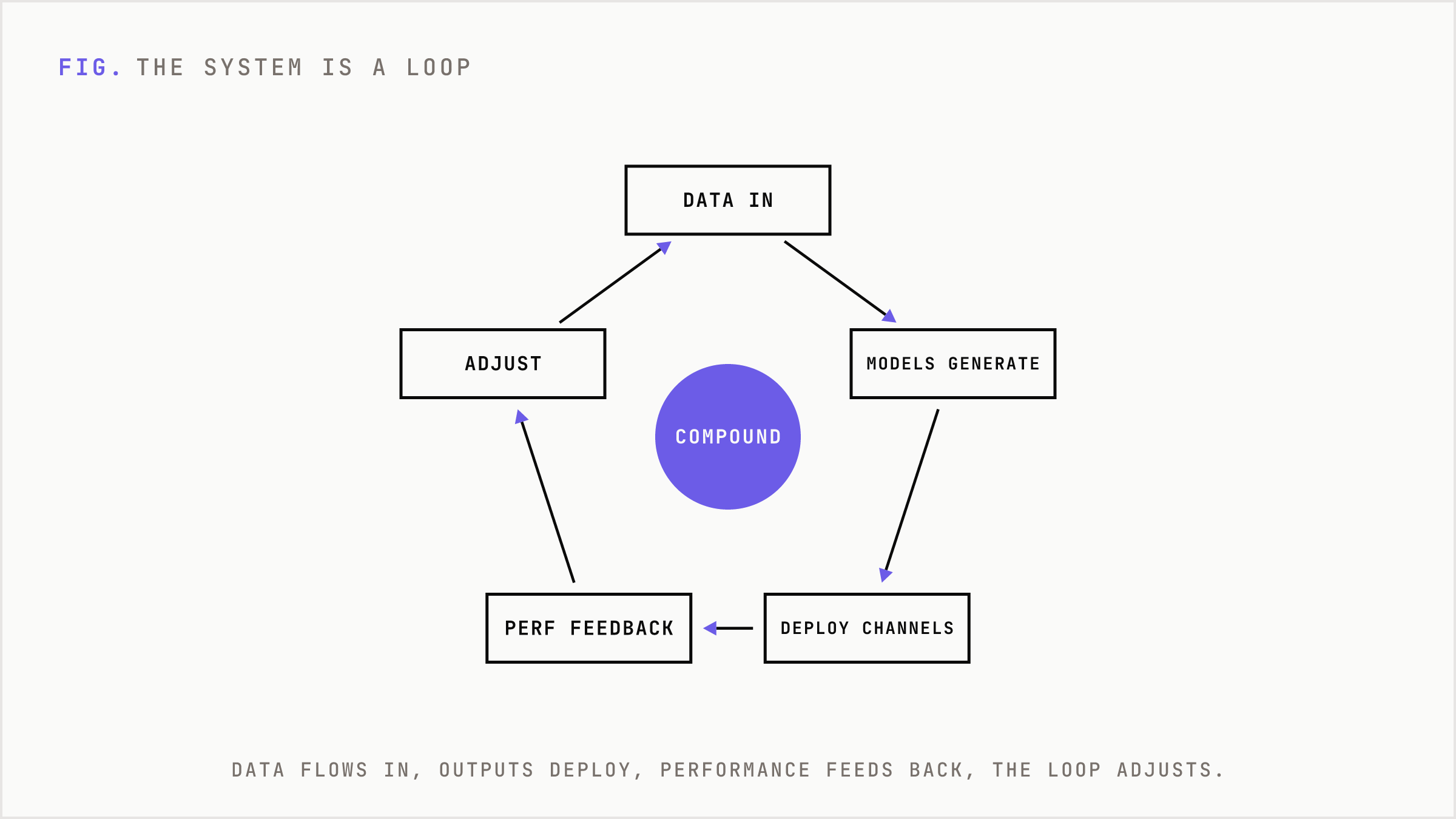
- Data flows in from CRM, analytics, and ad platforms
- Models generate outputs based on structured context
- Outputs are deployed across channels
- Performance data feeds back into the system
- Prompts, models, and workflows are adjusted continuously
This loop runs constantly. It compounds. And it requires ownership.
A tool can be handed off. A system cannot.
What “White Glove” Actually Means Now
The term “white glove” is overused, but in AI marketing it has a precise meaning.
It means the agency owns the system and the outcome.
Not just execution. Not just setup. Full lifecycle responsibility.
That includes:
- Designing custom workflows instead of using templates
- Structuring and conditioning client data for model use
- Integrating with CRM, ad platforms, and analytics pipelines
- Maintaining human QA to enforce brand and compliance constraints
- Running continuous optimization loops tied to business metrics
The AI is not the product. The system is.
And the system only works if someone is accountable for its performance.
Why Ownership Changes Pricing
Once outcomes become the unit of value, pricing detaches from inputs.
You are no longer paying for hours, seats, or assets. You are paying for a system that moves metrics.
This is why white glove AI marketing commands premium retainers. Often multiple times the cost of the underlying tools.
The margin comes from leverage.
A small team, equipped with internal tooling and AI workflows, can replace what used to require large execution teams. The upfront cost is high because systems need to be designed, integrated, and trained. But once running, the marginal cost of iteration drops sharply.
This creates a different economic profile:
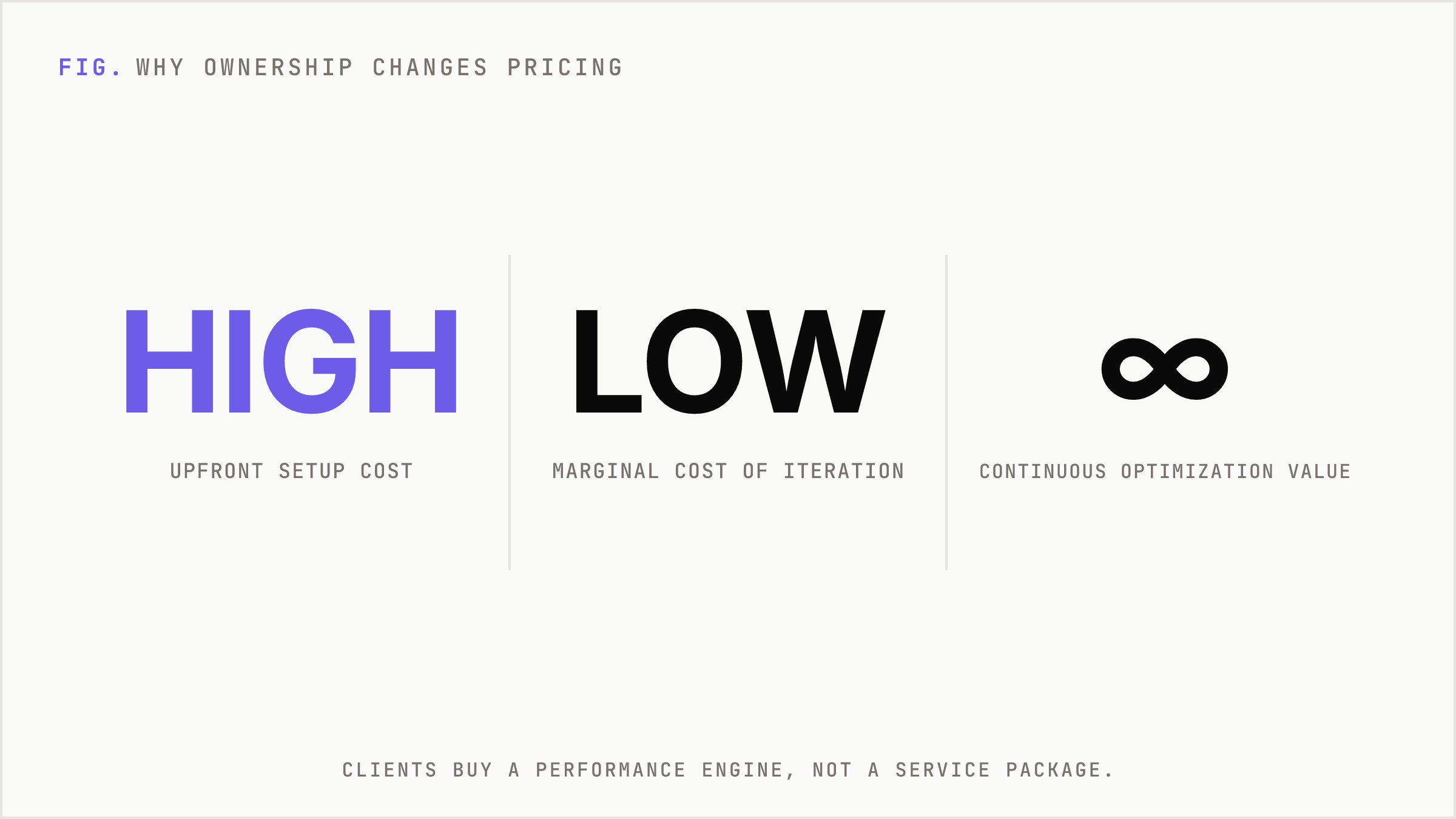
- High setup cost
- Low incremental cost
- Continuous optimization value
Clients are effectively buying a performance engine, not a service package.
The Internal Reality of These Agencies
From the outside, AI agencies look automated. Internally, they are not.
The structure shifts from large teams of juniors executing tasks to small teams of senior operators designing and managing systems.
Typical composition:
- Strategists who translate business goals into system architecture
- AI operators who build workflows, prompts, and agents
- Analysts who monitor performance and adjust loops
They rely heavily on internal tooling. Custom GPTs, orchestration layers, data pipelines, and monitoring dashboards that are not visible to the client.
Human oversight remains critical. Not because AI is weak, but because businesses are constrained by brand, legal, and strategic considerations that require judgment.
Automation handles scale. Humans handle direction.
Where Value Actually Comes From
The market often overestimates what AI tools themselves contribute.
The real value sits in five areas.
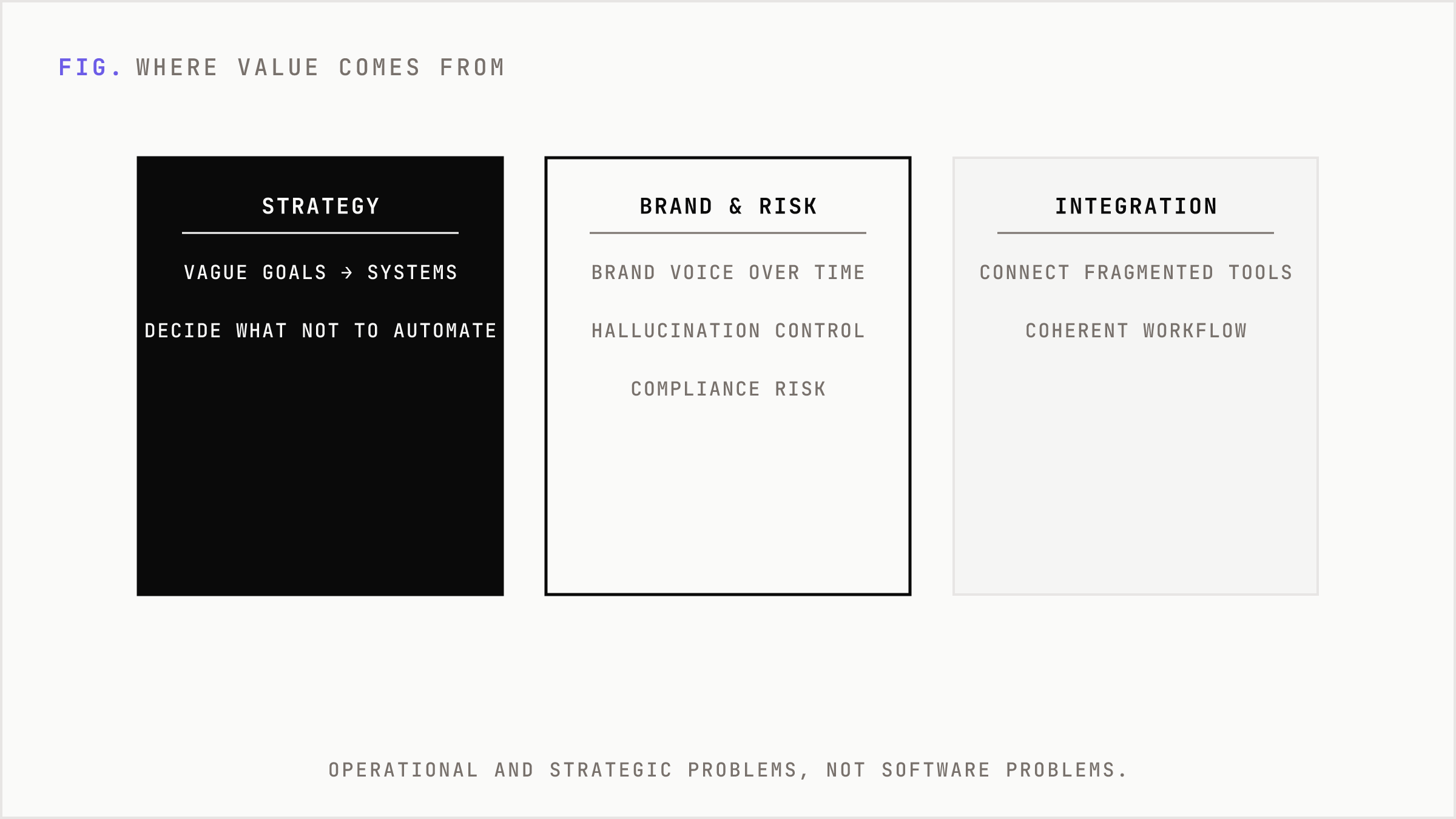
- Translating vague goals into structured systems
- Aligning outputs with brand voice over time
- Managing hallucination and compliance risk
- Deciding what not to automate
- Connecting fragmented tools into a coherent workflow
These are not software problems. They are operational and strategic problems.
This is why most low-end AI offerings fail to deliver sustained results. They optimize for speed instead of effectiveness.
Failure Modes in the Current Market
There is a clear pattern emerging among underperforming AI agencies.
They position as high-touch but operate as template shops.
Common issues:
- Reusing generic workflows across clients with minimal customization
- Over-automating content production, leading to brand dilution
- Lack of proprietary data, resulting in generic outputs
- No feedback loops, so performance plateaus quickly
- Reporting dashboards without interpretation or action
These models look efficient in the short term but break under scrutiny. Clients eventually notice that output volume does not translate into business impact.
The Competitive Moat Is Not AI
AI itself is not a durable advantage. The tools are widely available and improving quickly.
The moat is built elsewhere.
- Proprietary workflows refined through repeated use
- Accumulated prompt and data learnings
- Deep integration into client systems
- Strategic decision-making capability
These are slow to build and hard to replicate.
An agency that simply uses AI tools is interchangeable. An agency that embeds into a company’s revenue system is not.
Buyer Behavior Is Already Changing
Marketing leaders are starting to think differently about external partners.
The shift is subtle but important.
From:
- “How many campaigns will we run?”
- “How much content will we produce?”
To:
- “Can you lower our CAC?”
- “Can you increase pipeline velocity?”
- “Can you operate this function end-to-end?”
This reframes the agency relationship. It becomes closer to an embedded operator than an external vendor.
Budgets follow this logic. Instead of fragmented spend across channels and vendors, companies consolidate into fewer partners who can own broader outcomes.
Substitution Is the Real Threat
The biggest impact of AI in marketing is not efficiency. It is substitution.
AI systems, when properly designed, can replace entire layers of marketing operations.
Content teams shrink. Campaign management consolidates. Reporting becomes automated. Experimentation accelerates.
This does not eliminate the need for expertise. It concentrates it.
The question shifts from “how many people do we need” to “who designs and runs the system.”
From Campaigns to Infrastructure
The long-term trajectory is clear.
Marketing is becoming infrastructure.
Instead of discrete campaigns, companies run always-on systems that continuously generate, test, and optimize.
Channels become inputs into a unified engine rather than separate workstreams.
This changes how growth is managed. It becomes less about planning and more about tuning.
What This Means for Founders and Investors
If you are evaluating marketing capability today, the key question is not whether AI is being used.
It is whether there is a system in place that:
- Integrates data across the funnel
- Runs continuous experimentation
- Improves performance over time
- Has clear ownership and accountability
Anything less is transitional.
The market is moving toward a model where a small number of high-leverage operators control increasingly large portions of revenue generation.
In that environment, the winners are not those who adopt AI tools fastest, but those who build systems that compound.
The Bottom Line
White glove AI marketing is not about better execution. It is about taking responsibility for outcomes.
That requires custom systems, deep integration, and continuous human oversight.
It is more expensive. It is harder to deliver. And it is structurally different from traditional agency work.
But it aligns incentives in a way the old model never did.
And that alignment is what makes it stick.
FAQ
What is white glove AI marketing?
It is a fully managed approach where an agency designs, runs, and optimizes custom AI-driven marketing systems while taking accountability for business outcomes like revenue and CAC.
How is this different from traditional marketing agencies?
Traditional agencies focus on delivering assets or campaigns. White glove AI agencies own the entire system, including strategy, execution, and continuous optimization tied to performance metrics.
Why is it more expensive?
Costs reflect system design, integration, and ongoing optimization. Clients are paying for measurable outcomes and performance improvement, not just production or tool usage.
Do companies still need internal marketing teams?
Yes, but roles shift. Internal teams focus more on strategy and coordination, while external partners may operate core execution systems.
Is this model scalable?
Yes. Once systems are built, they scale efficiently due to low marginal costs of iteration, making them highly leverageable across channels and campaigns.