Nyyon · Blog
Open-weight AI companies are the hottest acquisition targets
Nvidia and Stripe secured where open weights live and how requests route. The scarce asset is the operator who owns one specialized model end to end.
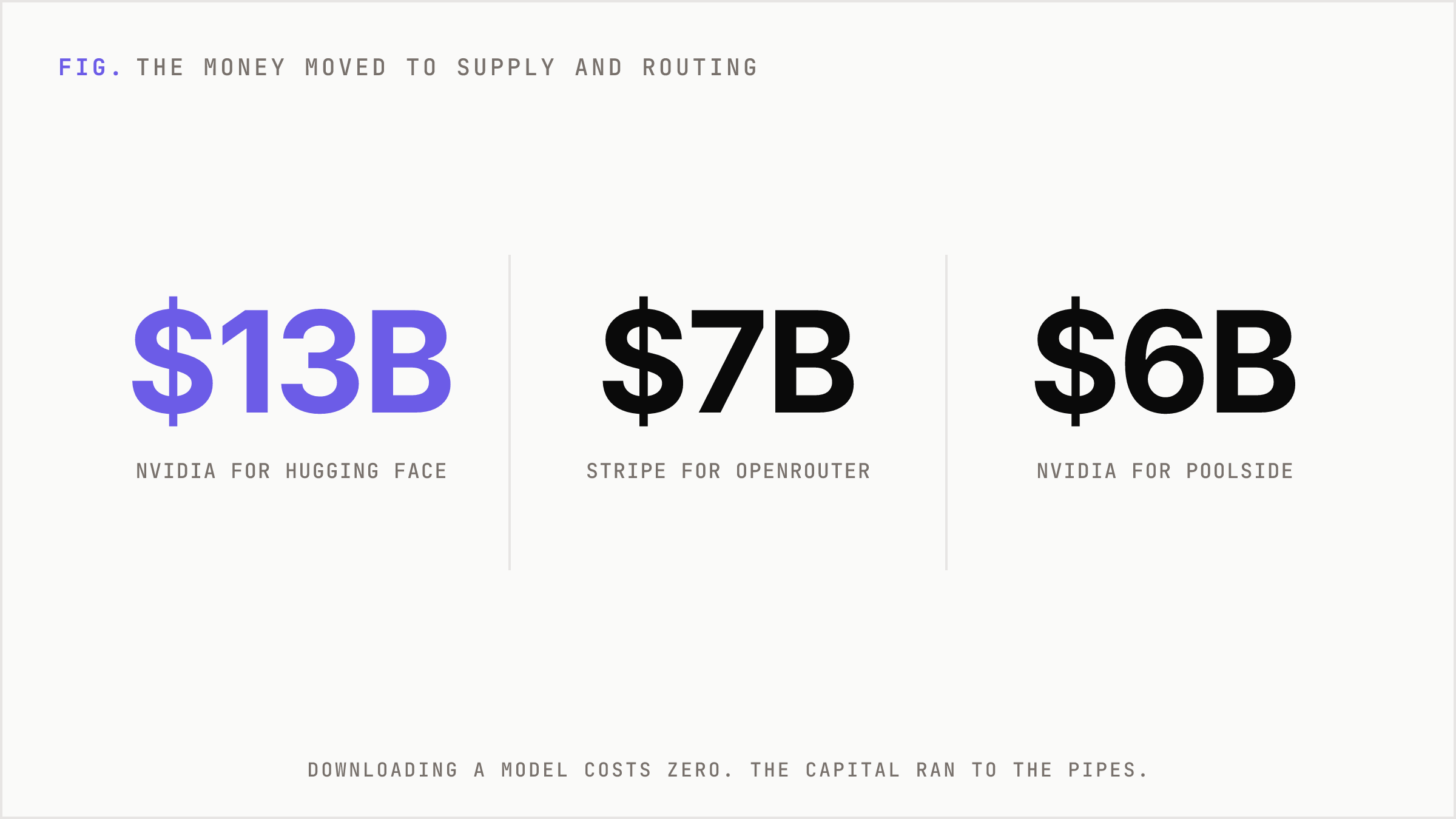
Nvidia is reportedly paying $13 billion for Hugging Face. Stripe already paid more than $7 billion for OpenRouter. Nvidia struck a $6 billion deal for Poolside that moves most of its staff onto the payroll. Read the headlines and the story writes itself: self-hosting open-weight models is going mainstream. Read the money and the story flips. The weights are turning free, which is exactly why the capital ran to whoever supplies and routes them. Those deals secure the pipes. They lock down where the weights live and how a request finds a model. None of them put a person inside your company who can pick the use case, curate the tuning data, stand up the inference, eval it, and hand it back running. That person is the scarce asset in 2026: one operator who owns one specialized model end to end, for one workload whose token math clears. Everything else in the acquisition wave is noise until you have run that math on your own highest-volume task.
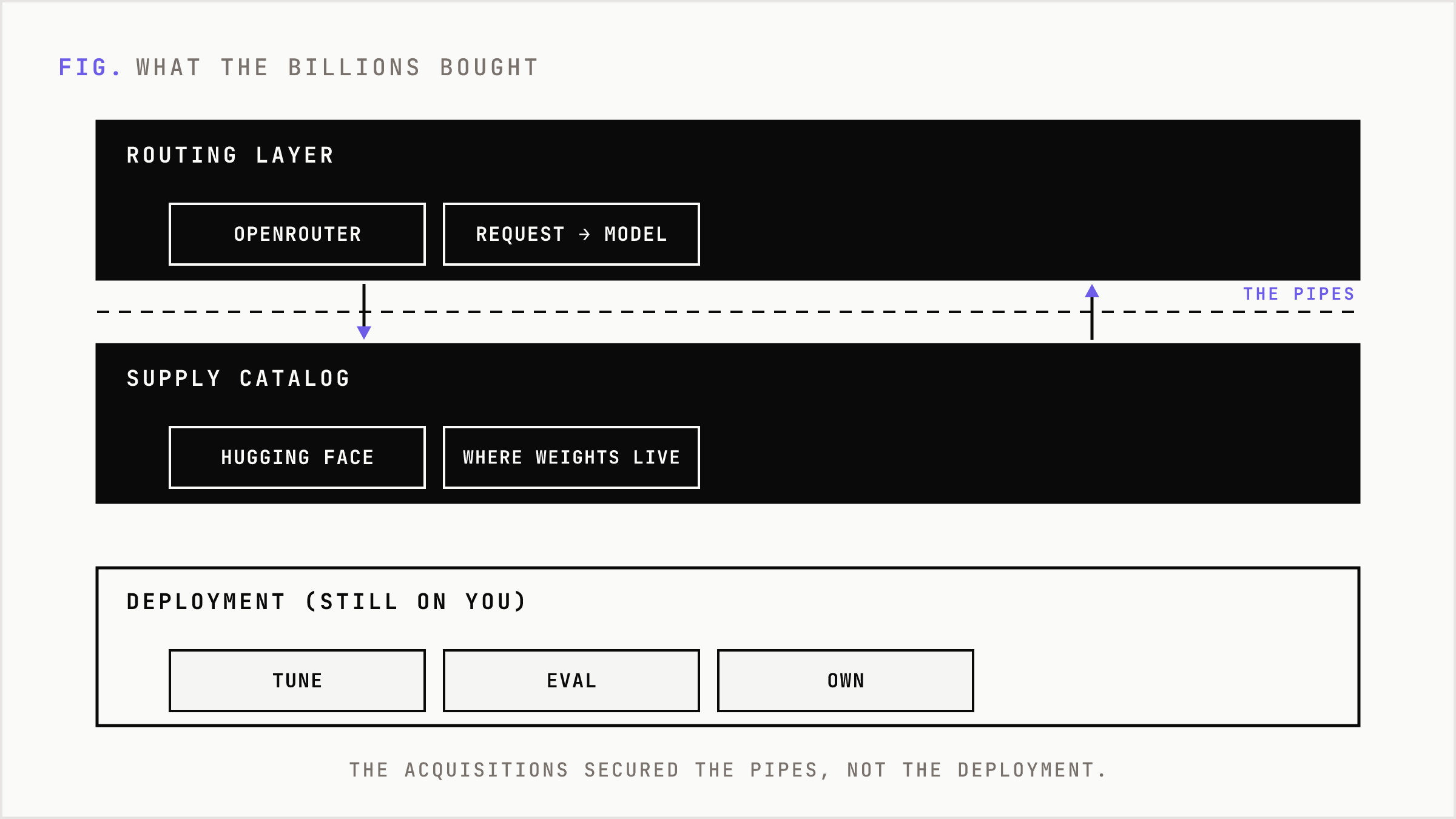
Let me be blunt about what got bought. Downloading a model costs zero. Nvidia knows that. Stripe knows that. The billions moved to the two spots where value still collects once the artifact is free: the supply catalog and the routing layer. Hugging Face is the developer space where open models live. OpenRouter is the top provider that decides which model your request hits. Owning those means owning a mass of users you can steer toward your chips and your standards. That is a smart bet on distribution. It is a bet on the easy half.
The acquisitions bought the pipes, not the deployment
Nvidia builds its own Nemotron family of open-weight models, and uptake has stayed thin. Buying the largest US developer space for open models solves that in one move: access to the developers, then a path to drive them to Nvidia silicon. The same logic runs under the OpenRouter deal. When frontier labs start making their own inference chips, and OpenAI announced its Jalapeño chip this week, Nvidia wants a seat in the model-making business so it is less exposed to the hyperscalers and labs it currently depends on.
All of that secures where weights sit and how traffic flows to them. Running a downloaded model against your specific workload, tuned and evaled and owned, is the entire cost. No acquisition ships you that. Nobody at Nvidia or Stripe walks into your building, opens your highest-volume task, and stands up an 8B fine-tune that clears your API bill. That work is still on you, and it is the work that actually saves money.
Only 6% of companies self-host, and the math explains it
Just 6% of companies use open-weight models today, per the survey TechCrunch cites. People read that number as proof this is a fringe. The math reads the other way. Self-hosting pays off only past a real usage threshold on a single task, and 94% of companies sit correctly below that threshold. This is the economics working the way it should.
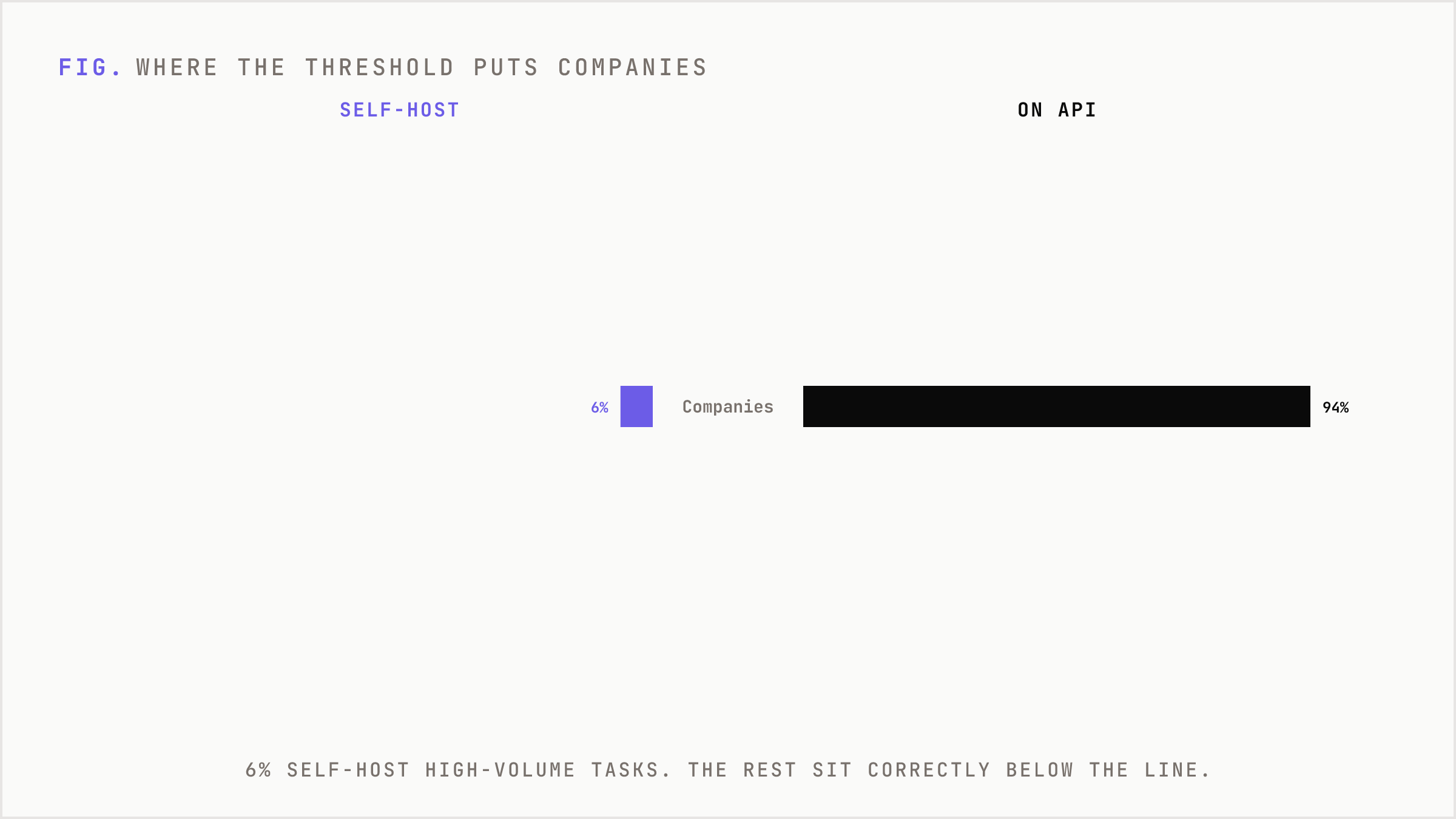
A fine-tuned open model beats a frontier API on one condition: your token volume on a single, stable use case is large enough to amortize the GPU plus the tuning plus the person who owns it. A workload burning millions of tokens a day on one narrow task can justify a self-hosted 8B fine-tune. A workload firing a few thousand calls a day cannot. Below the line, self-hosting buys you an idle GPU and a pager rotation. The 6% who self-host run it for high-volume repetitive work and stop there, which is the correct place to stop.
Price the token math before you buy a GPU
Here is the move. Take your single highest-volume, most repetitive AI task and price its real token count against what a frontier API charges you for it today. The Fireworks line that every company should have a model per use case holds only for the use cases that clear that bar.
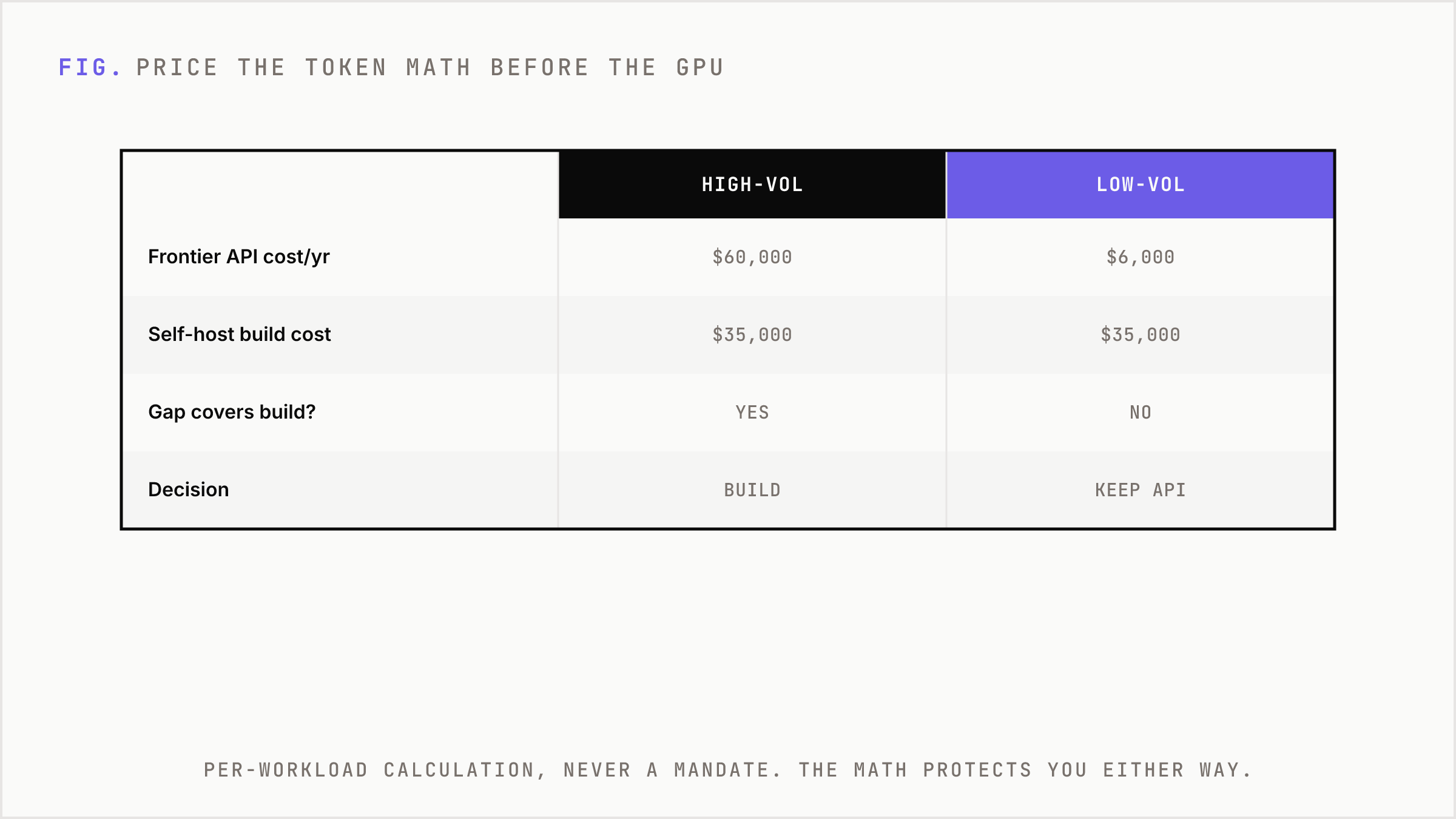
Say the arithmetic concretely. If that one task is costing you $60,000 a year on a frontier API and a self-hosted fine-tune plus a GPU plus half of an owner's quarter runs you $35,000, the gap covers the build with room left. Build that one model. If the same task costs you $6,000 a year, no self-hosted setup clears it, and you keep it on the API. The threshold is not a vibe. It is a subtraction you can do in an afternoon with your billing dashboard open.
The operator is the slot no acquisition fills
Weights are downloadable. Inference is rentable by the hour. Neither one picks your use case, curates the tuning data, evals the output, or catches the model when the prompt distribution shifts and quality drops in production. That end-to-end ownership is a person's job. It is the slot every billion-dollar deal leaves empty.
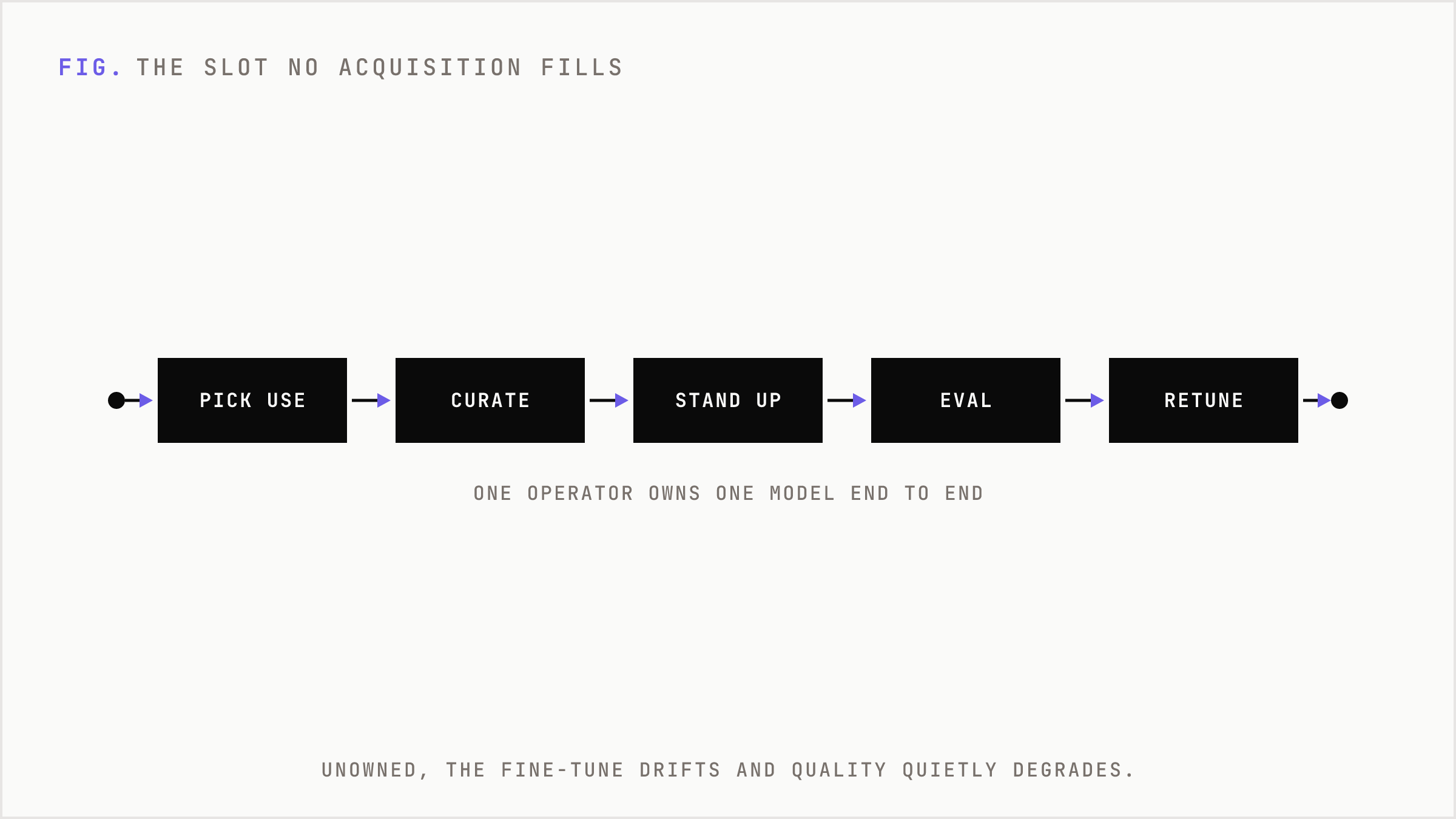
An unowned self-hosted model rots. The input distribution moves, the fine-tune drifts, and quality quietly degrades until a customer complains. The whole claim here rides on the owner who evals and retunes it, because the weights alone go stale on their own. This is where we work: we take the highest-volume use case, stand up the self-hosted model, wire the evals, and hand it back so the client's team runs it without us. Done is the deliverable. A model that demos well and rots in a month is a failure.
Handle the objection a skeptical CTO will raise
A CTO says the frontier labs will keep cutting prices, so self-hosting never pays. Sometimes that is true, and it is the reason the answer is a per-workload calculation, never a mandate. You self-host the one high-volume task where today's price gap already covers a GPU and an owner. You keep everything else on the API precisely because the price war favors the buyer on those workloads. The calculation protects you either way.
A second reader says 6% adoption proves this is niche, so ignore it. Fair on today's volume. The acquisitions are the leading indicator. Nvidia and Stripe are paying billions to own the supply and routing because they expect that 6% to grow into the high-margin workloads. The companies that staff the ownership gap early are the ones who capture it while everyone else reads headlines.
What changes, and what stays the same
Adopt this and one thing changes: you stop treating self-hosting as a posture and start treating it as a subtraction you run per task. What stays the same is most of your stack. The frontier API keeps serving your long tail of low-volume, varied tasks, and it should, because the token math there favors renting. The open weights themselves are becoming a commodity you download for free. The value moves to the routing, the supply, and above all to whoever owns a specialized deployment inside your company by name.
This quarter, do one thing. Pull the real token count on your single highest-volume, most repetitive AI task. Price a self-hosted fine-tuned open model against what that task costs you on a frontier API right now. If the annual gap covers a GPU plus the time of someone who will own the tuning and the evals, build that one model and assign that owner by name before the quarter ends. If it does not, stay on the API and stop reading the acquisition headlines as a signal to move.
If you have a problem, if no one else can help, and if you can find them, maybe you can hire Nyyon.