Nyyon · Blog
How to Choose an AI Marketing Agency
Choose an AI marketing agency by testing its operating system, governance, senior judgment, and proof of profit impact.
Choose an AI marketing agency by inspecting its operating system, not its pitch deck. If you are asking how to choose an AI marketing agency, the direct answer is: pick the team that can connect strategy, data, AI workflows, human judgment, and commercial outcomes into one governed system. The right agency should show how it makes better decisions faster, not merely how many tools it uses.
The common buying process rewards the wrong agency
Most companies still choose agencies the old way. They collect referrals, review case studies, compare retainers, sit through a few strategy slides, and pick the team with the most confident narrative.
That process was already weak for traditional marketing. It is worse for AI marketing because the category is noisy. Many agencies now say they use AI because their account team prompts ChatGPT, generates ad variants faster, or adds an AI reporting widget to the monthly deck.
AI usage is not AI capability.
An AI-enabled agency is an old agency that has added AI tools to its workflow.
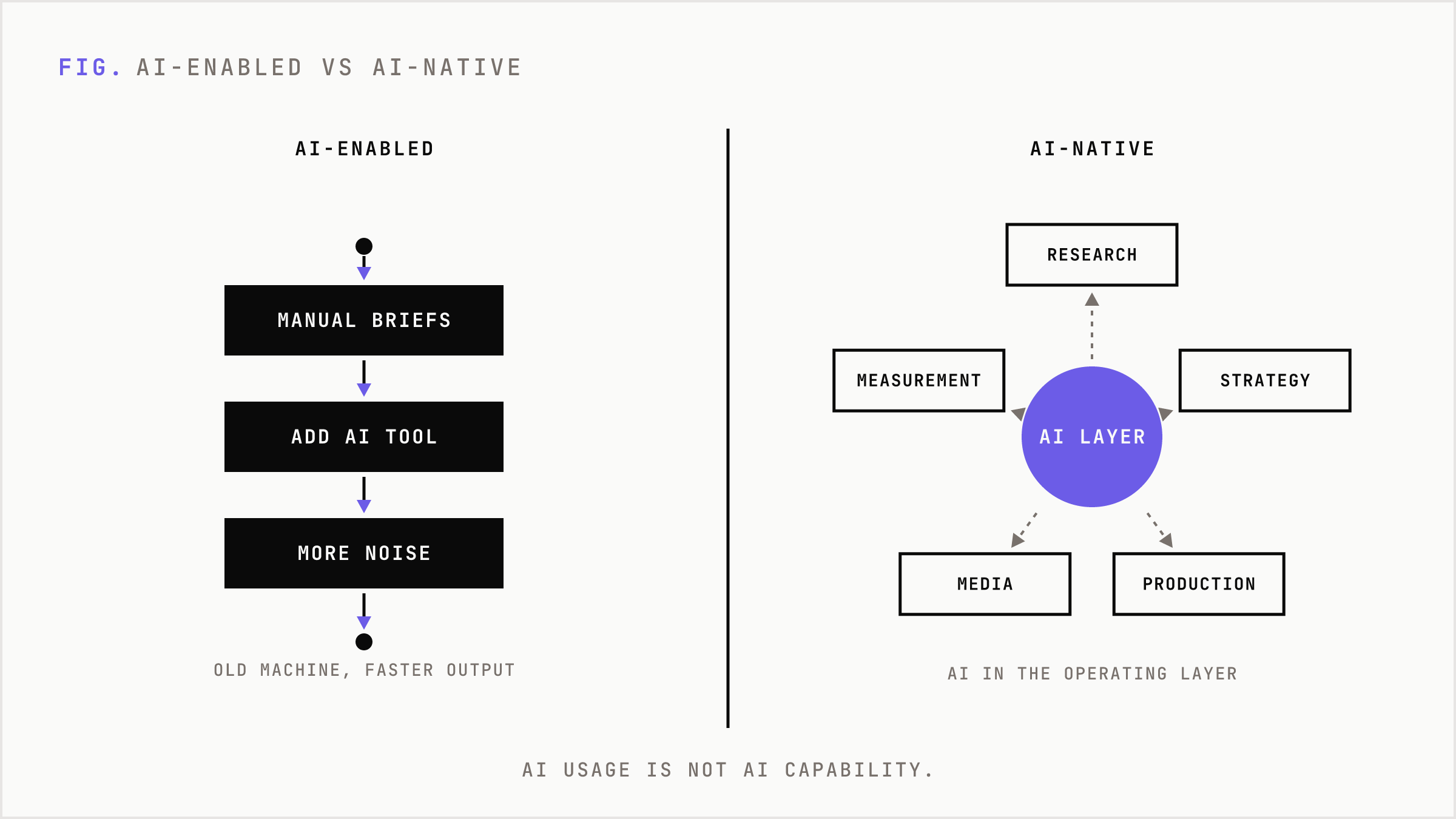
An AI-native agency is an agency where AI is built into the operating layer across research, strategy, production, media, measurement, and learning.
The distinction matters because marketing performance now depends on iteration speed and decision quality. If the agency still runs on manual briefs, disconnected reporting, weekly status calls, and opinion-driven approvals, AI will only make the same machine produce more noise.
The dominant pattern breaks in three places. First, the buyer overweights creative polish and underweights the system that produced it. Second, the buyer asks about tools instead of asking how decisions move from evidence to action. Third, the buyer accepts channel metrics as proof when the real question is whether marketing changed profit, pipeline quality, or payback.
A strong AI marketing agency will not hide behind tool names. It will be able to explain the mechanism. What data enters the system. What agents or workflows operate on it. Where humans approve, edit, and override. Which metrics govern decisions. How learning compounds from one campaign cycle to the next.
Use the Agency Spine Test
The Agency Spine Test is a selection framework for evaluating whether an AI marketing agency has a real operating system or only an AI-flavored service menu.
The test has five parts: commercial clarity, data architecture, AI workflow depth, human governance, and learning cadence. If an agency cannot satisfy all five, it may still be useful for a narrow project. It should not own your growth system.
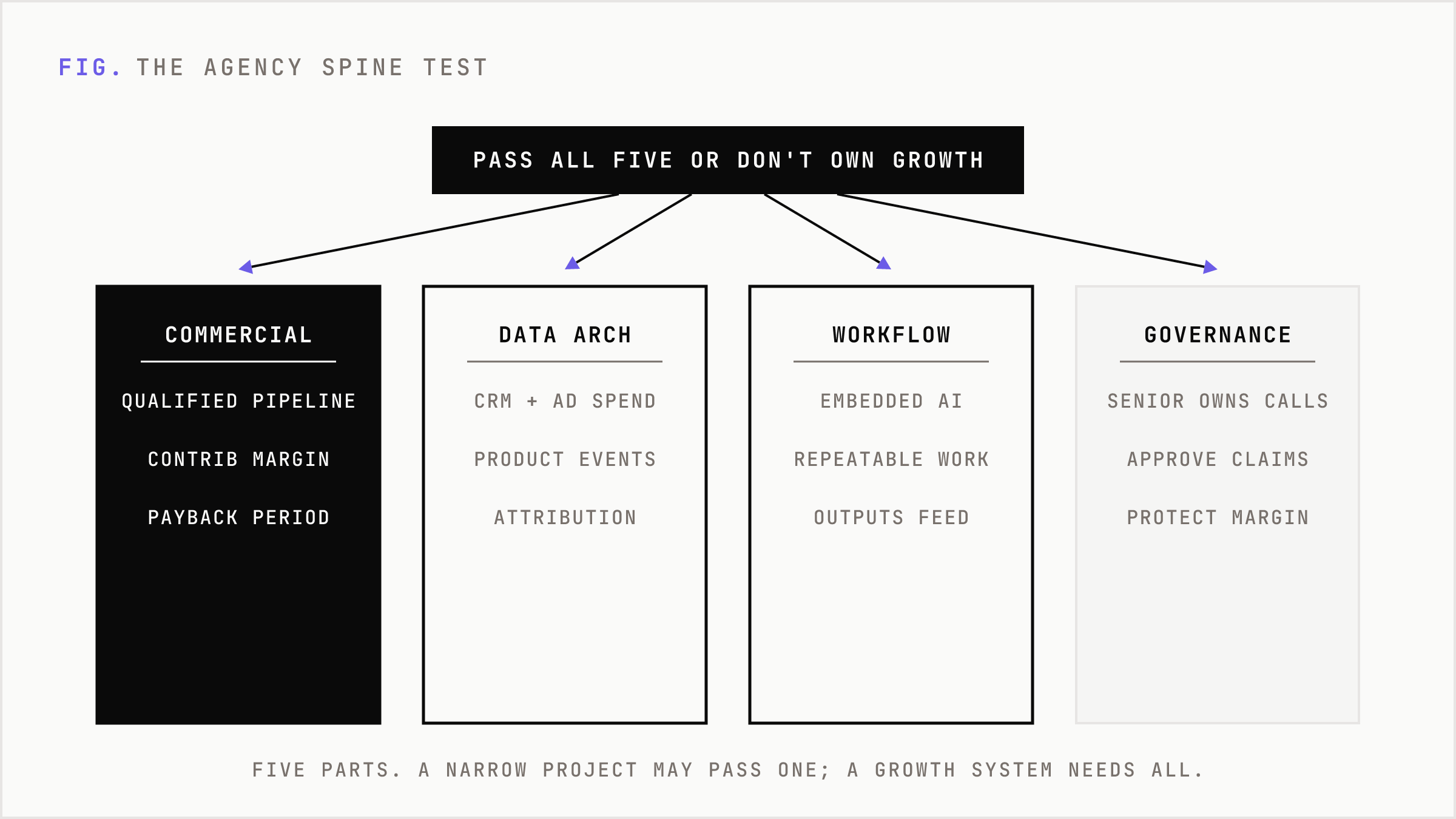
Commercial clarity means the agency can tie its work to the economic unit you actually care about. That may be qualified pipeline, contribution margin, payback period, retained revenue, or new customer profit. It is not a dashboard full of impressions, clicks, MQLs, and blended ROAS without context.
Data architecture means the agency understands the sources that shape marketing decisions. CRM data, ad spend, product events, web analytics, attribution rules, offer history, sales feedback, and revenue data all affect what the AI system should see. An agency does not need to replace your stack on day one, but it does need to know how your stack becomes a decision system.
AI workflow depth means AI is embedded into repeatable work. Audience research, message testing, creative generation, landing page diagnosis, search intent mapping, sales call analysis, experiment design, paid media monitoring, and reporting should feed each other. If every output starts with a blank prompt in a chat window, there is no operating system.
Human governance means senior people own the important calls. AI can draft hypotheses, cluster feedback, summarize trends, and produce options. It should not decide your positioning, approve claims in a regulated category, or chase a metric that damages margin.
Learning cadence means the agency has a rhythm for turning evidence into decisions. Weekly performance reads are not enough. The question is whether the agency maintains a decision log, records what was tested, captures why a choice was made, and uses that memory in the next cycle.
Ask for the workflow, not the tool stack
The weakest question you can ask is, “Which AI tools do you use?” Tool lists are easy to fake and hard to evaluate. A better question is, “Show me how a customer insight becomes a campaign decision inside your system.”
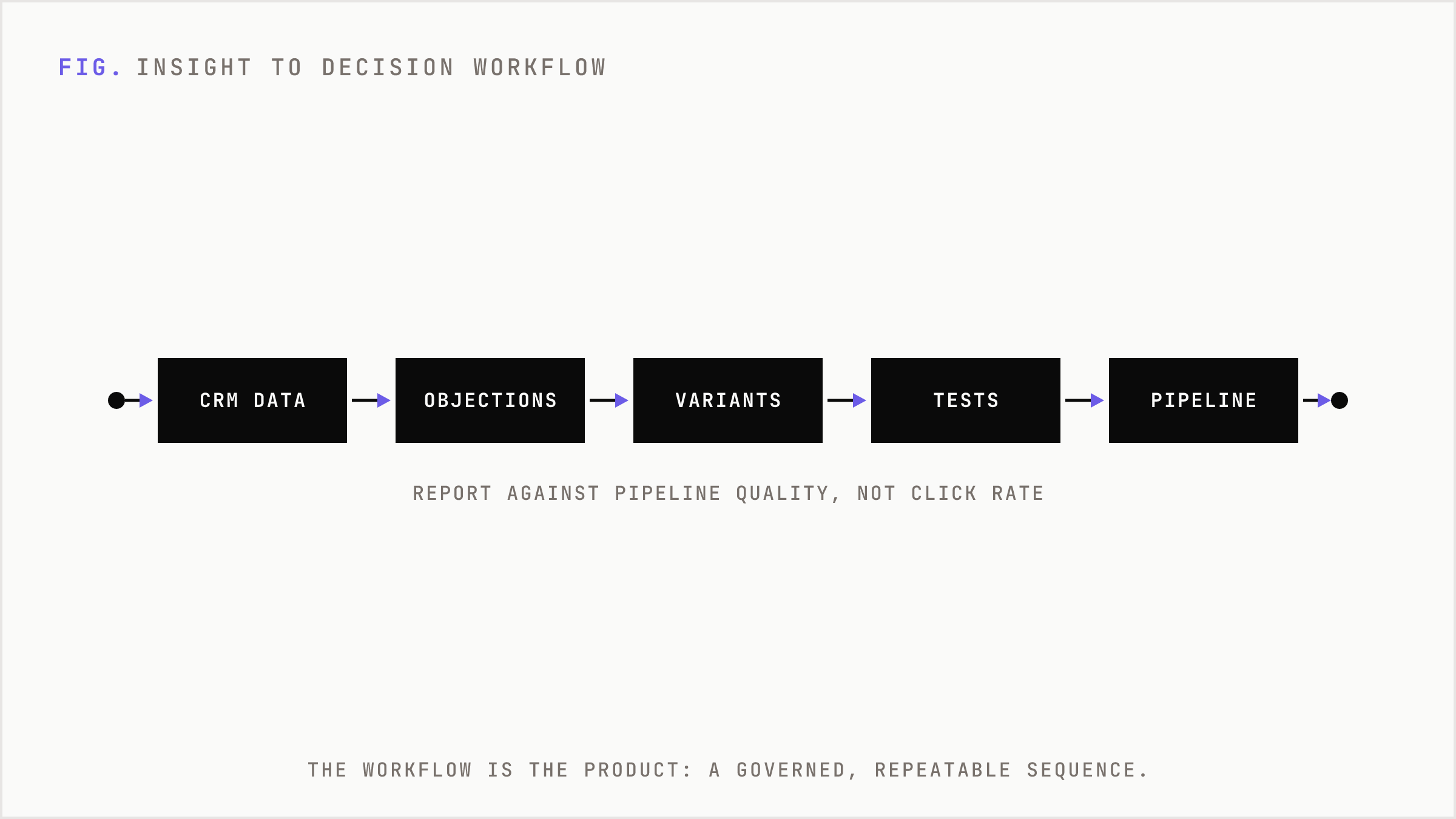
A capable agency should be able to walk through the path without theater. For example, it might analyze closed-won and closed-lost CRM records, extract objections from sales calls, compare those objections against landing page claims, generate message variants, map variants to paid search and paid social segments, launch controlled tests, and report the result against pipeline quality instead of click-through rate alone.
The workflow is the product.
A workflow is a governed sequence of inputs, actions, decisions, and outputs that can be repeated and improved.
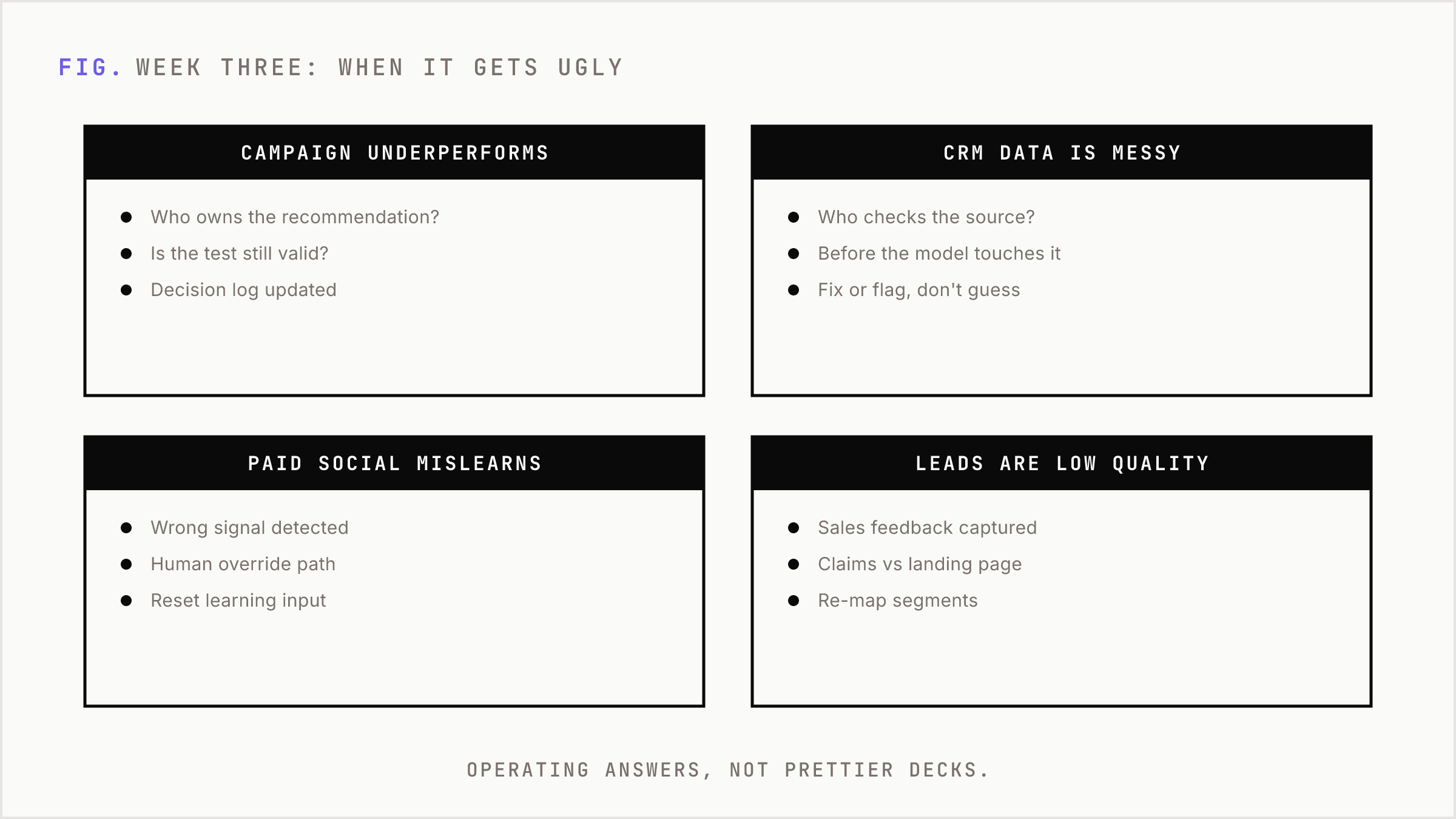
This is where senior buyers should press. Who checks the source data before the model touches it. Who defines the acceptable claims. Who decides whether a test is valid. Who owns the final recommendation. Where is the record kept. What happens when the AI output conflicts with customer evidence.
If the agency answers with a demo, slow the conversation down. Demos are designed to compress complexity. You need to know what happens during week three, when a campaign underperforms, the CRM data is messy, paid social learns the wrong signal, and the sales team says the leads are low quality.
Good agencies have operating answers for ugly moments. Weak agencies have prettier decks.
Demand proof at the level of decisions
Most case studies are written to make causality look cleaner than it was. That does not make them useless. It means you need to read them for decision evidence, not applause lines.
Ask the agency to show one example where its AI system changed the decision a human team would have made. The example does not need to reveal confidential client data. It does need to show the before state, the evidence, the decision, the action, and the commercial result or learning.
A concrete example might look like this: a B2B SaaS company believes its best paid search message is speed because that is what the product team emphasizes. The agency ingests sales call transcripts, CRM notes, competitor pages, and search query data. The system finds that buyers who convert faster talk less about speed and more about implementation risk. The agency changes ad copy, landing page hierarchy, and sales enablement snippets around risk reduction. The consequence is not just a new headline. The consequence is a better decision about what the market is actually buying.
That is the standard. AI should improve judgment, not decorate execution.
There are three numbered consequences of choosing an agency that cannot prove decision quality. 1. You get more assets without clearer strategy. 2. You get faster reporting without better choices. 3. You get more campaign motion while CAC, payback, or pipeline quality quietly worsens.
Proof should also include failure handling. Ask for a test that did not work and what changed afterward. Agencies that cannot discuss misses are usually selling performance as a story, not as an operating discipline.
Separate senior judgment from account management
AI changes production economics, but it does not remove the need for senior marketing judgment. In many cases, it raises the standard. When an agency can produce more ideas, more ads, more pages, and more analysis, the bottleneck becomes deciding what deserves to exist.
Senior judgment is the ability to make high-stakes marketing calls under uncertainty using evidence, context, and commercial taste.
This is different from having a senior person appear on the sales call. You need to know who will actually inspect the work, challenge the model, make trade-offs, and speak directly when the strategy is wrong.
Ask who owns positioning. Ask who approves the experiment roadmap. Ask who decides when a channel should be cut. Ask who will tell you that the offer is weak rather than pretending the media plan can fix it.
The answer matters because AI can make weak strategy more expensive at higher speed. A poor ICP definition becomes more bad audiences. A vague offer becomes more forgettable creative. A broken attribution model becomes more confident misallocation. A shallow content strategy becomes more pages that answer nobody’s buying question.
Good AI marketing agencies are not anti-human. They are anti-waste. Humans set direction, standards, constraints, and judgment calls. AI expands the agency’s ability to research, produce, monitor, and learn inside those constraints.
This is also where regulated and complex categories should be stricter. Fintech, health tech, and B2B SaaS with technical buyers cannot afford casual claims. The agency needs review gates, source discipline, and a clear policy for what AI may draft versus what humans must validate.
Know what changes after you hire one
Choosing a real AI marketing agency changes the client-side job. You should expect more decision velocity, more transparent trade-offs, and more pressure to clarify what the business actually values.
Decision velocity is the rate at which a team makes and compounds high-quality decisions.
The upside is meaningful. Strategy cycles shorten. Research becomes less episodic. Creative testing expands without waiting for large production blocks. Reporting shifts from status updates to decisions. The agency can carry more of the operating burden because AI reduces the cost of repeated analysis and production.
Some things do not change. The market still decides whether your offer matters. Sales still needs to handle the demand marketing creates. Product still has to deliver. Finance still has to care about payback and margin. AI does not erase weak fundamentals. It exposes them faster.
There are trade-offs. A strong AI-native agency will ask for access to data, not just brand guidelines. It will push for cleaner definitions of qualified pipeline, CAC, customer segments, and conversion events. It will ask your team to make decisions faster because slow approvals destroy the advantage. It may also challenge internal beliefs that have survived because nobody had the evidence or energy to confront them.
That can be uncomfortable. It is also the point.
If you want a vendor to take requests, generate assets, and send a monthly report, choose a production shop with AI tools. If you want an agency to improve the quality and speed of growth decisions, choose the team with a spine: governed data, embedded AI workflows, senior judgment, and a commercial scorecard that survives scrutiny.
The best AI marketing agency is not the one with the loudest AI story. It is the one whose system makes your team harder to fool.