Nyyon · Blog
The New Growth Engine: How AI Marketing Actually Wins in 2026
AI marketing does not win with better models. It wins with faster learning loops, rapid creative testing, and tight data integration across the funnel.
AI marketing wins by compressing the time between idea, test, and learning.
The category is mislabeled
There is no clean category called AI marketing agency. The market uses the term, but the structure underneath is fragmented.
Some firms generate ad creatives with models. Others run experiments faster. Enterprise consultancies layer AI onto existing data systems. A few vertical players embed AI deeply into specific funnels.
They all claim the same outcome. Higher conversion.
The mechanism is different.
The best performers are not defined by their models. They are defined by how tightly they connect generation, deployment, and feedback.
Speed replaces brilliance
Traditional marketing optimized for big ideas. Campaigns were expensive, slow, and high stakes. Creative quality mattered because volume was constrained.
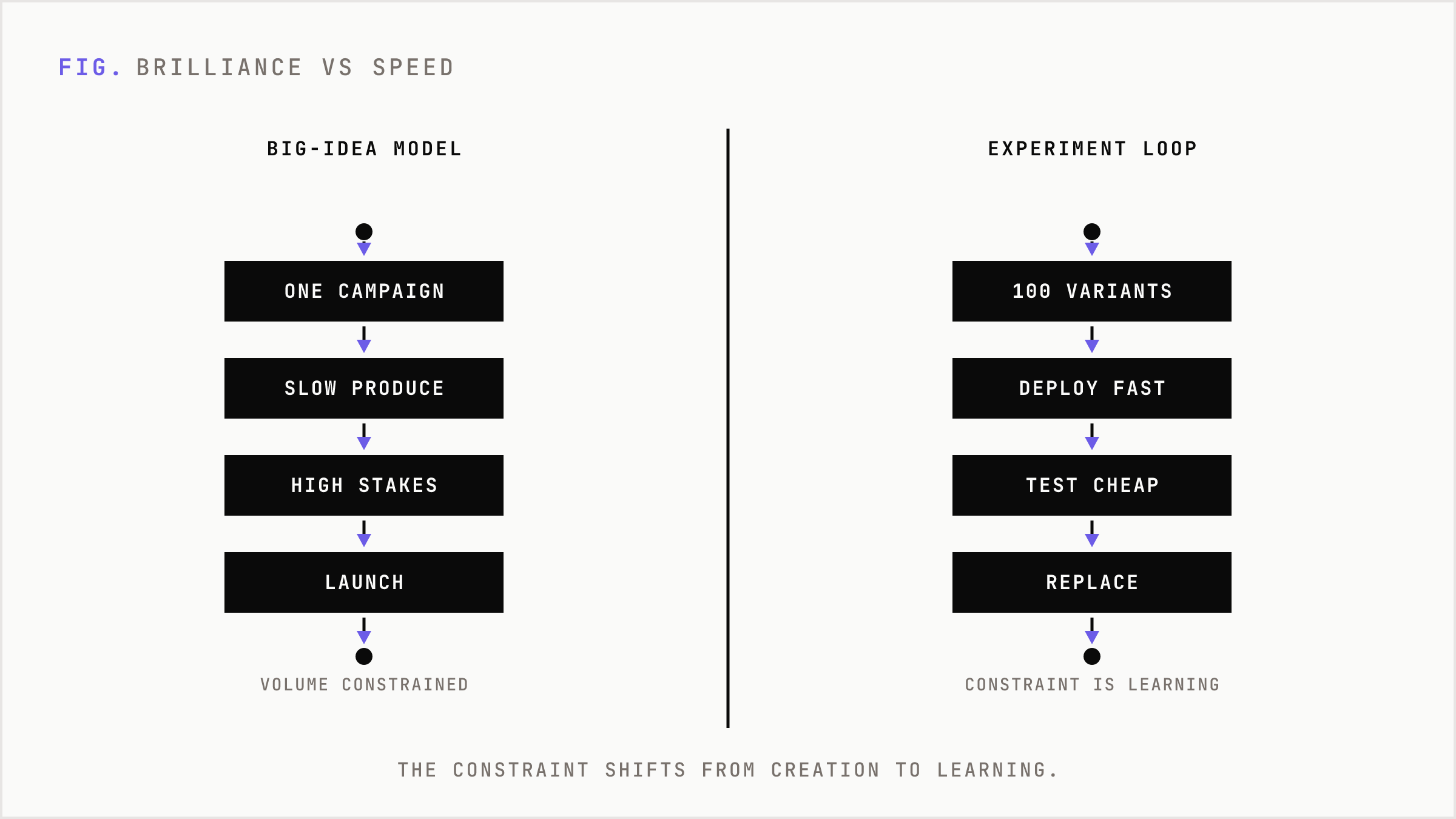
AI removes that constraint.
You can now generate 100 variations of an ad in the time it used to take to produce one. The constraint shifts from creation to learning.
Most teams fail here. They increase output but do not redesign the system around iteration.
The result is more noise, not more signal.
The teams that win treat marketing as a continuous experiment loop. They care less about any single asset and more about how quickly they can test and replace it.
The real unit of advantage: feedback latency
The most important metric in AI marketing is not ROAS or CTR. It is feedback latency.
How long does it take to go from idea to live test to decision?
Top systems push this below 48 hours. Many still operate on weekly or monthly cycles.
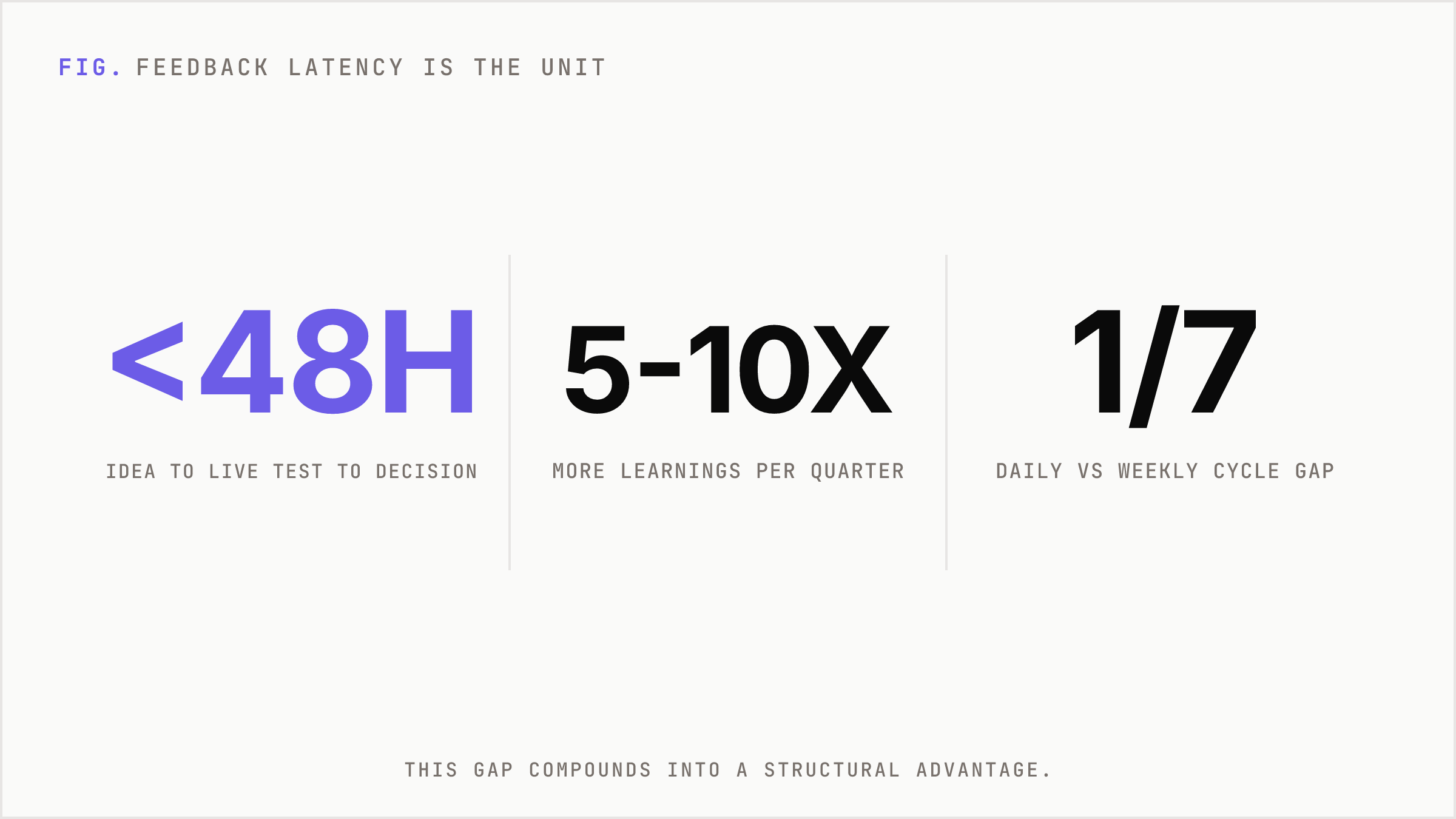
This gap compounds.
A team running daily iterations will process five to ten times more learnings than a team running weekly tests. Over a quarter, the difference becomes structural.
This is why smaller AI native agencies often outperform larger incumbents. Not because they are smarter, but because they move faster.
Creative volume beats creative quality
This is the uncomfortable shift.
In most paid channels, especially Meta and TikTok, performance is driven by variation density. The system needs options to find winners.
AI enables this by generating large batches of creatives tied to different hooks, formats, and audience angles.
Platforms like Pencil and AdCreative.ai automate parts of this process. More advanced teams build internal pipelines that connect performance data directly back into generation.
The winning pattern looks like this:
- Generate dozens of variants across formats
- Deploy quickly across segmented audiences
- Collect performance data in near real time
- Feed results back into the next generation cycle
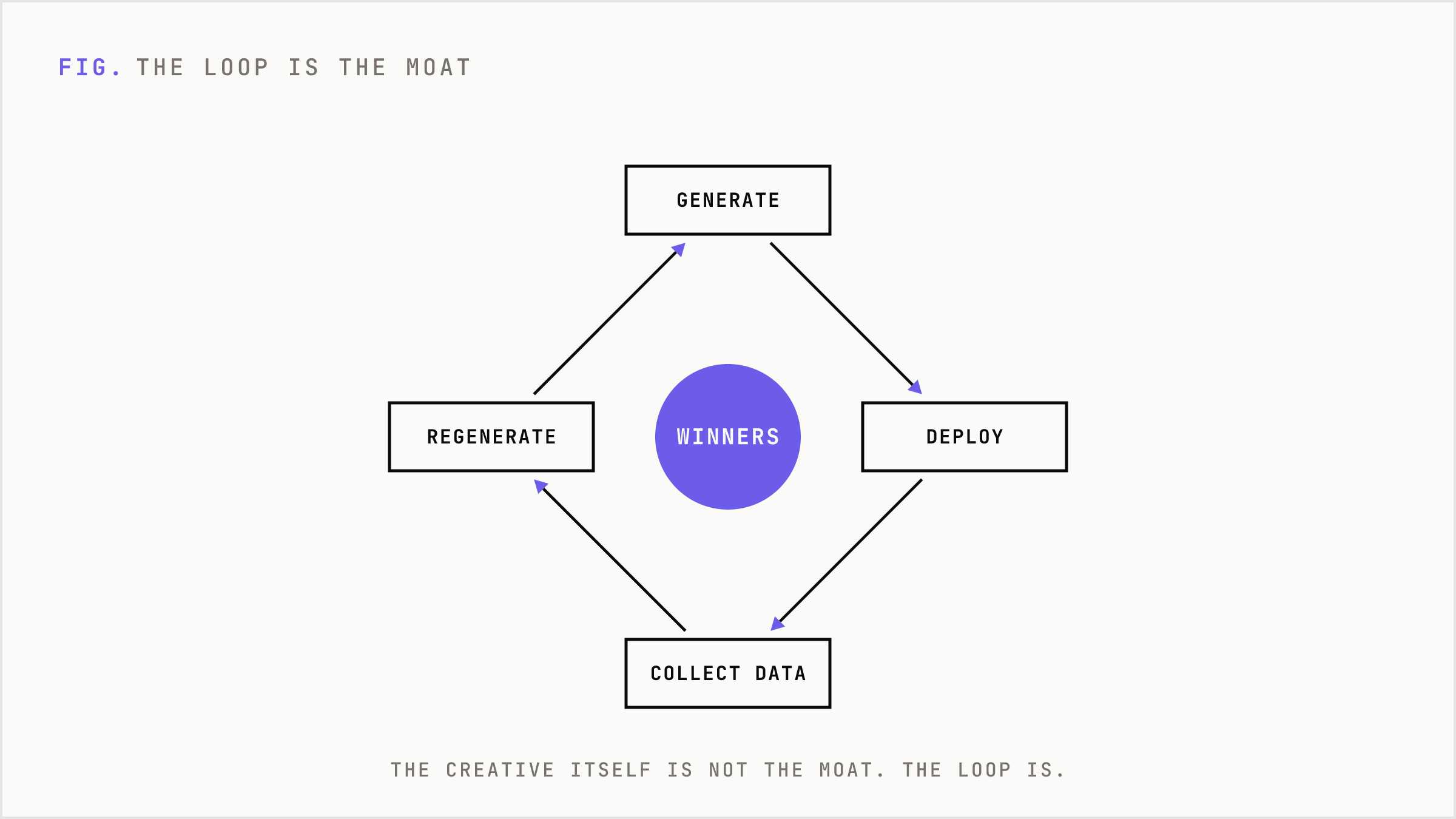
The creative itself is not the moat. The loop is.
Data ownership defines the ceiling
Most so called AI agencies operate on top of platform data. They pull metrics from Meta or Google and optimize within those constraints.
This creates a ceiling.
The highest performing teams integrate first party data. CRM events, purchase behavior, lifecycle stages, and cohort level retention.
When this data feeds into the system, optimization shifts from surface metrics to actual business outcomes.
Instead of optimizing for clicks, the system optimizes for downstream revenue or lifetime value.
Enterprise consultancies are strong here. They build deep integrations across CDPs, warehouses, and analytics stacks. But they move slowly.
AI native firms move faster but often lack this depth.
The opportunity is in combining both.
Model orchestration matters more than model choice
There is an obsession with which model is used. GPT variants, image models, fine tuning.
This is mostly noise.
What matters is how models are orchestrated into workflows.
A high performing system separates functions:
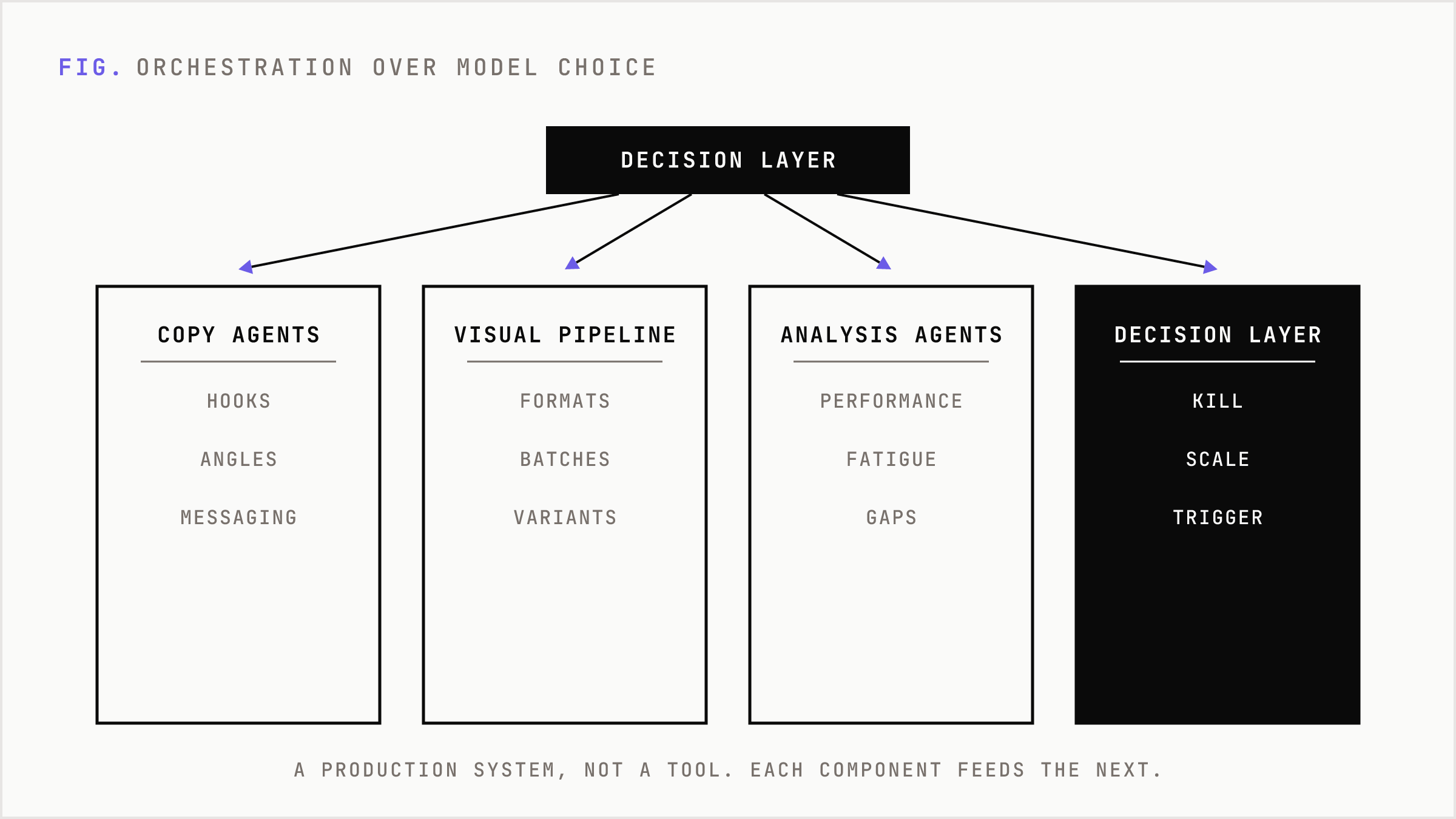
- Copy generation agents
- Visual generation pipelines
- Performance analysis agents
- Decision layers that trigger new variants
Each component feeds the next.
This is closer to a production system than a tool.
Single model setups cannot replicate this because they lack specialization and feedback structure.
Channel logic is not interchangeable
A common mistake is treating all channels the same.
They are not.
TikTok rewards native, fast moving, trend aligned content. Meta rewards structured variation and audience segmentation. Google relies more on intent and query matching.
AI systems must encode these differences.
A generic creative generator produces average results. A channel aware system produces competitive ones.
This is why verticalized agencies often outperform generalists. They embed channel and audience logic directly into their pipelines.
The bottleneck moves to decision making
As generation becomes cheap, human attention becomes the constraint.
Someone still needs to decide what to test, what to kill, and what to scale.
Many teams remain human bound here. Analysts review dashboards, write reports, and make weekly recommendations.
Leading systems reduce this friction.
They automate parts of the decision layer. Not fully autonomous, but assisted.
For example:
- Automatically pausing underperforming creatives
- Allocating more budget to emerging winners
- Triggering new variant generation based on gaps
This shifts human input from execution to oversight.
Why most AI agencies underperform
The failure modes are consistent.
First, they focus on prompts instead of systems. Generating content is not the same as improving performance.
Second, they lack closed loop attribution. Without tying actions to revenue, optimization drifts toward vanity metrics.
Third, they overuse synthetic personas. Real customer data is replaced with assumptions.
Fourth, they ignore offer testing. AI can optimize messaging, but it cannot fix a weak value proposition.
Finally, they produce volume without managing fatigue. Audiences burn out faster when exposed to repetitive patterns, even if generated by AI.
The shift from campaigns to systems
The campaign model is breaking.
Campaigns assume a start and end. AI driven marketing operates continuously.
Budgets are no longer allocated to discrete efforts. They are allocated to systems that run indefinitely.
This changes how buyers evaluate partners.
Instead of asking for case studies, they ask:
- How fast can you deploy new variants?
- How is data fed back into the system?
- What percentage of decisions are automated?
This is closer to evaluating infrastructure than services.
Where the market is going
The direction is clear.
Performance agencies are becoming software companies. They build internal platforms to manage generation, testing, and optimization.
Agent based systems are emerging. Autonomous media buyers, self updating landing pages, and adaptive creative pipelines.
First party data becomes the core asset as third party signals degrade.
Creative and media buying converge into a single loop instead of separate functions.
The firms that integrate these layers will capture disproportionate value.
The practical takeaway
If you are buying AI marketing, ignore the surface claims.
Do not ask what tools they use. Ask how their system learns.
Look for evidence of:
- High variant output per campaign
- Short deployment cycles
- Direct integration with your data stack
- Clear feedback loops tied to revenue
If those are missing, the AI label is irrelevant.
The advantage is not intelligence. It is iteration speed, structured into a system that compounds learning over time.
That is what actually drives conversion in 2026.
FAQ
What defines a true AI marketing system?
A true system connects creative generation, deployment, and performance feedback into a continuous loop that improves automatically over time.
Why is speed more important than creative quality?
Because platforms reward testing volume. More variations create more opportunities to find winning combinations faster.
Do AI agencies replace human marketers?
No. They shift human roles from execution to system design, oversight, and strategic decision making.
What data matters most for AI marketing?
First party data such as CRM events, purchase behavior, and lifecycle metrics. This enables optimization for real business outcomes.
How should companies evaluate an AI marketing partner?
Focus on iteration speed, data integration, and feedback loops rather than tools or model claims.