Nyyon · Blog
How AI Ends the Fixed Email Journey
AI changes lifecycle marketing by replacing rigid drip campaigns with event-informed conversations shaped by user context, goals, and a reporting layer built around decisions.
AI ends the fixed email journey. How does AI change lifecycle and email marketing? AI changes lifecycle and email marketing by replacing rigid drip campaigns with event-informed conversations built around user context, behavior, current state, and business goals. The real shift in AI email lifecycle marketing is not that AI writes more subject lines. It is that the system can decide what conversation should happen next for a segment of one.
The dominant pattern is still the fixed journey
Most lifecycle programs are still designed like maps. A user enters a welcome flow. A trial user enters an activation sequence. A customer enters an onboarding drip. A churn-risk user enters a winback path. The marketer defines the branch logic, the delay, the message, and the exit rule.
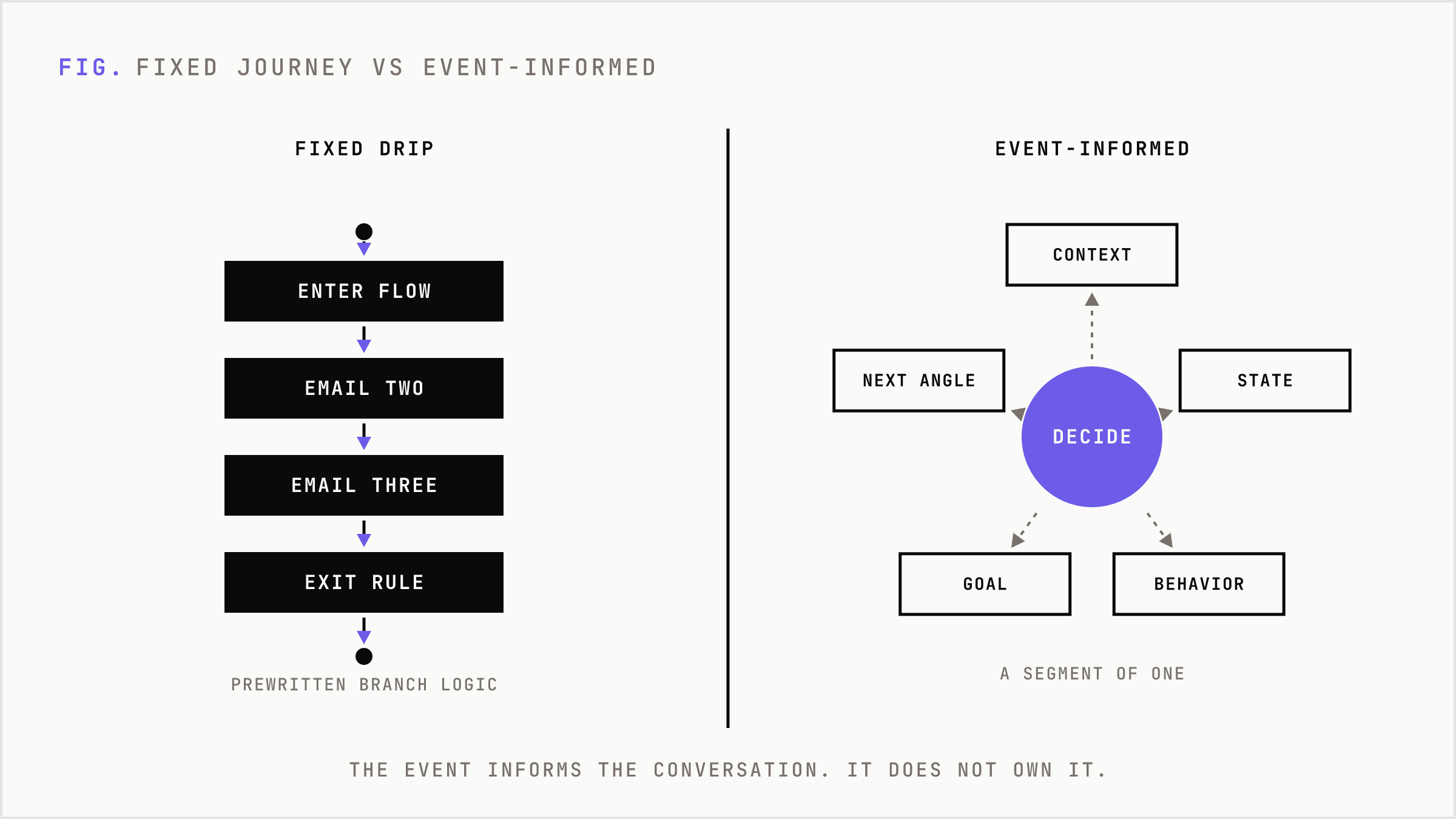
That model was reasonable when the system could only react to a small number of events. Signed up. Added to cart. Viewed pricing. Did not open email three. The flow builder forced marketers to turn behavior into a manageable tree.
The tree is now the constraint.
Fixed journeys break because users do not behave like journey diagrams. Two people can both create an account and need completely different next actions. One has invited teammates but not configured a workspace. One has explored advanced features but never completed the basic setup. One is a founder evaluating alone. One is an operator trying to prove value before a procurement conversation. A fixed activation email treats these differences as edge cases. AI makes them the center of the system.
The old lifecycle stack also overstates what a “transactional” email is supposed to do. A receipt confirms payment. A password reset gets someone back into the product. A shipping update reduces support demand. Those jobs still matter. But AI changes the ceiling. A system can now create as many purposeful interactions as needed to pursue a business goal, without pretending every message must fit into a prebuilt drip.
The better mechanism is event-informed conversation
Event-informed conversation is lifecycle communication where an event starts the reasoning, but context shapes the message.
That definition matters. This is not merely event-based automation with better copy. Event-based automation says, “User did X, send Y.” Event-informed conversation says, “User did X, given who they are, what they have already done, what state they are in, what the business goal is, and what action is likely to move them forward, what should we say now?”
The event informs the conversation. It does not own the conversation.
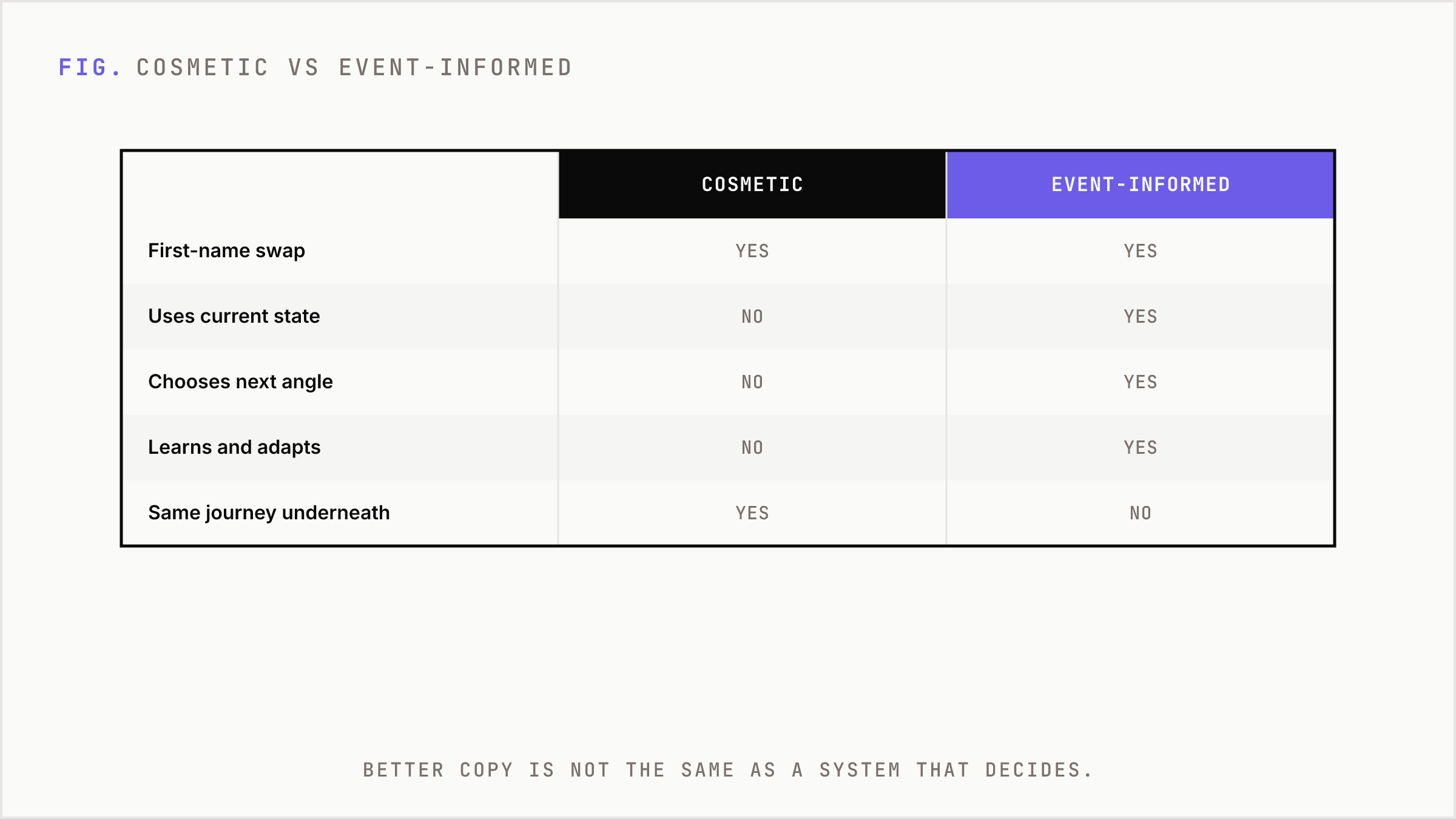
That distinction is where most companies underuse AI. They point a model at an email template and ask it to make the copy warmer, shorter, or more personalized. The result is cosmetic personalization. A first name, a role reference, a dynamic product mention. Better than nothing. Still the same journey underneath.
The stronger pattern is ultra-segmentation plus purpose. AI can speak to people as a segment of one across more touchpoints than welcome emails, transactional emails, nurture sequences, or drips. It can use product events, CRM fields, plan type, company size, prior messages, current usage gaps, and goal definitions to choose the next best angle.
Next best angle is the specific reason a user should act now.
For one user, the angle might be unfinished setup. For another, it might be value proof for a manager. For another, it might be wasted spend, unused inventory, team adoption, compliance risk, or a faster path to a result they already signaled they want. The email is no longer “email three.” It is an intervention with a purpose.
Activation is where the shift becomes obvious
Activation exposes the weakness of fixed lifecycle marketing because activation is rarely one behavior. It is a path to perceived value. The product team may define an activation event, but users reach that moment through different contexts and with different friction.
Consider a B2B SaaS company with a free trial. The old lifecycle program might send a five-email onboarding sequence: welcome, feature overview, case study, reminder, upgrade prompt. It can branch if the user does or does not complete setup, but the journey is still mostly prewritten.
An AI email lifecycle marketing system would treat the same trial differently. If the business goal is activation, the system pulls from actual user behavior, user context, segment, and current state. It sees that a marketing ops user connected the CRM but has not mapped lifecycle stages. It sees that a founder watched a demo video, invited no one, and returned to pricing twice. It sees that an enterprise user created a workspace, added teammates, but has not completed the permission step blocking collaboration.
Each user receives a different angle because each user has a different blocker.
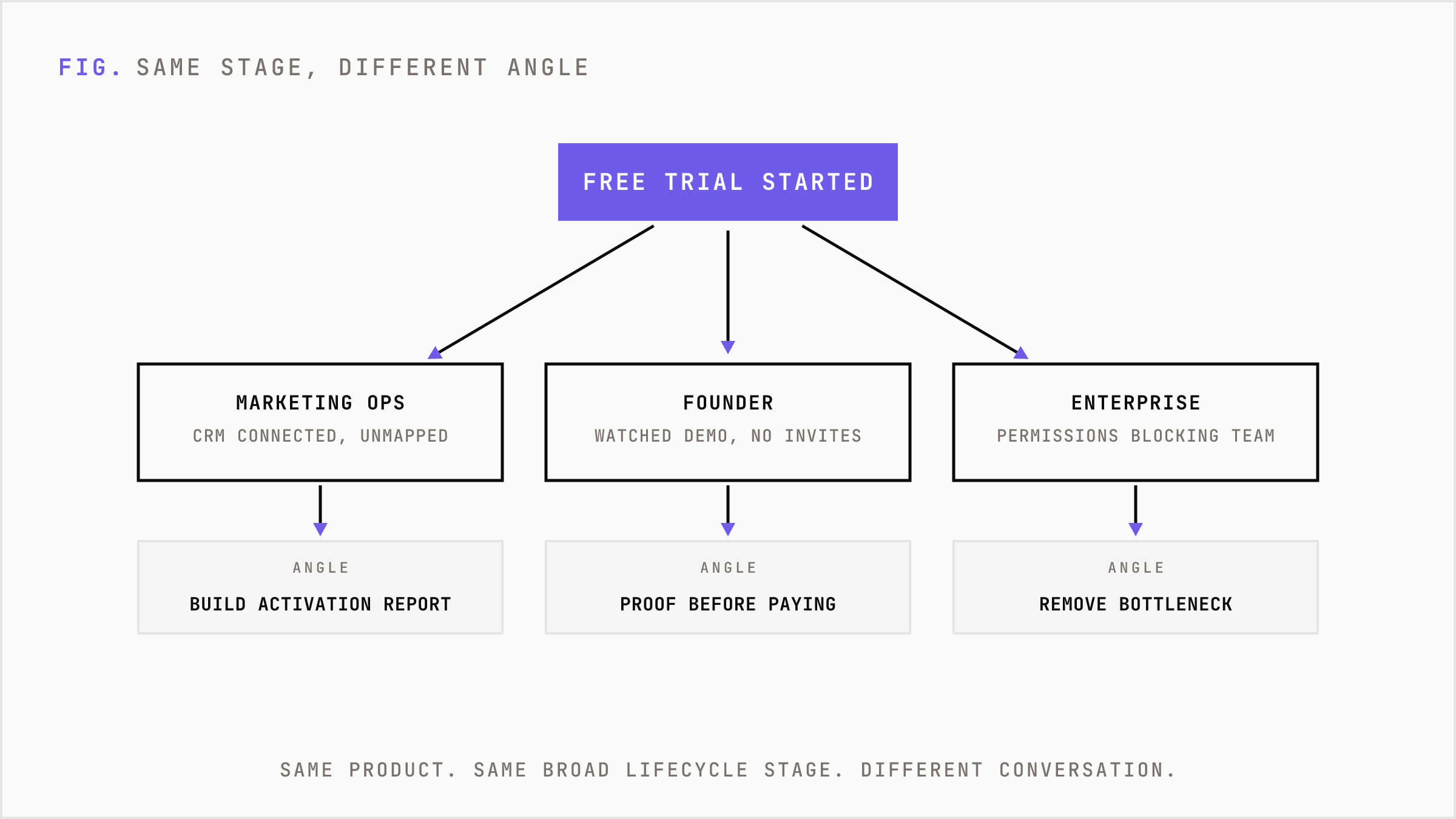
The marketing ops user might get a message about turning CRM fields into a usable activation report. The founder might get a message that frames the next action as proof before paying. The enterprise user might get a message focused on removing the permissions bottleneck so the team can test together. Same product. Same broad lifecycle stage. Different conversation.
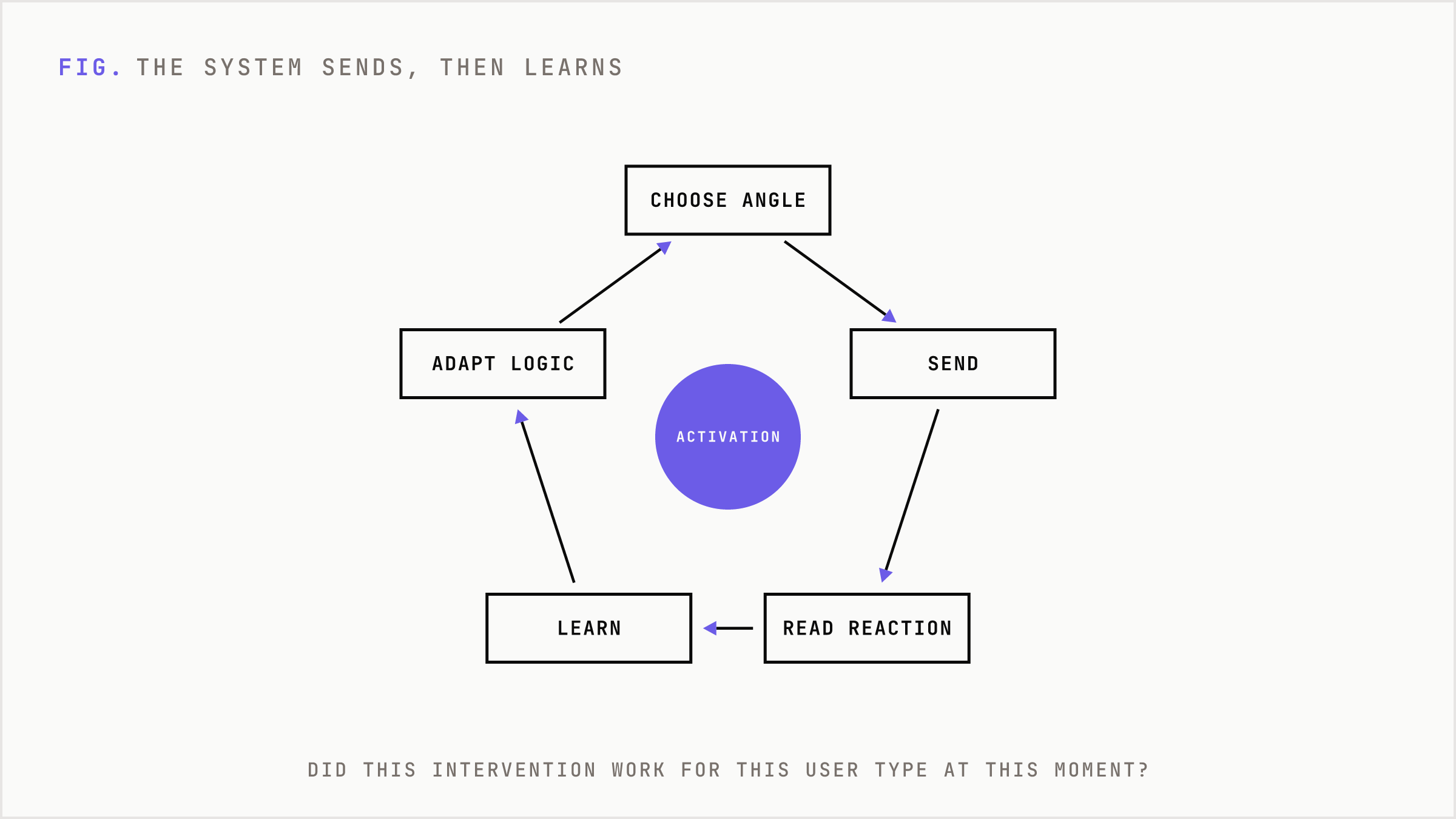
Consequence 1: lifecycle reporting shifts from “email 3 open rate” to “which angle moved this cohort toward activation.” That is the operating metric. Not whether the third message in a static flow performed better than the second. The question becomes whether the system learned which intervention works for which user type at which moment.
This is the part many teams miss. The AI system should not only send. It should learn. Based on the user’s reaction, it can learn whether that angle worked for this user type and adapt over time. If users in a certain segment ignore feature education but respond to a peer-proof angle, the system should change its future decision logic. If a certain action reliably predicts activation only for one plan type, the system should stop treating it as universal.
The encyclopedia model gives way to the chat model
Traditional lifecycle strategy often behaves like an encyclopedia. The team tries to design the complete book in advance. Every journey, every branch, every edge case, every content module, every lifecycle state. The premise is that if the library is complete enough, the user will receive the right page.
AI changes the design problem. You do not need an encyclopedia when you have a chat. You do not need to design the whole book if someone can answer the question. It is not about having a larger wiki. It is about having the right knowledge available when it is needed.
That does not mean the system invents strategy on the fly. It means marketers define the business goals, approved knowledge, brand rules, offer logic, decision boundaries, measurement rules, and escalation paths. The AI then uses those assets to shape the next purposeful interaction.
Knowledge availability is the governed access to the facts, rules, examples, and constraints an AI system needs to act correctly.
Without that knowledge layer, AI lifecycle marketing becomes random. The system may write fluent email, but it will not know which claims are approved, which products map to which segments, which users should not receive discounts, which actions indicate intent, or what the company actually means by activation. Fluency is cheap. Governed decision quality is the scarce part.
This is why the best AI lifecycle programs are not just prompt libraries. They are operating systems. They connect product events, customer identity, lifecycle states, commercial goals, message history, content assets, and outcome data. Human operators still hold the wheel. The AI gives the system the ability to reason across more context than a person can manually encode into a flow builder every week.
The reporting layer must change with the messaging layer
The strongest objection to event-informed conversations is visibility. It is a real objection.
Fixed journeys are easy to inspect. A marketer can open a flow, see where users are, compare email one to email two, and report on the branch. That comfort disappears when every user can receive a more granular message shaped by context and decision logic. It becomes harder to understand exactly where every person is in a fixed journey because the fixed journey is no longer the unit of work.
That trade-off is worth taking only if the reporting layer matures.
A goal-based reporting layer is measurement organized around business goals, cohorts, decision logic, outcomes, and learned angles.
Instead of asking only whether a specific email performed, the reporting layer asks sharper questions. Which cohorts moved toward activation after which category of intervention? Which angles increased usage depth without increasing unsubscribes? Which triggers created revenue movement rather than noise? Which user states predict response to a human follow-up rather than another automated message? Which model decisions should be overridden by a rule?
This is not an argument against email analytics. Opens, clicks, replies, conversions, unsubscribes, and deliverability still matter. They just stop being the top of the hierarchy. The hierarchy starts with the business goal. Activation. Expansion. Repeat purchase. Retention. Reactivation. Email metrics become diagnostic signals inside that goal, not the goal itself.
The trade-off is operational. Teams need cleaner data, stronger identity resolution, better event definitions, and a decision log. They need to audit the angles the system is using. They need to know which knowledge sources inform messages. They need governance around offers, claims, tone, compliance, and suppression. The AI creates more communication surface area, which means the controls matter more, not less.
What this looks like in reality
Do not visualize this as a prettier flowchart.
A fixed lifecycle journey is a map. An AI-native lifecycle system is closer to a control room. The useful view is not one giant diagram with every possible branch. It is a set of live surfaces that show the system’s current judgment and the evidence behind it.
At minimum, teams need four views.
1. A goal board. This shows the business outcomes the system is trying to move: activate trial users, expand high-fit accounts, rescue stalled onboarding, reduce renewal risk, or bring dormant users back. Every message should ladder up to one of those goals. If a touch does not serve a goal, it is probably noise.
2. A user-state view. This replaces the old “where are they in the drip?” question. The better question is: what does the system currently believe about this person? New evaluator. Stuck in setup. Needs proof for a manager. Ready for sales. At risk because usage dropped. The state should be explainable, not mystical.
3. An angle library. This is where the team manages the strategic moves the system is allowed to try. Product education. Peer proof. Cost of inaction. Manager-ready summary. Setup unblock. Expansion use case. Human follow-up. Each angle should have examples, constraints, and outcome history. The system can adapt the message, but it should not invent the strategy from nothing.
4. A decision log. This is the audit trail. Why did this person get this message, through this channel, at this time? What event triggered the reasoning? What context was used? Which goal was being pursued? What happened next? Without the decision log, adaptive lifecycle marketing becomes impossible to manage.
There are a few ways to build it.
The lightweight version is a warehouse plus reverse ETL plus a lifecycle tool. Product events, CRM fields, billing data, and message history feed a customer profile. The AI layer recommends the next best angle. The lifecycle platform sends the message. The warehouse records the outcome.
The more flexible version is agentic. Small agents own specific jobs: classify user state, choose an angle, draft the message, check compliance, decide whether to send or escalate, and write the decision back to memory. Each agent is narrow enough to test. The system becomes easier to maintain because the logic is modular.
The version I like most is chat-operated. A human operator can ask, “Why are these trials not activating?” or “Show me users who need a manager-proof angle,” and the system can answer from the same context it uses to send. That matters. If the reporting layer and the action layer are separate, the team will not trust either one.
The visual metaphor is not a journey builder. It is a live operating layer: goals at the top, user states underneath, angles as the available moves, decisions logged as they happen, and outcomes feeding the next round of judgment.
That is how you keep the system visible without forcing it back into a rigid diagram.
What changes, and what stays the same
What changes is the unit of design. The marketer stops designing a rigid sequence and starts designing a conversation system. The work moves from “what are the seven emails in this flow?” to “what goal are we pursuing, what context matters, what angles are available, what actions should follow each user state, and how will the system learn?”
What also changes is the role of lifecycle content. Content becomes modular knowledge. Proof points, use cases, objections, product instructions, customer examples, and offer rules need to be structured so the system can retrieve and apply them. A generic nurture library is less useful than a governed set of accurate, specific assets tied to customer states and business outcomes.
What stays the same is judgment. AI does not remove the need to decide what activation means, which behaviors matter, which segments are commercially valuable, when not to send, and what brand risks are unacceptable. It raises the cost of weak strategy because weak strategy now scales faster.
The companies that benefit most are not the ones with the most emails. They are the ones with enough behavioral data, clear lifecycle goals, and the discipline to measure outcomes beyond flow-level vanity metrics. B2B SaaS companies with product usage data are obvious candidates. Fintech and health tech companies can benefit too, provided compliance and governance are built into the system from the start. DTC brands can use the same mechanism around replenishment, education, post-purchase adoption, and retention, as long as they avoid turning personalization into noise.
The end state is not an inbox full of AI-written messages. The end state is fewer wasted touches and more purposeful ones. AI changes lifecycle marketing when it stops treating email as a prewritten sequence and starts treating it as a governed conversation system built to move the next right user toward the next right business outcome.