Nyyon · Blog
Goldman is asking agents the wrong money question
Goldman is asking when AI agents make money as if the agent were the product. The revenue sits one layer up, at the outcome the agent works inside, and only the vendor who owns that outcome escapes the price race.
The question in the report
Goldman Sachs put out a note this month asking when AI agents will start making money. The framing reads as a technology question with a dollar sign glued to the end: draft the email, file the ticket, book the flight, decide when the model output turns into revenue. Read the same question like an operator and it points at the wrong layer. Agent capability is the input, and the input is getting cheaper every quarter. Revenue lives one layer up, at the outcome the agent sits inside.
The agent that drafts a support reply is a feature. Two more vendors ship the same feature this quarter, and the price of that feature races to whatever the cheapest lab will subsidize it for. That is what commoditization looks like while it happens: the same capability, from more vendors, priced by tokens or seats. Anyone selling the capability is on the wrong side of that race.
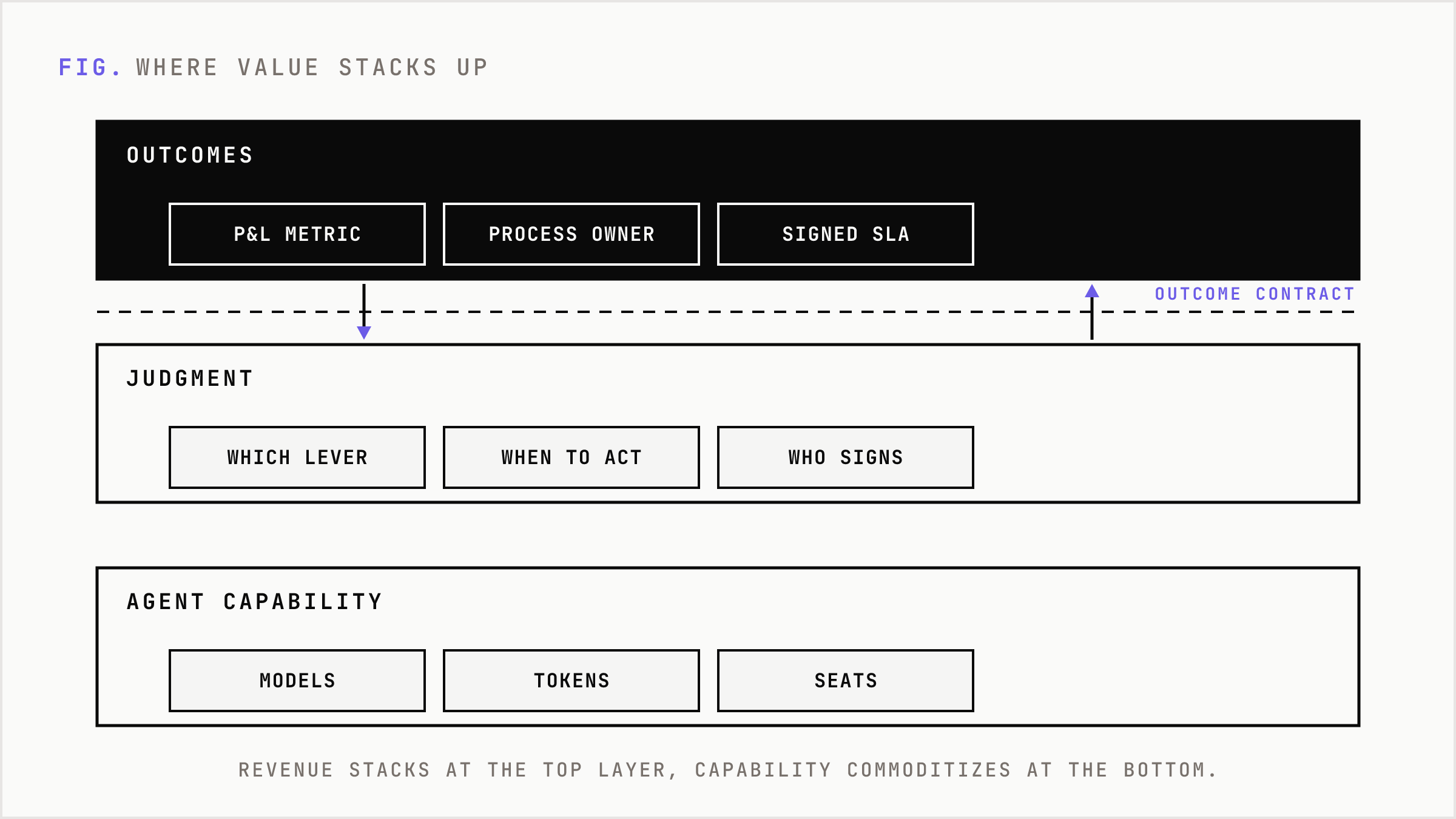
The revenue is somewhere else in the picture. It sits with whoever owns the collections cycle that closes faster, the onboarding flow that keeps a new account past week one, the invoice-matching process that stops leaking margin. Those outcomes have a business owner. Someone signs off on them. Someone gets called when they slip. An agent that lives inside one of those processes and shortens it is worth what the process itself is worth to the business, and that number is many multiples of any per-call price.
Why the framing keeps recurring
The reason Goldman's question keeps getting asked in that shape is that the visible cost sits at the model layer. Every conversation with a CFO about an AI initiative starts on the API bill, because the API bill is what shows up on a statement each month. Pricing back out to the customer in the same unit that shows up on the invoice feels like symmetry. Symmetry looks like strategy from the inside, and it leaves the actual leverage on the table.
The leverage sits at a layer that never appears on an invoice. Whoever owns the process that moves the customer's own P&L can charge against that P&L movement. A vendor pricing capability is charging against their own cost line. Those are two different businesses, and only one of them scales past the point where inference becomes free.
Where the revenue lives
Look at any recent AI project that produced hard revenue for the buyer and the same shape shows up. A specialist team owned a process that mattered to the P&L. They picked one metric on that process, made it accountable to a named person, and instrumented an agent inside the flow to move that metric. The agent is one line item on a working system. What the buyer paid for is the metric moving, and the reason they keep paying is the person on the other end signing for the number.
Compare that with the vendor pitch operators see every week now. A dashboard, a per-seat price, a per-call price, and a promise that the agent will handle X percent of tier-one tickets. That pitch measures dashboard adoption and per-call volume. Accountability for a hard case sits with the buyer. The metric on the customer's own P&L stays wherever it was. The buyer is being asked to price a component and hope the outcome shows up on its own.
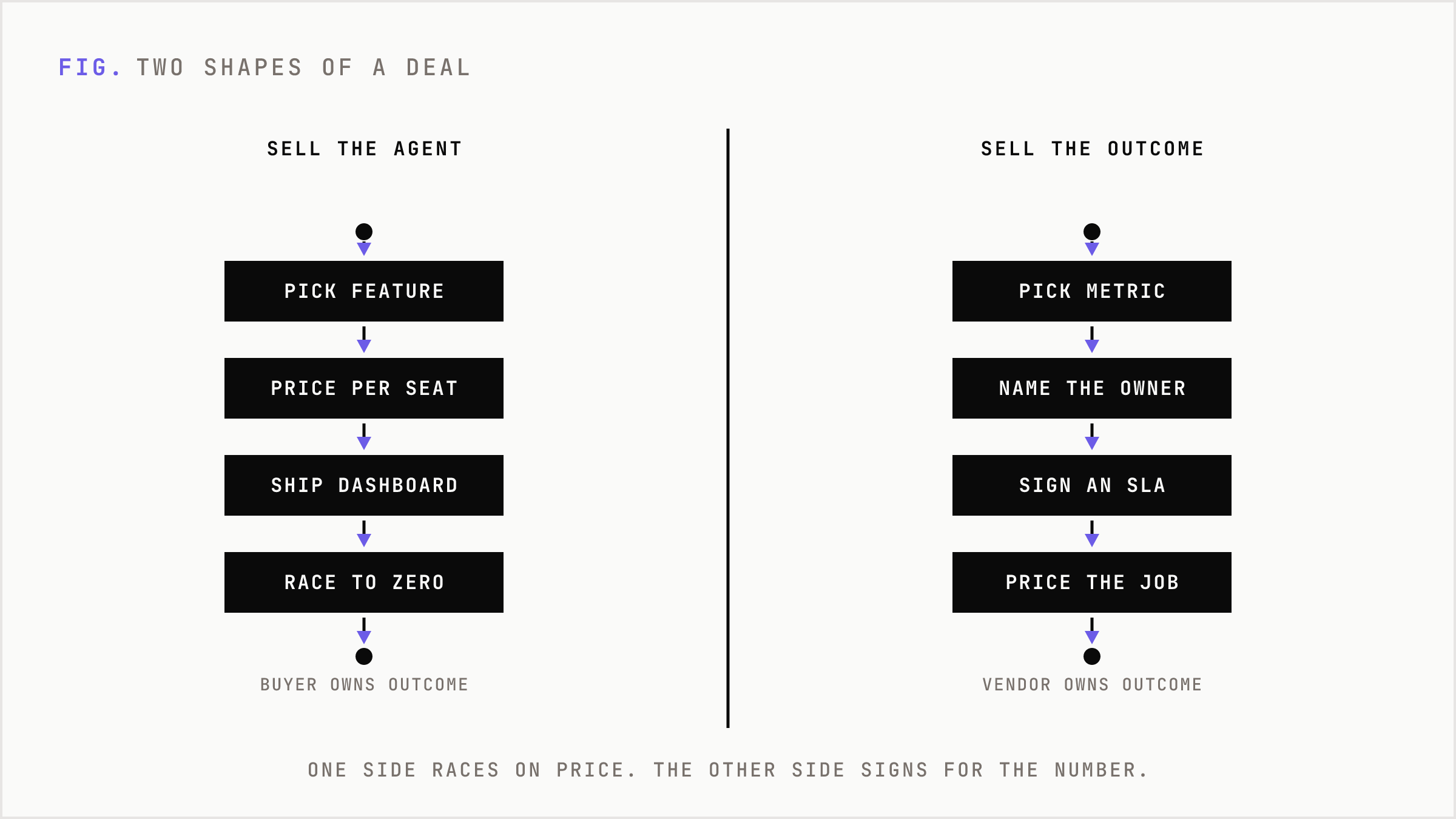
The outcome layer holds its price where the model layer softens under the same pressure. Every business has a slightly different definition of what a clean collections call looks like, what a good onboarding week looks like, what counts as an invoice reconciling cleanly. The judgment about which levers matter is local. Local judgment sticks to its context, and the vendor who invests in it earns pricing power that survives the next model drop.
The trap of pricing agent access
Usage-based pricing on the agent itself, seats, tokens, calls, is the trap. It anchors the whole revenue line to the input getting cheapest fastest. A capability that costs a dollar today, from a hundred lookalike vendors next year, is a race whose winner is whoever runs the cheapest inference. The seat that ate the SaaS market for twenty years assumed a human labor cost as the baseline. Agent capability sits on a shifting floor, and every quarter another lab drops that floor another notch.
Seat pricing worked because a seat was a proxy for a human doing hours of work. The agent seat sits above a thousand possible dispatches in an afternoon, and the buyer notices. When the buyer notices, they push back on the seat count, and the vendor discovers that the pricing unit and the value unit have drifted apart.
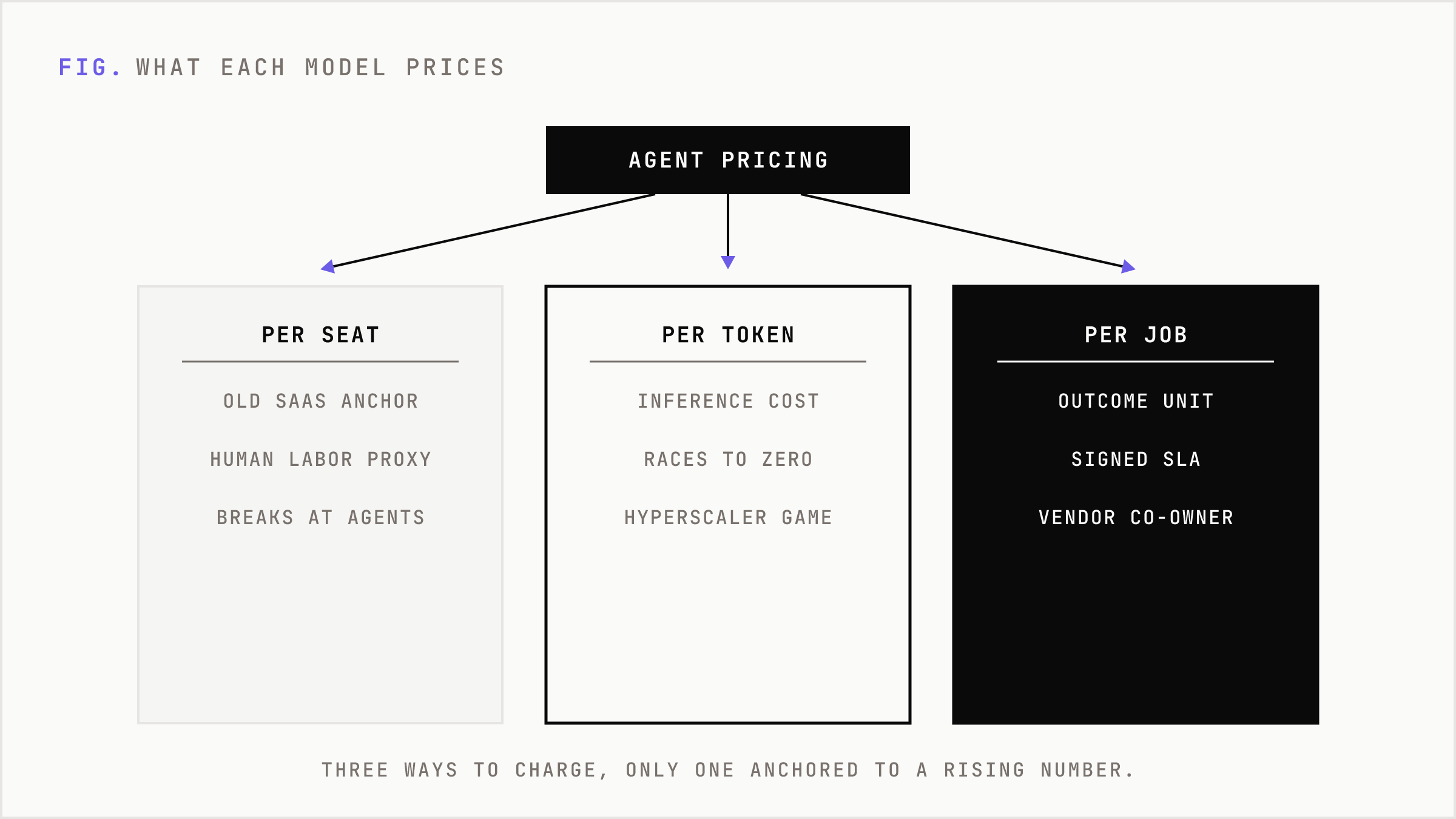
An operator pricing agent access is choosing to compete inside that floor. The finish line moves toward zero, and the only lever is running the same capability cheaper than the vendor beside them. That is a fine game for a hyperscaler. It is a very hard game for a specialist software company that expects gross margin.
Price the finished job
The pricing model that survives this decade puts a dollar figure on the finished outcome and lets everything below it stay where it is. Two support tickets closed with a customer-satisfaction score above a threshold, five collections calls closed, one clean invoice reconciliation, one net-new account moved past thirty-day retention. Those are the units the buyer already tracks internally, and the CFO already knows what each is worth. Selling in those units brings the vendor onto the same side of the table as the buyer, and the conversation stops being about capability at all.
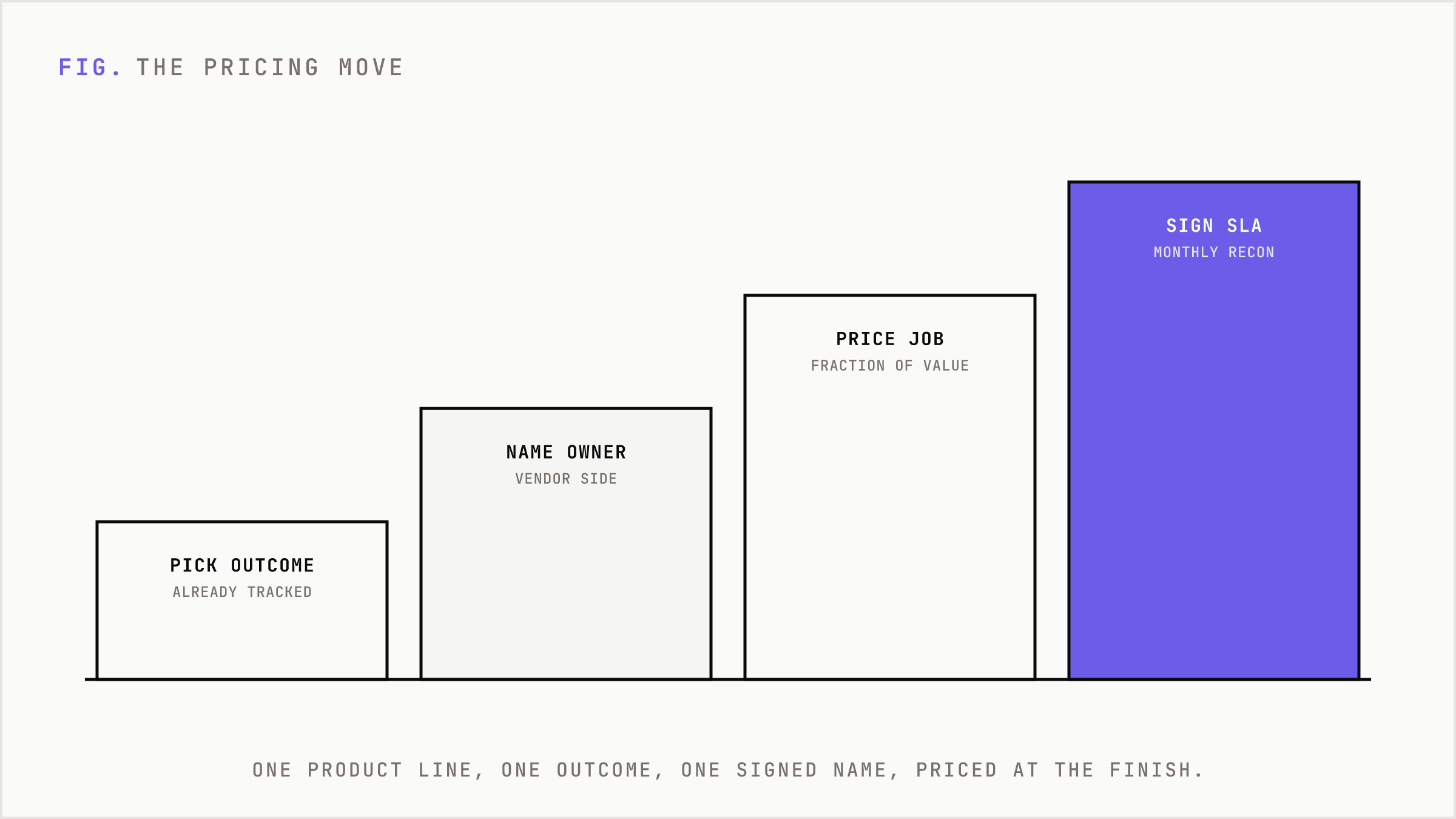
Operationally, pricing the job looks like a shared dashboard both sides can see, a definition of closed written before the contract signs, and a monthly reconciliation call rather than a monthly usage report. The relationship changes shape. The vendor stops being a component supplier and becomes a process co-owner, and both sides start optimizing the same number.
Pricing the job forces one more thing: someone has to sign for it. The vendor is now on the hook if the collections cycle drags, if the ticket comes back reopened, if the invoice bounces at reconciliation. That accountability is why the buyer will pay more per finished job than they would ever pay per token, and it is why a hyperscaler will step aside from that layer. A hyperscaler will ship the model at cost. Signing an SLA on the customer's own outcome sits with the vendor closest to the process, and that is the vendor with the specialist team.
The move this quarter
A founder pricing an agent product this quarter can run the switch on one product line without touching the rest. Pick one outcome the buyer already measures. Name the person on the vendor side who owns it if it slips. Price the finished job at a fraction of what the outcome is worth to the buyer, and price the agent access at cost or free. The revenue that used to come from seats and calls now comes from finished units, and every one of those units has a name attached to it.
A buyer evaluating three agent vendors this quarter can rank them on one question: who owns the outcome when the agent decides wrong. The vendor with a clean answer to that question is worth the meeting.