Nyyon · Blog
From ROAS Theater to Profit Decisions
AI marketing ROI optimization requires causal measurement, incrementality testing, margin models, and budget loops, not prettier platform ROAS dashboards.
AI does not optimize marketing ROI by making campaigns faster. It optimizes ROI when it helps leaders decide where the next dollar will create incremental profit.
That distinction sounds small. It is the market.
Most companies do not have a marketing AI problem. They have a capital allocation problem hidden inside marketing dashboards. Google says one thing. Meta says another. The CRM shows a different story. The agency reports activity. Finance sees spend. The CEO asks which dollars are working, and the room starts translating metrics instead of making decisions.
AI can make that room sharper. It can also make it worse.
If the machine is trained on bad attribution, it will automate bad allocation. If it optimizes for platform ROAS, it will move budget toward the places that are best at claiming credit. If it accelerates content production without a feedback loop to margin, it will create more assets, more reports, and more noise.
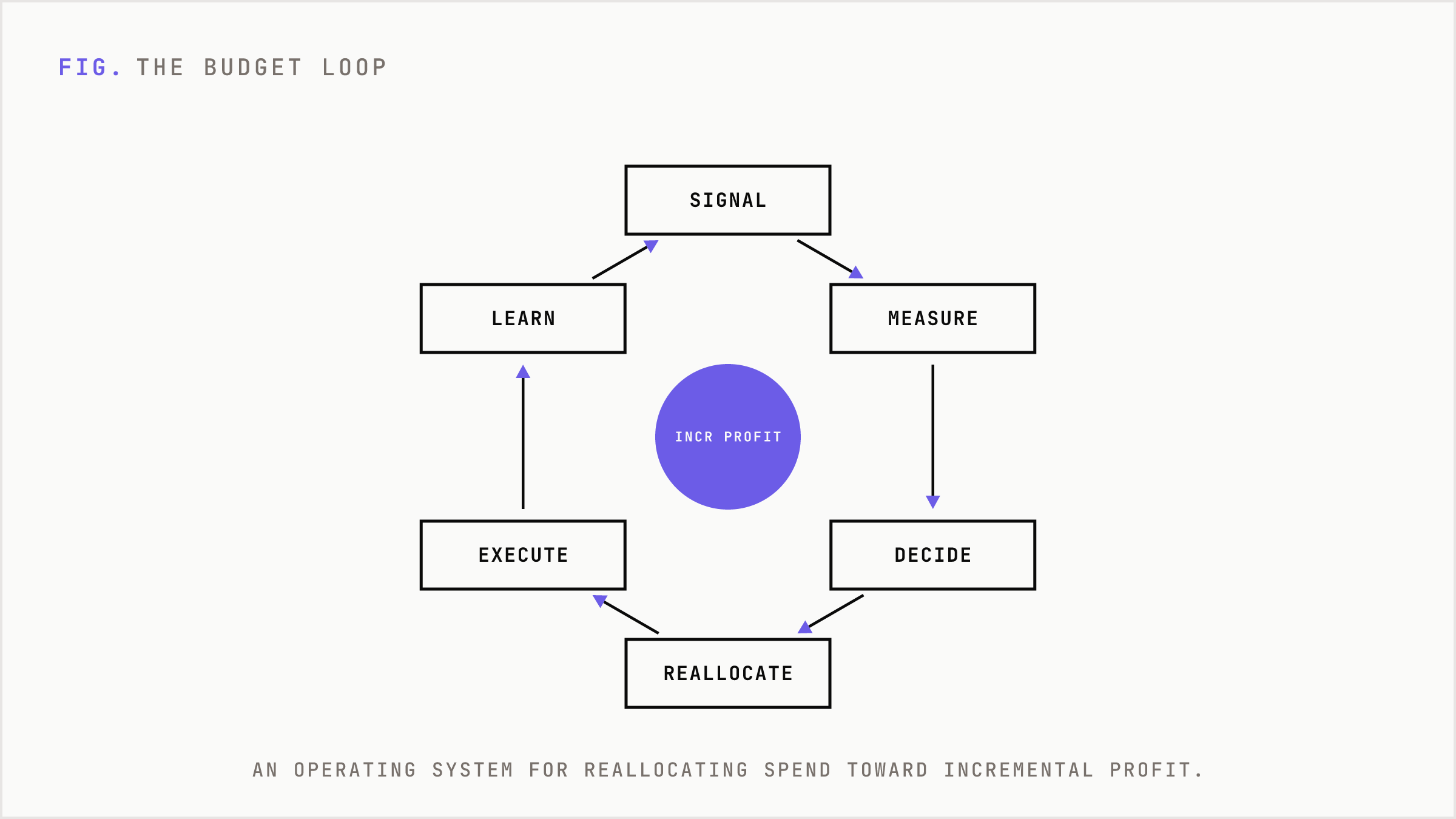
The useful version of AI marketing ROI optimization is not a content tool, a media buying button, or a prettier dashboard. It is an operating system for measuring incremental profit, reallocating spend, learning from creative and customer behavior, and tightening the loop between signal, decision, and execution.
The Budget Context Is Brutal
Marketing leaders are being asked to do more without getting much more to do it with.
Gartner reported that 2025 marketing budgets remained at 7.7 percent of company revenue, flat from the prior year. It also reported that 59 percent of CMOs said their budgets were insufficient to execute strategy. Paid media remains the largest line item, at 30.6 percent of marketing budgets. At the same time, 39 percent of CMOs planned to cut agency budgets and 39 percent planned to reduce labor spend.
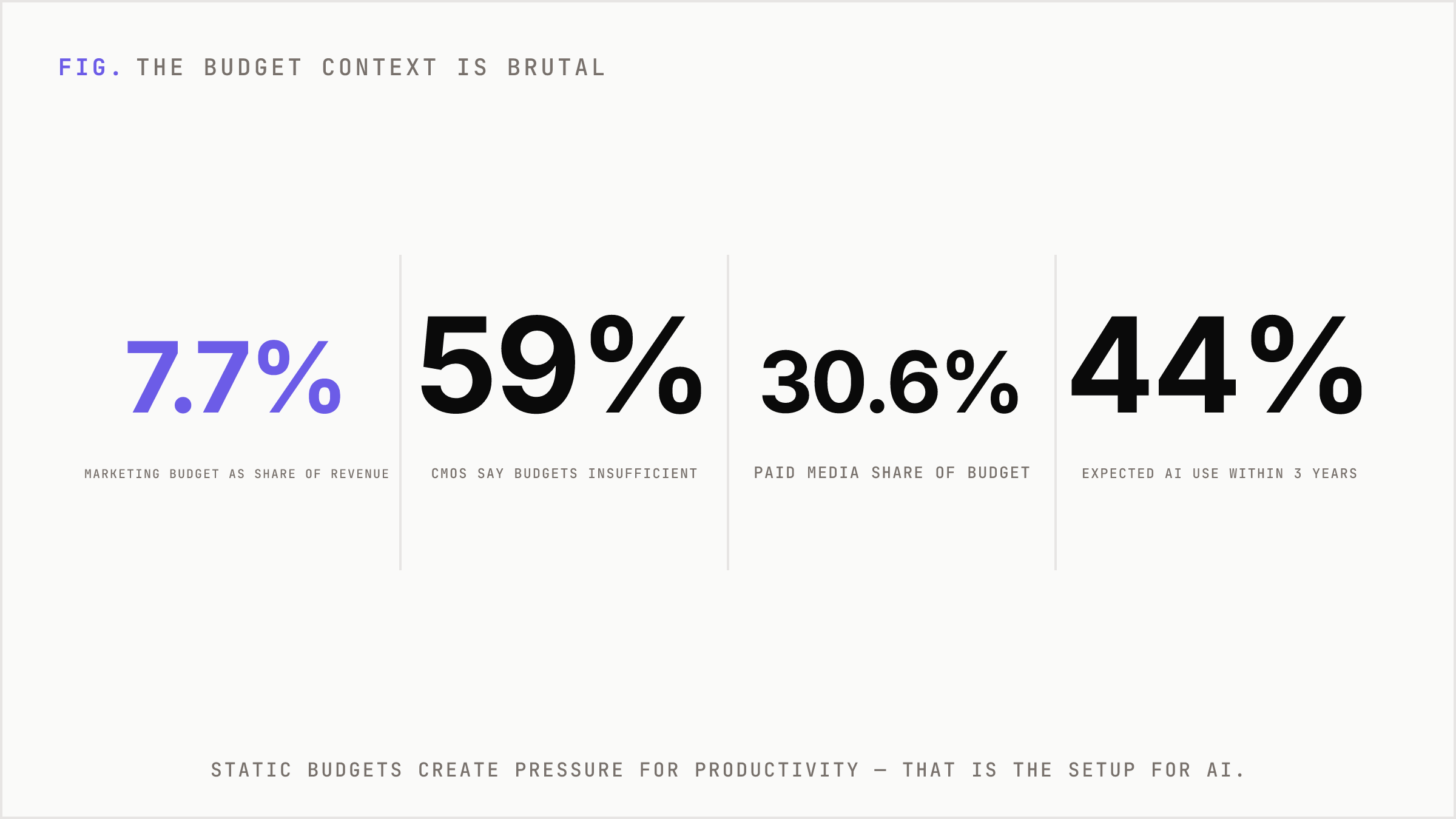
That is the setup for AI adoption. Not because executives suddenly became fascinated by generative interfaces. Because static budgets create pressure for productivity. The 2025 CMO Survey reported that companies currently use AI or machine learning to optimize or automate marketing 17.2 percent of the time, with expectations rising to 44.22 percent within three years. The same survey reported average AI driven improvements of 10.75 percent in marketing overhead costs and 8.56 percent in sales productivity.
Those are useful gains. But they are not the main prize.
The main prize is not making the same marketing machine cheaper. It is making the machine more economically accurate. A 10 percent productivity gain is helpful. A 20 percent reallocation away from non-incremental spend can change the shape of a business.
ROAS Is Not ROI
Platform ROAS is a reporting metric. Incremental contribution profit is a business metric.
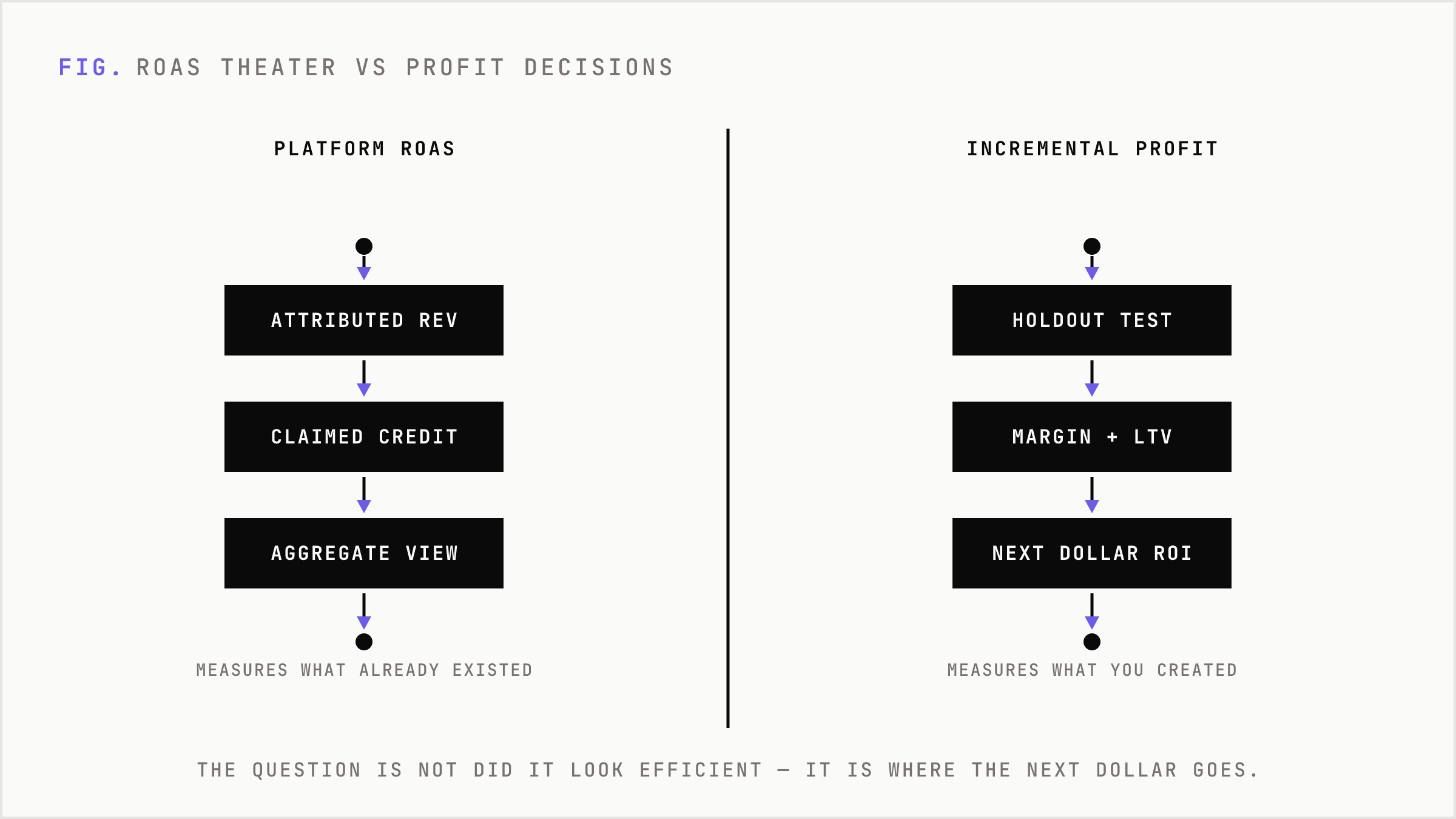
ROAS answers a narrow question: how much revenue did this platform attribute to this spend? That can be directionally useful. It can also be structurally misleading. Platforms operate inside their own walls. Google optimizes for Google signals. Meta optimizes for Meta signals. LinkedIn optimizes for LinkedIn signals. Each system is good at finding people likely to convert, but finding likely converters is not the same as creating new demand.
A simple ecommerce example makes the point.
A brand spends $100,000 on retargeting and sees $600,000 in attributed revenue. The dashboard shows a 6x ROAS. Good news, until a holdout shows that most of those buyers would have purchased anyway. Add gross margin, discounts, shipping, returns, and repeat purchase behavior, and the profit picture changes. The campaign was not a growth engine. It was a tax on demand that already existed.
Now take a prospecting campaign with a 1.8x platform ROAS. On the surface, it looks weak. But if it brings in new customers with higher second purchase rates and lower discount dependency, it may create more contribution profit over a six month payback window than the retargeting line item.
This is why serious ROI work moves from average ROAS to marginal ROI. The question is not did the channel look efficient in aggregate. The question is should we spend the next $100,000 there.
Measurement Is Hard, Even When You Are Trying
Marketing measurement fails because buyer behavior is messy. People search, compare, click, ignore, return, ask peers, see ads, read reviews, and purchase later on a different device. In B2B, the buyer and the user may not be the same person. In ecommerce, repeat purchase and discounting distort acquisition math. In marketplaces, supply and demand interact. In software, pipeline timing can make a good channel look bad for months.
This is not a dashboard problem. It is a causal inference problem.
Lewis and Rao’s well known work on advertising experiments showed how hard ROI can be to estimate even with randomized trials. Their analysis of 25 large field experiments found that the median ROI confidence interval exceeded 100 percentage points. The practical lesson is not that measurement is impossible. It is that certainty is usually fake.
The right architecture accepts uncertainty and manages it.
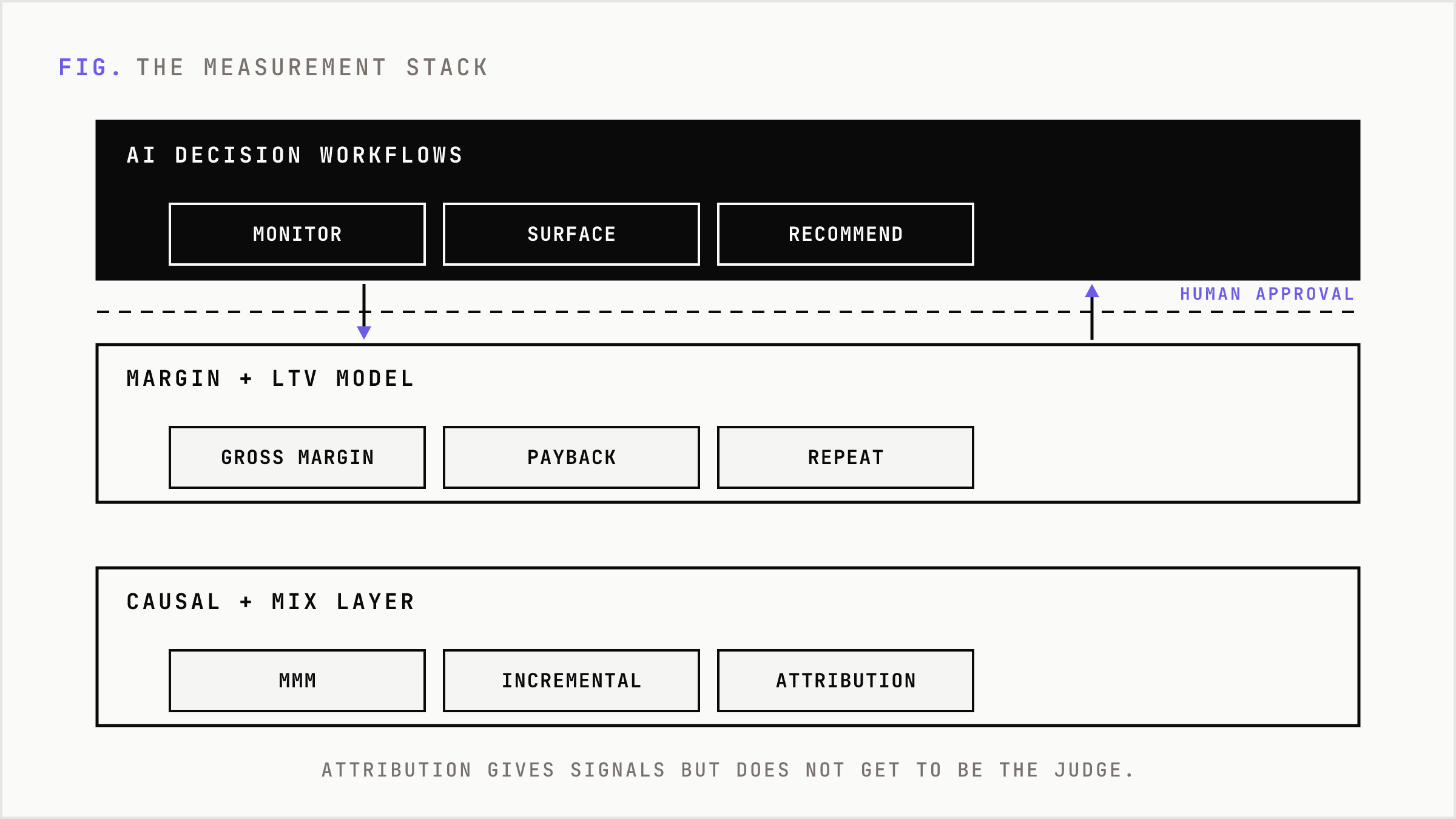
Marketing mix modeling helps estimate channel contribution, saturation, carryover, and macro allocation. Incrementality tests calibrate those estimates with causal evidence. Attribution gives tactical signals, but it does not get to be the judge. A margin and LTV model keeps everyone honest. AI workflows monitor changes, surface anomalies, summarize evidence, and recommend moves for human approval.
That stack is less seductive than a single ROI number. It is also more useful.
The AI Layer Is a Decision Layer
The common mistake is putting AI at the top of the funnel and calling it transformation.
Generate more ads. Generate more landing pages. Generate more emails. Generate more SEO pages. All of that can be useful. It is also becoming cheap and substitutable. Content AI alone is not a strategy. It is a cost curve.
The durable AI layer sits closer to decisioning.
It watches spend pacing. It flags conversion drops. It detects creative fatigue. It compares budget plans against saturation curves. It recommends holdouts where the business can tolerate them. It links paid media to contribution margin, not just revenue. It summarizes what changed this week and what decision needs to be made.
In a good system, AI does not own the budget. It compresses the work required to make a better budget decision.
A weekly growth meeting should not start with 40 slides of backward looking reports. It should start with a short decision queue:
- Google non-brand search is near saturation. Hold budget flat unless marginal CPA improves.
- Meta prospecting has lower attributed ROAS but higher new customer mix. Run a geo-lift test before cutting.
- Retargeting spend is above the likely incrementality band. Reduce by 20 percent and monitor total revenue impact.
- Creative cluster three is fatiguing across two channels. Brief new variants around the winning offer, not the winning format.
- AI referral traffic has longer sessions but lower conversion. Add comparison proof and clearer product fit pages.
That is not reporting. That is operating.
Open Source MMM Changes the Service Model
Marketing mix modeling used to feel like an enterprise consulting artifact. Expensive, slow, and often delivered as a quarterly PDF. That is changing.
Tools like Google Meridian, Meta Robyn, and PyMC-Marketing have lowered the cost of advanced measurement. Meridian, for example, supports Bayesian causal inference, non-media variables, optimization scenarios, reach and frequency modeling, and the use of incrementality experiments as priors. These systems matter because privacy changes, cookie loss, and platform signal degradation make deterministic tracking less reliable.
But open source does not make MMM plug and play.
Bad inputs still create bad outputs. Spend data needs cleaning. Revenue needs normalization. Promotions, pricing, seasonality, stockouts, and macro effects need to be modeled. Priors need judgment. Confidence intervals need explanation. Experiments need to calibrate the model. Business constraints need to shape recommendations.
This is where the market shifts from agency reporting to white glove decision infrastructure.
The value is not running a model. The value is building the operating cadence around the model: what to test, what to cut, what to scale, what to ignore, and what to tell the CFO when the answer is probable rather than certain.
Platform AI Is Useful, But Not Neutral
Platform AI is improving media execution. That is real.
Nielsen and Google reported that AI powered video campaigns on YouTube produced 17 percent higher ROAS than manual campaigns in an MMM study. Performance Max showed 8 percent higher ROAS and 10 percent higher sales effectiveness than Search only strategies. Adding Demand Gen to Search and Performance Max produced higher reported ROAS and sales effectiveness than campaigns without Demand Gen.
These are meaningful signals. They do not remove the need for independent measurement.
Platform AI optimizes within platform boundaries. The platform does not know your true gross margin by SKU unless you give it that data. It may not know whether a customer is truly new, likely to return, or heavily discounted. It does not resolve duplicate credit across channels. It does not decide whether the business should prioritize cash payback over LTV this quarter.
The service opportunity is reconciliation. Let platform AI improve auction execution. Then test its claims against incrementality, MMM, margin, and customer quality. Use the platform as an execution engine, not as the source of truth.
AI Search Is a New Consideration Layer
Search is not disappearing. It is fragmenting.
Gartner’s 2026 consumer research found that only about one-third of consumers believe generative AI chatbots are as effective as search engines for learning new information. AI search is complementing Google, social search, retail search, YouTube, Reddit, and review sites. It is not replacing them cleanly.
But behavior is changing. Gartner also found that 51 percent of consumers report changed research habits due to generative AI, with many using more specific, question based, and conversational queries. Adobe Analytics reported that generative AI driven traffic to U.S. retail sites rose sharply year over year in July 2025, while still remaining modest compared with major channels like paid search and email. Those AI referred shoppers had longer visits and lower bounce rates, but were less likely to convert than non-AI traffic.
The implication is practical. AI search is not just SEO with a new label. It is demand capture inside answer engines and research environments. Brands need comparison pages, structured proof, reviews, clear FAQs, entity consistency, expert content, and attribution that can handle assisted influence.
The KPI is not only AI referral conversion. It is share of answer, branded search lift, assisted conversion, category mentions, and the quality of traffic entering the site after AI mediated research.
The Workflow That Actually Works
A serious AI marketing ROI system has three layers.
First, the financial layer.
This includes revenue, margin, CAC, payback, LTV, refund rates, discounting, sales cycle timing, and customer quality. Without this layer, marketing optimizes toward revenue that may not be profitable.
Second, the causal layer.
This includes MMM, geo-lift tests, holdouts, conversion lift studies, spend shocks, saturation curves, and confidence intervals. Without this layer, marketing confuses correlation with impact.
Third, the execution layer.
This includes budget pacing, creative tagging, landing page QA, lifecycle personalization, AI search monitoring, anomaly detection, and weekly decision workflows. Without this layer, insights arrive too late to change behavior.
The sequencing matters. Most AI marketing ROI is won before media buying. Tracking has to work. CRM fields need discipline. Events need clear names. Creative needs taxonomy. Offers need economics. Experiments need design. Dashboards need to answer decision questions, not decorate meetings.
Then AI can accelerate the loop.
The Strategic Shift
The old marketing services market sold activity: campaigns launched, content produced, dashboards delivered, meetings held.
The new market sells decision quality.
This changes buyer behavior. A CMO under budget pressure does not need another channel specialist claiming secret tactics. A founder scaling burn does not need a blended ROAS screenshot. A CFO does not need marketing confidence. They need a defensible view of which spend creates net new profit, where the next dollar should go, and how much uncertainty sits around that decision.
AI expands the market because it makes advanced workflows cheaper to run continuously. MMM can refresh more often. Creative learning can be structured instead of anecdotal. Lifecycle personalization can operate at segment and user levels. AI search visibility can be monitored. Weekly performance narratives can be generated from source data. Experiment plans can be drafted faster.
But the scarce asset is still judgment.
The winning companies will not be the ones with the most AI generated assets. They will be the ones that connect AI to causal measurement, financial truth, and operating discipline. They will use automation to compress analysis time, not to outsource accountability. They will treat marketing spend like capital, not content fuel.
That is the useful definition of AI marketing ROI optimization.
From platform ROAS to incremental contribution margin. From last click to causal evidence. From reporting to budget decisioning. From content velocity to profitable demand creation. From manual analysis to always-on optimization loops.
Less theater. Better decisions.
FAQ
What is AI marketing ROI optimization?
It is the use of AI enabled workflows, causal measurement, incrementality testing, margin models, and budget optimization to improve incremental profit from marketing spend.
Why is platform ROAS not enough?
Platform ROAS measures revenue attributed inside a platform. It may overstate impact, duplicate credit, ignore margin, and miss whether customers would have converted without the ad.
Does MMM replace attribution?
No. MMM is useful for macro allocation and saturation analysis. Attribution can still provide tactical signals. Incrementality testing is needed to calibrate both.
Where does AI create the most value?
AI is most valuable in shortening the loop from signal to decision to execution: anomaly detection, budget recommendations, creative learning, experiment planning, and executive reporting.
Who is a good fit for this approach?
Companies with meaningful media spend, multiple acquisition channels, reliable revenue data, enough conversion volume for testing, and leadership pressure to prove marketing value are the best fit.