Nyyon · Blog
From Content to Control: How AI Marketing Actually Wins in 2026
AI marketing advantage in 2026 comes from data, attribution, and systems, not content. Learn how elite teams redesign decision-making, not just output.
AI marketing advantage no longer comes from producing more content. It comes from controlling how decisions get made.
The Shift Most Teams Miss
For the last three years, AI adoption in marketing has meant one thing: more output. More ads, more landing pages, more variations, more posts. Costs dropped. Volume exploded.
But performance did not scale linearly with output. In many cases, it degraded.
The reason is simple. Content was never the constraint. Decision quality was.
In 2026, the frontier has shifted. AI is no longer primarily a content engine. It is becoming a decision system layered on top of proprietary data, attribution models, and execution loops.
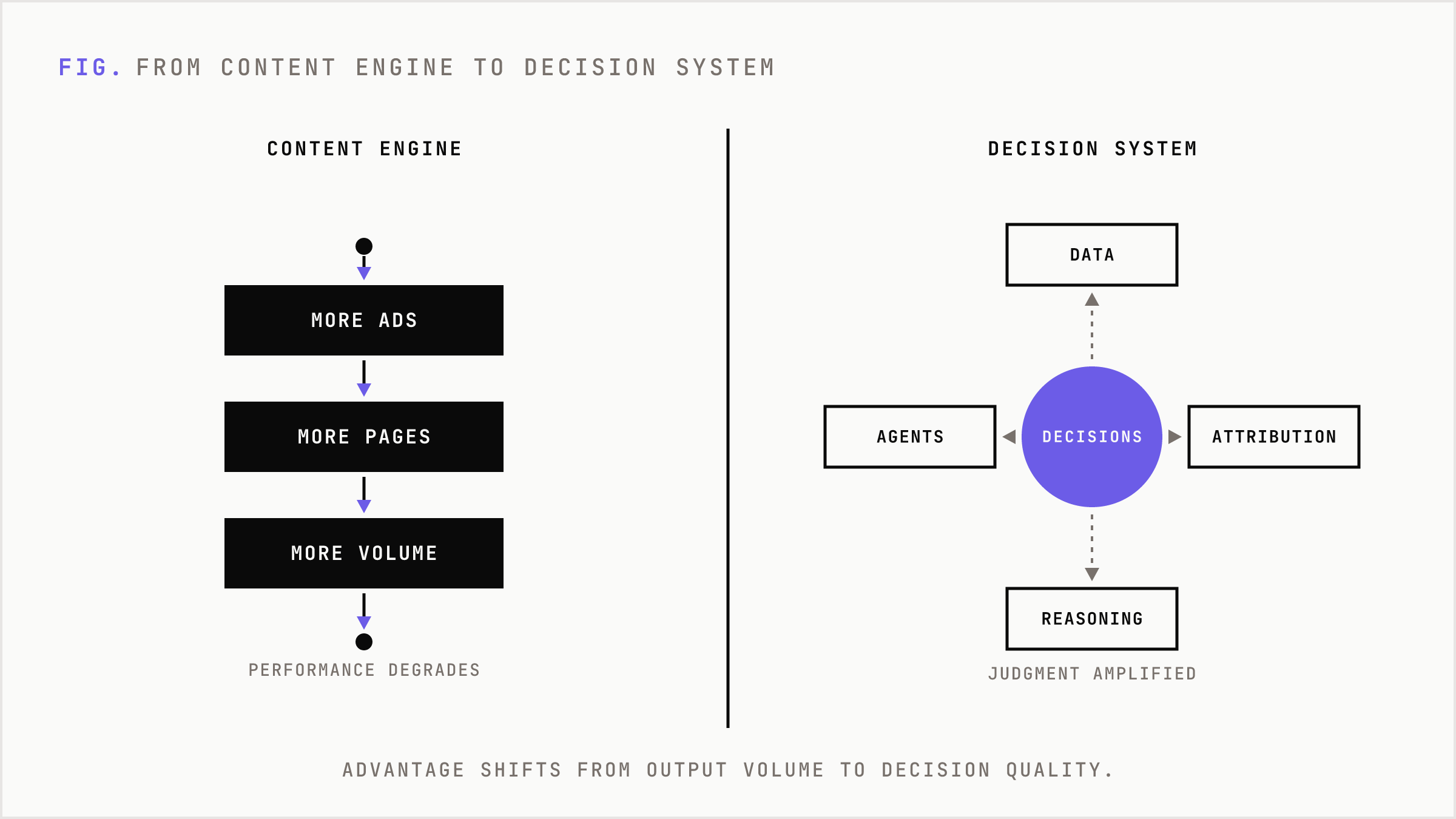
The gap between average and elite teams is now defined by system design, not tool choice.
Why Content Is No Longer the Bottleneck
Creative generation is effectively commoditized. Tools can produce hundreds of ad variations in minutes. Copy, images, video hooks, even full campaign structures are now cheap and abundant.
Yet creative quality across models has converged. The difference between the best and worst outputs is narrower than most teams assume. Human taste still determines what actually ships.
This creates a structural shift in how marketing teams allocate budget.
- Content production costs trend toward zero
- Distribution costs remain real
- Decision errors become more expensive
When you can generate 500 ads, picking the wrong 5 to scale is the real failure mode.
AI did not remove the need for judgment. It amplified the cost of bad judgment.
The Real Stack: From Tools to Systems
The modern AI marketing stack is collapsing into three functional layers.
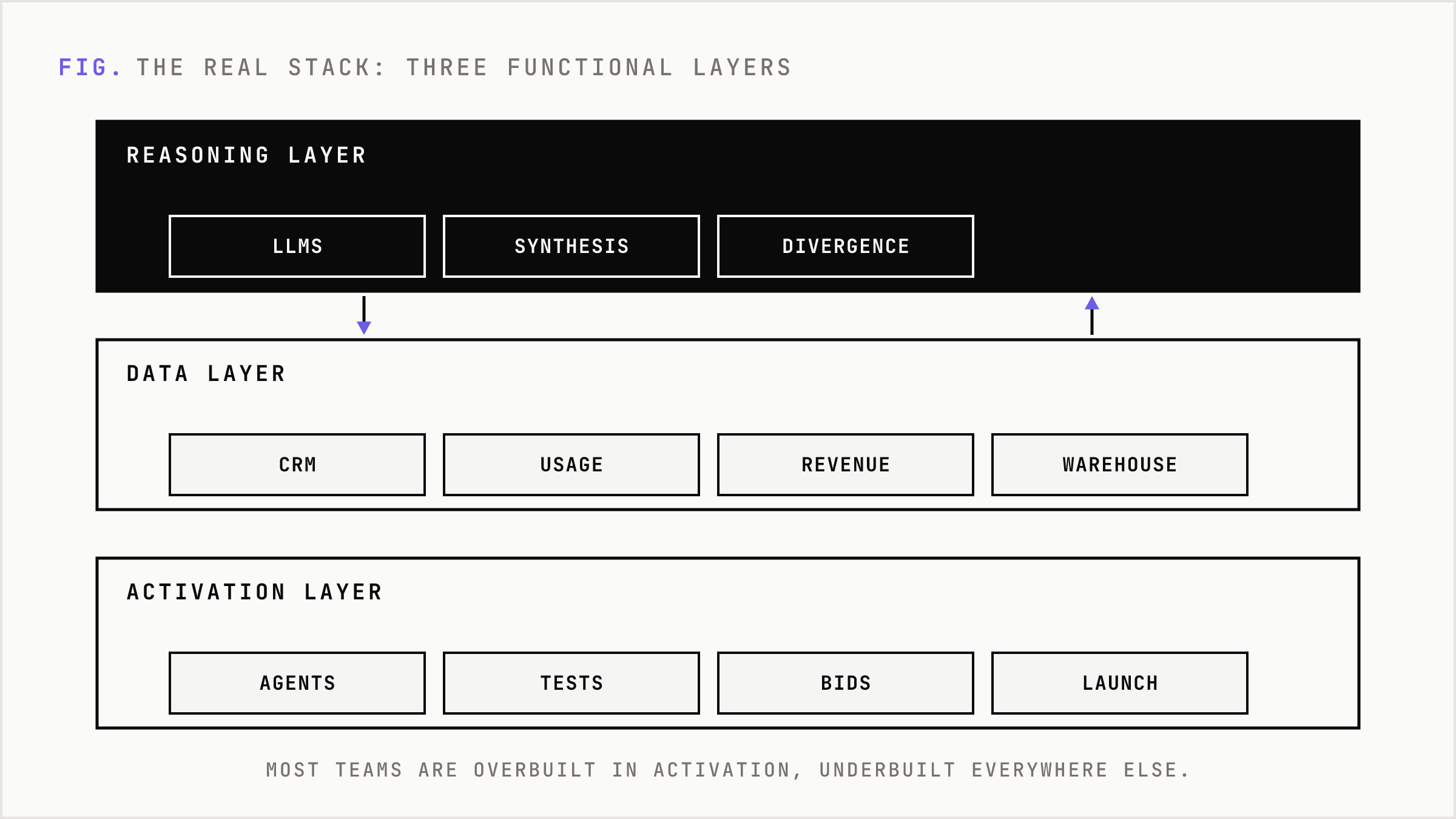
- Data layer
- Reasoning layer
- Activation layer
Most companies are overbuilt in activation and underbuilt everywhere else.
1. Reasoning Is Cheap, Context Is Not
General LLMs are now strong at synthesis. They can map markets, generate positioning angles, and simulate customer segments. They expand the option space quickly.
But they do not know your business.
Without access to internal data, they produce plausible strategies that are not grounded in revenue reality. This is why many AI-generated strategies feel sharp but fail in execution.
Used correctly, these models are divergence engines. They generate possibilities. Humans still decide what matters.
2. Data Is the New Strategic Moat
The real leverage comes when reasoning systems connect to proprietary data.
This means CRM, product usage, campaign performance, and revenue outcomes stitched into a unified layer. Platforms like Salesforce, HubSpot, or custom warehouse setups are becoming the core intelligence layer of marketing.
Once connected, AI stops guessing.
It can identify which segments actually convert, which campaigns drive pipeline, and where deals stall. It can prioritize based on probability instead of opinion.
This replaces gut-driven strategy with probabilistic reasoning.
The competitive advantage is not better prompts. It is cleaner, better joined data.
3. Attribution Is the Truth Layer
This is where most AI strategies quietly fail.
Without attribution, there is no feedback loop. Teams optimize for clicks, impressions, or engagement because those metrics are available, not because they matter.
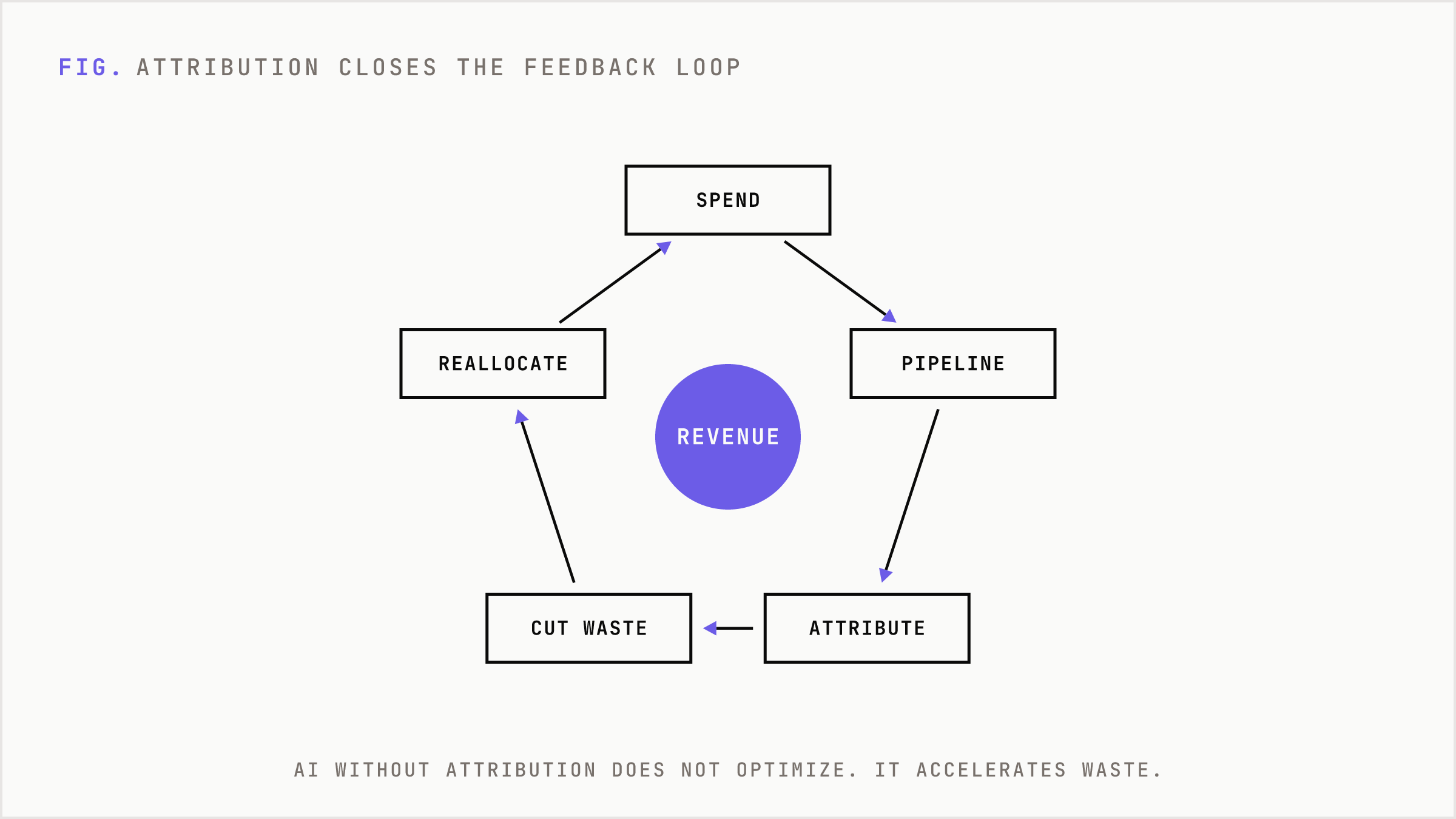
Modern attribution systems connect spend to pipeline and revenue. They use multi-touch models, identity stitching, and increasingly causal inference to determine what actually drives outcomes.
This changes behavior at the budget level.
Campaigns that look good but do not convert get cut faster. Channels that quietly drive revenue get scaled.
AI without attribution does not optimize. It accelerates waste.
4. Agents Execute, They Do Not Decide
Execution is becoming automated.
Agents can launch campaigns, run A B tests, adjust bids, generate variations, and iterate continuously. The speed of execution is no longer a constraint.
But agents should not be making strategic decisions independently.
The highest performing teams use agents to run testing loops within defined constraints. Strategy remains human-guided and data-validated.
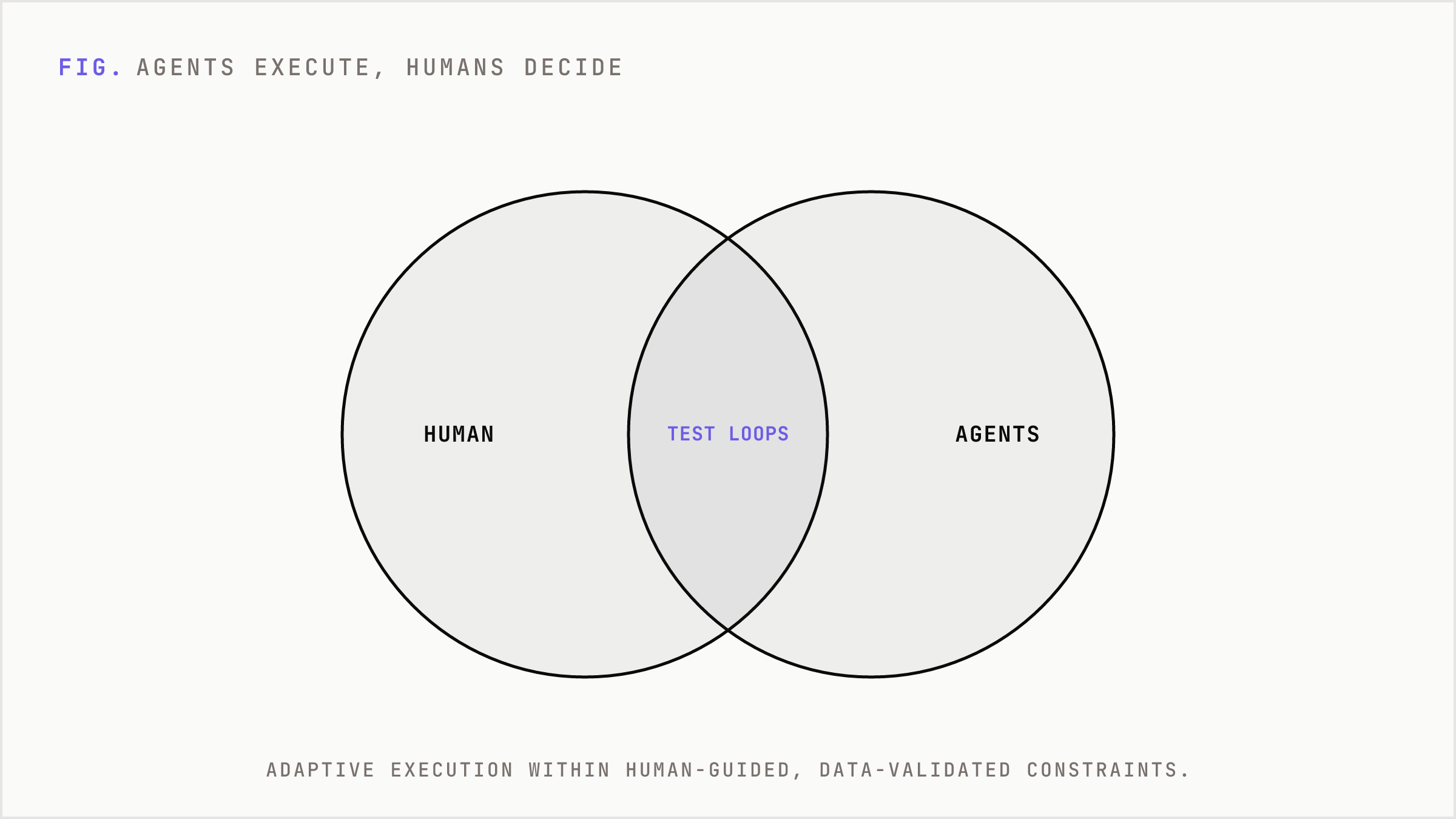
This division of labor matters. It keeps systems adaptive without becoming directionless.
Where Budget Is Actually Moving
If you look at how elite teams are reallocating spend, the pattern is clear.
They are pulling budget out of content production and pushing it into infrastructure.
- Data pipelines and warehouses
- Attribution and analytics layers
- Integration between tools
This is not a tooling trend. It is a structural reallocation.
When content is cheap, insight becomes expensive. When execution is automated, coordination becomes the bottleneck.
The ROI comes from improving decision quality, not increasing output volume.
Distribution Is the New Constraint
As content supply increases, attention becomes harder to capture.
This shifts advantage toward signal interpretation.
Tools that analyze search trends, competitor strategies, and real-time demand signals are becoming central to marketing workflows. Instead of planning campaigns months in advance, teams adjust continuously based on incoming data.
This compresses the feedback loop between market behavior and campaign execution.
The companies that win are not those with the best plan. They are the fastest at interpreting signals and reallocating resources.
The Emerging Battleground: AI Visibility
A new layer is forming above traditional search.
Large language models are becoming intermediaries between users and information. Increasingly, users do not click links. They accept synthesized answers.
This creates a new optimization problem.
It is no longer just about ranking on Google. It is about being cited, referenced, or recommended inside AI-generated responses.
This changes how content is structured, how authority is built, and how brand presence is measured.
Early movers in this space are already treating AI visibility as a distribution channel, not a side effect.
How Elite Teams Actually Operate
The difference in execution is not subtle.
Average teams use AI to produce more assets. Elite teams use AI to redesign workflows.
The pattern looks like this:
- AI generates a wide range of strategic options
- Humans select based on context and taste
- Data systems validate against real performance signals
- Attribution enforces truth at the revenue level
- Agents execute and iterate within constraints
This creates a closed loop system where ideas are constantly tested against reality and refined.
The output is not just more campaigns. It is better decisions over time.
The Strategic Implication
The role of marketing is shifting.
It is moving away from content creation and toward system design.
The most valuable operators are no longer the best copywriters or campaign builders. They are the ones who can architect systems that connect data, reasoning, and execution into a coherent loop.
This has hiring implications.
It has budget implications.
And it changes how companies think about competitive advantage.
Because once these systems are in place, they compound.
Better data improves decisions. Better decisions improve outcomes. Better outcomes generate better data.
This feedback loop is difficult to replicate from the outside.
What This Means Going Forward
The AI marketing conversation is still dominated by tools. That is the wrong level of abstraction.
Tools change quickly. Systems persist.
The companies that win in this next phase will not be the ones with access to the best models. Those are widely available.
They will be the ones that integrate those models into tightly governed systems tied directly to revenue.
This is a control problem, not a creativity problem.
And most teams are still solving for the wrong variable.
FAQ
Why is content no longer a competitive advantage in AI marketing?
Because AI tools have made content generation fast and cheap. The constraint has shifted to decision-making, distribution, and tying efforts to revenue outcomes.
What is the most important layer in the AI marketing stack?
The data layer. Clean, unified, and connected data enables accurate insights and makes AI systems actually useful for decision-making.
How does attribution impact AI marketing performance?
Attribution connects marketing activity to revenue. Without it, AI systems optimize for surface metrics like clicks instead of actual business outcomes.
Are AI agents replacing marketers?
No. Agents automate execution and testing, but humans still define strategy, constraints, and final decisions.
What is GEO or AI visibility optimization?
It refers to optimizing brand presence within AI-generated answers, not just traditional search rankings, as users increasingly rely on LLMs for information.