Nyyon · Blog
From Campaigns to Systems: How AI Native Agencies Are Rewriting Growth Economics
AI-native agencies outperform not by cutting costs, but by accelerating iteration, automating workflows, and turning marketing into continuous optimization systems.
The advantage of AI-native agencies is not cheaper work. It is faster learning.
The Wrong Frame: AI As A Cost Tool
Most buyers still evaluate AI agencies through a procurement lens. How much cheaper? How many hours saved? What percentage of spend?
This misses the shift entirely.
Traditional agencies are built around labor. Work is scoped, billed, and delivered in cycles. AI-native agencies are built around systems. Work is generated, tested, and refined continuously.
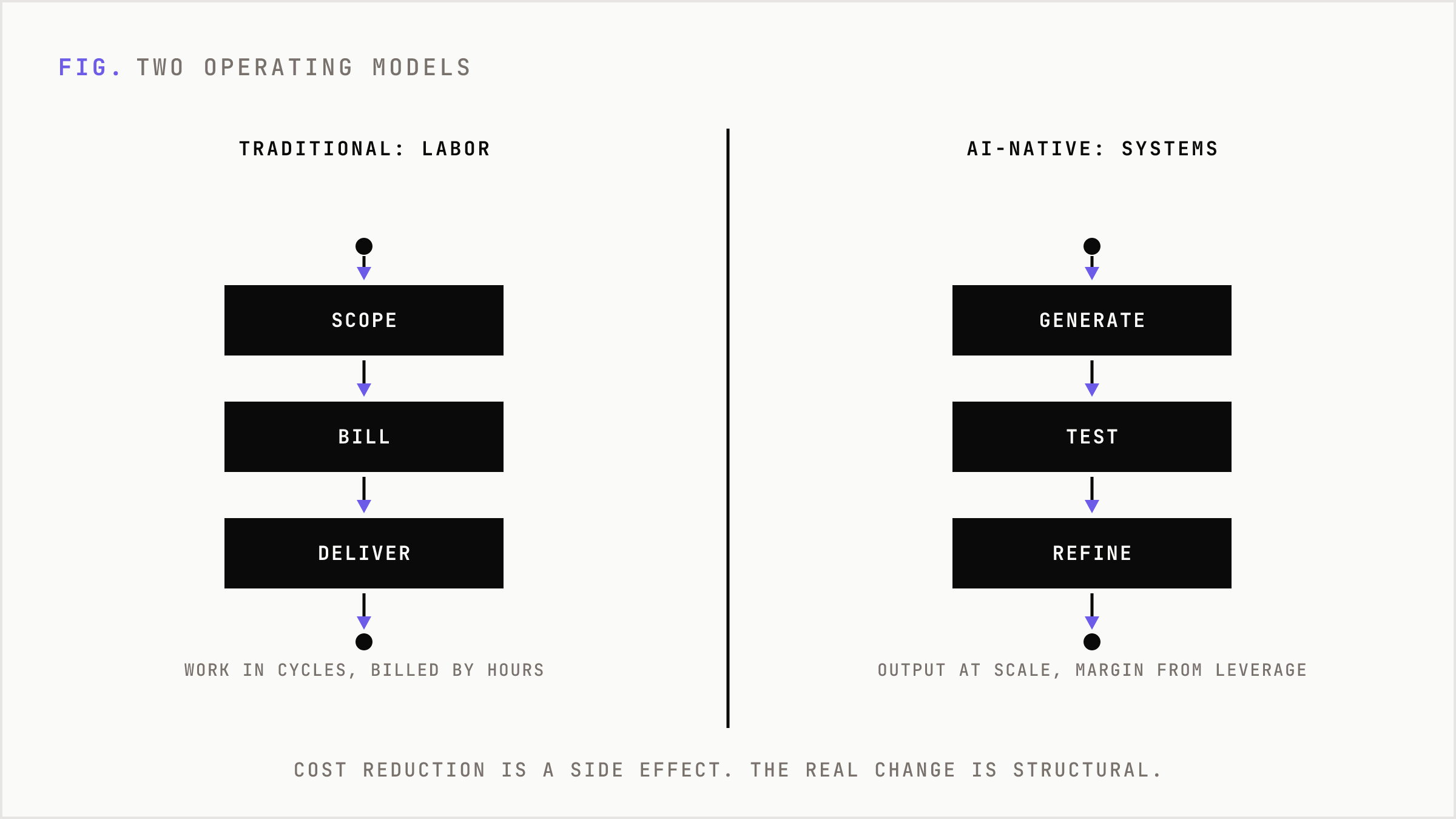
Cost reduction is a side effect. The real change is structural.
What “AI-Native” Actually Means
An agency that “uses AI tools” still looks like a traditional shop. Humans define the workflow. AI assists at the edges.
An AI-native agency inverts that.
Workflows assume automation first. Humans step in only where judgment matters. The result is a different operating model:
- Less than 30 percent human labor per deliverable
- Systems produce output at scale
- Margins come from leverage, not utilization
This is closer to a software business than a services firm.
The Four Layers Where Advantage Actually Comes From
The term “AI” hides where the gains are concentrated. In practice, the advantage shows up in four layers.
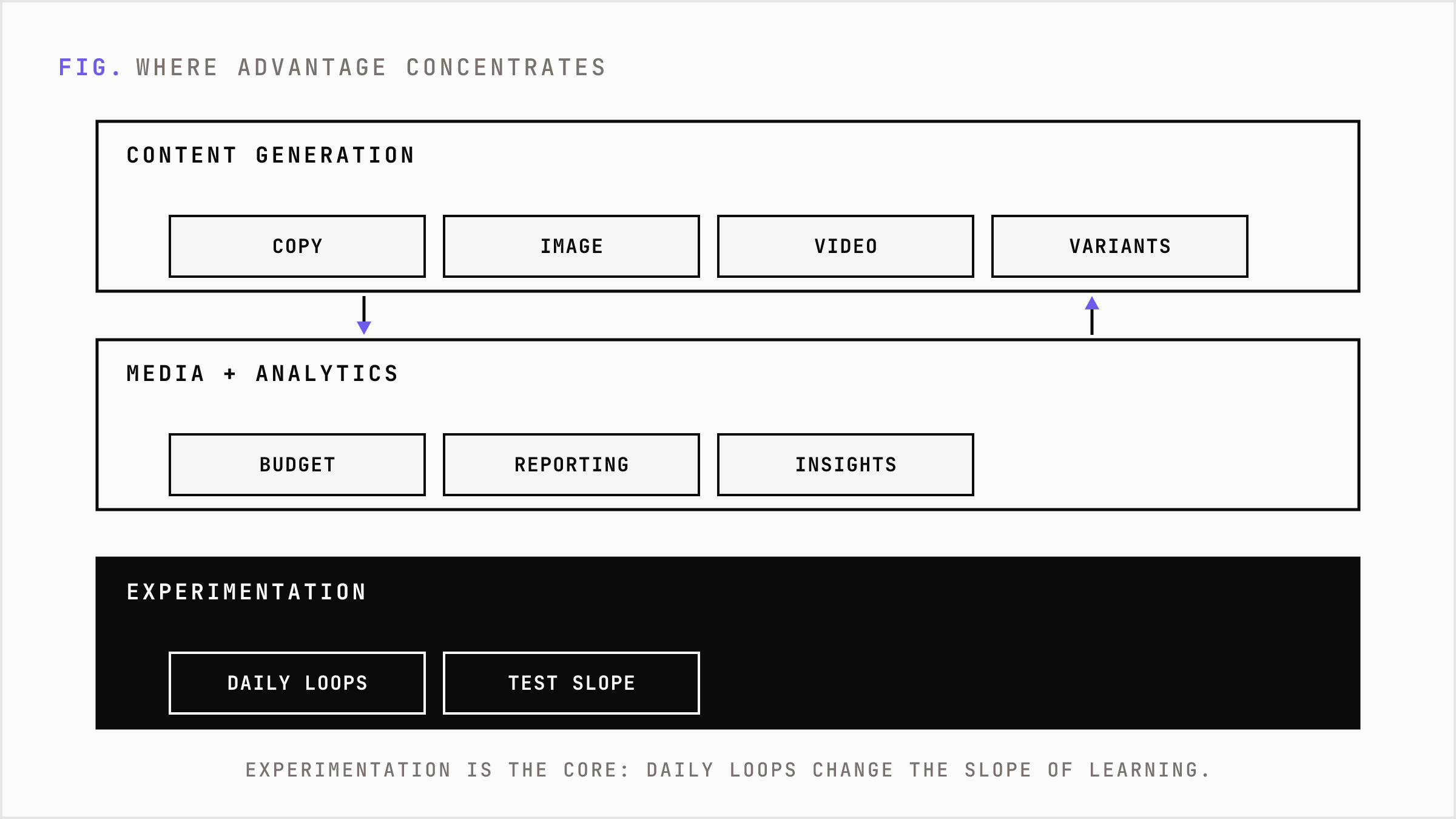
1. Content Generation
Copy, images, and video variants can be produced at near zero marginal cost. What used to be 10 assets becomes 100 or 500.
This is not about creativity. It is about coverage. More surface area increases the probability of hitting high-performing combinations.
2. Media Buying Optimization
Machine learning driven budget allocation improves efficiency incrementally. Gains are usually in the 10 to 30 percent range.
Useful, but not transformative on its own.
3. Analytics and Reporting
Reporting used to consume strategist time. Now it is largely automated. Dashboards update continuously. Insights are generated, not compiled.
This removes 60 to 80 percent of manual analysis work.
4. Experimentation
This is the core.
When creative production and deployment are automated, testing frequency increases dramatically. Instead of weekly or monthly tests, you get daily loops.
That changes the slope of learning.
Iteration Speed Is The Real Moat
A traditional campaign runs on a 2 to 4 week cycle. Brief, produce, launch, analyze, repeat.
An AI-native system runs continuously. New variants are generated, deployed, and evaluated every day.
The difference compounds.
After 30 days, one system has tested 10 ideas. The other has tested 300. After 90 days, the gap is not incremental. It is structural.
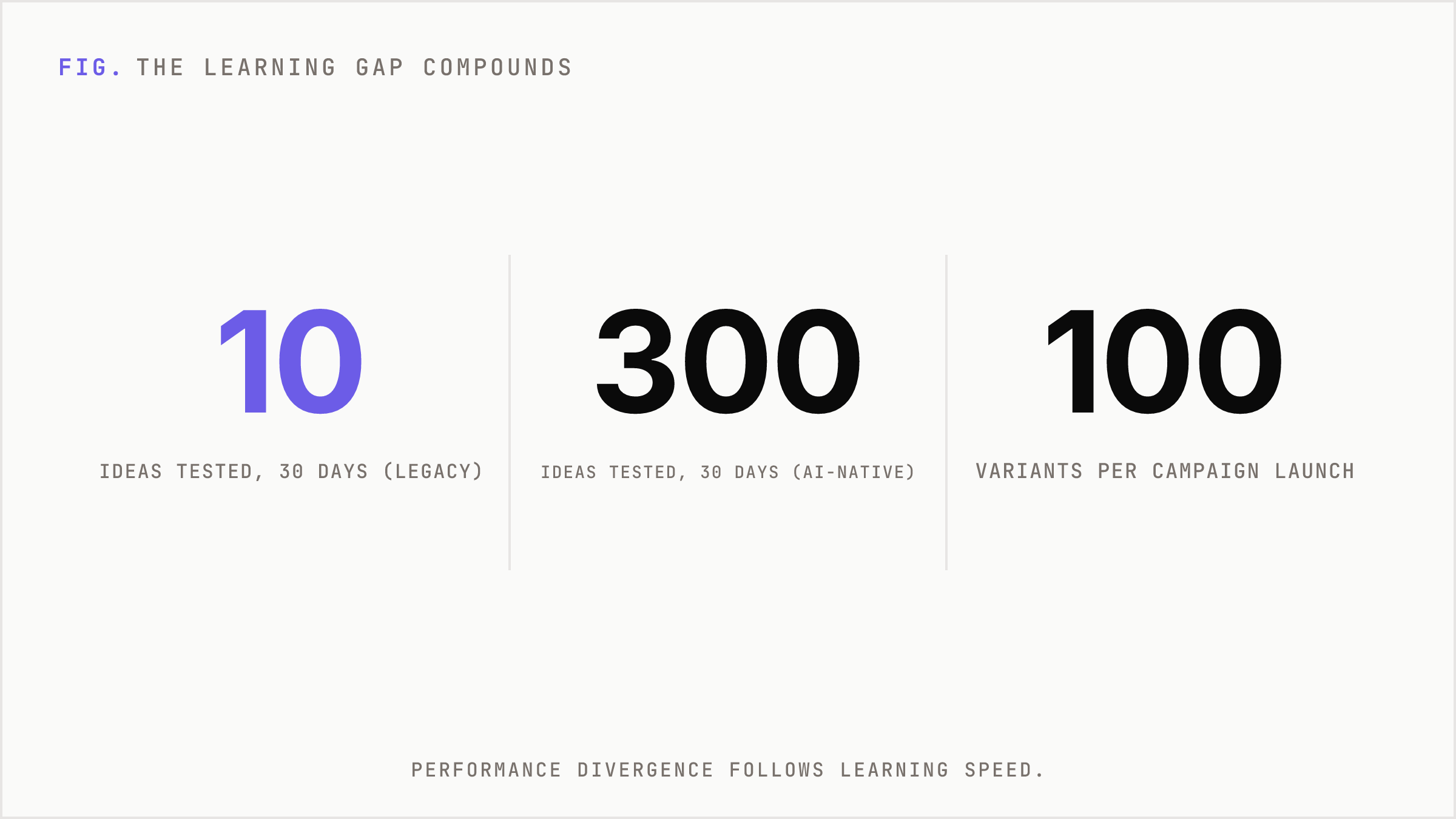
Performance divergence follows learning speed.
Creative Is No Longer The Bottleneck
For years, creative production limited experimentation. You could only test what you could afford to make.
That constraint is gone.
Platforms like Meta and TikTok increasingly reward volume and freshness. The best performing ads are often not the most polished. They are the most iterated.
AI-native agencies lean into this. A typical campaign might launch with 100 variants, not 10.
The lift comes from finding winners faster, not predicting them upfront.
Pricing Starts To Decouple From Spend
The legacy agency model ties revenue to media budgets. Ten to twenty percent of spend is standard.
This model weakens when execution becomes automated.
AI-native firms experiment with different structures:
- Flat subscriptions with performance bonuses
- Cost per asset or per experiment
- Hybrid models that combine software access with managed operations
The common thread is decoupling effort from billing.
As automation increases, percentage-of-spend pricing becomes harder to justify.
Talent Shifts From Producers To Operators
The org chart changes quickly.
Fewer junior roles are needed for production tasks like copywriting and reporting. More value shifts to people who can design and manage systems.
These are not traditional marketers. They look more like growth engineers.
Senior strategists remain important, but their leverage increases. One person can oversee output that previously required a team.
The Quality Problem Is Real
More output does not guarantee better outcomes.
Low-end AI agencies flood channels with generic content. The result is creative fatigue and brand dilution.
This is already visible in paid social feeds.
The better operators build constraints into their systems. Style guides, brand rules, and human review loops keep output aligned.
Without this layer, automation produces noise.
Data Becomes The Defensible Asset
Tools are widely available. Data is not.
Agencies that control performance data can build feedback loops. Creative outputs feed results. Results inform future generation.
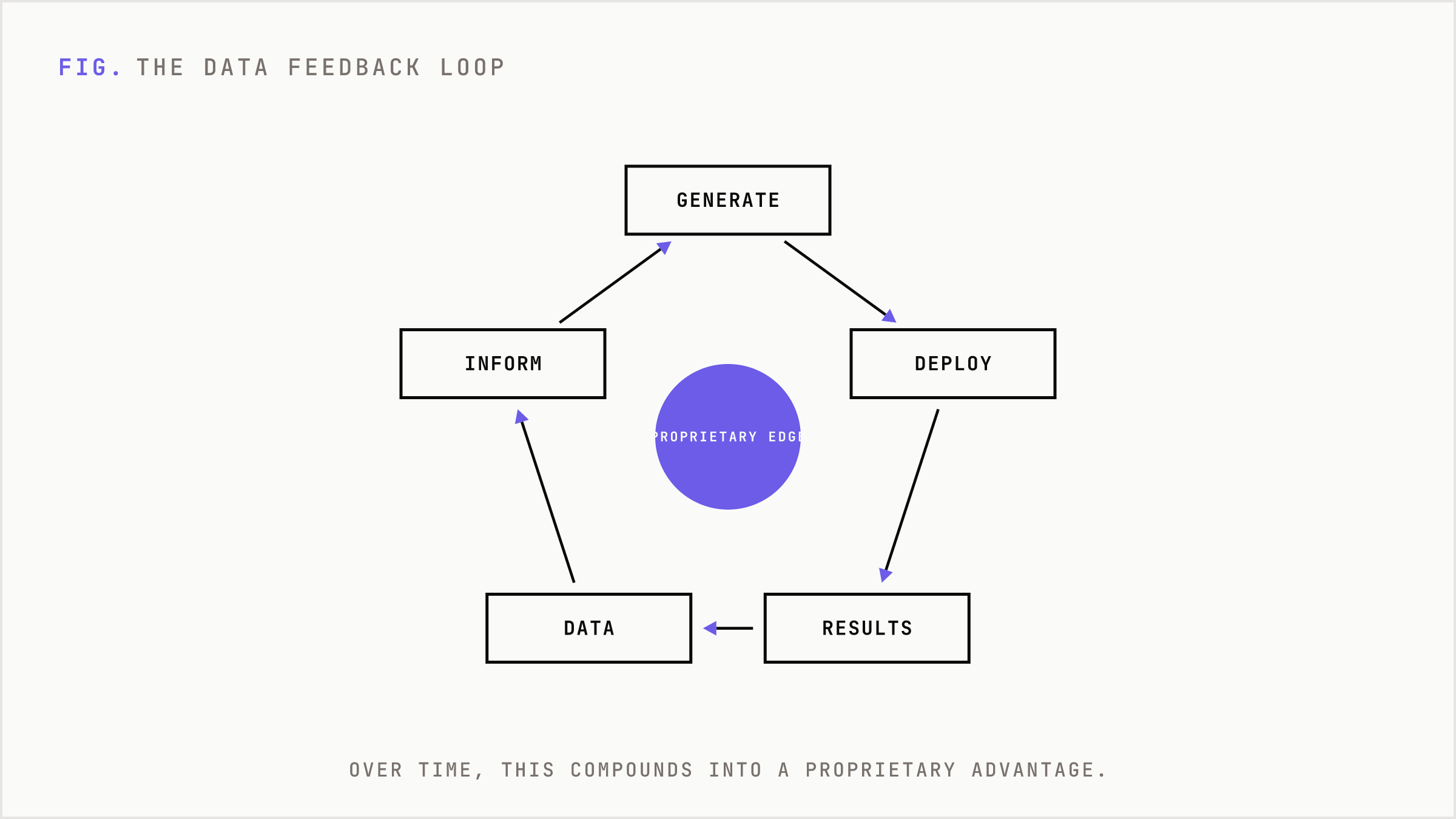
Over time, this compounds into a proprietary advantage.
Integration with first-party data is especially valuable. When campaigns optimize against customer lifetime value instead of clicks, performance improves in ways generic models cannot replicate.
Channel Impact Is Uneven
The gains are not uniform across marketing functions.
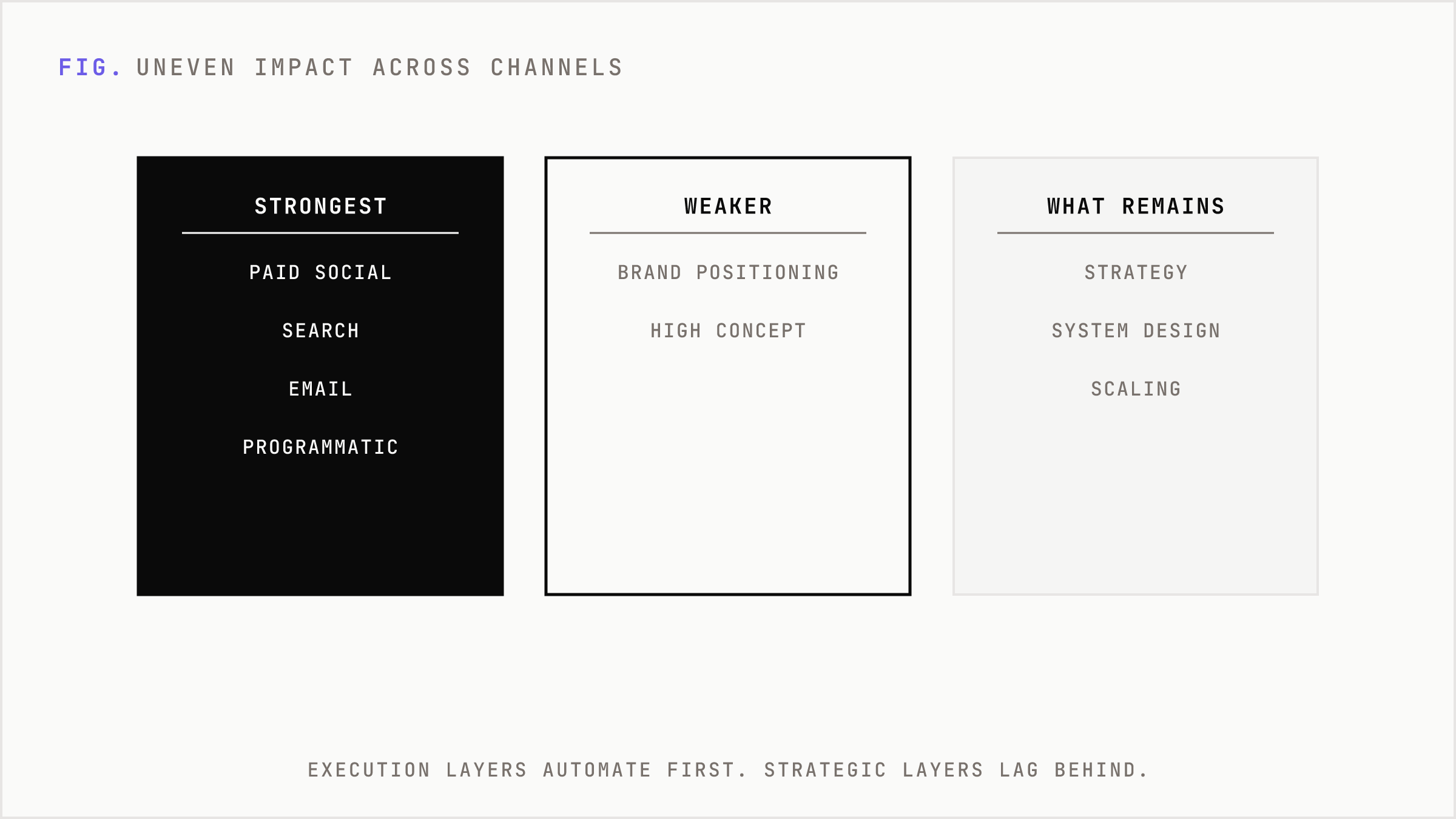
Strongest impact:
- Paid social
- Search
- Programmatic
Weaker impact:
- Brand positioning
- High concept creative
This creates a split. Execution layers become automated first. Strategic layers lag behind.
Why Many AI Agencies Look The Same
The barrier to entry has dropped.
Anyone can assemble a stack of language models, creative tools, and automation platforms. The surface level offering becomes indistinguishable.
Differentiation shifts elsewhere:
- Proprietary workflows
- Niche specialization
- Demonstrated performance
In practice, most firms compete on similar capabilities but diverge on execution quality.
The Buyer Starts To Reorganize
Clients are not passive in this shift.
Many are internalizing parts of the stack. AI tools reduce the need to outsource execution. What remains external is higher leverage work:
- Strategy
- System design
- Scaling frameworks
This creates hybrid models. Internal teams run day-to-day operations. External partners design and refine the system.
Failure Modes Are Predictable
The same patterns show up repeatedly.
- Over-automation strips brand voice
- Prompt-driven outputs converge toward sameness
- Optimization without strategy amplifies weak offers
The phrase “optimized garbage” is not theoretical. It is common.
Systems amplify whatever you feed them. If the input is undifferentiated, the output scales that problem.
Regulation And Platform Risk
Platforms are not neutral in this shift.
There is increasing scrutiny on low-quality and AI-generated content. Disclosure requirements are evolving. Enforcement is inconsistent but trending upward.
At the same time, platforms benefit from higher ad volume and faster experimentation.
This creates tension. The rules will likely tighten as supply increases.
From Campaigns To Continuous Systems
The underlying shift is conceptual.
Marketing used to be organized around campaigns. Discrete efforts with clear start and end points.
AI-native models replace this with continuous systems. Always on loops that generate, test, and optimize without pause.
This changes how budgets are allocated. Instead of funding campaigns, companies invest in infrastructure.
The question becomes less “what are we launching” and more “how fast can we learn.”
What This Means For Founders And Investors
At the task level, AI reduces cost and increases speed. At the system level, it changes market structure.
Firms that adopt system-driven models early will accumulate data, refine workflows, and widen their performance gap.
Those that treat AI as a bolt-on tool will see temporary gains but limited defensibility.
The long-term winners will not look like agencies in the traditional sense. They will look like growth platforms with embedded services.
The shift is already underway. The only real variable is how quickly different parts of the market adjust.
FAQ
What is an AI-native agency?
An AI-native agency is built around automation-first workflows, where systems generate, test, and optimize marketing output continuously, with minimal human intervention.
How do AI-native agencies outperform traditional agencies?
They iterate faster, test more creative variations, and use data feedback loops to improve performance continuously, leading to better results over time.
Is AI mainly reducing marketing costs?
Cost reduction is a side effect. The primary advantage is faster learning and iteration, which compounds into stronger performance.
What risks come with AI-driven marketing?
Common risks include low-quality content, loss of brand voice, and over-reliance on automation without strong strategic direction.
Will companies still need agencies?
Yes, but their role is shifting toward strategy, system design, and scaling, while execution becomes increasingly automated or internalized.