Nyyon · Blog
From Campaigns to Systems: How AI Actually Compresses Time to Growth
AI doesn’t speed up marketing through content generation. It compresses growth by building continuous feedback systems across data, distribution, and optimization loops.
AI does not make marketing faster by generating content. It makes it faster by eliminating the idea of campaigns altogether.
The Bottleneck Is Not Content
Most teams approach AI as a creative multiplier. More ads, more copy, more variations. That part works. Generation is cheap and fast.
But that is not where time is lost.
The real drag sits in integration, coordination, and decision-making. Data pipelines, attribution models, channel syncing, and reporting layers consume the majority of time and budget. In many cases, more than half of an AI initiative is spent just making systems talk to each other.
This creates a predictable failure pattern. Teams generate 10x more assets but move no faster to market. Output increases, but execution speed stays flat.
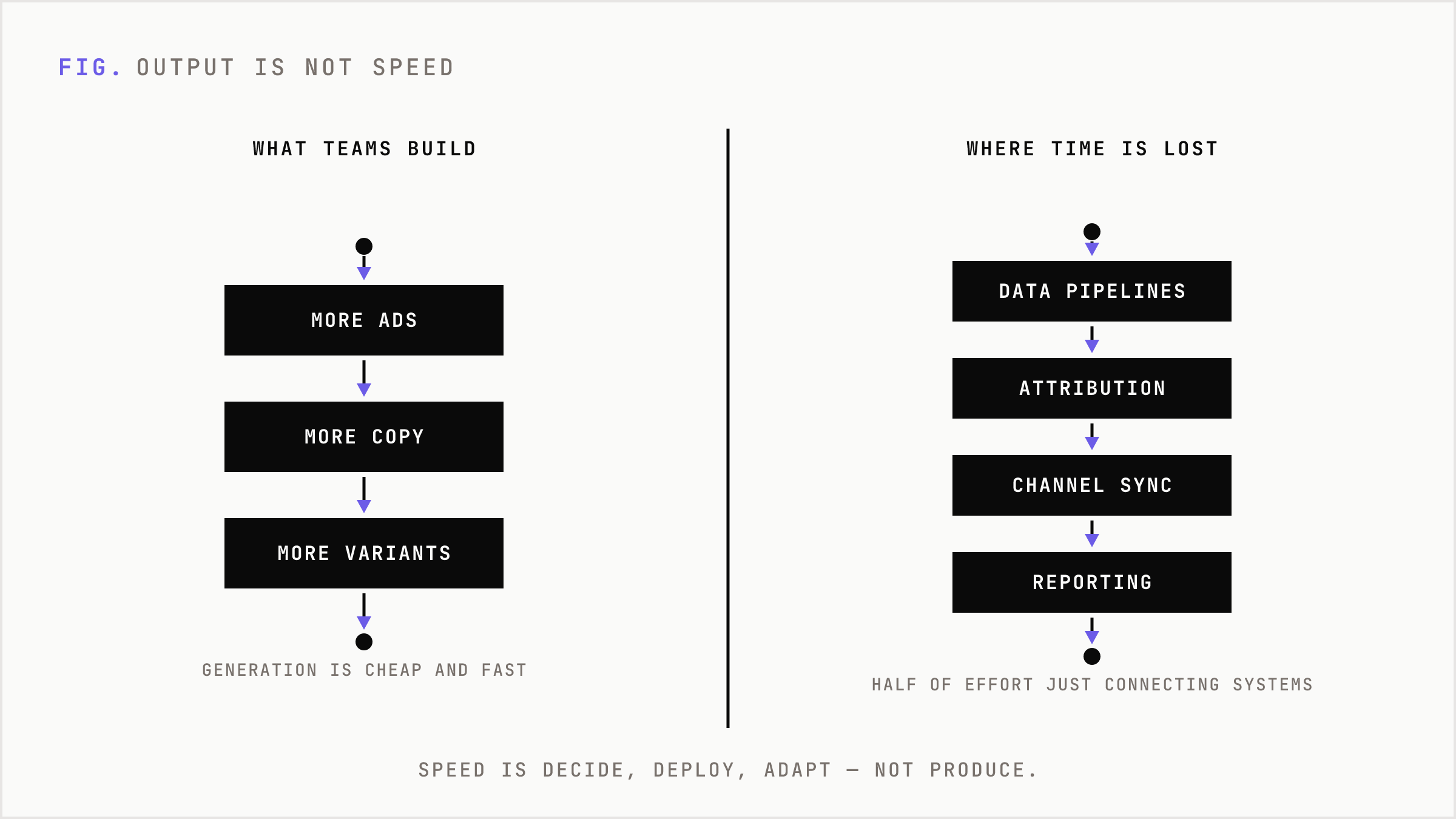
Speed in marketing has never been about how fast you can produce. It is about how fast you can decide, deploy, and adapt.
Why Most AI Marketing Efforts Stall
There are three structural reasons AI projects underdeliver in the first six months.
First, teams overbuild. Instead of using existing APIs and channels, they attempt to create custom infrastructure. This delays deployment and introduces unnecessary complexity.
Second, they fragment workflows across too many tools. Each additional platform adds coordination overhead. The net effect is slower execution, not faster.
Third, they treat AI as a creative layer instead of an operational one. This leads to static campaigns with better assets but no feedback loop.
The result is predictable. More content, same performance.
Where Speed Actually Comes From
The fastest teams invert the problem. They start with distribution and data, not content.
Instead of asking what to create, they ask where the feedback loop already exists. Paid social platforms, email systems, and landing pages already have structured data, measurable outcomes, and built-in optimization signals.
This matters because AI performs best in environments with clear inputs and outputs. You do not need to rebuild infrastructure. You plug into systems that already work.
For example, connecting an AI layer to Meta ads does not require reinventing targeting or measurement. It requires generating variations, deploying them quickly, and feeding performance data back into the system.
The time-to-launch shrinks because the system is already there.
Variation Beats Ideation
There is a persistent misconception that AI is best used for new ideas. In practice, it performs better as a variation engine.
High-performing teams do not ask AI to invent campaigns. They feed it proven angles and ask for hundreds of structured variations.
This is a different model of creativity. It is not about originality. It is about coverage.
If one headline works, generate fifty adjacent versions. If one audience converts, expand into micro-segments. If one landing page performs, create multiple variants with controlled differences.
The advantage is statistical, not artistic. You increase the probability of finding higher-performing combinations.
This is where AI drives real gains. More tests, faster cycles, lower cost per insight.
From Campaigns to Loops
Traditional marketing runs in sequences. Strategy, build, launch, analyze, iterate. Each step is discrete, and each introduces delay.
AI collapses this into a continuous loop. Generate, launch, measure, regenerate.
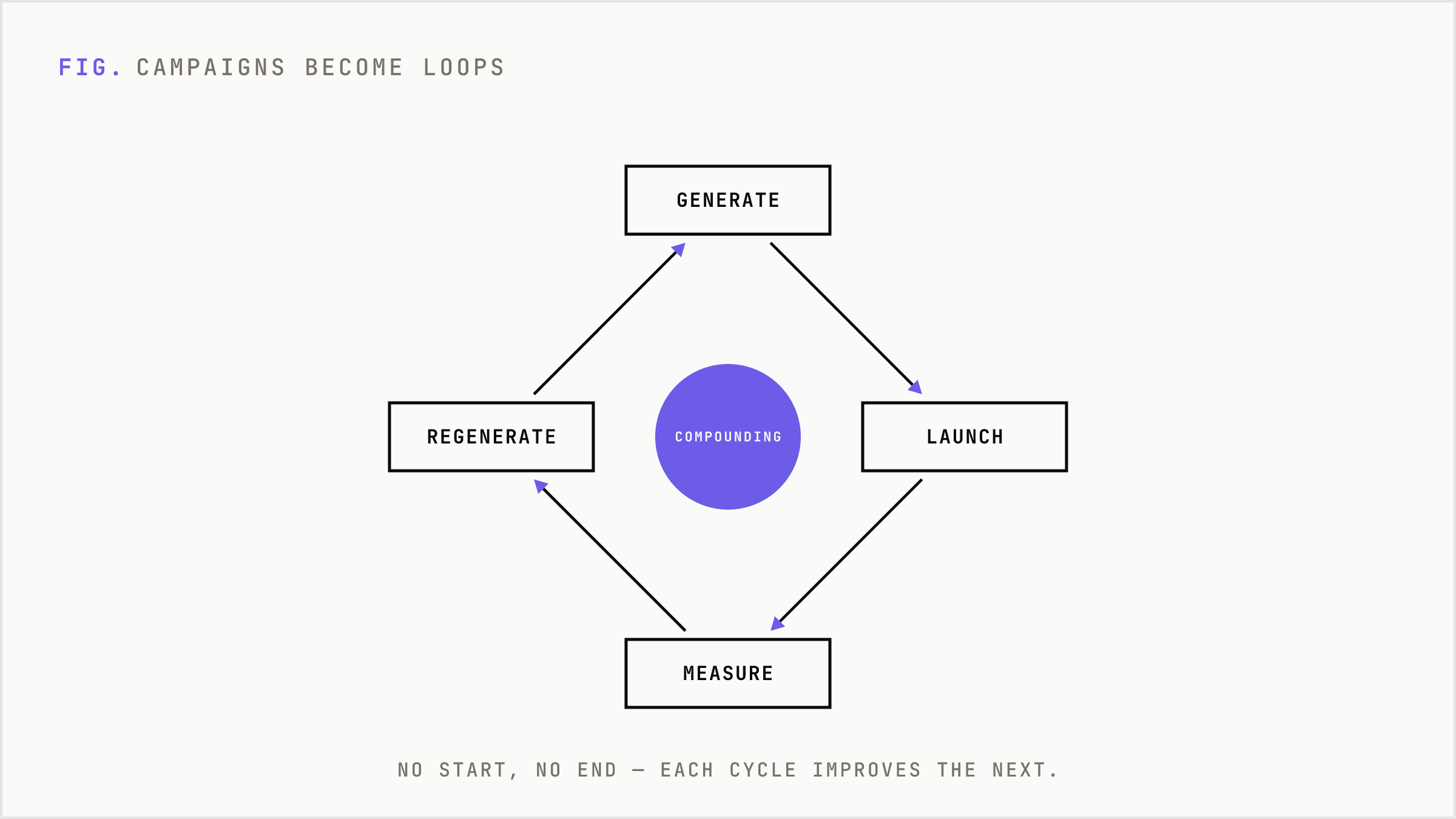
There is no clean starting point or endpoint. The system is always running, always adjusting.
This shift is subtle but important. A campaign is a one-time event. A loop is an ongoing process.
When you operate in loops, speed compounds. Each cycle improves the next without resetting the system.
The Minimum Viable Campaign System
You do not need a full stack to get this working. In fact, trying to build one will slow you down.
The minimum viable setup is simple. One model for copy and logic. One generator for visual assets. One automation layer to connect systems. One analytics loop to feed performance data back.
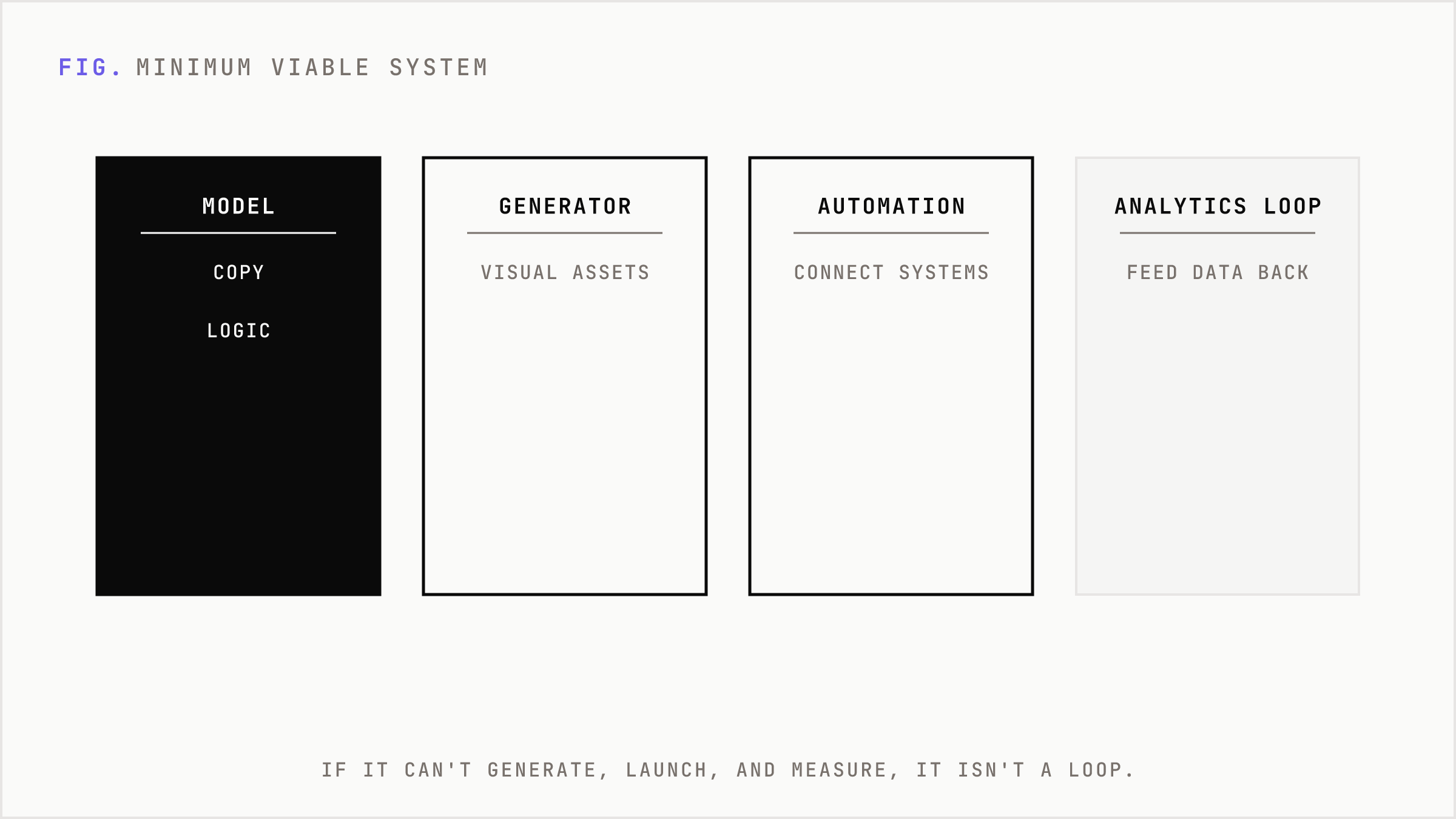
The constraint is strict. If the system cannot generate, launch, and measure automatically, it is not functioning as a loop.
This is where many teams fail. They stop at generation and never close the loop.
Reuse Is the Real Accelerator
The first campaign built this way is not fast. It requires setting up brand context, audience definitions, and baseline workflows.
But once that layer exists, everything changes.
Brand voice becomes reusable. Audience segments become reusable. Prompt structures become reusable. Even performance data becomes reusable.
The second campaign does not start from zero. It starts from a system that already knows what works.
This is where time compression actually happens. Not in the first launch, but in every launch after.
Focus on High-ROI Surfaces
Speed also comes from constraint. The fastest teams do not try to optimize every channel at once.
They focus on three surfaces. Paid social, email, and landing pages.
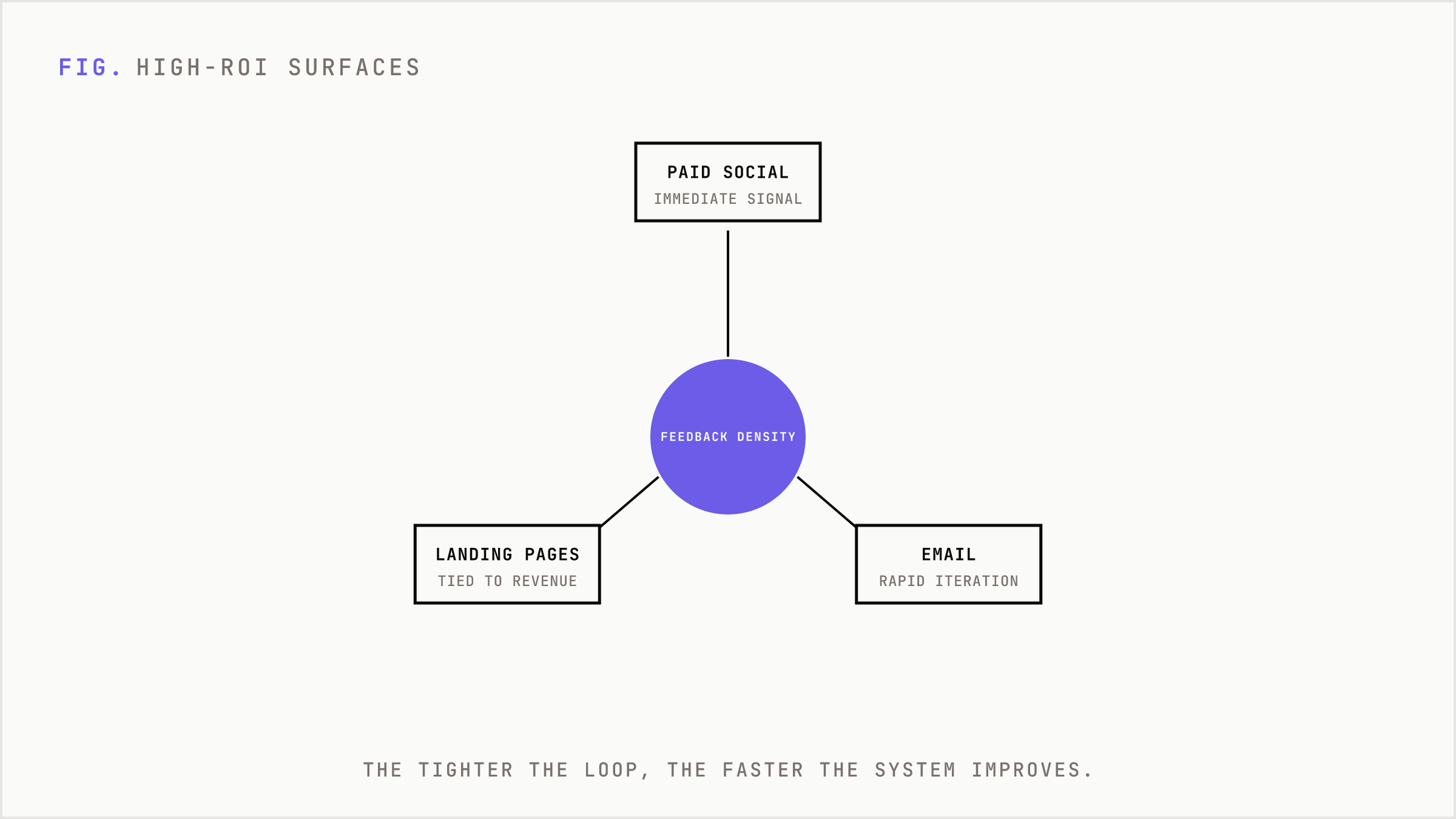
These channels have three properties in common. They produce immediate feedback, they support rapid iteration, and they tie directly to revenue.
Everything else introduces delay or weak attribution.
This is not about channel preference. It is about feedback density. The tighter the loop, the faster the system improves.
Synthetic Scale Before Real Spend
Another shift is how testing is approached.
Instead of learning through expensive live campaigns, teams generate and evaluate large volumes of variations before committing budget.
This does not replace real-world testing, but it reduces the cost of getting to viable options.
You enter the market with a higher baseline. Fewer wasted impressions, faster convergence on performance.
AI as an Operations Layer
The biggest gains do not come from better ads. They come from better orchestration.
AI is most effective when it controls timing, segmentation, sequencing, and allocation.
For example, deciding when a lead should receive an email, when they should be retargeted, and when they should be excluded from campaigns. These decisions are operational, not creative.
This is where cost reduction and conversion gains actually appear. Better coordination produces better outcomes.
What This Means for Budget Allocation
If you look at this from a budget perspective, the implications are clear.
Spending more on creative production has diminishing returns. Spending on systems that improve iteration speed has compounding returns.
This shifts investment from agencies and production toward infrastructure and automation.
It also changes how performance is measured. Output volume becomes irrelevant. The only metric that matters is how quickly the system improves outcomes.
The Strategic Shift
The broader change is a move from campaigns to systems.
Campaigns are fixed. Systems evolve.
Campaigns require repeated effort. Systems compound over time.
Campaigns optimize for launch. Systems optimize for learning.
This changes how companies scale. Growth is no longer driven by bigger launches, but by faster feedback cycles.
Where This Is Going
We are already seeing early signs of autonomous systems managing parts of this loop. Not fully replacing teams, but reducing the need for manual coordination.
At the same time, discovery is shifting. Content is increasingly surfaced through AI systems rather than traditional search. This introduces a new layer where optimization is not just for humans, but for models.
This further reinforces the need for structured, data-driven systems rather than isolated campaigns.
Bottom Line
AI does not compress time by making marketing easier. It compresses time by removing friction between steps.
The advantage is not faster creation. It is faster adaptation.
The teams that win are not the ones producing the most content. They are the ones running the tightest loops.
And once those loops are in place, speed is no longer a constraint. It becomes a property of the system.
FAQ
Why doesn’t AI immediately speed up marketing execution?
Because most delays come from integration, data flow, and decision-making. AI improves output, but without connected systems, execution speed does not change.
What is a minimum viable campaign system?
It is a simple setup where AI can generate assets, launch them through existing channels, and measure results automatically in a continuous loop.
Why focus on variation instead of new ideas?
Because performance improves through testing many controlled variations of proven concepts, not through unpredictable creative breakthroughs.
Which channels benefit most from AI marketing systems?
Paid social, email, and landing pages benefit the most due to structured data, fast feedback loops, and direct impact on conversions.
What changes when moving from campaigns to systems?
The focus shifts from one-time launches to continuous optimization, where performance improves over time through ongoing feedback and iteration.