Nyyon · Blog
From Campaigns to Systems: How AI Collapses Time and Sharpens Marketing Execution
AI is replacing linear marketing workflows with parallel systems, compressing timelines and improving precision through rapid testing, signal aggregation, and continuous optimization.
Marketing is no longer a sequence of steps. It is a system that runs continuously, learns constantly, and ships faster than teams can plan.
The Collapse of the Linear Workflow
Traditional marketing followed a predictable chain. Research informed strategy. Strategy guided copy. Copy moved to design. Then testing. Each stage waited for the previous one to finish.
This structure made sense when production was expensive and coordination was manual. It also created lag. A single campaign could take weeks before it reached the market, and by then the assumptions behind it were already aging.
AI breaks this constraint by removing the need for strict sequencing. Research, messaging, creative production, and testing can now run at the same time. Multi-agent systems generate hypotheses, produce assets, and simulate outcomes in parallel.
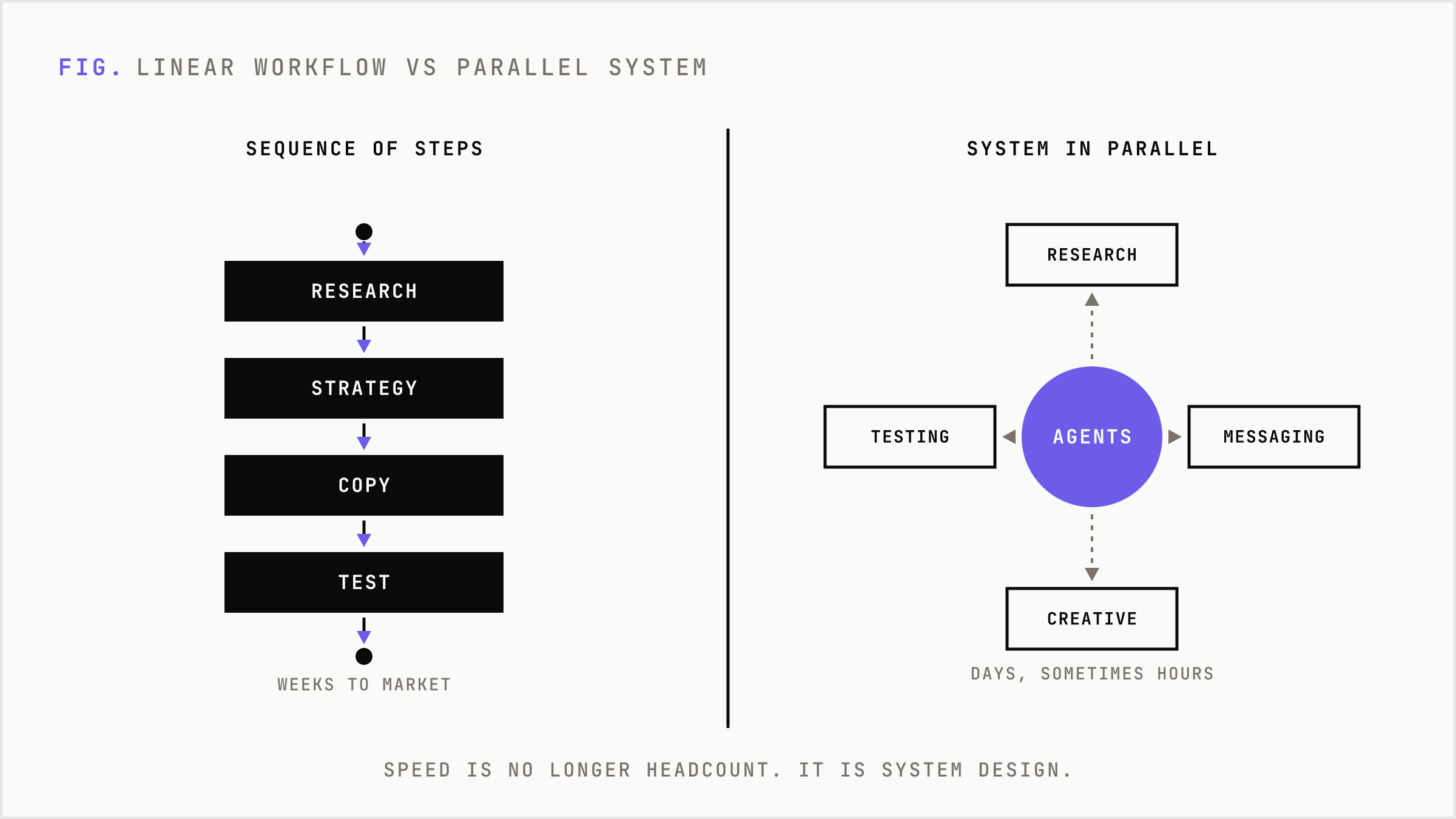
The practical effect is simple. Campaign timelines shrink from weeks to days, sometimes hours. Speed is no longer a function of headcount or coordination. It is a function of system design.
From Ideas to Throughput
The biggest shift is not better ideas. It is higher throughput.
AI-native teams do not depend on a single creative concept. They generate hundreds of variations across hooks, formats, and angles. A paid social campaign might launch with 200 headline variations instead of five. A landing page might have dozens of modular combinations.
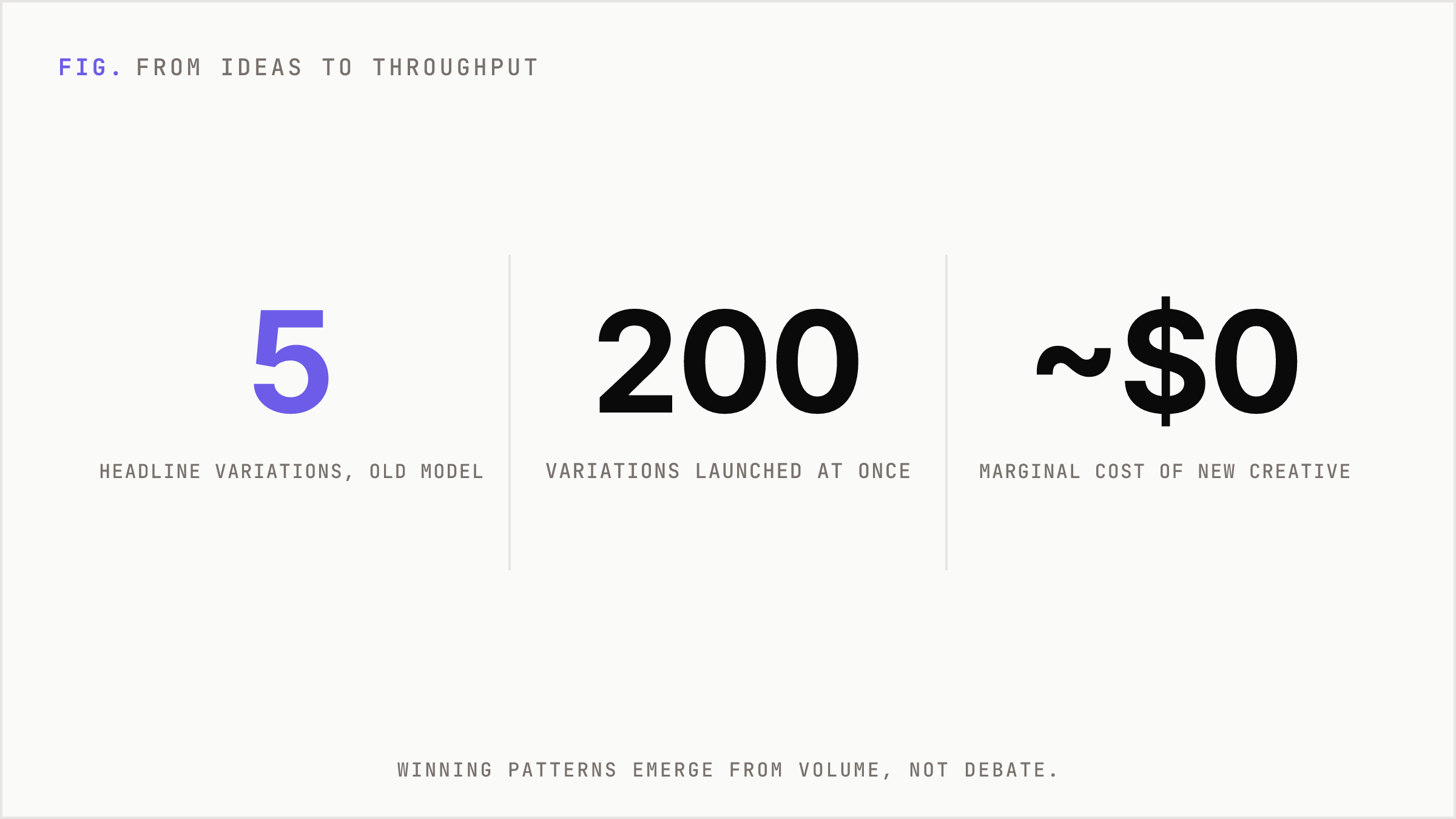
This changes how performance is discovered. Instead of debating which idea is best, teams test broadly and let results converge statistically. Winning patterns emerge from volume.
This is closer to how markets behave. Buyers do not respond to a single message. They respond to the right message at the right moment. Volume increases the probability of alignment.
Prompt Systems as Infrastructure
The highest leverage asset inside modern marketing teams is not creative talent. It is structured prompts.
Leading teams build internal libraries that encode positioning, customer profiles, messaging angles, and tone. These prompts act as reusable strategy units. Instead of rethinking a campaign from scratch, teams instantiate known frameworks and adapt them.
This reduces variability. It also compounds knowledge. Each iteration improves the system rather than existing as a one-off effort.
The outcome is counterintuitive. Consistency produces sharper output than raw creativity. The system learns what works and reinforces it.
Synthetic Research Replaces Early Guesswork
Primary research has always been slow and expensive. Interviews, surveys, and field studies delay execution. AI offers a substitute that is not perfect, but fast enough to matter.
Large language models can simulate how a target customer might respond to a message, what objections they raise, and what triggers a purchase decision. These simulations are trained on aggregated behavioral and market data.
They are not a replacement for real feedback. But they are directionally accurate for first drafts. That is enough to move forward.
The key shift is timing. Instead of waiting for research before building, teams generate drafts immediately and refine based on live performance data.
Signal Aggregation Beats Opinion
Marketing decisions used to rely heavily on internal judgment. That model does not scale.
AI systems now ingest data from multiple sources: CRM records, ad performance, sales calls, website analytics, and social interactions. These signals are clustered to identify patterns in customer language, objections, and intent.
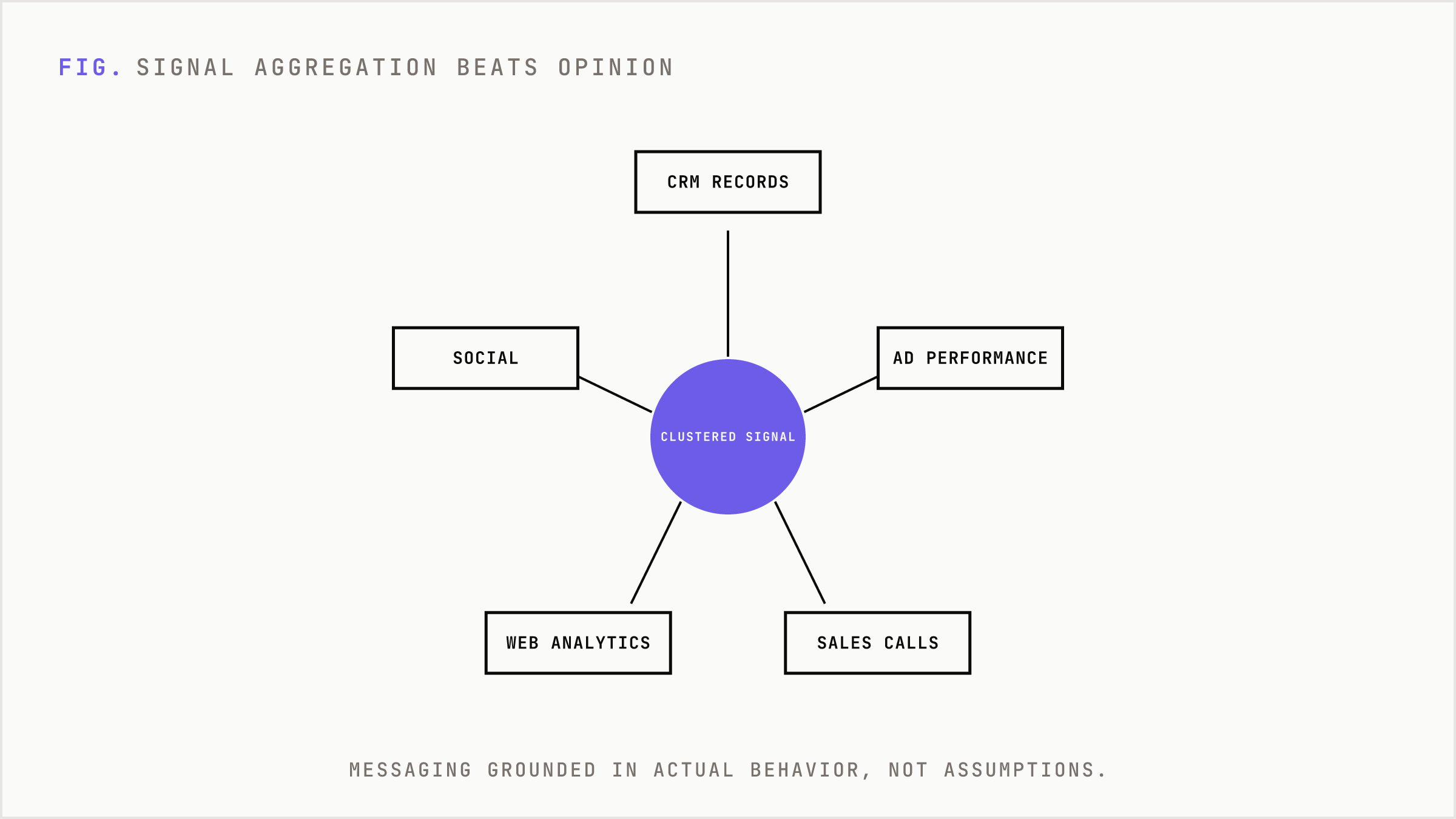
This produces messaging grounded in actual behavior. Not assumptions.
For example, a B2B SaaS company might discover that buyers consistently frame their problem as risk reduction rather than efficiency. That insight shifts headline language, proof points, and calls to action across campaigns.
The advantage is precision. Campaigns start to reflect how customers actually think and speak.
Real-Time Feedback Loops
Traditional campaigns operate on a launch and wait cycle. Performance data arrives days or weeks later. Adjustments are slow.
AI compresses this loop. Performance data feeds back into the system continuously. Messaging evolves in near real time.
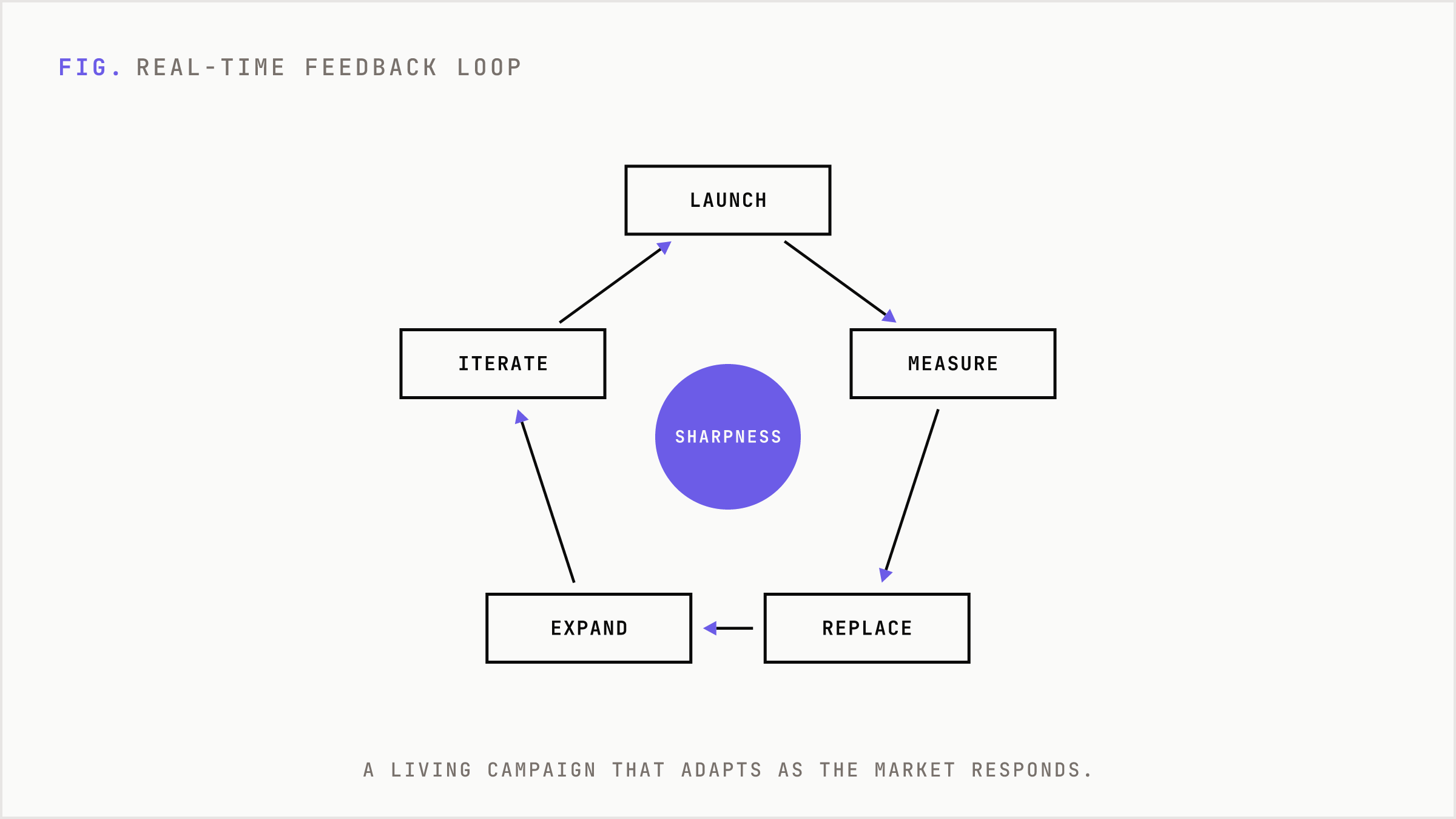
If a headline underperforms, it is replaced within hours. If a specific angle gains traction, variants expand around it automatically.
This creates a living campaign. It adapts as the market responds.
Sharpness becomes a moving target. It is not defined at launch. It is maintained through constant iteration.
Modular Campaign Architecture
Another structural change is how campaigns are built.
Instead of monolithic assets, campaigns are broken into components: hooks, angles, proof, and calls to action. Each component can be swapped or recombined.
This modularity allows rapid iteration without rebuilding from scratch. A single proof point can be paired with multiple hooks. A strong hook can be tested across different audience segments.
It also aligns with how AI systems operate. Models generate and recombine components efficiently, producing new variations at scale.
Creative Production Is No Longer the Bottleneck
Production used to limit experimentation. Design queues, video editing, and copywriting cycles created delays.
AI removes these constraints. Image generation, video synthesis, and copy production happen instantly. More importantly, they happen together.
This eliminates handoffs between teams. A concept can move from idea to live campaign within the same day.
The implication is economic. When the marginal cost of new creative approaches zero, the optimal strategy shifts toward aggressive testing.
Positioning Becomes Iterative
Positioning was traditionally treated as a one-time decision. Workshops, frameworks, and months of debate.
AI changes this by making positioning testable. Models can simulate competitive comparisons, identify undifferentiated claims, and suggest alternatives.
More importantly, positioning can be validated in market quickly. If a message fails to resonate, it is adjusted and retested.
This turns positioning into an ongoing process rather than a fixed statement.
Pattern Recognition at Scale
Humans struggle to detect patterns across multiple variables. Tone, format, audience segment, and channel interact in complex ways.
AI systems can analyze these interactions across thousands of data points. They identify correlations that would otherwise be missed.
For example, a specific combination of informal tone, short video format, and mid-funnel audience might outperform other configurations consistently.
This level of insight improves targeting and message-market fit beyond what manual analysis can achieve.
The Economics of Speed
The cost structure of marketing is shifting.
When creative production and iteration are cheap, the constraint moves to decision-making and system design. Teams that can process feedback quickly and redeploy resources efficiently gain an advantage.
Failure becomes inexpensive. Losing angles are killed within days. Budget flows toward winners automatically.
This increases overall performance without increasing spend. Efficiency comes from allocation, not reduction.
The Role of the Human Operator
AI does not remove humans from marketing. It changes their role.
Instead of generating content, humans curate outputs, enforce quality, and make strategic decisions. They act as editors and judges.
This removes the blank page problem. It also raises the bar for taste and judgment.
The skill is no longer execution. It is selection.
From Campaigns to Systems
The cumulative effect of these changes is structural.
Campaigns are no longer discrete deliverables. They are continuous systems that ingest data, generate variants, test performance, and adapt in real time.
This has implications for how companies allocate budget and evaluate partners. Agencies that rely on manual processes and fixed timelines will struggle to compete.
The advantage shifts to teams that build internal tooling, integrate data sources, and design feedback loops.
Market Implications
For founders and investors, this is not a tooling upgrade. It is a change in how growth is produced.
Customer acquisition becomes more predictable because it is driven by systems rather than isolated bets. Time to market decreases, allowing faster iteration on product and positioning.
There is also a compounding effect. Systems improve as they run. Each campaign feeds data back into the next. Knowledge accumulates.
This creates defensibility. Not through brand alone, but through operational advantage.
What Actually Matters
The core constraint is no longer creativity or budget. It is clarity.
AI systems perform best when inputs are well defined. Clear customer profiles, strong offers, and specific constraints produce better outputs faster.
Teams that invest in defining these inputs will outperform those that rely on tools alone.
Speed is downstream of clarity. Always has been.
The Bottom Line
AI does not make marketing easier. It makes it faster, more measurable, and less forgiving of weak thinking.
The teams that win will not be the ones with access to the best models. They will be the ones that design the best systems.
And those systems will look less like campaigns and more like machines that never stop running.
FAQ
What is an AI-native marketing system?
An AI-native marketing system uses automation, data integration, and continuous feedback loops to run campaigns in parallel rather than sequentially, improving speed and performance.
How does AI improve campaign performance?
AI increases testing volume, identifies patterns in customer behavior, and adapts messaging in real time, leading to better alignment with market demand.
Is synthetic research reliable?
Synthetic research is not perfectly accurate but is directionally useful for early-stage ideation and messaging before real-world data is available.
What replaces traditional creative workflows?
Parallel workflows powered by AI replace linear processes, allowing research, copy, design, and testing to happen simultaneously.
What skills matter most in AI-driven marketing?
Strategic thinking, judgment, and the ability to define clear inputs matter more than execution, as AI handles most production tasks.