Nyyon · Blog
From Campaigns to Compounding Growth Systems
AI has made execution cheap. The advantage now comes from systems, data, and iteration loops that turn marketing into a compounding growth engine.
Marketing advantage has shifted from creative output to system design.
The End of Campaign Thinking
The traditional campaign model assumes scarcity. Limited creative, limited testing, limited time. Teams plan, launch, measure, and reset. Each cycle starts close to zero.
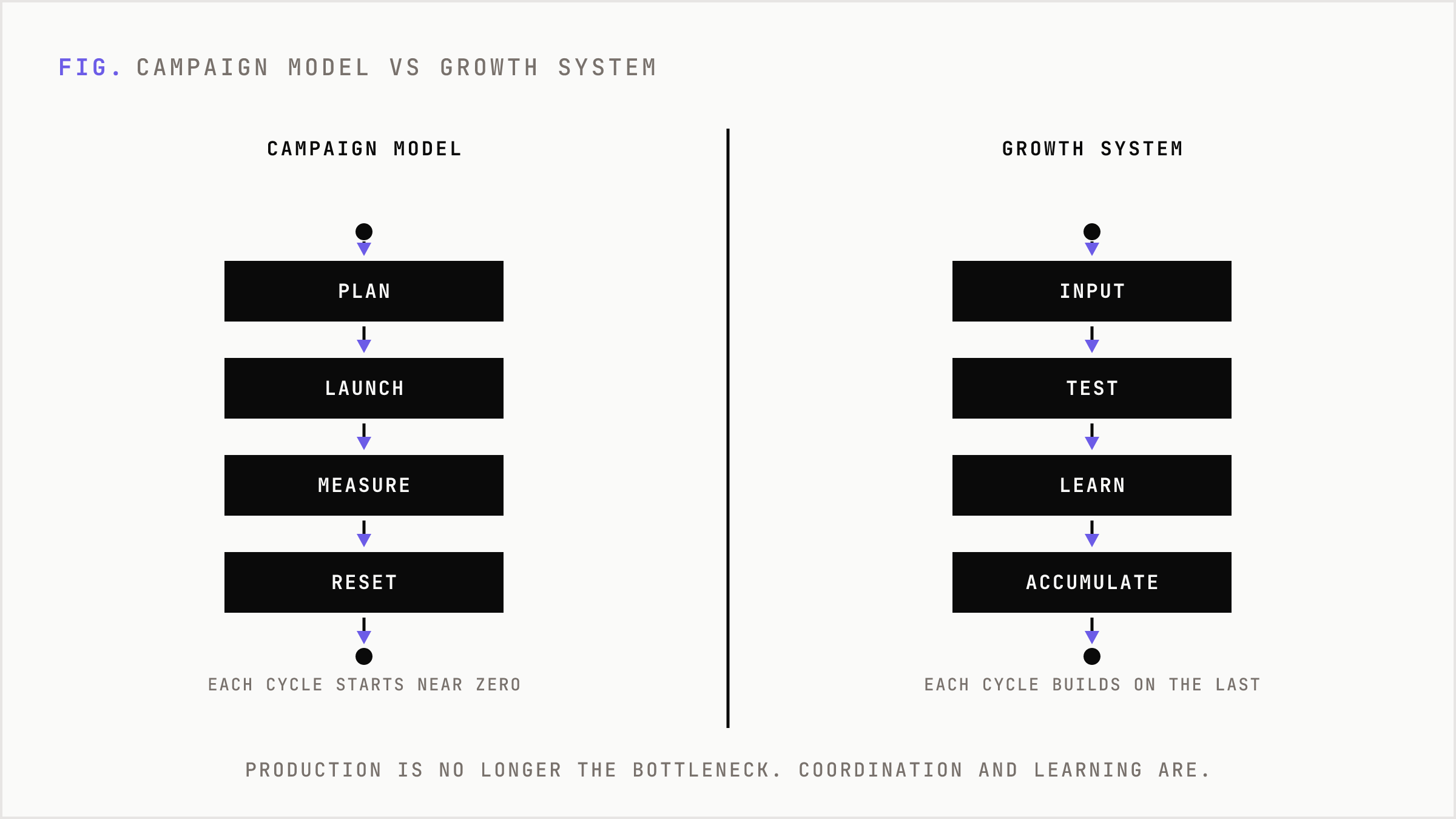
AI removes that constraint. Content is no longer expensive. Variations are effectively free. Testing can run continuously. The bottleneck is no longer production. It is coordination and learning.
This breaks the economic logic of campaigns. If you can test 500 variations in a week, the idea of a single “big launch” loses relevance. What matters is not the campaign itself, but the system that produces, evaluates, and evolves it.
High-performing teams have already moved. They do not ask what campaign to run next. They ask how their system is learning.
Hybrid Is Baseline, Not Differentiation
Every agency now claims some version of AI plus human. It does not matter. The market has normalized it.
The real question is where humans intervene and where they do not.
In top-performing models, the division is clean:
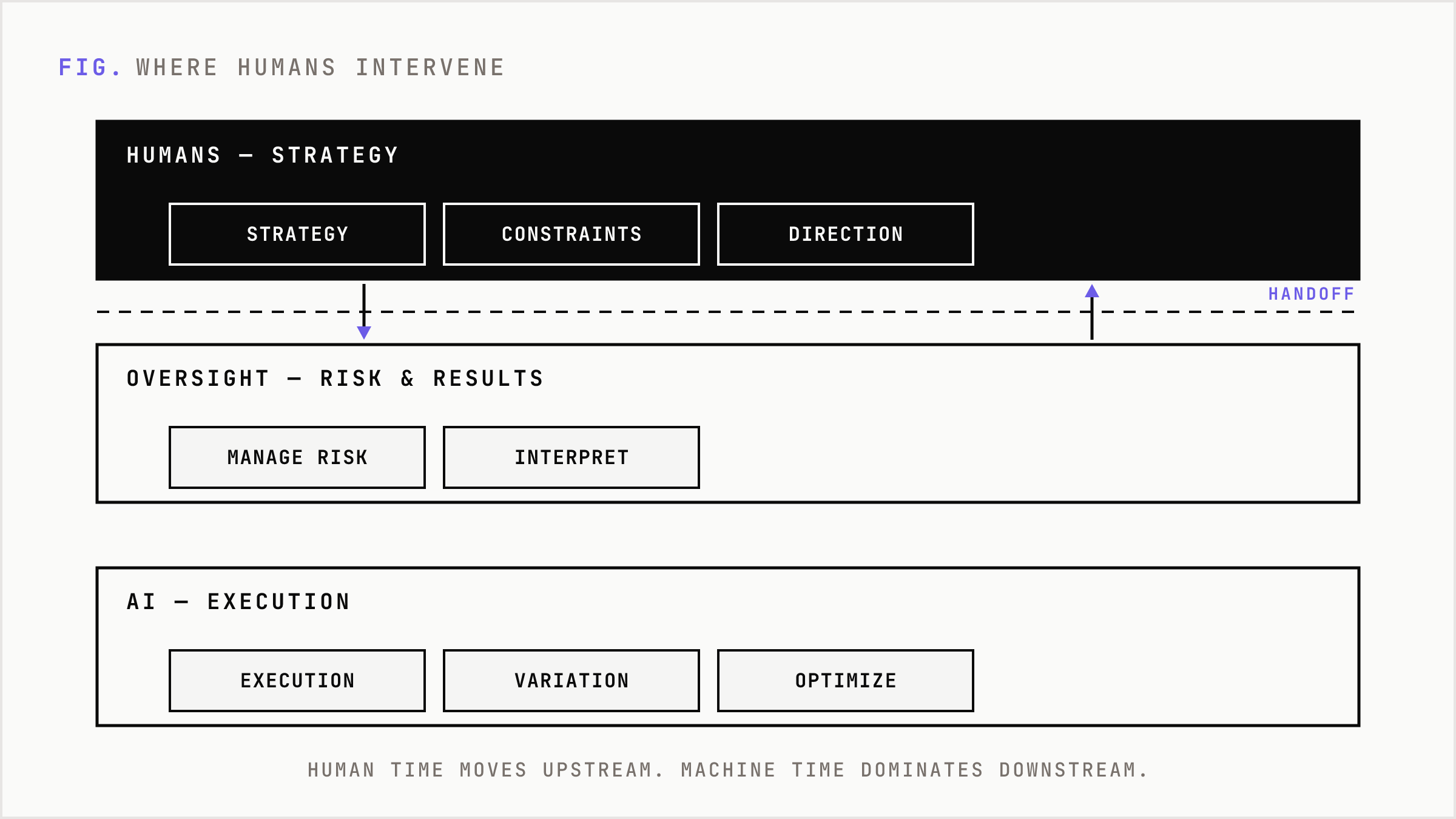
- Humans define strategy, constraints, and direction
- AI handles execution, variation, and optimization
- Oversight combines both to manage risk and interpret results
This is not a philosophical distinction. It shows up in workflow structure and cost allocation. Human time moves upstream into framing and decision making. Machine time dominates everything downstream.
Agencies that blur this boundary waste resources. They either overuse humans in execution or overtrust AI in strategy. Both degrade performance.
Execution Is Already Solved
Content generation, media optimization, and personalization are no longer differentiators. The major platforms have embedded these capabilities directly into their products.
Meta optimizes creative combinations in real time. Google automates bidding and targeting. Email platforms generate and test subject lines automatically. Open models produce infinite variations of copy and visuals.
The marginal cost of execution is approaching zero.
This creates a substitution effect. Tasks that once required specialists are now absorbed by systems. The value of execution collapses. The value of orchestration increases.
Founders still paying for output are buying a commodity. The market is moving toward paying for outcomes driven by systems.
The Rise of Growth Systems
A growth system is an always-on loop with three properties: continuous input, continuous testing, and continuous learning.
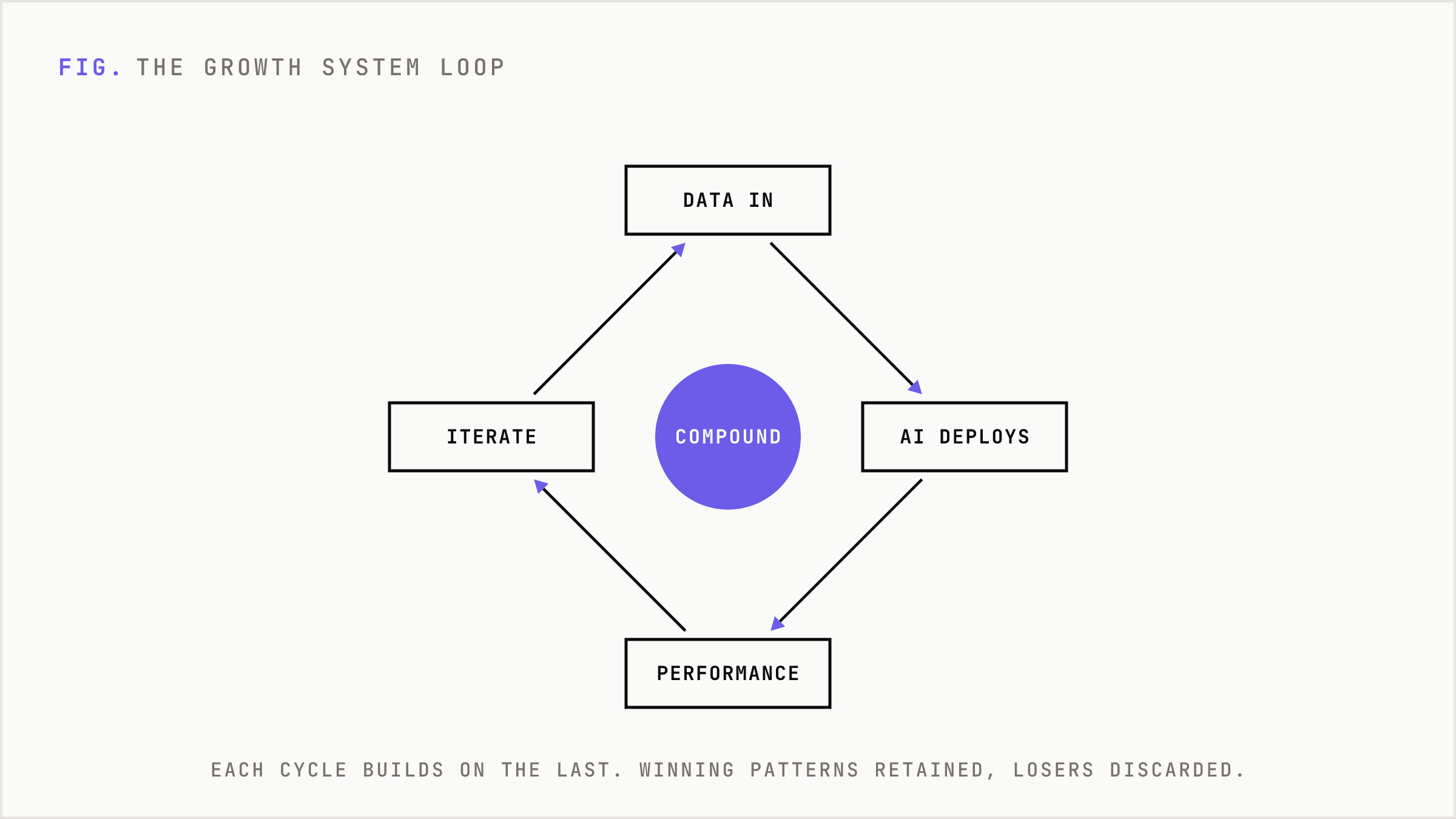
Instead of discrete campaigns, you get a pipeline:
- Data flows in from CRM, product usage, and ad platforms
- AI generates and deploys variations across channels
- Performance data feeds back into the system
- The next iteration improves automatically
The key difference is accumulation. Each cycle builds on the last. Winning patterns are retained. Losing patterns are discarded. Over time, the system becomes more efficient without requiring proportional human effort.
This is what compounding looks like in marketing. Not bigger campaigns, but faster learning loops.
Data Is the Only Durable Advantage
Tools are commoditizing fast. The same models are accessible to everyone. The same platforms offer similar automation.
The only defensible edge is data.
Specifically:
- Historical performance data across creatives and audiences
- First-party data from CRM and product usage
- Structured feedback loops that connect outcomes to inputs
Most teams underinvest here. Data is fragmented, poorly labeled, or inaccessible to the systems that need it. As a result, AI outputs remain generic.
Teams that fix this see nonlinear gains. Better data improves targeting. Better targeting improves performance. Better performance generates better data. The loop reinforces itself.
This is why two companies using the same tools can produce completely different results.
Where Humans Still Matter
AI is strong in the middle of the workflow. It struggles at the edges.
Humans remain critical in four areas:
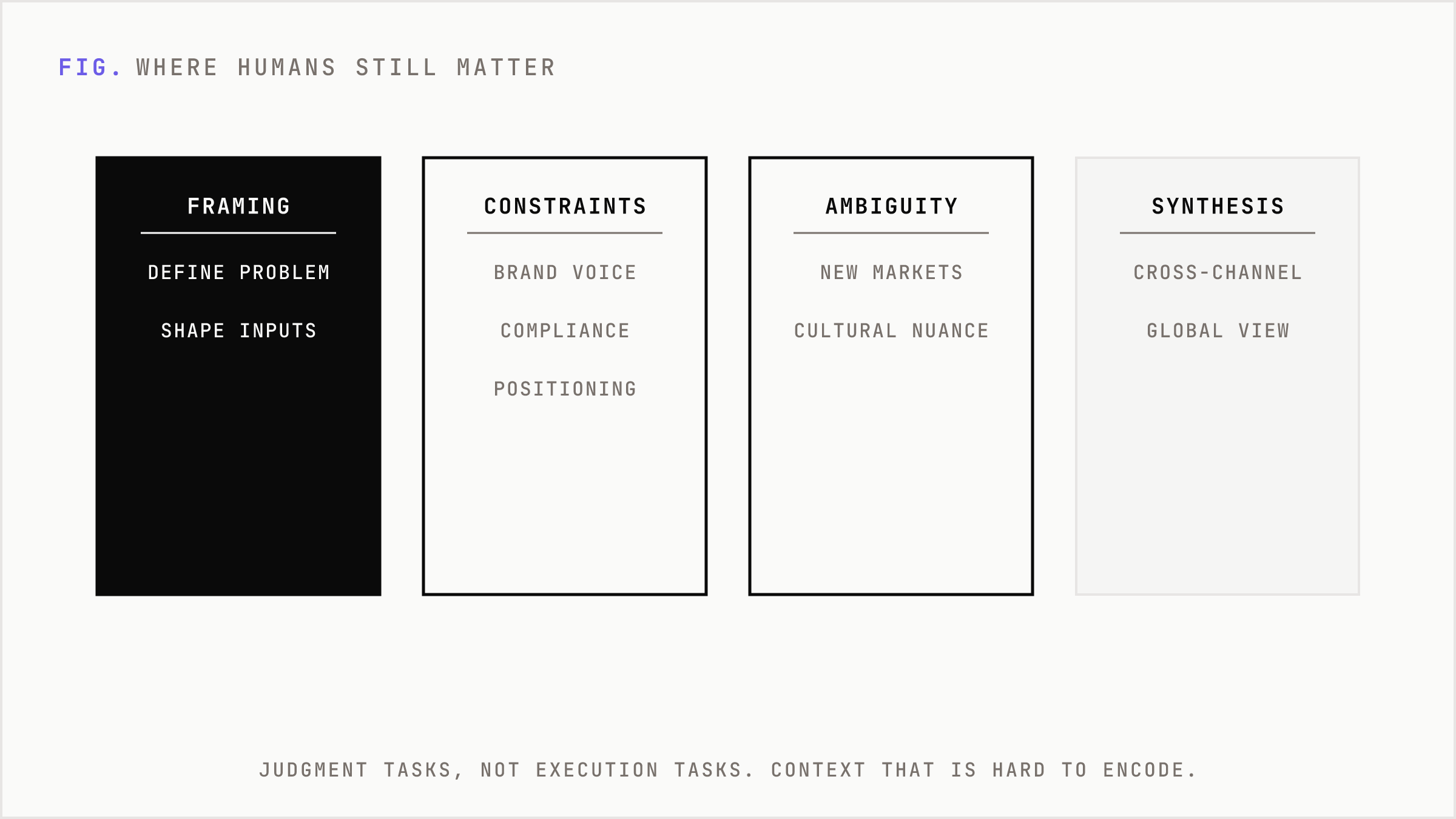
- Problem framing. AI is highly sensitive to inputs. Poor framing produces irrelevant outputs at scale.
- Constraint setting. Brand voice, compliance requirements, and positioning must be explicitly defined.
- Ambiguity interpretation. Emerging markets and cultural nuance are still difficult for models to handle reliably.
- Cross-channel synthesis. Most systems optimize locally, not globally.
These are not execution tasks. They are judgment tasks. They require context that is not easily encoded.
Teams that push AI into these areas without guardrails introduce risk. Teams that ignore AI in execution leave performance on the table.
From Outputs to Infrastructure
The most important shift is conceptual. Marketing is becoming infrastructure.
Instead of asking what assets to produce, teams design systems that produce assets. Instead of measuring campaign performance, they measure system efficiency.
This changes how budgets are allocated.
Spend moves away from one-off creative and toward:
- Data pipelines
- Experimentation frameworks
- Integration between platforms
- Internal models trained on brand data
The return profile changes as well. Investments take longer to set up but produce ongoing gains. Margins expand as automation scales output without proportional headcount increases.
Experimentation Becomes Core Infrastructure
Most teams still run superficial A B tests. Two variations, small sample sizes, inconclusive results.
This does not work in an AI-driven environment. When you can generate hundreds of variations, you need statistically valid testing systems.
That means:
- Clear hypotheses tied to business metrics
- Sufficient sample sizes
- Automated allocation of traffic to winning variants
- Persistent storage of results for future use
Without this, increased output just creates noise. With it, every test contributes to a growing knowledge base.
Orchestration Is the New Bottleneck
Generating content is easy. Coordinating it across the customer journey is not.
A user might see a paid ad, click to a landing page, receive an email, and interact with a product. Each touchpoint is often managed by a different system.
Without orchestration, messaging fragments. Optimization happens in silos. Gains in one channel are offset by losses in another.
The leading teams unify these layers. They connect CRM data, media platforms, and content systems into a single loop.
This enables:
- Consistent messaging across touchpoints
- Better attribution of outcomes
- Faster feedback into the system
The result is not just higher performance, but more predictable performance.
Pricing Follows the System
As execution becomes automated, pricing models change.
Hourly billing makes less sense when machines do most of the work. Project-based pricing breaks when outputs are continuous.
The shift is toward:
- Performance-based models tied to outcomes
- Retainers for maintaining and improving systems
Buyers are adapting quickly. They expect speed and volume by default. What they pay for is clarity, measurable lift, and system-level thinking.
Claims of being AI-powered carry little weight without evidence of results.
The Next 24 Months
The direction is clear.
Agent-based systems will take on more of the execution loop. Creative generation will be directly tied to performance data in real time. Internal brand models will encode voice and history.
At the same time, constraints will tighten. Privacy changes push more reliance on first-party data. Regulated industries demand auditability and human validation layers.
The gap between teams with integrated systems and those without will widen.
The Strategic Implication
The advantage is no longer having AI. It is how you structure around it.
Teams that treat AI as a tool will see incremental gains. Teams that redesign workflows around it will see compounding returns.
The difference shows up in iteration speed, data quality, and decision accuracy.
Over time, that difference becomes structural. One organization learns faster than the other. And in a system driven by continuous feedback, learning speed is the only metric that compounds.
Bottom Line
Campaigns reset. Systems accumulate.
Execution is cheap. Coordination is not.
Data beats tools. Structure beats prompts.
The winners are not producing better ads. They are building systems that make every ad better than the last.
FAQ
What is a compounding growth system in marketing?
A compounding growth system is an always-on marketing framework where data, testing, and AI-driven execution continuously improve performance over time instead of resetting with each campaign.
Why are traditional campaigns becoming less effective?
AI has reduced the cost of content creation and testing, making one-off campaigns inefficient. Continuous systems can iterate faster and learn more, producing better results over time.
What role do humans play in AI-driven marketing systems?
Humans focus on strategy, framing, constraints, and interpretation. AI handles execution, testing, and optimization at scale.
What creates a competitive advantage in AI marketing today?
Proprietary data, integrated systems, and fast feedback loops create durable advantage. Tools alone are widely accessible and no longer differentiate teams.
How should companies adapt their marketing budgets?
Budgets should shift from one-off creative production to building data infrastructure, experimentation systems, and integrated growth engines that deliver ongoing returns.