Nyyon · Blog
From AI Output to Campaign Velocity
AI speeds campaign deployment when experts redesign workflows across strategy, creative, governance, testing, and optimization, not just content.
AI does not make campaigns faster because it writes faster. It makes campaigns faster when experts redesign the system campaigns move through.
That distinction matters because most companies are still buying the wrong promise.
They hear AI and think output. More headlines. More social posts. More landing page copy. More ad variants. That is useful, but it is not where campaign time actually disappears. The real delay lives between tasks. It sits in the handoff from strategy to creative, from creative to legal, from legal to media, from media to analytics, from analytics back to strategy.
AI can reduce production time. AI-native experts reduce waiting time.
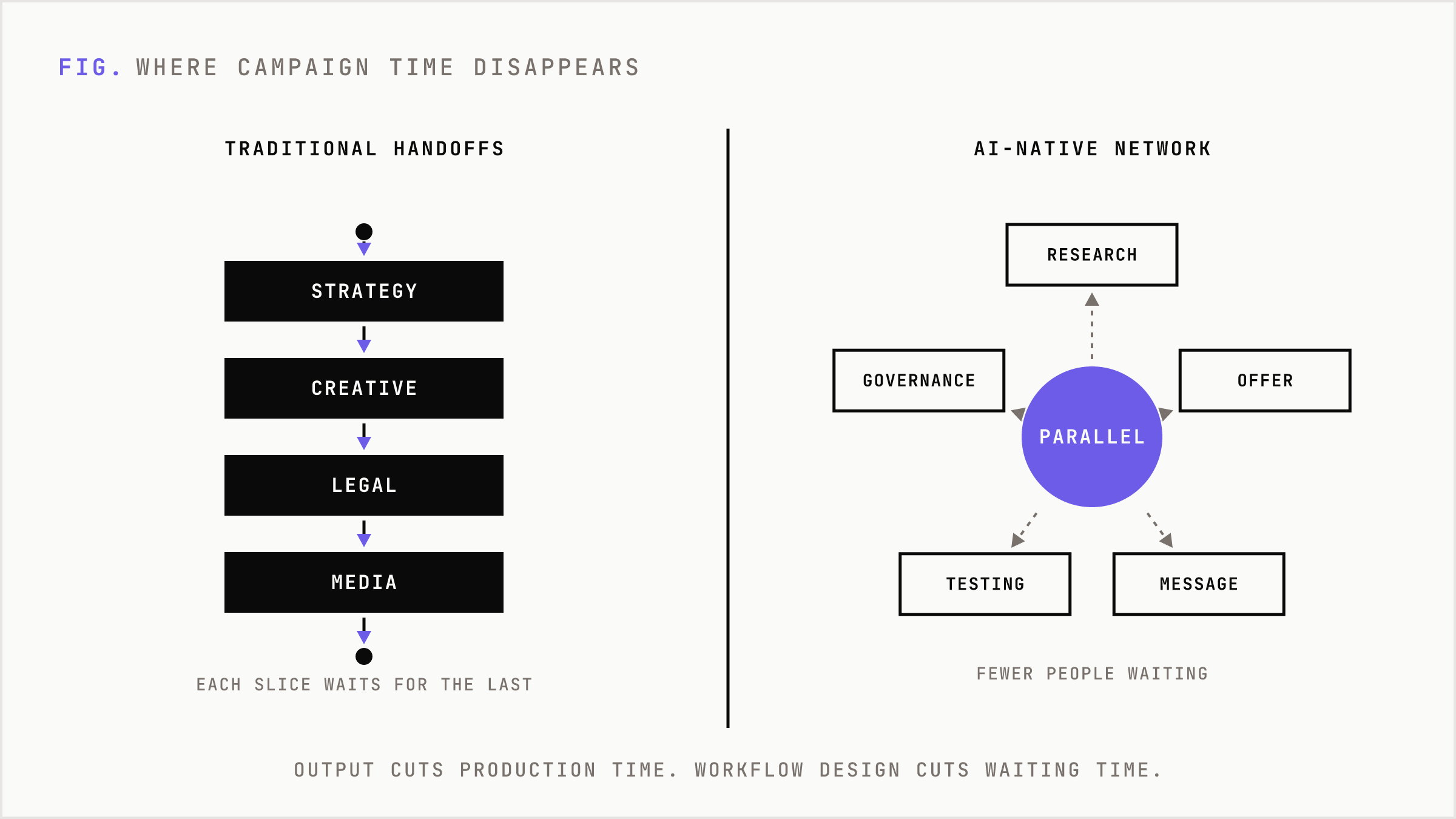
That is the difference between content volume and campaign velocity.
The campaign bottleneck moved
For years, the obvious bottleneck was production. A team needed research, a brief, copy, design, media setup, landing pages, emails, sales assets, reporting templates, and approval. Each function owned a slice. Each slice waited for the previous slice to finish.
That model made sense when creation was expensive and specialized. It makes less sense when a capable operator can draft ten campaign angles, build a message matrix, create channel variants, pressure-test claims, and summarize competitive positioning in the same afternoon.
But the bottleneck did not vanish. It moved.
The new bottlenecks are brand context, data access, offer logic, compliance rules, channel constraints, review gates, naming conventions, test design, and performance feedback. These are not solved by asking a model to write more copy. They are solved by designing a workflow where AI is embedded into the operating structure.
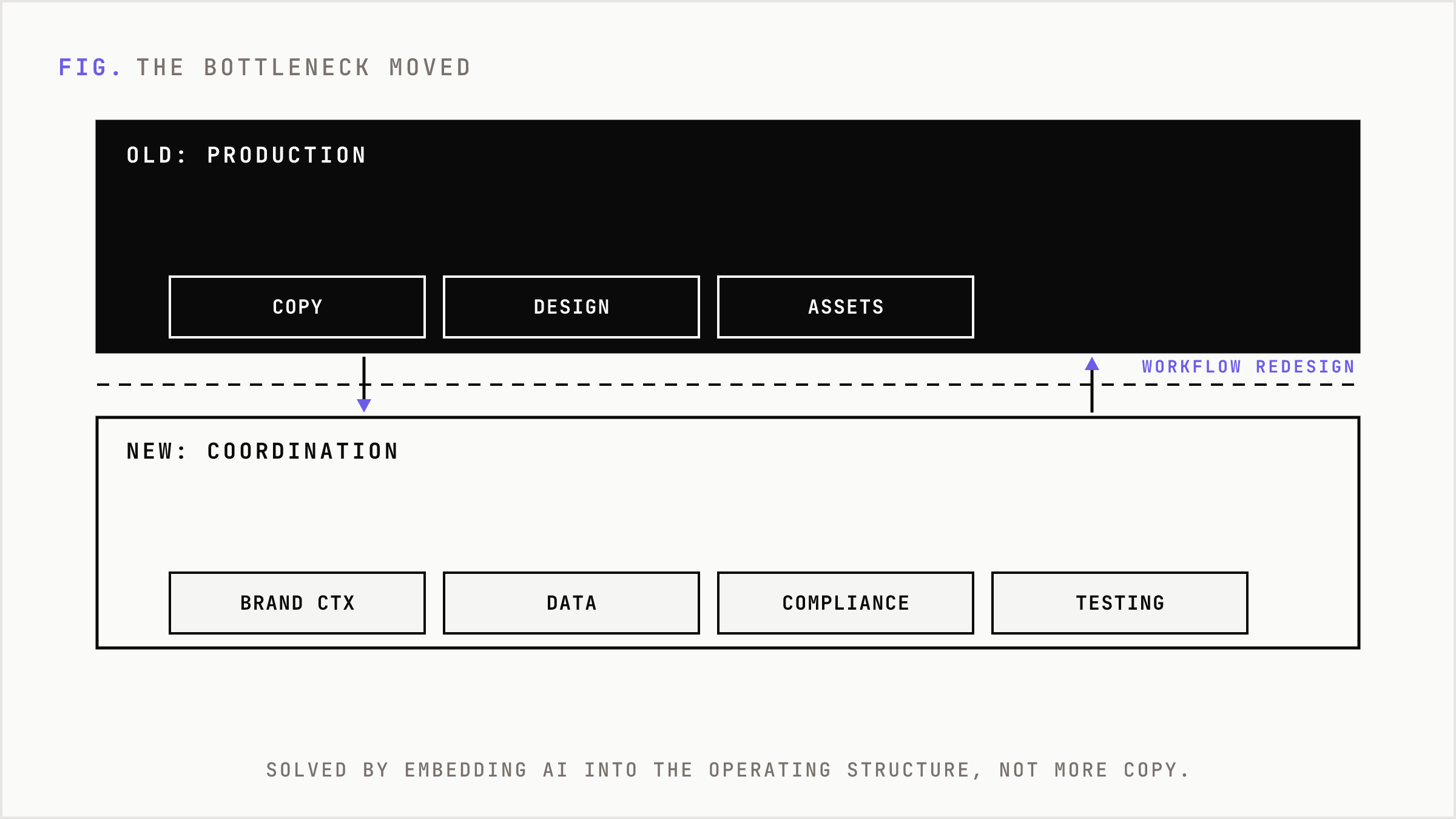
This is why the phrase AI marketing expert is often misunderstood. The expert is not valuable because they know better prompts. They are valuable because they know which parts of the campaign supply chain can be parallelized, which parts need human judgment, and which parts should never be automated without review.
The market is not waiting for theory
The economic signal is already visible.
McKinsey has estimated that generative AI can move some marketing work that once took months into weeks or days, especially around content design, insight generation, targeting, personalization, and testing. It also estimates that generative AI could raise marketing productivity by 5 to 15 percent of total marketing spend.
That is not a copywriting statistic. It is a budget statistic.
Gartner has reported that campaigns and media plans consume 44.5 percent of total marketing budget. It also found that 87 percent of CMOs had campaign performance issues in the prior 12 months, and 45 percent sometimes, often, or always terminated campaigns early because of poor performance.
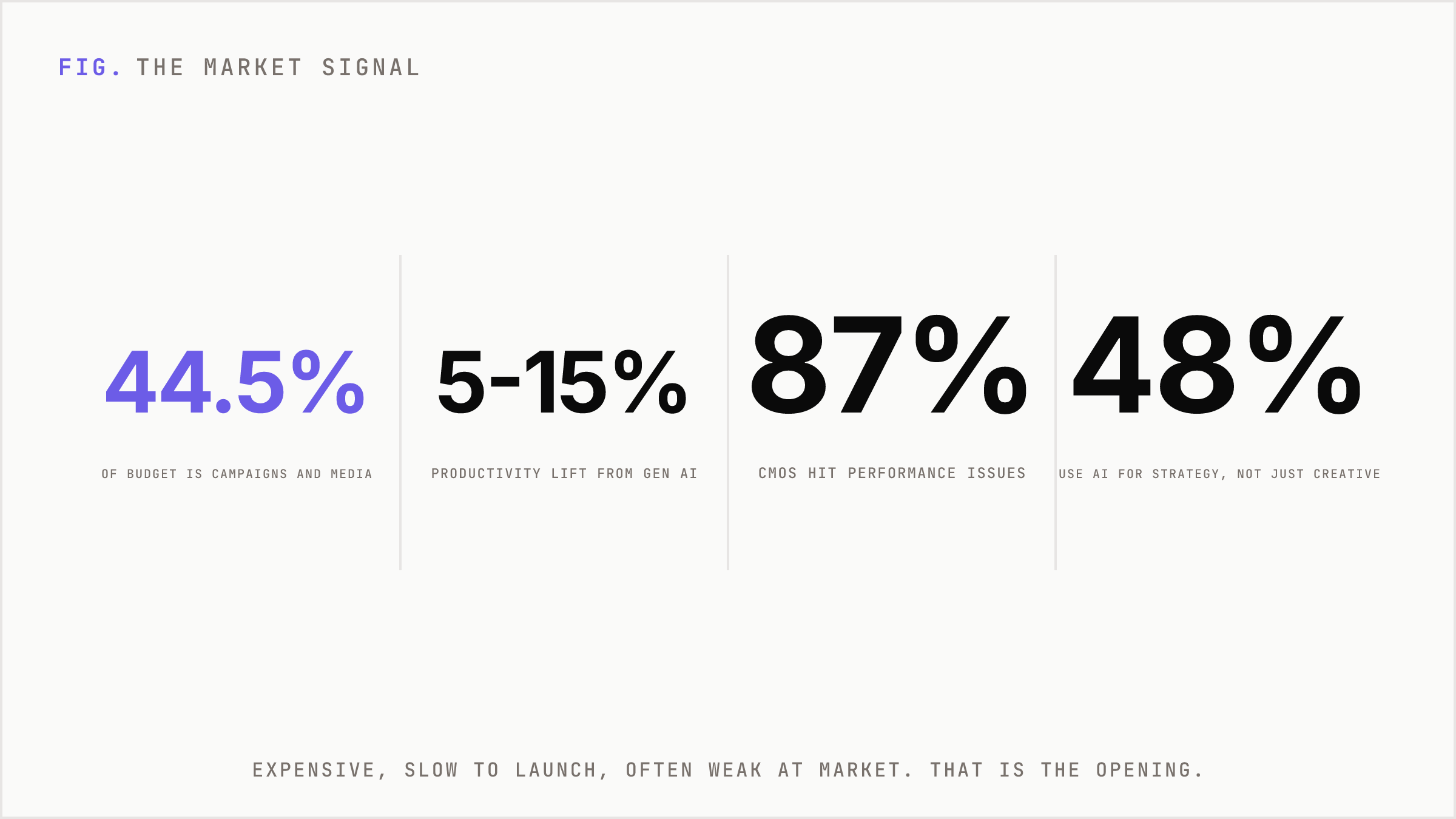
This is the core buyer problem. Campaigns are expensive, slow to launch, and often weak when they hit the market.
At the same time, adoption is uneven. Gartner found that 27 percent of CMOs said their marketing organization had limited or no generative AI adoption in campaigns. Among adopters, 77 percent used it for creative development, while only 48 percent used it for strategy development.
That gap is the opportunity.
Most brands are using AI where it is easiest to see. The leaders are using it where it changes the economics of decisions.
Output is cheap. Coordination is expensive.
AI collapses the marginal cost of first drafts. That changes buyer behavior.
A founder no longer wants to wait three weeks to see whether an agency understands the category. A growth lead no longer wants one campaign concept with three headline options. A CMO no longer wants a quarterly calendar built around assumptions that will be stale before the media buy clears.
They want sharper options earlier. They want to see the campaign architecture before committing to production. They want evidence that the team can learn fast after launch.
This shifts the value away from isolated deliverables and toward integrated campaign systems.
A traditional campaign might look like this:
- Research team gathers insights.
- Strategist writes the brief.
- Creative team develops concepts.
- Design team builds assets.
- Legal reviews claims.
- Media team adapts formats.
- Analytics team builds reporting after launch.
An AI-native campaign looks different:
- Research synthesis, audience segmentation, offer testing, and message architecture start together.
- Claims are mapped to proof points before creative development scales.
- Channel variants are generated from a governed message system, not invented one by one.
- Brand and compliance checks run before the review meeting, not after final asset delivery.
- Testing plans, UTM logic, dashboards, and postmortem templates are built into the launch package.
The sequence becomes a network. The network moves faster because fewer people are waiting for a clean handoff.
The expert role is judgment under compression
The best evidence for this is not marketing-specific. It comes from work studies on AI assistance.
A Harvard and BCG field experiment found that consultants using GPT-4 completed 12.2 percent more tasks, worked 25.1 percent faster, and produced more than 40 percent higher-quality results on tasks inside the AI capability frontier. The same research showed a problem. When tasks fell outside that frontier, AI could hurt quality because people failed to catch weak or false outputs.
This is the jagged frontier. AI is strong on some work, uneven on other work, and dangerous when users do not know the difference.
Marketing is full of jagged frontier problems.
AI can summarize reviews. It cannot know which complaint matters commercially unless someone understands the buyer and the category. AI can generate positioning territories. It cannot decide which claim is ownable, provable, and worth media spend. AI can produce variants. It cannot tell you whether you have designed a statistically useful test or just created noise with a spreadsheet attached.
The expert is the compression layer.
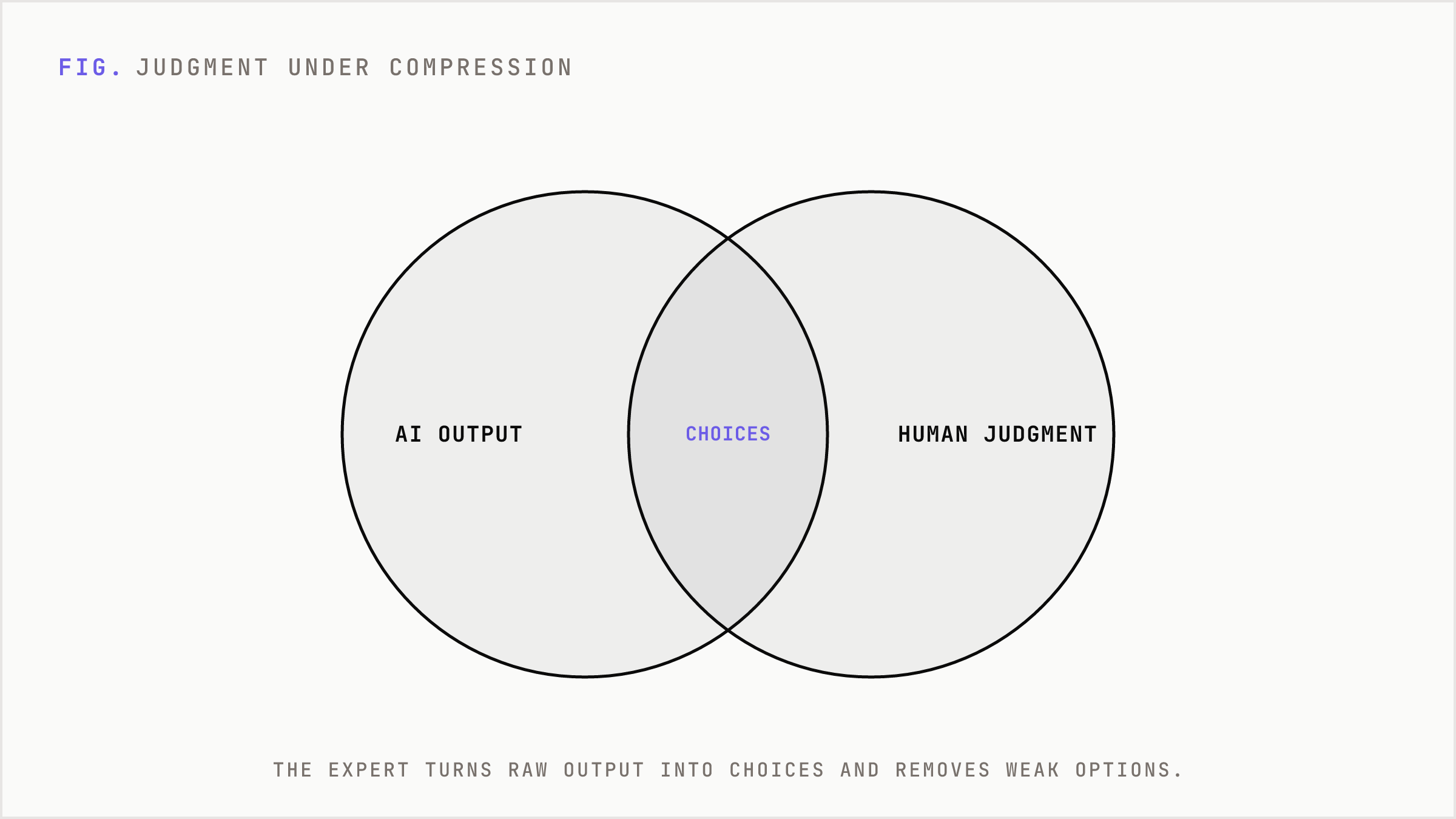
They turn raw AI output into choices. They remove weak options. They catch hallucinated claims. They build the message hierarchy. They define what must be tested and what should be ignored. They preserve brand voice without turning the brand into a museum.
In slower organizations, these decisions happen across meetings. In AI-native teams, they happen inside the workflow.
Where speed actually comes from
There are several places where campaign deployment time gets compressed.
Research compression
AI can synthesize customer reviews, competitor pages, sales notes, search results, analyst commentary, social discussion, call transcripts, and internal documents. The output is not the strategy. It is the raw map.
An expert turns that map into buyer triggers, objections, urgency signals, switching reasons, proof gaps, and segment-specific angles.
Brief compression
A strong brief is not a document. It is a decision container.
AI can turn discovery into structured campaign inputs: ICP, pains, use cases, alternatives, buying committee concerns, offer angles, proof points, and messaging hierarchy. The expert removes generic persona language and forces the brief to name tradeoffs.
If the brief does not say who the campaign is not for, it is not ready.
Message architecture
This is where most teams lose time. They move straight from insight to assets. Then every channel invents its own version of the campaign.
An AI-native team builds a modular system first: core promise, audience pains, claims, proof points, objections, CTAs, landing page modules, email angles, sales enablement notes, and reporting taxonomy.
Once that exists, creative scaling is faster and less chaotic.
Governed variant production
Generative AI is already widely used for creative development. IAB research has shown heavy adoption in video ad creation and creative enhancement, including audience-specific versions, visual style changes, and contextual relevance.
That matters, but variants without governance are a liability. More ads do not mean more learning. They often mean muddier signals.
The expert defines the test matrix: what changes, what stays fixed, which audience sees which message, what success metric matters, and how results will be interpreted.
Review acceleration
Legal and brand review often become the silent schedule killer.
AI can pre-check assets against brand voice, banned claims, required disclaimers, reading level, channel specs, and compliance rules. It can flag risky language before humans spend time reviewing finished assets.
This does not replace approval. It makes approval cleaner.
Optimization acceleration
Launch is no longer the finish line. It is the first market read.
AI can ingest performance data, summarize patterns, identify weak audiences, suggest creative refreshes, draft postmortems, and recommend next tests. The expert decides whether the pattern is meaningful or just early noise.
Campaign velocity is not speed to publish. It is speed to validated learning.
The substitution story is wrong
The lazy version of the AI marketing story is that machines replace marketers. That is too blunt to be useful.
The better version is that AI substitutes for low-leverage coordination and first-draft labor, while expanding demand for people who can operate across strategy, data, creative, and experimentation.
It reduces the need for some handoffs. It increases the value of the person who can collapse those handoffs into one coherent system.
This is already visible in customer support research from Stanford, MIT, and NBER, where AI assistance increased productivity by roughly 14 to 15 percent on average, with the strongest gains for less-experienced workers. The pattern is important. AI lifts execution, but the system still needs design, escalation, and judgment.
Marketing follows the same curve. Junior teams can move faster with AI. Senior AI-native teams can redesign how the work moves.
The budget implication
Campaign acceleration is not a productivity vanity metric. It changes capital allocation.
If a team can launch in ten days instead of six weeks, it can test more offers per quarter. If it can adapt creative weekly instead of monthly, it can reduce wasted media. If it can connect performance back to message architecture, it can stop debating opinions and start compounding learning.
This matters because media spend is only as intelligent as the campaign system feeding it. A brand can waste money faster with better targeting if the offer is wrong. It can generate a thousand variants and still learn nothing if the test design is broken.
The commercial advantage is not more content per dollar. It is more decision quality per dollar.
What founders and investors should watch
The interesting companies in this category will not look like content mills with AI wrappers. They will look like campaign operating systems.
They will connect customer data, brand memory, research synthesis, claim governance, creative production, media adaptation, testing, reporting, and optimization. They will give teams reusable architecture, not just disposable assets.
The service firms that win will not sell prompt packs. They will sell deployment capacity. They will know how to take a campaign from market signal to launch-ready system with fewer meetings, fewer handoffs, and fewer blind spots.
The internal teams that win will not treat AI as a side tool. They will rebuild the work around it.
The hard line
AI-generated volume is not a moat. Everyone can make more copy now.
The moat is proprietary customer data, brand context, offer judgment, governance, distribution knowledge, and fast learning loops. The moat is knowing what not to generate. The moat is turning campaign work from a sequence of departments into a governed system that can move at market speed.
Faster campaign deployment is real. But it does not come from asking AI to write campaigns faster.
It comes from experts who know how to redesign the campaign supply chain.
AI creates output. AI-native experts create velocity.
FAQ
Can AI marketing experts deploy campaigns faster?
Yes. The speed comes from redesigning the full campaign workflow, not just generating copy or creative assets faster.
Where does AI reduce campaign launch time?
AI can compress research, briefing, message architecture, variant production, QA, legal preparation, testing plans, reporting, and optimization.
Does AI replace marketing teams?
No. It reduces some low-leverage production and coordination work, but increases the value of experts who can apply judgment, governance, and strategy.
What is the biggest risk of using AI in campaigns?
The biggest risk is scaling weak ideas faster. Without expert review, AI can produce generic messaging, unsupported claims, poor tests, and brand inconsistency.
How should campaign velocity be measured?
Measure both speed to launch and speed to validated learning. A fast campaign is only useful if it produces clear signals for the next decision.